Author Archive
Some very personal views on the College of Europe

Every time we meet for the first time a reader of this blog, we get the question of how Nicolas and I met. Most people guess we studied together at the College of Europe, but that’s not the case. In fact, next weekend Nicolas will be celebrating the 10th anniversary of his promotion, whereas last weekend I celebrated the 5th anniversary of mine (I´m not used to telling the truth here; people often assume that I was there much longer ago –which doesn’t say much about my juvenile looks..- and I always fail to tell them wrong).
With all these current commemorations it seems like an appropriate moment to share some of our views on the College, an institution which elicits all kinds of reactions from different people [an illustration of those reactions: a recent book titled “Intimate Brussels” characterizes alumni of the College of Europe as the evil characters in Brussels and profiles them/us as a much hated secret society (!)]
This post is not entirely competition law-related and we don´t want to bore you, so click here if you’re interested on this long story:
State aid conferences: that’s where the fun is!

(You’ll understand why we chose this pic if you keep on reading)
The European State Aid Law Institute held its 10th Experts’ Forum on new developments in European State aid law last Thursday and Friday.
I didn’t attend (as a means to reducing my current backlog I’m quitting conferences for a while) but some of my colleagues did. One of my bosses colleagues, José Luis Buendía, develivered a critical presentation on the State Aid Modernisation Initiative (“SAM”). Hopefully he will be able to turn it into a post for this blog once he manages to take some time off for this (he’s currently a bit busy representing the Spanish Fund for Orderly Bank Reestructuring, which will be borrowing 100.000 million euros from the EU rescue funds; see here or, actually, almost anywhere else).
I hear that there were other excellent sessions (e.g. there seems to be unanimous praise for Marc van der Woude’s presentation), but the session that will perhaps stick for longer in attendees minds was the Opinion Panel featuring Ryanair´s CEO (Michael O´Leary) and the Deputy Director General for State aid (Gert-Jan Koopman). As you may know, O´Leary has a reputation for being somewhat of an histrionic character, and he stood up to it.
The version of O´Leary’s CV included in the materials was already a bit different from the usual stuff (I promise I’m not making any of this up):
“Michael O´Leary has served as Ryanair CEO since 1993. Born in a stable in 1961, he was a boy genius, who excelled both academically and at sports. Having represented Ireland internationally at bog snorkelling and flower arranging, he graduated from Trinity College in Dublin as soon as they could get rid of him. He then became another boring KPMG accountant until divine inspiration sentenced him to a life of penal servitude in the airline business. Despite his best efforts, Ryanair is the World´s favorite airline, with 1,5000+ low fare routes accross 28 countries. (…) It is widely known that women find him irresistible“.
Some of the points he made in his speech that were most warmly received by the Commission were that (i) DG COMP has hired North-Korean economists to draft the guidelines on regional airports ; (ii) that no Commission official has ever set foot in Charleroi because they only fly on expensive tickets ; (iii) that he had woken up to fly at 6 a.m, something that the Deputy Director General does not even conceive has humanly possible; and (iv) that there are only two sorts of people that like the guidelines: flag carriers and Kim Jong Il. His last slide was actually of Kim Jong Il saying “These guidelines are fab!”.
I’m so sorry I missed it…
Nick Banasevic appointed head of the unit in charge of IT, Internet and consumer electronics

We have just learnt (via M-lex) that Nicholas Banasevic has been appointed Head of the Unit dealing with IT, internet and consumer electronics at DG COMP.
In previous posts we had already highlighted the importance of this appointment at a time when this particular unit is dealing with an immense workload which includes some of the most interesting ongoing cases in our discipline.
We hear that the competition for the job was very tough, and that says a lot both about DG COMP’s staff and about the newly appointed Head of Unit.
Nick is not only an excellent economist, a hard-working, nice and very very tall guy, but he’s also very reasonable, which means that he probably won’t mind about us commenting critically (for good or for bad) on his unit’s work.
Congrats and best of lucks to him!
Ruminations on the Google investigation

Over the past few months we have provided you with our views on the investigation undertaken by the European Commission with respect to Google. Here is an account of recent developments, thoughts, concerns, readings, ideas, and possible questions to be posed:
The developments. As you all may well know, the Commission has sent Google a preliminary assessment (a necessary formal step towards a commitment decision under Article 9 of Regulation 1/2003) and has requested Google to provide swiftly proposals of possible commitments that could address the concerns set out on that document. For the Commission’s statement identifying in broad terms the practices it objects to, see here.
In parallel, Google has lodged a complaint against Microsoft and Nokia. Google claims that “Nokia and Microsoft are colluding to raise the costs of mobile devices for consumers, creating patent trolls that side-step promises both companies have made. They should be held accountable, and we hope our complaint spurs others to look into these practices“. We have no additional information on this complaint and therefore do not have any opinion on whether it may be well-founded or not, but we regard it as something potentially interesting given that, until now, patent trolls had managed to stay more or less away from the antitrust spotlight in this bout of “patent wars” (note the IPCom settlement).
(By the way, the European Commission has excellent staff working on the unit dealing with cases related to IT, Internet and Consumer Electronics, but they must be incredibly swamped with so many complaints piling up on their desks).
The substantive concerns. We’ve already been quite vocal about our substantive concerns with regard to this case (note the caveat that we speak about matters of principle and on the basis of almost no case-specific information), so we won’t insist on them today.
The policy concern. We fully understand the policy rationale for changing the tone and attempting to address competition concerns in high-tech innovative markets swiftly and on the basis of “negotiated” solutions. However, the increasingly frequent recourse to such solutions also gives rise to several concerns. One of them is that commitment decisions do not contain a final position on the existence or non-existence of an infringement. If such decisions become the standard way of dealing difficult with cases –which would then be left substantively unresolved-, this would imply blurring the contours of the law. Laws should be clear. How can we expect the law on Article 102 to be clear when 14 out of the past 17 abuse of dominance cases were put to an end by virtue of brief and unconclusive commitment decisions? How does one strike the right balance between setting the law straight and addressing competitive concerns rapidly and effectively?
The doubt. (this one is not our’s but Pablo Ibañez’s): does publicly requesting a company to offer commitments fit with the letter and spirit of Article 9 of Regulation 1/2003?
The idea. We feel a bit frustrated by the fact that we’ve spent months thinking about this investigation having no information other than news clips and press releases. We’d love to see how the Commission has framed its concerns regarding Google under current competition law standards. We do not rule out the possibility that we may have been wrong all along, and maybe (although I have my doubts) having a look at the Commission’s preliminary assessment would convince us. How about requesting access to the non-confidential versions of the key documents in the file pursuant to Regulation 1049 as soon as the investigation is over? It could be an interesting exercise…
Competition law for kids

If you want to know how to teach the virtues of competition, the harms arising out of monopolies and the concept of an exclusionary abuse to 1-4 year old kids, this could do the trick: http://www.youtube.com/watch?v=3GZ5Yz97erE
Thanks to our yongest reader (Eduardo Guilbeau López, pictured below reading us) for the pointer [and congrats on his second birthday 😉 ]
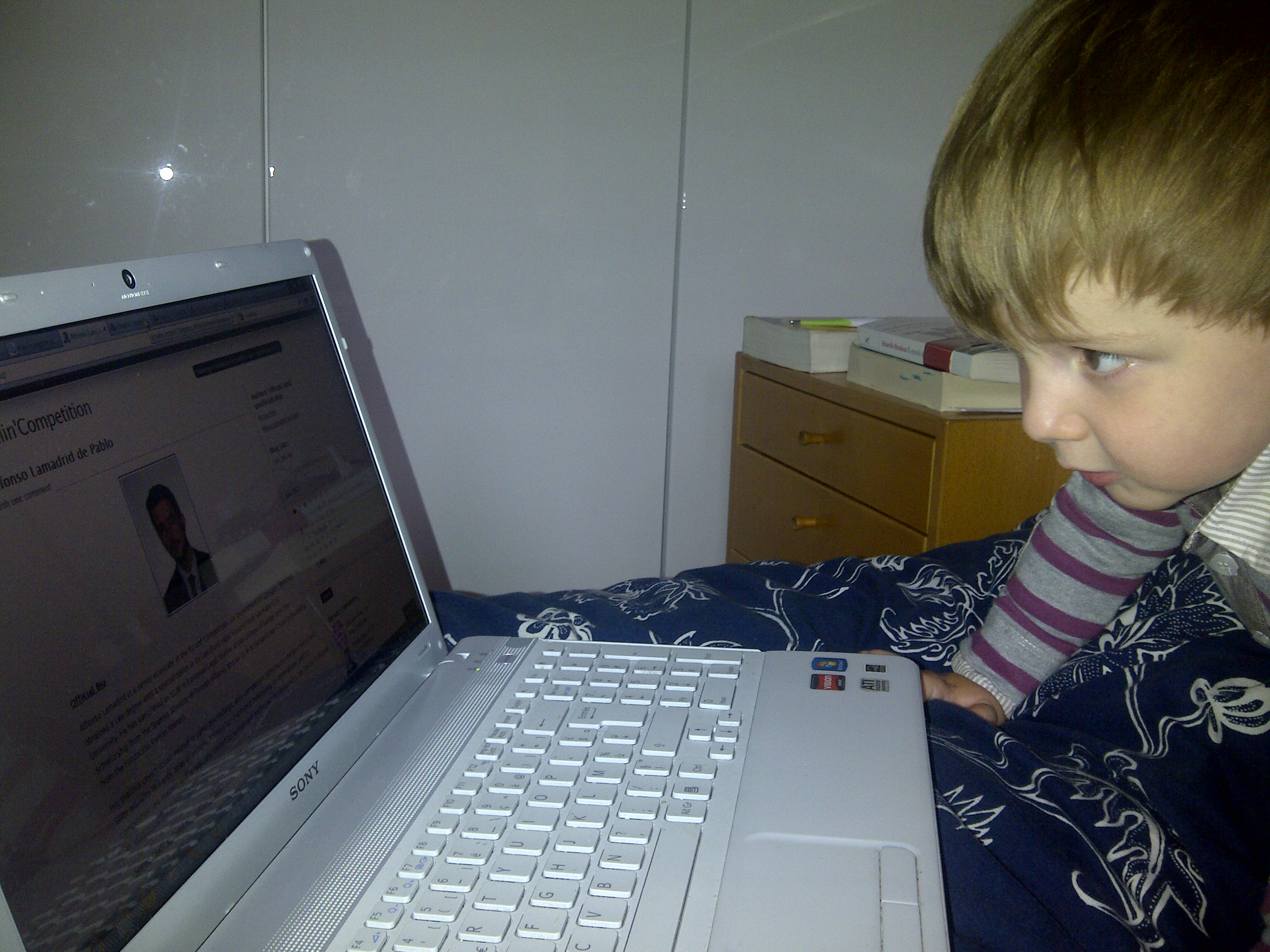
The Fastest Antitrust Expert Award

[If you’re reading this, it means that the above pic of Robocop Nicolas hasn’t scared you off, in which case you’ve earned my respect]
A few posts ago we referred to the proliferation of awards in the competition law world and we created what we referred to as the “first objective legal competition”: the Fastest Antitrust Expert Award. The idea was to give the award to the competition law expert who could run the Brussels 20k faster. We said that we would both participate. Nicolas did and I didn’t (a few days before I was told not to because I seem to have a herniated disc, a.k.a. a very convenient excuse, so I followed the maxim “when in doubt, chicken out“).
A bunch of you ran too. Some of you (mainly our friends who wanted to show off) have been kind enough to send their times. The contest is still open: you have until Friday to submit your results. The provisional semi-finalist readers/runners are the following:
1) Mark English (Shearman & Sterling): 1h 39′ 21” (it was about time that Mark earned a reputation for something other than endive bashing).
2) Nicolas Petit (Chillin’ Competition): 1h 42′ 02” (actually, there’s another (?) Nicolas Petit who apparently did not finish the race -see here ChronoRace20k-; who’s who?).
3) José Enrique Elías (Chief Economist Team): 1h 44′ 12′. We are told that José Enrique ran fast because he was being chased by some violent ordoliberals who were throwing stones at him.
4) Napoleón Ruiz (Garrigues): 1h 48′ 39”. Napoleón was, in fact, one of the ordoliberals throwing stones at José Enrique.
We are also told that Philip Lowe (former Director General at DG Comp, now Director General for Energy) did 1h 42′ 30” and that G.J. Koopman (Deputy Director General for State Aid) did 1h 49′ 27”. Very impressive.
Congrats to all others who took part in the race, and especially to those who signed up by commenting on the previous post, namely Philip Werner, Sandy Tsakiridi, Montse Adam and M. Fevzi Toksoy.
Once again: this post serves not only as a provisional set of results but also as a final call for any other readers to submit their times. We will publish a definitive list – and announce the winner of the coveted Friday slot and Li-ning shoes – in the coming days. So, who beats Mark English?
Nico’s fools day
I was the first victim of the scam. Here’s my version of the story:
I was having a particularly busy and tough week: swamped at work and unsuccesfully trying to give a hand to some close people who are having trouble coping with the crisis in Spain. So I didn’t have the time to write anything on this blog and, in full frankness, to a certain extent I didn’t feel like it (at times it feels weird to focus on this very narrow field of competition law when there are so many more important things going on out there). Last week was somehow similar, and we covered it with some “easy” brief posts. But since we are becoming increasingly more concerned about not sacrifying quality in exchange for output, I told Nicolas yesterday that I wouldn’t have time to write anything this week. He said he would take care of posting something. So far so good.
At around 18 pm I was at a meeting with Luis Ortiz, Marcos Araujo and Susana Cabrera when suddenly I started receiving a first set of weird emails entitled: “I’m so sorry“, “What happened?”, etc. So I first thought: has Spain collapsed or what on earth is going on??
Then I see another set of emails coming in asking “Is it a joke?“. I still had no idea of what they were talking about, but judging by the number of emails it looked like something big.
But then a minute later I get one from Nicolas entitled “Check out my post…” followed by some others asking what had I done to him (?!). It took a few hours until I was able to read the post, but then I read it and understood all the fuzz. Of course it was a joke (although the fact that it wasn’t funny might have misled you to believe it wasn’t!).
Since then I’ve received tenths of very kind emails from all kinds of people (most of whom I’ve actually never met, which is nice). I’ve tried to respond saying that everything was ok, but, once again, there was no time to respond to everyone.
Not only we’re not parting ways [although after this I’m starting to have second thoughts 😉 ] but we’re thinking about ways to make this blog better. Our problem is that there are now too many things on which we would like to write something sensible, and since you are a particularly informed and smart bunch of readers, we’re afraid not to have the time to stand up to the challenge (and perhaps the brains neither; don’t let the size of Nico’s head fool you) (sorry but it’s easy-joke-day around here!).
In sum, the show will go on, for whatever it’s worth.
A few additional comments:
– Whoever wrote the comment saying that after our divorce I should keep the blog has definetely earned a free dinner!
– Could the creator of chilledcompetition please identify himself? (No sooner has one gone that another comes along…). I’m impressed by the fast move. You deserve a guest post here!
– If what Nicolas wanted was traffic then the scam was a successful one; more than 3,000 visits in less than 24 hours is insane for a blog like this.
– Next time my dear co-blogger does something like this without consulting me first we’ll split up for good!
– We owe you one. Those interested in having one or a few beers on Sunday evening (post Brussels 20km + Street jazz festival) are welcome to join us. Everything is on Nicolas, of course. No kiddin’ here.
– This very timely scam has made me lose most of today’s morning. And now I’m leaving for the airport. My firm will take care of billing Nico for this (hourly rates apply).
Refining “The Friday Slot”

“Friday Slot” interviews have proved to be quite successful. The interviews keep on receiving an insane number of visits, and for the most part we keep on receiving very positive feedback. However, we’re a bit concerned about the “straightjacket effect” that our questionnaire may give rise to. That’s why we need your help: Could you please let us know your suggestions on how we could make Friday Slot interviews better?
Also, following the suggestions of a couple of our previous guests who have “complained” about our comfortable position in asking but not answering questions, I’ve decided to invite the founding mother of this blog (I guess I’m the stepdad), Monsieur Nicolas Petit, for a “Friday Slot” interview (he will find our about this invitation when he reads it here). The idea is not to let him have a nice time replying to easy questions, so I need your help here too. Could you please send me any questions that you may have for Nicolas?
(Those who wish anonymous treatment when the questions are published can send me an email at alfonso.lamadrid@garrigues.com including the question/s and an alias).
And speaking of Nicolas, the competition law social event of the day will be held tonight in the form of a BBQ party at what will very soon be his former house. Since he’s leaving the place, the pic illustrating this post is from the office from which he’s been doing his writings -including this blog- during the past few years. No promising future awaits this desk (see here).
Legal films and series

Many of you are aware about our taste for antitrust videos. In previous posts we commented on “The Informant” and on the OFT’s own production, we awarded Chilling Competition’s Antitrust Oscars, and we brought to you the wonderful classic”The Raid“. Many of those posts rank high in our list of most visited posts, so there are reasons to believe that you share our “geek” taste for these movies.
Our “Friday Slot” guests also seem to be fans of legal movies. In the interviews published so far some of them have confessed that legal movies rank among their favorites [e.g. “12 Angry Men” (Eric Gippini Fournier); “12 Angry Men”, “Philadelphia” and “The Verdict” (Johan Ysewyn), or “To Kill a Mockingbird” (Maurits Dolmans)].
The American Bar Association has a list of the 25 Greatest Legal Movies of all times [headed by “To Kill a Mockingbird” and “12 Angry Men”, which reveals that Maurits’, Eric’s and Johan’s taste for movies is not as original as their legal constructions 😉 ] Other websites have posted lists of the top-15 film/TV lawyers in history. The image that oursiders sometimes have from our job is often dictated by these movies and these characters. Whether or not they portray reality is generally a contentious issue. I went to Harvard Law School thinking that it would be like in “Legally Blonde” (I even died my hair and let it grow…here is the evidence), but it actually was closer to the scary “The Paper Chase“. Actually, it didn’t ressemble any of them. But it didn’t ressemble “The Social Network”s constant drunk partying neither..
Nowadays the good stuff has moved from the big screens to the TV. There’s a surprising number of “legal” TV series (see here for a list). Not having ever watched most of them, I have to confess that I’ve a clear favorite: The Good Wife. For the past couple of months watching an episode (sometimes a couple, sometimes even one or two more…) has been a late-night vice routine. I know for a fact that other competiton lawyers are going through the same problem right now with this series. I even know someone in the US who called in sick the day the last season was released in DVD and watched the whole thing in one day. Maybe that was a bit too much, but you really should watch it. I’m now done with all available episosed and opened to suggestions for a new series. Anyone?
The Friday Slot- Eric Gippini Fournier

You all are familiar with leading cases in the EU competitition law canon such as Michelin II, Pre-Insulated pipes, Métropole, O2, Cementbow, IMS, Endesa, Aer Lingus (in the Ryanair merger case), Glaxo Smithkline, Lélos, Astra Zeneca, Wanadoo, Telia Sonera, KME, Teléfonica or Tomra. A good question for one of our quizzes would have been to ask what it is that all of these cases have in commmon. The right answer would be that in every single one of them one of the Legal Service’s agents representing the European Commission in Court was Eric Gippini-Fournier.
Today’s Friday Slot features an interview with him. Eric is one of my (I don’t use the default plural here because Nico and Eric have not yet properly met, although this will be fixed soon) favorite people in this small competition law world. After reading his answers to our questionnaire you will understand why. Above all, Eric is an incredibly nice, reasonable, gentle and frank guy. But he’s also a brilliant and intellectually honest jurist, a tough adversary, and -like Fernando Castillo de la Torre and other members of the Legal Service– he’s a living encyplopedia on competition law. Eric is not contaminated or constrained by some of the oddities that at times surround the profit-making side of this business, and this often gives his views an added interest. On top of all of the above, we also share a taste for late Sunday lunch at Roi du Poulet… We are very thankful to him for having accepted our invitation to appear here.
“Oscar” of the best antitrust law book? Non-antitrust book?
The best antitrust books are slow food, the result of a long process by one or two cooks, not more. Areeda/Turner, Bork’s “Paradox” and Waelbroek/Frignani are great examples. Among recent books, I would nominate Luis Ortiz Blanco’s “Market Power in EU competition Law”.
Non-antitrust books? “Belle du Seigneur” by Albert Cohen comes to mind. Lately I have enjoyed Art Spiegelman’s “Maus“, and two great biographies, of Benjamin Franklin and of Franklin D. Roosevelt (both by Henry Brands).
“Oscar” of the best case-law development in the past year? “Oscar” of the worst case-law development?
My nominations in the first category will not necessarily please the blog hosts. They go to the ECtHR (Menarini Diagnostics), the ECJ (TeliaSonera, KME Germany and Tomra), and the EFTA Court (Posten Norge). On the “bad” side, I have misgivings –but only that, misgivings– about the hands-off approach to reverse payments, most recently by the court of appeals for the 11th circuit in Watson Pharmaceuticals.
Let’s do it like economists => assume that you could change rules, principles, judgments, institutions in the current EU antitrust system. What would you do?
I am not fond of the law on exploitative abuses, in particular excessive pricing. In fact I am not sure that prosecuting excessive pricing –essentially a consumer protection issue– fits with the overall design of EU antitrust, with its focus on protecting the competitive process.
I would revamp evidence rules before the EU courts, for example re-introduce the old ECSC rule that, in case of appeal against a Commission decision, the entire case file is automatically transmitted to the General Court. Right now the court file includes only evidence provided by the parties, which gives an incomplete view of a case.
Average working time/week?
Probably too much. I don’t count the hours but it should be possible to do the math. At any given time I have 40 or 50 cases pending before the EU courts and in a typical year I present oral argument in eight to twelve hearings, sometimes more. I should say that litigation is less than half of my workload.
Why do you work in antitrust law? How did you first get into it?
My home university inSpain has a tradition in IP and competition law. By law school graduation, the Merger Regulation had just been adopted, and it was the subject of my thesis. I then studied EU and U.S. antitrust at Bruges and Berkeley, with Robert Kovar and Einer Elhauge. These great teachers, and others like Val Korah and Louis Vogel inspired me. I also did some basic microeconomics coursework at LSE when I was a teaching assistant in Bruges and we were about to introduce a microeconomics course for lawyers.
All this was twenty years ago. What keeps me interested is that each antitrust case requires me to study and understand a different technical and economic reality: how Tetra Paks or CPUs are made, the intricacies of copyright management societies or the details of pharmaceutical pricing in Spain.
Most interesting, intense or funny moment of your career?
Around 1998 I had a hectic, but very interesting time with sports-related antitrust issues like FIA/Formula One and the FIFA player transfer regulations. I have had intense hearings over the years, including GlaxoSmithKline, Telefónica, and many others.
Funny moments came especially in non-antitrust cases. In a case involving regulatory obstacles to selling nutritional supplements, we arranged to meet with the complainant’s board of directors. Four huge bodybuilders showed up, each 150 Kg of muscle and built like trucks! We immediately agreed with everything they said and promised swift action.
Your role model (if any) in the antitrust community?


 Chillin'Competition
