Author Archive
An announcement: blog posts from Harvard Law School students

I am currently enrolled in a great seminar on “Antitrust, Technology and Innovation” taught by Prof. Philip Malone at Harvard Law School. As part of the requirements of the seminar, everyone attending it is supposed to write several posts on an internal blog only accessible to the rest of the class. Given that my classmates are a truly brilliant group of students, the discussions held in the blog have been extremely interesting. Accordingly, Nicolas and I thought that it would be very useful, particularly for our student-readers, to have access to these discussions and to be able to contribute with their own views.
Therefore, in the coming weeks, and in parallel with ordinary posting activity, we will be publishing here some of the posts written by HLS students on a number of selected issues, as well as follow-up comments by other members of the class.
Prof. Malone has kindly allowed us to include a reference to his terrific syllabus (really a great source of information) so that anyone interested will be able to better follow the discussions.
Ranking the rankings

A few weeks ago, law.com featured an article echoing the controversy surrounding U.S. News’ (a magazine that has traditionally ranked law schools in the US) announcement that it would start ranking law firms. Soon after the announcement was made, the American Bar Association passed a resolution committing to examine the methodology employed by several rankings. It is reported that opponents to the resolution claimed it could constitute an antitrust violation, but that’s not the issue I wanted to touch upon.
Law firm rankings are certainly very good sources of information and, as illustrated by market entries, quite possibly a profitable business (not really surprising: I would invest in any industry where lawyers’ egos were one of the possible sources of revenue!).
I tend to believe that rankings do their job thoroughly, but I confess that sometimes I’ve come up with rankings of particular firms or lawyers that I didn’t quite understand (at least not solely by reference to their real merits or their alleged lack of merits). My disagreement with specific issues is hardly surprising since we all probably have a different idea of how an ideal ranking would look like. Nonetheless, I suspect we could find some common ground in determining which rankings contain more “surprising features” overall.
All this brings to mind a question that I heard many times from a brilliant, well-ranked, Brussels-based partner: when will someone rank the rankings?
(Image possibly subject to copyright: source here)
Oligopolistic collective dominance: the BCA’s Telefonica decision

Some weeks ago, the Basque Competition Authority (“BCA”) issued a decision which has gone largely unnoticed outside of Spain, but which is definitely worth commenting here. To my knowledge, this decision is the first ever to sanction an abuse of a purely oligopolistic collectively dominant position.
In essence, the decision concludes that Telefónica de España SAU (“TSAU”, a subsidiary of Telefónica SA) abused of its dominant position in retail fixed telephone market, and, more interestingly, that Telefónica Móviles (“TME”, another subsidiary of Telefónica SA) also abused of the collective dominant position it held together with Vodafone and Orange in the Spanish retail mobile telephone market.
The BCA considers that TME, Vodafone and Orange constituted a “tight oligopoly”, and pursuant to a thorough examination of market conditions at the moment where the investigated infringements took place, it concludes that the Airtours conditions for a finding of collective dominance are fulfilled. The BCA further refers to the existence of empiric evidence of parallelism of prices and other commercial conditions adopted by the members of the oligopoly. Moreover, citing the CFI’s Judgment in TACA, the decision rebuts the contention that a certain degree of internal competition (allegedly illustrated by the high degree of portability) is incompatible with a finding of collective dominance.
With regards to the abusive conduct, and also in a nutshell, the BCA asserts that both TSAU and TME charged discriminatory tariffs to calls destined to users of the Euskaltel mobile network. The decision concludes that such conduct breached Article 2 of the Spanish Competition Act, and imposes TESAU and TME fines of nearly 3 and 1 million euros respectively.
A few brief comments:
Firstly, it’s interesting to remark that the Comisión Nacional de la Competencia had attempted to affirm its jurisdiction to deal with this case, but the organism in charge of addressing jurisdictional disputes between the CNC and regional authorities ruled in favor of the Basque Authority in light of the strictly local effects of the conduct under analysis. My guess is that had the CNC investigated the case, its outcome would have certainly been quite different.
Secondly, collective dominance is one of the favorite topics of Nicolas and myself, but also of Javier Berasategi, the author of the Telefónica decision, see here (his first work on the subject while a student in Bruges) and here (English version of a recent and extensive report on tacit collusion in the daily distribution of consumer goods which relies heavily on Nicolas’ work). It seems as if this or a similar decision had been under gestation for quite some time.
Finally, independently of whether one believes or not on the necessity of having several regional competition authorities in one Member State, it seems fair to acknowledge that in the past few years, under the Presidency of Berasategi, the Basque Competition Authority has brought forward very interesting cases on which it has adopted brave and innovative but always technically sound decisions.
Only a few days after the Telefónica decision was issued, Berasategi stepped down from the Presidency of the Basque Authority to start a new project in private practice. Congratulations for the good work, and the best of luck in his new venture!
(Image possibly subject to copyrights: source here)
Competition Law and Sport (II) – Football: State aids and salary caps

Last Wednesday UEFA published an interesting report which provides thorough and useful information about the financial status of European football clubs. A quick look at the report reveals at least a couple of issues that bear a strong relationship with competition law:
Firstly, UEFA’s report advocates the need for “financial fair play” (in essence: more transparency and financial responsibility) in order to address a problem highlighted in Platini’s foreword: “[t]he many clubs across Europe that continue to operate on a sustainable basis (…) are finding it increasingly hard to coexist and compete with clubs that incur costs and transfer fees beyond their means and report losses year-after-year”.
According to the report, most European football clubs face recurrent losses. The most important leagues, both on the sporting level and economically wise, are the ones with the greater aggregated debt: Premier League Clubs have a net debt of approximately 4000 million euros, followed by Spanish First Division Clubs with a debt of nearly 1000 million.
The inevitable question is: how do clubs operate in spite of such losses? In many instances shareholder’s contributions do the job, but in many other situations clubs subsist thanks to public intervention, which in some cases could qualify as State aid. In the sports sector, as in any other, State aid can appear under multiple guises (e.g. direct subsidization; sponsorship under non-market conditions; non-collection of tax or social security debts; aid for the construction of sports infrastructure; etc). One would expect the European Commission to intervene increasingly more in this sector or, alternatively, to lay down specific rules for the assessment of State aid in the world of sports.
Secondly, the report insists on the fact that the financial perspectives of European clubs presage an even worse future. The report seems to blame the constant increase in player’s salaries, which amount to more than 60% of clubs’ expenses, a proportion that is steadily rising. It is on the basis of this and similar data that UEFA has for some time been proposing to establish a salary cap in European football. The compatibility of a salary cap with EU competition law is unclear. In fact, it was listed as one of the “main pending and undecided issues” in Annex I to the White Paper on Sport: sport and EU competition rules.
All the above seems to confirm something I mentioned on a previous post: the world of sports will be an important and growing source of interesting and complex competition-related issues in the very near future.
Google Books Settlement- It’s the search market, stupid!

As in most instances, this snowclone is a bit of an oversimplification: to be sure, the GBS brings to the fore extremely interesting issues such as those related to copyright law, privacy, or the function and limits of the class action mechanism, which are unrelated to the competitive impact of the GBS on the search market. However, also like in most instances, it helps us not lose sight of the important stuff. Indeed, the antitrust objections to the settlement raised by the DOJ other than those dealing with the search market (fundamentally those related to the ASA’s pricing system) seem to me somehow weak (see first comment to this post below).
As Gary Reback –one of the most prominent leaders of the opposition to the settlement- noted in a blog post last week: “at bottom, the Google Book Settlement is not really about books. It’s really about search, the most important technology in the new economy”. The transcript of the fairness hearing held last week conveys the impression that the DOJ shares the same main concern.
I’m no expert on the GBS and wouldn’t dare to comment on all of its aspects here. However, some of the issues raised in Reback’s post caught my attention.
Reback’s post points out that the search market, allegedly dominated by Google (how do you define the search market? Note, for instance, that on the fairness hearing AT&T claimed to be Google’s competitor because of its Yellow Pages), is “difficult to enter because of powerful network effects and scale characteristics” . He then insists on how access to books covered by the settlement would grant Google a tremendous competitive advantage. The said advantage would stem from the fact that Google would be improving its ability to support “obscure” or “tail queries” by virtue of its “exclusive” (?) access to in-copyright books whose authors are unidentified (that’s what some have labeled as the “orphan works monopoly”, a term that not only assumes that there exists a market for “orphan works” and that competitors would be barred from accessing to such works, but which also, by putting together the words orphans and monopoly, adds a bit of Dickensonian dramatism to the debate). Read the rest of this entry »
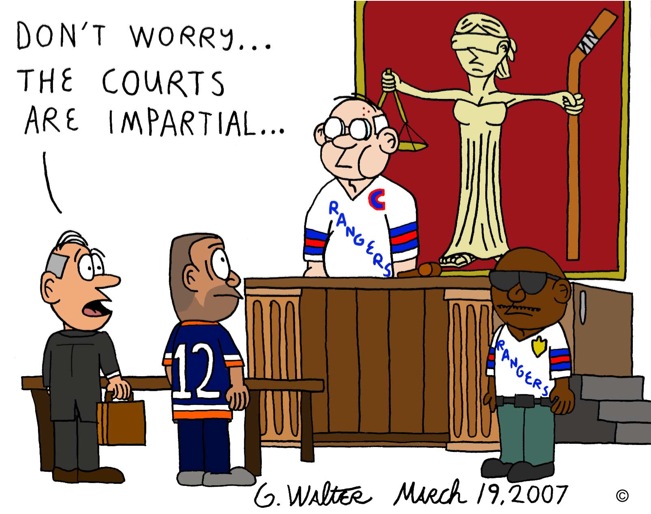
Anticompetitive partiality?

We have all heard people complaining about how a case turned out in a particular way due to the special relationship that the contrary party had with the decision maker (be it a judge or an administrative agency), but I suspect that categorizing that as an anticompetitive practice hadn’t crossed the minds of many of us.
Apparently it did occur to someone that fostering a good relationship with judges could amount to an anticompetitive practice. The Spanish Audiencia Nacional has issued a Judgment upholding a decision issued by the CNC in 2006 which shelved a complaint alleging that a Bar Association infringed the competition rules by paying judges to intervene at conferences and seminars organized by the Bar. The complainant argued that those judges could eventually be called upon to decide on cases on which the Bar itself or the members of its Board might be interested parties.
The legal basis for the complaint was a provision in the former Spanish Competition Act which targeted acts of unfair competition that significantly distort competition and therefore affect the public interest (the current Act retains a similar but amended provision). The alleged act of unfair competition is envisaged in Article 15 of the Unfair Competition Act, which provides that it is deemed unfair to obtain benefits from a significant competitive advantage obtained by illegal means.
The complainants firstly alleged that the retribution perceived by judges in exchange for their attendance to a given conference could compromise their impartiality. With respect to this claim, the Court responds that judicial activity is not an economic activity carried out in the market, and therefore cannot be reviewed in the light of the Competition Act.
Secondly, it was argued that the practice could have an affect on the market for legal services in as much as the attendance of judges to such conferences could create an impression upon clients that a particular lawyer is more trustworthy because of his ability to have built a relationship with judges over the course of those events.
The Judgment also rejects this second contention stating that in order for such practice to affect competition it would be necessary that (i) potential clients had a very extensive knowledge of the particular relationships between specific lawyers and judges; and (ii) the cases affecting those clients would fall under the jurisdiction of the said judges. The Court underlined that the parties had not put forward any evidence showing that such information existed on the market, nor had they provided examples of particular cases.
I certainly would never support applying competition law to this sort of conduct, and therefore believe that the Judgment is a sensible exercise of common sense. In fact, I would encourage fostering as much interaction as possible between enforcers and lawyers. It is a healthy way of exchanging viewpoints which can be enrichening for all: lawyers can convey their concerns to enforcers, and the latter are able to receive feedback and have the opportunity to publicly explain and debate their views without the constraints posed by formal acts. In this sense, enhancing communication results in benefits to the functioning of the system. In addition, I very much doubt that in most instances an enforcer’s independency could be undermined because of their attendance to a conference or seminar.
Nonetheless, reading the Judgment I couldn’t help wondering whether some aspects of the reasoning put forward by the Audiencia Nacional are truly applicable to the little and idiosyncratic world of competition law to the same extent as they are to other areas. Don’t get me wrong; it’s not that I believe there’s anything wrong with how things are done in our field; my point is that the Judgment’s reasoning departs from an assumption regarding legal markets that highlights the difference of niche areas of practice, and particularly of ours:
Competition is surely one of the areas of law practice where there is a greater interaction between enforcers, lawyers, economists, academics, and even clients. It is a somehow narrow and certainly specialized area, and its enforcement has traditionally been entrusted to specific authorities located in a handful of cities (most relevant EU Competition law cases are still dealt with in Brussels).
All those factors mean that not only are we relatively few people working on these issues (which explains the astonishing cult of personality that exists here in comparison to other areas of law), but also that enforcers and lawyers or economists on the other side of the table are in constant interaction: many are friends or have very similar backgrounds: some have probably studied together, some others have worked together, and in many instances people’s lives take place in the same communities.
In this context, it is not rare for lawyers and officials to write books or articles jointly, and it is all the more common to attend conferences or seminars together. Accordingly, contrary to what the Audiencia Nacional assumes to be standard market circumstances, in our field many potential clients do have a “very extensive knowledge of the particular relationships between specific lawyers and judges”, and “the cases affecting those clients would fall under the jurisdiction of the said authorities”.
Does this affect the perception clients have of their lawyers? Sure it might, and in fact it’s one of the main marketing tools for some law firms. Does this mean that fostering interaction with judges or competition authorities is an anticompetitive practice? Surely not, but because of different reasons to those stated in the Judgment above. Is it unethical or morally/professionally reprehensible? Not at all provided that deontological boundaries are effectively respected and appear to be respected (Caesar’s wife must be above suspicion). Should lawyers ‘sell’ clients their good relationships with enforcers? I don’t see the problem provided that it is done prudently: a lawyer may sell the fact that he’s respected in the legal community since clients will surely appreciate having a lawyer perceived as trustworthy by people on the other side of the table, but it could be imprudent on the part of the lawyer to imply more than that, and naive on the part of the client to think that an enforcer might adopt a different stance towards matters defended by lawyers with whom they have a closer relationship. One can understand suspicions on the part of contrary parties, but at the end of the day, it all comes down to having a little more faith on the enforcers.
(Image possibly subject to copyrights: source here)
Competition Law and Sport (I) – American Needle v. NFL

A few days ago, shortly before its infamous and dangerous ruling in Citizens United, the US Supreme Court heard the oral arguments in American Needle v. NFL. American Needle is the latest antitrust case to have made it to the Court’s docket, and it has the potential to be the single most important decision in the history of sports law in the US.
The application of competition law to the sports sector is a fascinating theme yet to be fully explored in Europe and which, moreover, has been haunting me for a while now. I will therefore develop some reflections on this topic in soon to come posts, but for the time being American Needle seems a very good starting point.
The facts in a nutshell: American Needle, a manufacturer of sportswear had traditionally enjoyed a non-exclusive license to manufacture and distribute products including NFL’s teams names and logos. In 2000 the NFL changed its policy and decided to grant a exclusive license to Reebok. American Needle responded by challenging the agreement between the NFL and Reebok on the grounds that it violated Section 1 of the Sherman Act.
The applicability of antitrust law to exclusivity arrangements in the sports sector is not a novel issue, and similar claims have arisen regarding sports equipment standards. However, the debate at stake in American Needle goes well beyond a mere contractual dispute and has more profound implications.
Part of NFL’s defense consists in arguing that sport leagues constitute single entities, which pursuant to the Copperweld doctrine, would imply that no agreement (“contract, combination or conspiracy’ in the sense of the Sherman Act) can be found within the said leagues. The NFL’s argument brings to the fore an interesting debate: given that Copperweld’s single entity doctrine relates to the relationship between a parent company and a wholly owned subsidiary, could such doctrine be applied to sports leagues? How divergent are the interests of the members of such peculiar organizations? Can a league be deemed to be a single entity only with respect to certain aspects of its functioning?
In the past, the applicability of the single entity argument with regards to sporting leagues had been rejected practically every time it was brought up before a Court. However, in American Needle the 7th Circuit adopted a new stance by accepting the NFL’s arguments and declaring that this is a matter that “should be addressed not only one league at a time, but also one facet of a league at a time”. This statement was used for the purpose of affirming the District Court’s decision, which had held that the fact that teams had traditionally licensed their trademarks jointly through a company called NFL Properties meant that on this particular aspect they acted as a single entity. Such reasoning raises an interesting question: is a traditional business practice enough to determine that franchises within a league do form a permanent single-entity? How integrated must the conduct of the members of a joint venture be in order to exempt them from potential antitrust liability by virtue of the single entity doctrine?
Moreover, as a way to support the proposition that the NFL acts as a single entity regarding licensing of trademarks, both the District Judge and the 7th Circuit emphasized the efficiencies arising from joint licensing. Once again, this argument seems flawed: there are other markets where joint licensing/selling is common and generates efficiencies, but it doesn’t follow that those efficiencies justify granting single-entity status to the ‘intermediary’. On the contrary, the fact that efficiencies may arise is precisely what determines that such practices are to be subject to a rule of reason analysis instead of to a per se rule, and is a key factor to be considered when engaging in that analysis (see BMI v. CBS).
The approach of focusing closely on the competitive impact on the restraint rather than on the single-entity issue seems more appealing to me. Such approach was used by the 1st Circuit in Fraser v. Major League Soccer, an opinion written by Judge Boudin (which, by the way, served as inspiration for his exam at Harvard last semester). An opinion authored by Justice Sotomayor before being appointed Supreme Court Justice (Major League Baseball Properties v. Salvino) also implicitly undertook a similar approach.
A reading of the transcripts of the recent hearing suggests that the Court may be inclined to accept the Solicitor General’s view, grounded on the precedent in NCAA v. Board of Regents, that leagues may be entitled to single-entity treatment with respect to the issues where cooperation is required to organize the essential aspects of the league’s operations, but not in relation to additional business activities such as licensing of trademarks.
As illustrated by the number of amicus curiae briefs submitted to the Supreme Court, the stakes are very high. If the NFL’s argument were upheld, that would bring about radical changes in the way professional sport in the US now operates (for instance, collective bargaining agreements to deal with issues such as salary caps for players wouldn’t be needed in order to immunize the agreement from antitrust scrutiny), and even possibly in the manner in which the Sherman Act is applied to certain joint ventures.
The Court’s ruling is expected by late June. In the meanwhile, for a couple of very good articles analyzing the case and its possible implications, see here and here
(Image possibly subject to copyrights: source here)
FTC sues Intel

Yesterday, practically coinciding with the European Commission’s announcement of the end of the infringement proceedings against Microsoft, the FTC decided to sue Intel.
The FCT charges Intel with a violation of the Sherman Act as well as with a stand-alone violation of Section 5 of the FTC Act, which targets ‘unfair methods of competition’. Chairman Leibowitz and Commissioner Rosh have issued a statement which deals primarily with the second alleged violation, and which is particularly interesting in as much as it foreshadows a possible new trend in antitrust enforcement by US agencies.
In essence, the statement proposes to consider an increased use of Section 5 of the FTC Act in order to avoid the implications of perceived private over-enforcement under the Sherman Act:
‘[C]oncern over class actions, treble damages awards, and costly jury trials have caused many courts in recent decades to limit the reach of antitrust. The result has been that some conduct harmful to consumers may be given a ‘free pass’ under antitrust jurisprudence, not because the conduct is benign but out of a fear that the harm might be outweighed by the collateral consequences created by private enforcement. For this reason, we have seen an interesting amount of potentially anticompetitive conduct that is not easily reached under the antitrust laws, and it is more important than ever that the Commission actively consider whether it may be appropriate to exercise its full Congressional authority under Section 5′.
We Can’t Talk about Pricing…

Skimming through some US antitrust cases I came across an interesting passage that I confess I’d never read before (it’s one of those ‘smoking gun’ sort of things that somehow always catches our eye). This is an unaltered excerpt of the 5th Circuit’s Opinion in US v. American Airlines 743 F2d 1114 United States v. American Airlines Inc L
“For some time before February 1982, American and Braniff were competing fiercely for passengers flying to, from and through Dallas Fort Worth, by offering lower fares and better service. During a telephone conversation between Robert Crandall, American’s president, and Howard Putnam, Braniff’s president, the following exchange occurred:
Crandall: I think it’s dumb as hell for Christ’s sake, all right, to sit here and pound the * * * * out of each other and neither one of us making a * * * * * * * dime.
Putnam: Well– Crandall: I mean, you know, goddamn, what the * * * * is the point of it?
Putnam: Nobody asked American to serve Harlingen. Nobody asked American to serve Kansas City, and there were low fares in there, you know, before. So–
Crandall: You better believe it, Howard. But, you, you, you know, the complex is here–ain’t gonna change a goddamn thing, all right. We can, we can both live here and there ain’t no room for Delta. But there’s, ah, no reason that I can see, all right, to put both companies out of business.
Putnam: But if you’re going to overlay every route of American’s on top of over, on top of every route that Braniff has–I can’t just sit here and allow you to bury us without giving our best effort.
Crandall: Oh sure, but Eastern and Delta do the same thing in Atlanta and have for years.
Putnam: Do you have a suggestion for me?
Crandall: Yes. I have a suggestion for you. Raise your goddamn fares twenty percent. I’ll raise mine the next morning.
Putnam: Robert, we–
Crandall: You’ll make more money and I will too. Putnam: We can’t talk about pricing.
Crandall: Oh bull * * * *, Howard. We can talk about any goddamn thing we want to talk about.
Putnam did not raise Braniff’s fares in response to Crandall’s proposal; instead he presented the government with a tape recording of the conversation.
(Image possibly subject to copyrights: source here)
Treaty of Lisbon enters into force (goodbye 81 and 82)
The Treaty of Lisbon entered into force on Monday. Probably its first impact in the daily life of many of us is that from now on we will no longer refer to Articles 81, 82, 86 or 87 EC, but to Articles 101, 102, 106 or 107 of the Treaty on the Functioning of the European Union; there isn’t anymore a Court of Justice of the European Comunities, but a Court of Justice of the European Union; the former CFI is now the General Court, and so on…
Btw, at the time of writing the Court’s web page was up to date on the changes, not yet the case of DG Comp’s web.


 Chillin'Competition