Archive for the ‘Antitrust Scholarship’ Category
A turn of the screw (José Luis Buendía on SGEIs)

[Note by Nicolas and Alfonso: Since we learnt the news that the Commission was preparing a reform of the State aid rules applying to services of general economic interest we have been trying to have our friend (also Alfonso’s boss) José Luis Buendía to give us his views on the reform. Apart from a being a top-notch State aid lawyer and the author of the seminal (and perhaps only) book on Article 106 (a new edition is in the pipeline), he was heavily involved in the drafting of the original “Altmark package” at the time when he was working for the European Commission. In fact, a few months ago a member of the European Commission said at a conference that whereas some people call this package the “Monti package”, many Commission officials refer to it as the “Buendía package”. We are very thankful for him for having taken the time to write this insightful piece that we believe will be a “must” for anyone dealing with this subject. It’s a privilege for us. Enjoy!]
The editors of this blog have kindly invited me to comment the recently adopted ‘Almunia package’, in which the EC has revisited the State aid rules applicable as regards the financing of Services of General Economic Interest (SGEI).[1]
I have chosen the expression “a turn of the screw” to introduce this short comment for two reasons. The first and most obvious reason is that the new rules would – at least at first sight – increase the pressure and make life more difficult for the big operators of SGEI. The second relates to a Henry James novel, “The Turn of the Screw” (1898), subsequently adapted to cinema by Jack Clayton under the title “The innocents” (1961). The reference to the story seems pertinent to me because it has had very differing interpretations, often mutually exclusive. The ambiguity of the story makes difficult to conclude whether the governess has actually seen the ghosts or whether she simply dreamed. “The Turn of the Screw” definitively looks like a ghost story but… is it really a ghost story? In any case it is a great story I can recommend.
As I will try to explain, when comparing it with the previous post-Altmark (or Monti-Kroes) Package, the Almunia package definitively looks as a turn of the screw as regards the rules applicable to the financing of SGEI.
In my opinion, and given the current political context, the most remarkable feature is the mere adoption of the package by the Commission. One has to remember that some Member States wanted that the rules on SGEI were adopted, not by the Commission but by the Council and the Parliament, under the new legal basis introduced in Article 14 TFEU by the Lisbon Treaty. Despite this political pressure the Commission chose not to make a proposal under this new basis (probably for the same reason that turkeys do not vote for Thanksgiving). Instead, it revisited the package under its own powers under Articles 106 and 107 TFEU. This decision seems wise and legally well founded, in particular given the limits of Article 14, but is still quite courageous in this time of centrifugal tendencies at the EU level.
Obviously this small comment cannot cover all the interesting issues raised by the package. It is however fair to say that the content of the reviewed package does not look as particularly conciliatory with those who wanted more flexibility for SGEI. It is true that there are some changes going in that direction. This is the case for the small operators in charge of SGEI that are exempted from notification (in particular, there is a new exemption of some social services and a new draft de minimis specially conceived for SGEIs), but the story seems quite different for the bigger operators that remain subject to individual notification. Under the Almunia package – and contrary to the previous Monti-Kroes package – the rules applicable to the big operators are going to be different and stricter from the rules applied to the smaller.
The Endive Brainstorming Room

Yesterday we said we were surprised by the number of people who had suggested us to comment on the fine imposed on French endive growers. Our post on this issue has given rise to very profound competition law related thoughts.
This is why we have created The Endive Brainstorming Room.
In addition to Hans Zenger’s brilliant comment on endives and Giffen goods (see the comments to yesterday’s post), over the past few hours several people have conveyed to us their views on endives:
– Well-known Commission official:
“I think the typically insightful analysis on your blog of the endives cartel has left a couple of important questions unanswered:
First, given that endives figured large on the menu at Garenmarkt a full 20 years ago, I think we should be looking at the possible 102 aspects and not only the 101. There’s clearly some durable market power at work here. The only plausible explanation of this continuing position of dominance must be exclusionary conduct as against those vegetables that are not utterly unpleasant.
Second, I think this cuts to the heart of the consumer welfare problem in antitrust. Surely consumer welfare is enhanced by endives being priced at as high a possible level, thereby reducing demand? Is the cartel therefore not welfare enhancing?”
– Raymond Radiguet:
“Alfonso and Nicolas use this blog to promote vegetables other than endives, which is fine with me. However, the claim that no one likes endives is so obvious that it is simply hilarious“.
– Current students at the College of Europe:
One student says “there is a maverick around here: last week (during dinner on Wednesday 29) a law professor was heard stating “I like endives; it’s a pity that they are not as bitter as they used to be”. “Seed selection should be blamed for this”, he added.
Another student tells us that in reality endives are not dominant: “at most, they are part of a duopoly; I would argue that endives and frites are collectively dominant“.
A third ELEA student commented that ” ‘Roulade de jambon avec endives’ sounds good but tastes horrible“.
– The anonymous lawyer who has found the solution to the debt crisis:
First email: “Great post! So the French are enforcing competition law in the agricultural sector. Cripes – whatever next?! Will DG COMP pay OPEC a visit in Vienna??
Second email (2 minutes later): “Thinking about it, that would be a way to solve Europe’s debt problem – fine all OPEC countries 10% of their turnover! This is brilliant! I’ve found the solution to the crisis!!!!”
If you have any additional reflections on the relationship between endives and competition law/economics that you just can’t keep for yourself, please share them with us.
Yet another well-timed complaint against Google

It has been reported by Reuters that Microsoft and other companies are behind a new complaint against Google before the European Commission. Microsoft has denied having lodged any formal complaint. Regardless of whether Microsoft is involved or not, the news raises some thoughts:
Timing:
Once again, this complaint seems to have been strategically timed. Rumor had it that the European Commission would be adopting a preliminary position on the ongoing investigation by mid-March. No matter the merits of the complaint, whoever is behind it deserves credit for outstanding timing; they know how to play the game.
It reminds me of a well-known scene of my favorite movie saga, when in The Godfather III (yes, my taste for movies is absolutely mainstream) Al Pacino screams “Just when I thought I was out, they pull me back in!” (doesn’t he look a bit like Sarkozy in the pic above?) (it also brings to mind the “Yet another on-time flight from Ryanair” pre-recorded phrase that follows that “sweet” melody that you get when you land..).
In our previous posts on this pending case we have always highlighted the good timing of complainants (see here). Also, last April Nicolas wrote here that the “chief, and maybe sole merit [of Microsoft`s complaint] is to throw some mud at Google in the press, at a moment when (i) Google has been reported to be close to a settlement with the Commission; and (ii) Google has suffered a major setback last week, when its settlement with US publishers and authors was annulled by a NY judge” (this opinion by Nicolas was also reported in the press).This time, the complaint not only comes a few days before the Commission is expected either to drop the case or send an Statement of Objections. It also comes a few days after Microsoft lodged another complaint against Motorola (only a week after the Commission and the DOJ gave green light to its acquisition by Google). Per Hellstrom and his unit must be swamped with so many complaints being brought in relation to IT markets.
Substance:
The new complaint apparently focuses on a new function recently introduced by Google (“Search, Plus Your World”) that integrates information (photos, news and comments) from Google’s social network (Google+) within Google’s search results. Those opposing the new function apparently claim that it constitutes anticompetitive tying on the part of Google. This would be intended to reinforce allegations that Google uses its search engine to promote its own services.
According to the Commission’s initial Press Release, the alleged conduct subject to investigation is “unfavourable treatment of [other search service providers’] services in Google’s unpaid and sponsored search results coupled with an alleged preferential placement of Google’s own services” . Following the initiation of the investigation by the Commission there have been various attempts at enlarging its scope.
In the past both Nicolas and myself have been very critical with the allegations against Google (we have no direct/indirect involvement whatsoever in the case and only comment on info that is in the public domain, so we may lack relevant information). For our previous comments on this case, see here, here, here and here; see also here for a guest post by Pablo Ibañez Colomo on this same issue. We understand that the Commission had no choice but to investigate it thoroughly, given that an eventual rejection of the complaints would with all certainty be challenged in Court. Nonetheless, we are concerned that a case against Google would imply either a significant lowering of standards of intervention or the acceptance of the theory of “Karate Competition Law“.
I’m not aware of any evidence pointing out to the fact that Google does or doesn’t discriminate, but let’s move away from the facts, let’s leave aside important issues such as the question of whether Google is dominant and the ease of switching to competing services, and let’s focus on a matter of legal principle: can we require absolute neutrality from a company, even if it is dominant?
The mere term “discrimination” carries extremely negative connotations (if you look at is as “differentiation” it sort of looks a bit more acceptable). It also implies some sense of inherent unfairness. Nonetheless, there is a significant difference between what is unfair and what is questionable under the antitrust rules. Many things in life are unfair, but I can’t complain saying that they’re illegal; or can I?
As we have both written in previous posts, discrimination does only run afoul of the antitrust rules provided that it gives rise to foreclosure (i.e. elimination of competition) (as with most antitrust debates, the best way to find a solution is often to go back to basics). Foreclosure is is the usual standard of intervention and we see no compelling reason for abandoning it in this particular case. Let’s apply this criterion to the reported new complaint: is the fact that information from Google+ will appear in the results enough to eliminate competition from, let’s say, Facebook? It seems like a very long shot.
Given the above, and in light of the limited information at our disposal, we tend not to see any grounds for intervention.
Some suggested readings:
I spent a few hours of the weekend in the train from Brussels to Luxembourg (I would have gone by car, but I never told you that my car got burn by skinheads who felt like burning a trash can right next to my parked car..). The train takes ages, but it allows for some good reading time. The subject of this trip’s readings (aside from an incredibly good novel in Spanish) was precisely search neutrality.The three pieces I read are highly recommendable:
– If Search Neutrality is the Answer; What is the Question? (by G. Manne and J. Wright);
– “Non-Discrimination in Communications and IT Regulation: Understanding the Rise of a Transformative Principle” (forthcoming; can’t say who the author is because the paper is currently undergoing a blind-peer review).
– Search Neutrality as an Antitrust Principle (by D. Crane).
Economics in competition law


Nicolas’ post from yesterday was somewhat of a declaration of lawove to economics. However, as the post noted, in my personal case this love is not at all unconditional.
Nico’s post stated that the “reptilian reflex of dismissing economics as a source of legal uncertainty is misguided“, but acknowledged that “on this point Alfonso has more nuanced views that he will develop here“.
So, here they are.
Those “more nuanced views” have been recently developed in a couple of pieces co-written by Luis Ortiz Blanco and by myself (one was presented at Fordham’s Annual Conference and the other at a GCLC Annual Conference, and both are about to be published as part of the proceedings of these two events). In these papers we argue that the growing influence of economics in competition law enforcement has brought about many positive consequences, but that we should be mindful of letting the about pendulum swing too far. We submit that there is a limit to the concessions that a legal regime can make without renouncing its nature, and that effects-based legality tests might approach decision-making to economic divination to the prejudice of legal certainty.
I’m conscious that these thoughts may not appear be shared by the mainstream (I don’t expect them to make me the most popular guy if I go to Place Lux for a drink tonight). Nevertheless, I do tend to think that there is a silent large minority/majority that supports these ideas. In fact, a very prominent European Commission official read outloud the following paragraphs from one of our papers at a conference held two or three months ago (by the way: he said he liked them, not that he endorsed them), and invited the attendants to reflect on them:
(If interested, click here to continue reading)
Antitrust Writing Awards

The Institute of Competition Law – the publisher of the journal Concurrences and the e-Competitions Bulletin – and George Washington University Law School, are giving, for the first time, Antitrust Writing Awards. Congrats to Concurrences (with whom, by the way, we have a “partnership” agreement) and to GW University for this great initiative.
Now, the competition for these awards takes place within two distinct relevant markets: there is a category for “Academic Articles” (articles published in academis journals) and another for “Business Articles” (published in professional magazines, alert memos or newsletters). As with all market definitions, this one also entails some debatable elements: in the category for “Academic Articles” thereare 5 pages online papers competing against 50 papers published on reputed journals? Do these belong within the same relevant market?
The decisions with regard to the shortlist of eligible articles were made by the Editorial Committee and then by the Steering Committe of the Institute for Competition Law. The final decisions on the winners are made by the members or the Board of the Institute, who take into account reader’s votes as registered by the Concurrences website.
Nicolas is nominated in the category for Academic Articles. You can click here to vote for his article on Credit Rating Agencies, the Sovereign Debt Crisis and Competition Law
P.S. I’ve never said this here, but if I wasn’t an antitrust lawyer I wouldn’t have mind being a campaign manager, so this is my chance to put at test the use of blogs in campaigning 😉
For real?

In the last weeks, France lost its triple A, but gained a fourth operator in the mobile telephony sector.
The chronology of events that led to the entry of Free Mobile brings a good illustration of what may constitute retaliation tactics amongst semi-collusive oligopolists. A reminder of what happened:
- Since last year, rumour has it that a new operator contemplates entering the French mobile telephony triopoly;
- In the summer 2011, the 3 incumbent oligopolists introduce low cost subscriptions in a bid to possibly dissuade the new entrant;
- As the threat of entry grows in the first days of 2012, the incumbents make statements in the press that they are ready to throw heavy artillery at Free mobile;
- On 10 January, Free Mobile launches its mobile telephony service, cutting the incumbent’s mobile offers by several €s, and outcompeting them on voice, sms and the Internet;
- In the following days, all three incumbent players align their offers on Free, with Bouygues Telecom even applying similar prices as Free ;
- Yesterday, one incumbent send bailiffs to witness that Free’s network is dysfunctional, in violation of a number of contractual obligations.
Looks to me as if 2, 3, 5 and 6 are clear examples of ex ante and ex post retaliation tactics. Thanks to Free Mobile for offering an opportunity to put pictures on theory. Will likely use this as a case-study with my students.
Now, the theoretical question is: can Free Mobile rely on the competition rules to block incumbents’ retaliation tactics? As a matter of theory, retaliation practices of collectively dominant oligopolists could fall within the scope of Article 102 TFEU’s under-used abuse of collective dominance doctrine (O’Donoghue and Padilla, 2009, p.158).
That said, traditionnally, the economics of oligopolistic retaliation are still seen as too equivocal to be imported into a legal standard. Economists for instance disagree on the magnitude of retaliation measures. Whilst some believe that only measures akin to predatory pricing constitute an effective retaliatory mechanism, others view a mere temporary breakdown of collusion as a sufficient deterrent mechanism. Moreover, economists still disagree on whether retaliation must be specifically targeted at the cheating firm or whether general retaliation through market-wide price reductions is a sufficient disciplining factor.
Now, what is interesting in the Free Mobile case, is that retaliation is not just confined to prices. Incumbents seems to be engaged in a broadening pattern of retaliation tactics, the purpose of which is to force Free Mobile off the market. Those include the sending of anticompetitive signals through the press, agressive price competition, and possibly judicial/contractual harassment.
If things go on this way, and new retaliation measures are taken by incumbent oligopolists, Free Mobile may well solicit the protection of competition authorities under Article 102 TFEU. The fact that there are additional retaliation measures in addition to aggressive price competition could indeed make a strong case of abuse, under a Karate-competition law approach. Moreover, the incumbents might have coordinated their response to Free Mobile’s entry, as they did back in the day when they organized a Yalta on mobile telephony.
A last reason to believe: at the press conference announcing the launching of Free Mobile’s offer, X. Niel, the CEO of Free Mobile praised Bruno Lasserre, the head of the French CA, for his support in the last few years. And in reading Bruno Lasserre’s own words about free, it seems the French CA is quite enthusiastic with the entry of a fourth player in the market.
I wish I was…

During a recent conversation with a Judge, he mentioned that he felt envious of competition agencies (we were talking about the European Commission) because they could easily behave in a “schizophrenic” way, taking one stance in one case and a completely different one in another. He argued that courts are much more concerned about respecting their own precedents (as I pointed out, there are also some nuances to this view) than competition authorities are. In my view, there is a lot of truth to this statement; competition enforcers do not feel bound by their decisional practice because the Court has endorsed the view that each case must be dealt with in light of its specific circumstances. Moreover, progressive interpretations of the law (notably with regard to unilateral behavior) show that some national competition authorities as well as the European Commission do not necessarily feel obliged to follow the case-law neither. To a certain extent, much of this could be understood, but only provided that adequate reasoning is offered to justify that the circumstances merit a change of approach. Sadly, this is not always the case (although, to be fair, the Courts are not a paradigm of transparency when they overrule their previous case-law neither). I´m sure you can think of quite a few examples of radical unexplained shifts.
This conversation made an idea spring to mind: we should ask you who or what (within the antitrust world; yeah, we know, that´s pretty limited, but..) do you wish you were?
Here are a couple of ideas to get the ball rolling:
– I wish I was one of those economists who can say “this is an economic model that we developed for this particular case“. I´m waiting for the day when I can say “this is a legal principle that we developed for this particular case“!.
– I wish I was NOT the lawyer (or rather the former lawyer, I suppose) of the Austrian company that has requested a preliminary ruling from the ECJ on whether having obtained wrong legal advice can exempt a company from responsibility…
Anyone else?
Christmas miscellanea
We will be closing the shop for a few days, but there are a few things that we would like to tell you first:
– Our personal Christmas wishlists appear in a special issue from Competition Policy International. They´ve done a great job with editing our pictures (“thanks” to all those of you who have written to say that I need to change the one I use for these things), and we´re grateful for having been placed in such good company. I´m also grateful for the opportunity to do some free advertising of my family´s bakery: thanks to this they will now start seeing some usefulness to my job! Nicolas also profited from this occassion to make it (more) evident that he´s a competition law freak geek.
– Nicolas and I had some pre-holiday drinks last night together with some good friends. Not only all of us were competition lawyers, but the place we went to was also packed with competition lawyers from a well-known firm. We´ll keep the name of the firm confidential, but we can give you a hint: what do you see in the second row of the image below? 😉
– Many other lawyers in Brussels and elsewhere are also getting some last-minute Christmas gifts. Our thoughts will be with all those who, like our friend David Henry, will have to be stuck at the office with a merger filing…
– The Spanish CNC also received a Christmas gift the day before yesterday, when the names of the members of the new Spanish government were made public. The new minister for the economy is Luis de Guindos, who was the Secretary General for Competition between 1996 and 2002. The CNC is certainly poised to play an important role in the coming years as Spain makes an effor to boost competitiveness. (By the way, the CNC has joined the list of national competition authorities resorting to animated cartoons to explain their job and the benefits of competition. Check it out here).
– A reminder of some events coming up right after the holidays: Nicolas will be opening the new edition of the IEB´s Competition Law Course in Madrid on 13 January (we´ll profit from our visit to Madrid to plot a couple of interesting projects on which we´ll report right after the holidays). The BSC will also be holding a very interesting conference on “Costs in Competition Law” on 25 January.
– A light piece of Christmas reading: Freedom to Trade and the Competitive Process by A. Edlin and J. Farrell. This short article is perhaps the most insightful paper I´ve read in a long time. It´s cool to see two top-notch U.S. economists saying sensible stuff that in Europe would be received with the worst of all insults: Ordoliberal!
– Finally, we want to thank whoever had the idea of improving the search tool in the webpage of the European Court of Justice. You made our lives easier.
– To be frank, there were more issues on which I was planning to comment, but I need to run to the airport…Merry Christmas to all and our best wishes for 2012!!
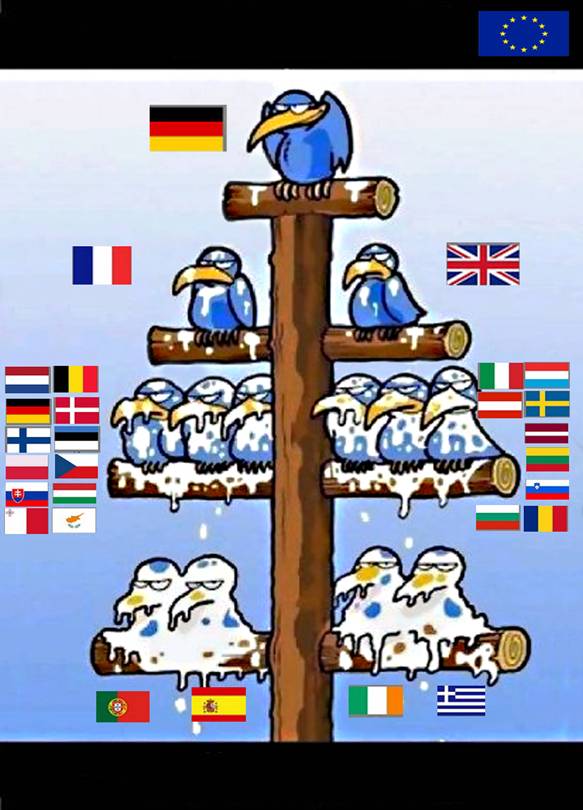
P.S. We leave you with the image of the European Union´s Christmas tree:
Ebooks and Resale Price Maintenance

Last week the European Commission announced the opening of formal proceedings to investigate whether international publishers may have engaged in anti-competitive agency agreements regarding the sale of ebooks (see Press Release). Dawn-raids in connection with this case were carried out last March.
Today´s edition of the Financial Times (edited by Pearson -a publisher affected by the investigation-) features a most interesting piece on a very related topic under the title Don´t make Amazon a monopoly.
Its author -John Gapper- argues that competition authorities in the US and the EU should not challenge the arrangements under which publishers set minimum prices for ebooks and preclude companies such as Amazon, Apple or Barnes&Noble from offering discounted prices. It explains that this is a textbook example of the situation that the US Supreme Court had in mind when it overturned Dr. Miles in its Opinion in Leegin, and submits that it would be paradoxical for competition rules to enable free riding-based discounting on the part of Amazon, thus enhancing its alleged “monopoly”.
This situation and the legal controvery surrounding it raises very interesting questions that go beyond the situation at issue and which have the potential to affect online distribution in general.
Does anyone have any strong views on this?
Economic advice for Christmas shopping

This morning, as I was doing a some last-minute airport shopping for a “Secret Santa” gift for my firm´s Christmas dinner in Brussels tonight, I received an email announcing that Frontier Economics has released a paper on the economics of Christmas. It wasn´t so useful for me because I had severe budget constraints, but it has the sort of fun approach that we like, and we thought you might find it useful or at least entertaining. As they explain on their web page:
It’s easier to think of economists as the prophets of trading doom than as Santa’s little helpers – too busy telling everybody what’s happening to productivity, energy demand and like-for-like sales to provide any insights into the annual exchange of goodwill and good-or-ill gifts to family and friends. So Frontier Economics has been scouring the academic literature of behavioural economics for tips to make that last struggle with your present list a little easier…
If interested in economic advice for Christmas shopping, click here: Present values- The economics of Christmas.
And if you´re one of those who likes to “shop around” for the best deals, you can also check out Waldfogel´s seminal paper on this matter (which Nicolas already recommended last year) and The New York Times´ collection of stories about the economics of Christmas.
By the way, this week is a nervous time for competition lawyers all over Brussels waiting to see if their Christmas break will be wiped out by unexpected Christmas gifts from the Commission!
P.S. This morning we crossed the 200.000 visits threshold. Once again, thank you for taking the time to read us!


 Chillin'Competition