Archive for the ‘Antitrust Scholarship’ Category
The slow death of Article 101(3)

Yesterday we attended the first session of the annual conference of the Global Competition Law Center (of which, btw, Nicolas is the director). As expected, the conference was extremely interesting, and gave us plenty of ideas for future posts. Here´s one.
Our friend Damien Gerard made a very good presentation in which, following a historical approach, he presented several paradoxes of the modernisation of EU competition law. After he concluded, I posed a question to the panel, asking whether the interplay of the three dimensions of modernisation that Damien mentioned (substantive, procedural and institutional) may have had the effect -or perhaps the object..- of killing Art. 101(3). The comments that followed showed that this is a widespread concern.
Let me now explain to you how I view this, and why the usual question (who did it?) has no clear answer. My take is that all the usual suspects bear some responsibility:
In the early days of the classic case law, EU Courts paid great attention to Art. 101(3) because they were conscious of the crucial role that the drafters of the Treaty had attributed to this provision. But it wasn´t their task to apply it. They saw it as something too complex and abstract, so they washed their hands off: they left its application up to the Commission and decided to apply a light standard of review. That is, in fact, where the “manifest error of appraisal” test of judicial review was born for EU competition law.
For many years, the Commission exercised its monopoly over the application of 101(3). Those were, in a way, the “golden days” of this provision (even though there were some obvious disfunctionalities as a consequence of the centralized system). With the entry into force of Regulation 1/2003 this whole situation changed. The Commission shifted its priorities to focus on the “most serious infringements” which, as a matter of fact, are also the “most obvious” ones. It therefore also washed its hands and left the cases where Art. 101(3) would be relevant to national competition authorities (NCAs) and national courts.
But NCAs and national courts also regard the application of 101(3) as something which is too complex, and, let´s face it, the Commission´s Guidelines on Art. 101(3) are far from being decisively helpful. Couple that with the feeling that undertaking an effects analysis under 101(1) is also too burdensome, as well as with the fact that NCAs have, logically, their own priorities, and what you get is a situation where at the national level there are essentially only “object cases” where 101(3) assessments are reduced to an absolute minimum under the argument that “object restrictions” are hardly redeemable (which, btw, is at odds with all case law departing from European Night Services) There are no available stats on this, but I bet they would be mindblowing.
The Commission hasn´t done much to solve this situation. It has failed to provide case by case guidance, and has instead focused on sanctioning cartels, abuses of dominance (mostly in network industries) and in releasing general guidance; moreover, where an issue appears as uncertain, the usual solution is to adopt a commitment decision. Not really helpful. Furthermore, the Commission has contributed to fostering the confusion by enlarging (with the help of EU Courts) the “object” category (e.g. with regard to information exchanges).
EU Courts, on their part, could also be charged as accomplices. Three pieces of incriminating evidence are (i) the enlargement of the “object” category in T-Mobile; (ii) the ruling in Tele 2 Polska precluding NCAs from adopting negative decisions; (iii) the adoption of distinct standards for the review of 101(3) assessments: would the overly simplistic Premier League Judgement, where the Court says, without providing much support for its assertion, that the exclusivity arrangements at issue do not meet the conditions of Art 101(3) (see para 145 of the Judgment) comply with the Court´s tough stance against the Commission in Glaxo Spain?
What does this imply for competition law:
In my view, this situation is dramatic for EU competition law (well, as dramatic as a legal matter in the competition law field can get, which, to be frank…). The interplay of all the factors above has led to an overly simplistic view of competition law, to a shifting of the burden of prove, and to even more arbitrariness and uncertainty.
PS. The painting illustrating the post is “Prometheus bound” by Rubens. As Art. 101(3) in the world of competition law, Prometheus was “credited with -or blamed for- playing a pivotal role in the early history of mankind“. As you know, immortal Prometheus was punished by Zeus to a -quite nasty- eternal punishment: he was bound to a rock where his liver was eaten daily by an eagle, only to regenerate and be eaten again the following day. Mithology has it that Hercules finally slayed the eagle and freed Prometheus. Will anyone eventually free Art.101(3)?
Case C-439/09: Is it just us, or is the ECJ naming the “EU rule of reason”?

Last Thursday, the ECJ issued its Judgment in Case C-439/09, Pierre Fabré Dermo Cosmétique v. Président de l´Autorité de la Concurrence. Little attention has so far been paid to this Judgment which, to me, appears as having more substance than it meets the eye. Let´s see:
In 2009, the French Conseil de la Concurrence adopted a decision sanctioning Pierre Fabré (“PF”) for including a de facto ban on the sale of its cosmetics and personal care products via the internet in its selective distribution contracts. In reality, PF´s contracts obliged its distributors to sell its products in the physical presence of a person with a degree in pharmacy. The Conseil considered that this constituted a restriction of passive sales in so far as it precluded online sales. PF appealled the decision and the Cour d´Appel de Paris addressed a reference for a preliminary ruling to the ECJ.
What meets the eye:
The specific and obvious discussion at stake relates to whether the exception contained in Art. 4 c) of Regulation 2790/1999 (now replaced by the same Art. of Regulation 330/2010 ) [pursuant to which ” the exemption to the prohibition laid down in Article 101(1) TFEU is not to apply to vertical agreements which, directly or indirectly, in isolation or in combination with other factors under the control of the parties, have as their object (…) c) the restriction of active or passive sales to end users by members of a selective distribution system operating at the retail level of trade, without prejudice to the possibility of prohibiting a member of the system from operating out of an unauthorised place of establishment“) (emphasis added)] justifies a requirement such as that included in PF´selective distribution contracts. The solution adopted by the Court is that, given that companies will allways enjoy the possibility of benefiting from an individual exemption pursuant to Art. 101(3) TFEU, it is not necessary to give a broad interpretation to the provisions bringing agreements within block exemption regulations.
In sum, the ECJ ruled that in case of doubt Block Exemption Regulations are not to be interpreted broadly, and that in such circumstances the competitive assessment of the agreements at issue shall be carried out within the framwork of Article 101(3). You may or may not agree, but it is reasonable enough.
What doesn´t meet the eye:
As we said above, there might be more about this Judgment than meets the eye. Perhaps we´re wrong; the fact that this Judgment has grabbed no one else´s attention does not mean we´re smarter (which is definately not the case), but simply that we may not be right. Let us explain ourselves:
(Click here to continue reading)
Chillin´Competition: The Conference

As our usual readers know by now, this blog was born out of the conviction that it was possible to do and say some things differently within our small competition law world. We have intended to do that on the blog, and now we want to extend this attitude to a conference -the 1st Chillin´Competition conference- which will be somehow different from what you may be used to. We can´t say much more for now (except that it will be held in Brussels), but details will follow soon.
We want you to be involved to the greatest extent possible, and therefore we would like you to please send us your ideas on possible topics and speakers: we´re looking for excellent and open minded practitioners, officials or academics who might give brilliant, fresh and even humorous views on competition law issues. We already have ideas on a number of people who fit that description, and some of them have already expressed their willingness to participate in this initiative. Please send us your suggestions either publicly by commenting on this post or in private at nicolas.petit@ulg.ac.be and alfonso.lamadrid@garrigues.com
Thanks!
Our Fordham Paper

Just before the summer we anticipated that Chillin´Competition readers would have a virtual seat at the mother of all antitrust conferences Fordham´s Annual Antitrust Conference (see here and here). As you may recall, Luis Ortiz Blanco had been asked by Barry Hawk to chair a panel on European competition law enforcement featuring a very impressive line-up of speakers (namely Alexander Italianer, John Finfleton, Bruno Lasserre, Andreas Mundt, and Manuel Sebastiao).
Luis and I decided that it could be interesting to profit from this opportunity to draft a paper examining the current state of EU competition law enforcement in terms of effectiveness and uniformity. We decided to draft an unorthodox paper which touches upon many issues and that concludes every section with a question. Those questions were the ones posed to the panelists at the roundtable.
The brainstorming work that preceded the drafting of the paper was mainly based on the suggestions and ideas that we received from readers of this blog. Accordingly, Barry Hawk has given us his very kind permission to post the version of the paper that was distributed at the conference on this blog.
Here it is: Ortiz & Lamadrid_European Comp. L. Enforcement
(Considering that drafting this took a substantial portion of my summer holidays, I really hope that at least one or two of you read it! )
Our intention is to edit it and turn it into a standard academic paper with a view to its publication in the annual volume edited by Barry Hawk. Any comments that any of you may have on the current version of the paper would therefore be most welcome and, of course, duly acknowledged.
Prizes (+ a Leak)

Last week at the annual congress of the International League for Competition (LIDC) in Oxford, Jérôme Gstalter (Foreign affairs service, France) and Pablo Ibanez Colomo (LSE) were both awarded the Nobel Prize in competition law Jacques Lassier Prize.
Jérôme wrote a very comprehensive Phd dissertation on the new monopolies of the information society. Pablo wrote a very dense dissertation on regulation and competition in the context of technological convergence, with a specific focus on audiovisual services. Both works were very different, with distinct qualities. It was a tough call for the jury. We eventually decided to award the prize to the two dissertations.
And tomorrow, the GCLC Prize will be awarded to the best thesis in competition law written last year by a coleurope stud’. A tip: the prize has been granted to a dissertation supervised by someone known as the lawyer who played a priest in a famous antitrust compliance movie (I cannot say more).
Pay Tribute

A while ago, Prof. I. Goavere (College of Europe) invited me to write a short text for a liber amicorum in honour for a god of EU law, Prof. J. Bourgeois.
My paper is entitled: “Parallel Trade: Econ-oclast Thoughts on a Dogma of EU Competition Law“. Alfonso – and his clients – are fans of this paper :).
The book has now been published. It is entitled “Trade and competition in the EU and beyond” and appears at E. Elgar.
I attach hereafter the flyer.
Tough Competition

Competition is tough nowadays, even in competition law blogging!
Check this out:
Some weeks ago, when introducing “THE RAID”, we wrote the following:
“In Chilling Competition we have devoted a number of posts to antitrust-related movies (see our previous posts on: “First ever Hollywood competition law movie?”; “More competition-related entertainment“; “OFT goes to Hollywood”, and, very specially, our nominations to the “Antitrust Oscars”). Given that all of those posts received a crazy amount of visits, we can reasonably presume that you too like this sort of videos.”
This afternoon, one of our readers sent us a link to CPI´s September Antitrust Chronicle, where we see that CPI has created its “First CPI Film Festival”. Does this sound familiar?
Not only the concept “sort of” ressembles our “Antitrust Oscars”, but the films are also the same ones that we had referred to in our previous posts, and that you had referred to in previous comments.
It´s nice to know that even though CPI Blogs o´Blogs has tipically “boycotted” our posts (with one exception; Nico had already referred to this in the past), their ideas and tastes are so strikingly similar to ours!
Our competition lawyers mindsets lead us to the conclusion that there´s not much that can be done here since this situation can be regarded as either
a) a case of Conscious Parallelism (CPI) in an oligopolistic setting where CPI´s conduct can be qualified as a follow-the-leader reaction? 😉
or
b) a situation in which the content of our most visited posts must be regarded as an essential facility that needs to be shared with competitors.
Reform of UK Competition Law – Again?

Our friend Kit Brown (Matrix Chambers) has sent us an interesting blog post on the proposed reform of the UK competition system. Kit is one of the most talented Barristers of his generation and it is a great honour to publish his writings on this blog.
In March 2011 the Department for Business, Innovation and Skills launched a consultation on potential reform to the UK competition law landscape. The consultation document, A Competition Regime for Growth: A Consultation on Options for Reform, sets out options in respect of virtually every aspect of the domestic regime apart from the substantive tests themselves. Most notably, the Government is adamant that there shall be a merger of the two principal competition agencies, the Office of Fair Trading and the Competition Commission, creating a Competition and Markets Authority (CMA); it is considering amending the antitrust enforcement framework such that cases would be prosecuted by the CMA rather than decided in the traditional administrative manner; it is pondering the introduction of some form of mandatory merger notification system; and it is interested in removing the dishonesty requirement contained in the criminal cartel offence. But this reform agenda comes just 8 years after the most recent major piece of competition legislation – the Enterprise Act 2002 – came into force and just 11 years after the entry into force of the most radical reform of them all here in the UK: the Competition Act 1998. An important question is this: why yet more reform?
Initially, before the consultation document emerged, many in the profession suspected that the Government would look to merge the competition agencies as part of the “bonfire of quangos” [for a panorama of quangos, see picture above] announced shortly after the last General Election; that the merger of the OFT and CC would be motivated by a desire to cut costs. After all, why have two agencies when one will do? Cost-cutting is not, however, the Government’s motivation. Instead, it considers that a merged agency will be better able to make flexible use of the powers currently available to the authorities; will be able to make better use of resources; and will become a stronger advocate for competition in the UK. In particular, the CMA will be able to deploy its powers to inquire into markets more flexibly than is currently the case – at present, the OFT may conduct market studies or (where it suspects the presence of features of a market which have an adverse effect on competition) may formally refer markets to the CC for in-depth (and costly) investigation.
Re-Opening Soon
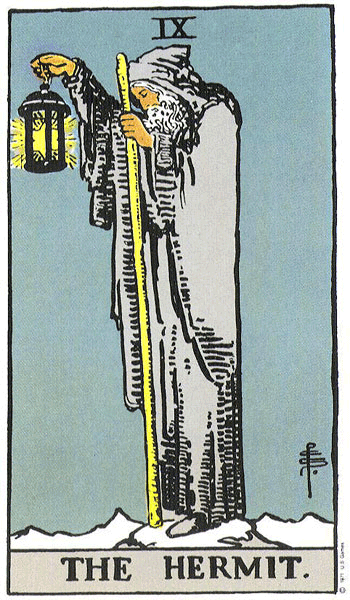
This blog is closed until next Monday.
As an “aperitif“, please find hereafter a link to a new working paper entitled “Credit Rating Agencies, the Sovereign Debt Crisis and Competition Law“ (42 p.).
Again, a piece of heretical thinking, written in the solitary quietness of the summer.
Actually, there were so few emails in the past weeks, I really felt like a hermit.
Subversive Thoughts (3) – Regulating Rating Agencies with the Competition Rules
The rating agencies “oligopoly” has been trashed by virtually all EU policy makers in the past days.
The big question on the policy agenda is now: how to regulate them?
Here’s a first taste of my answer, which I will further articulate in a forthcoming paper with my assistant N. Neyrinck. This paper will make extensive use of my prior research on oligopolistic dominance.
Let’s start with two propositions.
Proposition 1: The market for rating services exhibits a bunch of features which makes them prone to antitrust scrutiny. Market structure is oligopolistic, with essentially three big players (Moody’s, S&P and Fitch). Conduct is close to coordination (tacit or explicit), with quasi simultaneous and identical downgrading cycles. Performance is welfare decreasing, with borrowers paying a steep price in terms of interest rates (not to talk of the price to pay for taxpayers, called to rescue downgraded countries)
Proposition 2: The toolbox of antitrust agencies comprises a variety of flexible remedies which could be instrumental to regulate the rating agencies oligopoly (e.g., structural and behavioral remedies). Moreover, competition policy is an exclusive EU competence. Hence, those Member States that are reluctant to regulate the rating agencies cannot undermine Commission action under the competition rules. Finally, the EU competition rules can be enforced in a timely fashion (think of Article 9 proceedings) and also apply to non-EU firms.
Obviously, the main outstanding issue is to build a case around those two basic propositions. This implies devising a credible theory of harm, in other words a scenario of anticompetitive conduct that would allegedly explain the rating agencies’ behavior.
On this, and out of pure speculation, an hypothesis with both a collusion and a foreclosure component can be floated. Together with a number of banks, the rating agencies may be trying to harm other rival banks that have purchased Greek and Portuguese paper. Of course, the main problem here would be to (i) explain why rating agencies have an interest in siding with certain banks and not others; (ii) establish a link, convergence of interests, concertation between the rating agencies and those banks.
But even in the absence of a strategic link with banks, one may still consider that the rating agencies conduct is amenable to antitrust scrutiny. After all, with their self-fulfilling prophecies, the rating agencies risk injuring the structure of banking markets by pushing certain players to bankruptcy. In turn, this will increase market concentration, weaken competition and harm consumer welfare. Note that scenarios of this kind are often found in secondary line injury price discrimination cases (where the seller places some third parties at a “competitive disadvantage” (a sort of negative externality?) in a related market). Hence, it would not be crazy for antitrust regulators to run a theory of this kind. Moreover, the explanation for the rating agencies’ conduct can perfectly be framed in the words used by (i) behavioral economists to describe irrational conduct – why hammer Greece and Portugal, and meanwhile maintain the US’ AAA?- in markets where players are excessively risk averse; or (ii) conventional economists to describe information imperfections and reputation dynamics (to stay credible, agencies need to be tough on rating).
Happy to have your comments on this.
PS: I had initially decided to use a picture of Cassandra to illustrate this post. I changed my mind given (i) the fact that Cassandra was often right, but never believed; and (ii) my musical tastes.


 Chillin'Competition