Archive for the ‘Antitrust Scholarship’ Category
Terrorist Competition Law

… is the reaction that I triggered from a participant at the APRAM’s conference yesterday. See my presentation below. A paper on trademarks and competition law is in the making.
The APRAM is a famous French association that gathers practitioners active in trademarks and designs law.
And now a question: will the French APRAM urge international colleagues to start bombing raids over the Institute for European Legal Studies?
A New Theory of Harm

I attach below a presentation I delivered yesterday at the Amsterdam Center for Law & Economics (UvA). This presentation summarizes and updates my PhD work.
In substance, It shows that Article 102 TFEU may provide a workable ex post remedy against certain types of oligopolistic conducts. The concept of abuse of joint dominance may be applied to the artificial tactics which oligopolists adopt to protect an observed collusive equilibrium from the natural, disruptive effect caused by an external shock (entry, natural disaster, change in tax rate, etc.). In this sense, it is different from the proposals of Prof Whish re. excessive prices and Korah, Monti & Stroux re. facilitating practices.
A related aspect of my work challenges the over-optimistic, and naive view that the merger regulation is the ultimate preventive instrument against tacit collusion.
The good news is: my hosts in Amsterdam – very bright economists and lawyers – were quite attracted by the idea. They advised me to send it to officials within competition authorities.
A paper will shortly follow.
Presentation ACLE – 14 March 2011 – N Petit
A big thank you to Maarten Pieter Schinkel, Carmine Guerriero and all the other ACLE nice guys I met yesterday.
PS: With yesterday’s post on the Dutch competition authority, Alfonso’s taste for dirty stories is now public. Unlike him, I have decided to spare our readers from stories on coffee shops and other infamous districts of Amsterdam.
Price Discrimination (and the Brussels Conference Market)
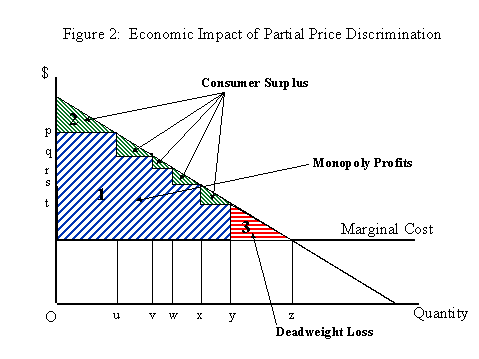
A thought on something that lawyers – including myself – often have a hard time to understand.
Conventional economic theory posits that price discrimination by a monopolist is conducive to allocative efficiency.
This is because price discrimination entails a welcome departure from uniform monopoly pricing. With price discrimination, the monopolist undercuts its own uniform price to the benefit of certain customers (or to categories of customers as shown in the above picture). With price discrimination, customers that could not initially take the uniform monopoly price now get a chance to be served.
Furthermore, the monopolist increases output and, assuming fixed costs, achieves economies of scale. Price discrimination is thus also conducive to productive efficiency.
With this background, I was last week confronted with an odd price discrimination scheme which, in my opinion, brings little – if no – improvements in terms of allocative efficiency. A famous conference organizer has the following price menu for a forthcoming competition law event:

On cursory examination, this conference organizer has designed the above price menu to attract academics, judges and young lawyers. However, I doubt this price scheme will attract many of them, simply because those fees are well beyond the average reservation price of such customers. Saving appearances?
An additional remark: given that this conference is sponsored (law firms essentially) and that most speakers are brussels-based (means no transport/accomodation costs), I do not see the cost basis for such rates. Although I am not a huge fan of excessive pricing cases, the Brussels competition conferences market could make an interesting candidate for Article 102 TFEU proceedings. Still to see whether there is a dominant player on this market. Food for thought.
My WE Readings…

… involved approximately 5000 pages of case-law (see list below).
I am currently preparing for a conference this Thursday. I have 40 minutes to brief the audience on the main developments in EU and French competition law over 2010.
Now that I have read all that stuff, I should certainly start monetizing my knowledge by making presentations for law firms in Brussels and Paris. I heard a god of competition law used to do this in the past. Any clue?
Weekend reading and a confession

For those of you who can get some time off to do some reading this weekend, this is a real must: Why (Ever) Define Markets? , by Louis Kaplow.
PS. I was reading last week a piece on the identity of the real people behind many tweets, facebook status updates and posts attributed to celebrities, politicians and others. It made us reflect and feel bad for not having been completely open to our readers. We too have a ghost writer who does most of the work for us. He´s quite shy, but as a exception, has admitted to have a picture taken: here he is.
The Law of Unintended Consequences

With rising fines for antitrust violations, there’s been a lot of fuzz about the adequacy of the current EU penalty system.
The EU fines system is generally lambasted on two counts. First, it would be inefficient because the average level of fines currently slapped by competition authorities would still be far below the optimal deterrence level. Second, it would be unfair because it targets companies as a whole, rather than the individuals which have secretly engaged into unlawful conduct. In so doing, administrative fines would thus harm a range of third parties (shareholders, workforce, etc.) which have nothing to do with the infringement. Interestingly, increasing fines to satisfy the efficiency concern would further exacerbate the unfairness concern.
The upshot of this has been a renewed interest for alternative penalties (director disqualification, individual fines, etc.). In a recent paper published in ECLR, our esteemed colleague Prof. Alan Ryley (City University London) puts forward a creative, and somewhat radical proposal:
Thirdly, the expulsion of aliens from EU territory: Most international business executives need to be able to travel into the European Union, the world’s largest single market. Prohibition from entering EU territory for a term of years would make it difficult for them to act as senior level executives, as well as significantly damaging their reputations.
Now a question: beyond preventing business executives from making Xmas shopping in Paris and London – which I do not view as a particularly strong deterrent – I fail to see how this could really dissuade guilty alien executives to operate cartels within the EU. Paradoxically, those executives will be increasingly incentivized to negotiate cartels targeted at the EU outside of the European territory, with the unintended side-effect that the Commission’s will face mounting difficulties to gather evidence of unlawful conduct.
The full reference of Prof. Riley’s excellent paper is “The modernisation of EU anti-cartel enforcement: will the Commission grasp the opportunity?”, E.C.L.R. 2010, 31(5), 191-207, 2010.
Thanks to my assistant N. Neyrinck and my student B. Boggaerts for the pointer.
The picture above is taken from one of the worst French movies ever.
New Paper
A poorly informed friend just told me over the phone that he was concerned by my low publishing record in recent weeks.
To prove him wrong, I am proud to announce the publication of a new paper entitled “Behavioral Economics and Abuse of Dominance: A Fresh Look at the Article 102 TFEU Case-law” (pdf available at the end of this post). The paper appears in the Osterreischische Zeitschrift für Kartellrecht (Dezember 2010 /Nr. 6, Seiten 201-236, p.203), and was co-drafted by my assistant Norman Neyrinck. This paper is an upgraded version of a GCLC working paper.
Recent publications

In the past few days there have been several publications on which we hadn´t had the chance to comment:
Some days ago the European Commission published a document stating its position regarding the nowadays common claims on inability to pay made by undertakings on which a fine has been imposed. Interestingly, the document was published on a Commission´s site on transparency, but not on DG Comp´s website.
Last week, DG COMP also launched the public consultation on collective redress (thanks to P. Sabbadini for immediately pointing us to this).
On the European Courts side (and aside from an arguably insufficient but nevertheless welcome fine reduction that some colleages of mine got in the Spanish raw tobacco case), Advocate General Kokott issued a very important Opinion in the Greek decoders case (the one concerning Karen Murphy, the owner of the Red White & Blue pub in Portsmouth, who cancelled her licence with BSkyB -who holds the right to broadcast live Premier League games in the UK-, and instead signed up with a Greek provider and imported its decoders). The matter eventually arrived at the ECJ by way of a reference for a preliminary ruling. In her Opinion, AG Kokott considers that “territorial exclusivity agreements relating to the transmission of football matches are contrary to EU law“. Were the Court to follow its Advocate General, its Judgment would constitute a revolution that would shock the world of sports in a way only comparable to the Bosman Judgment, not to mention its potential implications for the cinema and TV industries in general. We´ll post a comment on the Opinion here as part of our “Competition Law & Sport” series as soon as we get the time to read it and think it through.
And speaking of publications, there´s a new journal which might be of interest to many of us: the Journal of Universal Rejection They will reject absolutely everything submitted to them 🙂
Linkedln: A new book, a new case, and an “innovative” ground for exploitation claims

The new book: Lorenzo Pace is the editor of a forthcoming book on The Impact of the Commission Guidance Paper on Article 102 which features contributions by a bunch of truly outstanding academics, namely Pace himself, Valentine Korah, Ernst-Joachim Mestmäcker, Catherine Prieto, Richard Whish, and Luis Ortiz Blanco together with Pablo Ibañez Colomo. I´ve had the chance to read some of the contributions, and they are frankly excellent. Keep an eye open for its publication.
The new case: L. Ortiz and P. Ibañez´s contribution in that new book emphasizes that a significant difference exists between the enforcement of the almost identical provisions on abuse of dominance at the EU and Spanish levels. In particular, they show that, in remarkable contrast to the record of the European Commission, as much as half of the total number of prohibition decisions adopted by the Spanish authority were of a “regulatory nature”, in the sense that they concerned exploitative practices put in place by undertakings enjoying or having enjoyed exclusive rights or operating in regulated network industries.
An investigation formally initiated yesterday by the Spanish authority seems to prove their observations right, and not only retrospectively: Telefónica Móviles, Vodafone and Orange are being investigated for having allegedly set excessive prices for wholesale origination and termination services for short SMS and MMS messages on their mobile telephone networks.
As reported on this blog, Telefónica was also recently sanctioned for having abused the collective dominant position that it enjoyed together with Vodafone and Orange in the retail mobile telephone market. I am wondering whether the CNC will be attempting to bring this new case on the basis of a finding of collective dominance on the wholesale market (seems unlikely, but remember the Irish case where ComReg decared O2 and Vodafone collectively dominant in the whosale market; that decision recently commented and criticized in the August 2010 issue of European Competition Journal), or will rather act the “Magill way”, holding that each operator is dominant with regards to its respective network.
An innovative ground for complaint: As harsh as the CNC´s attitude in relation to claims of excessive pricing may seem, things can always be worse:
The Bolivian government has announced the initiation of a probe on the rise of 50 cents in the price of Coca Cola. The reason why the government is reacting as if the price of a 1st need product had skyrocketed and might even order CocaCola´s bottler to cease its activities is simple: last year the government launched its own drink with the aim of competing against Coca Cola. They named their product: Coca Colla. Subtle, isn´t it? .
Despite its appealing brand name the government-sponsored drink wasn´t a success, so Evo Morales´administration is now following an alternative path; i.e. investigating their direct competitor for having increased its prices (even if it only did so in response to the 23% increase in the price of sugar approved by the government..). Aside from the fact that forcing a producer to stop production seems an interesting remedy to excessive pricing (aka restricting output), this is a genuinely innovative ground for competitors to take action. Who would have guessed it? Bolivia at the avant-garde of antitrust..
Horizontal Cooperation Agreements

Last week, I faced the very pleasant situation of having to lecture on horizontal cooperation agreements a day only after the adoption of the new horizontal framework by the Commission…
The good thing is that it gave me an opportunity to read the text from top to bottom.
So here’s my own assessment of this lenghty set of Guidelines. I like: (i) the introduction of a chapter on information exchange agreements; and (ii) the examples, which are very instructive and draw on national practice, §§107 and 109 notably (or the bottom-up learning effects that arise with decentralization)..
However, there’s a heap of less satisfactory things in the Guidelines. To structure things a little, I distinguish between formal (1) and substantive (2) issues.
1. Formal issues
Unpractical self-assessment method. The Guidelines stick to the good old Article 101(1)-Article 101(3) sequence. But why not endorse a simpler self-assessment method which involves:
- First step: screening of the agreement through incompatibility presumptions (hardcore provisions); followed by screening of compatibility presumptions (de minimis; market share thresholds; and conditions);
- Second step: detailed assessment of possible restrictive effects under 101(1); followed by detailed assessment of possible pro-competitive effects
Incorporation of the rules on environmental agreements within the standardisation section. Why are those agreements no longer worth a specific section?
Linguistic mistakes in French version. The concept of “vente groupée” used under the section on agreements on commercialization is confusing. The Commission and Court routinely refer it in relation to bundling under Article 102 and the EUMR (see Microsoft and Tetra Laval).
Perfunctory treatment of Article 101(3) arguments. The Guidelines often say that horizontal cooperation agreements bring significant efficiencies, pro-competitive effects, and so on. Yet, when it comes to providing guidance on efficiencies, the Guidelines dedicate little time and space to the issue (or they simply restate in substance what has been said under Article 101(1), check the section on standardization agreements). True though, one can find help in the unhelpful Article 101(3) General Guidelines.
2. Substantive issues
Inconsistent, and old-fashioned analytical framework for collusion. There’s been a number of great books on tacit collusion in the past decade, and more importantly, good judgments and soft law instruments (the Airtours ruling, the Guidelines on horizontal mergers, the Article 102 Guidance Communication). All set out a modern, consensual framework for the assessment of collusion concerns which hinges on the proof of 4 cumulative conditions. Very remarkably – and to the exception of a footnote in the section of information exchanges – the new Guidelines suggest however to test tacit collusion through an impressionistic, structural, and reduced range of factors. The section on purchasing agreements which refers to commonality of costs and exchange of information (§§213-216) brings a glaring illustration of this. But the same applies to production (§§175-182) and commercialization (§§242-245) agreements. My question: are the dark times of the checklist approach back? Of course, this approach leaves more leeway to enforcement authorities, but it generates huge legal uncertainty + high type I errors risks. And it is wholly inconsistent with the approach taken under the EUMR, which pursuant to §21, has “certain common elements … pertaining to the potential restrictive effects, in particular as regards joint ventures“.
The §§ on FRAND terms are devoid of legal basis, and should be disregarded. To draw possibly on the expertise gathered in the Qualcomm and Rambus cases, the section on standardisation agreements devotes some wording to what is, and how to self-assess, a FRAND price. Now, under EU competition law, it is well settled that unilateral conduct falls short of an agreement under Article 101 TFEU. Assume that following the adoption of a standard, a party unilaterally decides to request terms which other parties challenge as unFRAND (the classic patent ambush story). In such a setting where firms antagonize, there is no, and there cannot be, an unlawful agreement under Article 101 TFEU. Since the Bayer and VW rulings, the fact that the parties have, in the past, co-operated in the SSO is no longer sufficient to trigger the applicability of Article 101 TFEU (those cases repealed the “contractual framework” doctrine inherited from the Ford case). And by the way, everyone knows this. To date, allegations of unFRAND terms have only been brought under Article 102 TFEU (notably by discontent parties which had participated to the standardization process).
PS: The new texts were given a number today. The R&D BER is Regulation 1217/2010 and the specialisation BER is Regulation 1218/2010.
PS2: The GCLC will have a conference on the horizontal package in February 2011.


 Chillin'Competition