Archive for the ‘Breaking – Antitrust – News’ Category
News from the Court

This was an unusual week at the European Courts. First, as we anticipated some time ago, the ECJ was partially renovated. The Member States have reappointed Judges Arabadjiev, Arestis, Berger, Bonichot, Fernlund, Jarasiunas, Levits, Malenovsky, Prechal and Von Danwitz as well as Advocate Generals Bot and Mengozzi.
The new faces at the ECJ will be Judge Da Cruz Villaça (replacing Cunha Rodrigues), Judge Vadja(replacing Schiemann), and AG Wathelet (replacing Masák). Nils Wahl (one of the good competition experts in Luxembourg) will have to remain at the General Court for a short period before swearing in as Advocate General (apparently the candidate proposed by Sweden to replace Judge Wahl was vetoed by the ‘Art. 255 Committee’).
The ECJ also held elections for President (Judge Skouris was re-elected), Vice President(Judge Lenaerts will be the first VicePresident in the history of the Court) and Presidents of Chambers (winners are: Tizzano; Silva de Lapuerta, Ilešič, Bay Larsen, and von Danwitz),
Here’s a video of the speeches pronounced that day at the Court (if you watch it, that means you’ve plenty of free time; we’re just saying 😉 ] Our highlight (as if we had watched the whole thing..) is Judge Schiemann’s great and very funny farewell speech (starting in minute 31.20).
By the way, our next Friday Slot interview will feature a member of the General Court. We’re sure you’ll love that one.
Have a great weekend!
Perpendicular Collusion

Last summer, I rediscovered how tasty a good old Desperados beer was.
But I was also amazed to discover how pricy that good old Desperados beer was.
In a standard Belgian supermarket, it cost me a little more than 16€ to acquire a pack of 6 Desperados… I recall that I actually complained to the cashier.
Now, the press in Belgium reports today that Belgian supermarket chains may have colluded to artificially push prices up. And on top of this horizontal price fixing scheme, they may have also colluded with suppliers of cosmetic and hygienic products, in some sort of large-scale RPM scheme…
I am now a little less surprised by the price of Desperados in Belgian supermarkets (although beer does not seem to be a target of the inquiry).
If the infringement is confirmed, we’ll have to come up with a creative label for this type of horizontal+vertical collusion. Here’s my take: perpendicular collusion.
But the decision may never come. The case has now landed on the desk of the decisional organ of the Belgian NCA. And, to put it euphemistically, this organ has not seemed very keen on actually enforcing the Belgian competition rules… This actually explains the recent legislative proposal that purports to suppress the existing NCA and replace it with a brand new competition watchdog, tailored alongst the lines of the French Competition Authority.
Heard through the Grapevine

Down here in Brussels, there is rising speculation over who will step-in to replace Kai Uwe Kühn when his term arrives.
Rumour has it that Massimo Motta is a very strong (Universitat Pompeu Fabra and Barcelona Graduate School of Economics) contender for a place in the seat of DG COMP’s Chief Economist.
Would be a very good decision. For long, I am a great fan of Massimo Motta’s book entitled Competition Policy – Theory and Practice.
Amongst others, his innovative paper on the effect of antitrust fines on share valuation is also a must read.
Breaking News

I was baffled yesterday when I learnt that Professor Richard Whish is leaving King’s College London.
Richard is one of our antitrust gods (we are polytheists at chillincompetition), and the author of a true competition bible.
(Click here to read our Friday-slot interview with him).
How can King’s let Richard go? If I were King’s dean, I would have offered a raise.
PS: I attach hereafter the slides I presented yesterday at a conference on Aims and Values in EU Competition Law in Copenhagen. The slides make a number of remarks on (i) industrial policy and competition law; and (ii) the current status of the Guidance paper on Article 102 TFEU.
Aims and Values in EU Competition Law – N PETIT (19 09 12)
Thanks to Caroline Heide Jorgensen and Christian Bergqvist for having me on the programme of this very good conference.
Change of Times
In contemporary antitrust law, price-fixers have enjoyed a somewhat “gentlemanesque” image.
Price-fixers, as the story goes, would typically be well-instructed managers, who would convene in the smoked-filled rooms of luxury hotels, drink Cognac and exchange views about prices, politics and philosophy.
But since yesterday, the masks have fallen, revealing the true face of XXIst century price fixers.
According to this website, and as reported by the Handelsblatt:
“the Steel managers who were fixing prices and dividing up the railway track market took Deutsche Bahn employees to brothels after talking business over dinner, spending more than €71,000 on “entertaining” over five years“.
The bottom-line (courtesy of a good friend met yesterday at RBB’s party): “Germans always put business before pleasure“.
Misc.

A hotch potch of AT-related news, including some self propaganda:
- The next GCLC lunch talk will be devoted to the Microsoft compliance case, following the General Court’s judgment in Case T-167/08. Speakers are Eric Barbier de la Serre (Jones Day) and Thomas Kramler (COMP). See link hereafter for registration form: 61st GCLC Lunch Talk – Registration form
- The next GCLC annual conference will take place on 8 and 9 November, and will be devoted to “Competition law in times of economic crisis”. The final agenda is in the making.
- I will be speaking at a conference in Hong Kong on 19 October 2012. Just cannot wait to be there. See here for the conference website and hereafter for the programme: Leaflet_2012_9_4. My speech will be about challenges for 21st century competition authorities. If you have any suggestions of topics, items, or remarks to convey at the conference, please do not hesitate to drop a line;
- Our good friend Ewoud Sakkers from COMP is taking a one year sabbatical. He will be thinking and writing at Yale law school. May he also take some good rest while there;
- Marek Martyniszyn, a Senior Research Fellow at the Institute for Consumer Antitrust Studies (Loyola University Chicago) has posted online an interesting book review of the liber amicorum in honour of Professor Jacques Bourgeois.
Antitrust Comics
It is a well-known fact that competition lawyers increasingly compete in court with economists (at least in the US).
But they may now have to compete with comics artists.
Some background: earlier in 2012, the DoJ filed suit against Apple and 5 e-books publishers for alleged violations of Section 1 of the Sherman Act.
Later in 2012, three publishers got off the hook, settling the case with the DoJ.
But the feud goes on between Apple, two publishers and the DoJ.
In this context, Bob Kohn, a media expert, has refiled a 25 pages request to participate as amicus curiae in the form of a comics. See link hereafter: 104906877-Kohn-Amicus (2)
The result is amazing, and possibly more convincing that the initial submission. Kohn even managed to quote judicial precedents.
So here goes the question: besides mock trial sessions, should law schools introduce drawing courses in their curriculums?
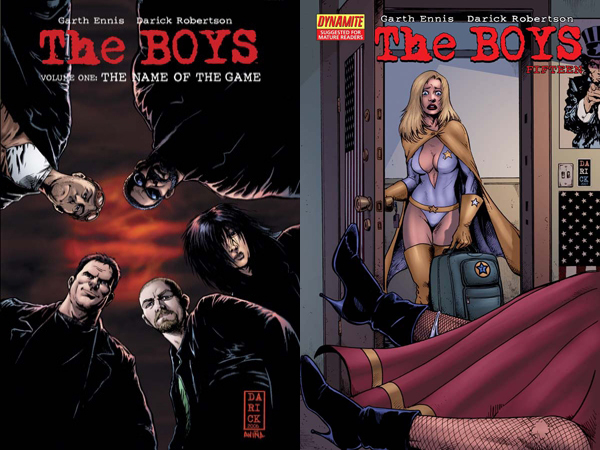
PS: the above pic is taken from the last strips I read. The Boys is dark, violent and very politically incorrect. A must read.
PS2: thanks to David Mamane (Schellenberg Wittmer) for the pointer.
On competition and blogs

Competition seems to be moving moving to the blog arena.
Some of you may recall that a while ago we discussed the case of a Spanish professor who had been sued for accusing a Promusicae of anticompetitive behavior (see here). We are glad to report that the blogger has won the case, thereby establishing a good precedent to shield Nico and myself from possible similar attacks 😉
Another interesting blog-related development has taken in the U.S. In the context of a high-profile patent infringement case between Google and Oracle, district court judge Alsup has ordered these companies to diclose the identity of bloggers, journalists and consultants that they pay for favorable opinions or consultancy work (for more, see here or here).
This decision has been triggered by the revelation that Florian Müller a well-known IP blogger (from the blog FOSS Patents) had been hired by Oracle shortly after the trial begun.
This unprecedented move should cast light upon the problem related to the lack of transparency surrounding blog content. As the influence of certain blogs grows, it is necessary to start thinking whether the ethical rules governing traditional journalism should also apply in this area. It has certainly led Nicolas and myself to reflect on the way we want to do things.
In our case, we don’t pretend to be impartial informers. We are simply two young professionals who voice out subjective opinions in public to entertain and/or to spur some hopefully interesting debates. We see Chillin’Competition more like a diary than like a newspaper story or an academic paper, and therefore don’t feel under the pressure of being always perfectly informed, accurate, exhaustive and objective about what we write. Of course we try to do our best and to be as technically rigurous as possible, but we’re not afraid of posting first thoughts on some topics, even if our views may evolve afterwards (remember our disclaimer?) 🙂
The small dimension of the competition law community makes it practically unfeasible to continuously disclose personal links. We often know quite well, or are friends with, in-house counsel, external counsel, Commission officials, clerks or Judges involved in all sides of the cases on which we comment here. Disclosing friendship or other informal ties with the people involved in the cases on which we comment would be tremendously burdensome (and it would look a bit weird too…). As said above, we don’t pretend to be always objective. In fact, we generally try to be subjective, but we develop our reasons and we expose them to public criticism. For the time being, our policy is to indicate only the cases in which we are personally involved. Also, where we have written about a case and have later become involved in it, we have also publicly stated it. However, we are, as always, open to comments and suggestions on how to better do what we do.
Blogging law is getting increasingly complicated. Nico: we need a lawyer.
Interviews with Commissioner Almunia

By the time you read this Nicolas and I should hopefully be away on holidays. We have scheduled this “lazy” post for those interested in watching the series of video-interviews with Commissioner Almunia published by the independent EU policy broadcaster viEUws.
In these interviews (you can click on the hyperlinks to watch the videos) Commissioner Almunia talks about the Google investigation, Microsoft’s lack of compliance with browser choice, Standard Essential Patents (Apple vs. Samsung, Motorola vs. Apple & Motorola vs. Microsoft), State aid & cross-border mergers in the European banking sector as well as about the Libor / Euribor case.
After the holidays we will do our best provide you with our very own interview with Joaquín Almunia. Any suggestions as to possible questions that you would like him to respond to?
Oops!

Monsieur Petit seems to have abandoned this blog in order to share his thoughts on an exclusive basis with US media. On Wednesday he was quoted again in The New York Times, this time in relation to yet another a new investigation on Microsoft’s non-compliance with a Commission’s decision.
As you may know, the Commission issued a statement announcing an investigation over Microsoft’s possible non-compliance with the 2009 commitment decision which obliged it to include a brouser choice screen to enable users to pick a browser instead of using the pre-installed one (until then Internet Explorer).
Microsoft has also issued a statement apologizing and explaining that:
“We have fallen short in our responsibility to do this. Due to a technical error, we missed delivering the Browser Choice Screen (BCS) software to PCs that came with the service pack 1 update to Windows 7. The BCS software has been delivered as it should have been to PCs running the original version of Windows 7, as well as the relevant versions of Windows XP and Windows Vista. However, while we believed when we filed our most recent compliance report in December 2011 that we were distributing the BCS software to all relevant PCs as required, we learned recently that we’ve missed serving the BCS software to the roughly 28 million PCs running Windows 7 SP1”.
The Commission has anticipated that it might impose “severe” penalties.
Keith Hylton (Boston University) has stated that the Commission is overreacting because “there may be a few people on the planet, living deep in forests on the Marshall Islands, who are not already aware that Microsoft’s Internet Explorer is not the only browser available”.
The well-informed and ironic reader who has conveyed Mr. Hylton’s statement to us responds that “whoever at Microsoft was not aware that they had to include a browser choice screen in Windows must also live deep in the forests in the Marshall islands, and whoever told the Commission in December that such error had not happened must live in the woods next door”.
We lack any precise information about this investigation but it’s hardly conceivable that Microsoft would do this on purpose, so, just as Microsoft says, this is most certainly due to an unfortunate mistake.
In any event, this story shows that antitrust law does perhaps not worry some companies as much as we usually think. Most importantly, the fact that nobody had noticed until now that 28 million copies of Windows had been sold since February 2011 without the browser choice screen says something about how compliance with antitrust commitments is monitored…


 Chillin'Competition