Archive for the ‘Our Publications’ Category
On DG Comp’s fight against tax competition and tax planning

The European Commission has in recent years been very active applying State aid rules to tax provisions and regimes. The first paper I ever wrote back in 2004 (don’t read it, it was initially done for a tax course and I was a 20 year old student…) dealt with those issues; now, ten years later, I’ve taken interest again on this subject and am currently involved in a handful of cases dealing with the taxation/State aid interface before the General Court.
The fact is that the Commission has recently undertaken a more proactive and prominent role in resorting to State aid rules to public initiatives that, in its view, facilitate aggressive tax planning. Those of you attending the 2014 Competition Forum back in February will recall that the Commission held a panel on “Taxation and Competition Policy”, in which it inquired about the role of State aid investigations in tackling tax evasion, tax fraud and aggressive tax planning (a video recording of the discussion as well as the transcripts of the speeches are available here).
Against a background of lack of political consensus on how to deal with harmful tax competition and what is seen as tax avoidance, the Commission is keen on being regarded as a proactive authority (it’s not the first time that competition policy is used to achieve results that couldn’t be attained by governments and legislators).
As part of this effort, the Commission has sent information requests to various Member States in order to assess the compliance of tax ruling practices (advanced binding decisions in fiscal matters which may allow for special treatment for some particular companies) and patent box regimes (incentives designed to encourage companies to make profits from their patents) with state aid rules. Yesterday the European Commission went through the trouble of issuing a Press release aimed at naming and shaming Luxembourg for having failed to provide information (specifically, the names of thelargest 100 companies benefitting from the patent box regime) , invoking fiscal secrecy.
I was quoted yesterday in a Bloomberg piece in relation to this news, so I though it’d be interesting to recycle my thoughts explain my views in a bit more detail here:
This is a highly sensitive area where publicly visible messages (such as yesterday’s press release) may send powerful signals and give rise to concern on the parts of governments and companies, and where playing to the gallery might therefore be considered useful at times. That’s part of the game and shouldn’t surprise anyone.
But if we’re realistic, we should realize that (for as long as fiscal policy remains within the realm of nation States), there’s a limit to what can be achieved with State aid rules, and that it’s doubtful that the current investigation, focused on patent box regimes and tax rulings, will yield any meaningful results:
– Patent box regimes have been authorized in several Member States, and the Commission has consistently accepted that they do not confer the selective advantages that would qualify them as State aid.
– With regard to tax rulings –and whereas I’m not aware of the details of the investigation- even in the event that the Commission were to find incompatible State aids, this would only have the effect of suppressing divergent tax treatment within the Member State at issue (the Commission can only identify as aid deviations from “the system of reference” provided by the State’s standard tax regime ). This would therefore not at all address the main, big picture, concern linked to divergent treatment across, and beyond, different Member States.
It’d nevertheless be interesting to follow developments on this area. The amounts that could be in play for many companies would make any antitrust fine look insignificant. Anyone in need of a lawyer? 😉
Two-sided markets in merger and abuse of dominance cases

When you have a 8 9 10 to 9 ? job it’s often quite hard to do things on the side, and, between us, it may not make much sense that many of them are work-related. Only this month, and in addition to ordinary work -which included 5 Court deadlines- and blog posting, I had to lecture in Madrid about 102 (intro, tying and refusal to deal in 3 hours), participate in the panel on interop at AIJA’s antitrust and tech conference on a Saturday morning, finish and present a paper on evidence in cartel cases, and lecture -next Friday- for 6 hours at the Brussels School of Competition on procedure. And since I thought it would be the quietest month in sight, I took a week off for my postponed Christmas holidays (not very smart, no). Overall I spent almost as much times in planes (11 flights this month) as in the office, and had to compensate at the cost of sleeping hours.
Why should you care about all this? You shouldn’t; this is all to explain why during this whole month I kept on swearing myself that -blogging aside- I would refuse any non-work projects for the next few months. Well, said and not done:
On 3 April ERA will be hosting an afternoon workshop on Two sided markets in merger and abuse of dominance cases here in Brussels. They couldn’t have chosen a more interesting topic, so I gladly accepted to chair it. Not only is the subject matter a fascinating one, it will also be dealt with by two great panellists: Thomas Graf (Cleary Gottlieb) and Lars Wiethaus (E.CA Economics).
The program is available here: Two Sided Markets in Merger and Abuse of Dominance Cases (ERA)
Antitrust and Tech Seminar Materials

A few days ago I participated at a very interesting AIJA seminar in Bruges on Antitrust and Technology. All panel discussions were great, but I’m particularly grateful to Pablo Ibañez (LSE) and Kevin Coates (DG Comp) for their participation in the panel I moderated on interoperability issues, which was truly excellent (and not because of me).
The presentations projected at the conference have been made available at AIJA’s website (I include the hyperlinks below for your convenience):
- Technology Licensing and the New TTBER
Dominic Muyldermans – Exclusion of termination for challenge of IP
Olivier Sasserath – Exclusion of the exclusive grant-back obligations
Anna Vernet – update after public consultation
Stefan Vollering – Big Change on a Minor Issue
- Keynote speech – With great power comes great responsibility
Dr Philip Marsden – With great power comes great responsibility
- Caught in the antitrust web -Regulating internet services
Gerardo Faundez – Travel as evolving market
Thomas Graf – The EU Google Investigation
Silke Hossenfelder – German Antitrust Cases in the Internet Economy
Sebastian Jungermann – Regulating internet services
- Patent litigation and settlements -The limits of settlements and Pay-for-delay
Tamar Dolev-Green – Pay-for-delay
Kyriakos Fountoukakos – Patent litigation settlements
Simone Gambuto – latanoprost-pfizer saga in Italy
- Patent strategies and abuse of dominance What are the antitrust boundaries
Miguel Rato and Nicolas Petit – Abuse in Technology Enabled Markets
Maria Troberg – Patent Strategies and abuse of Dominance
Jan Peter Van der Veer – An economic perspective on patent strategies
- Competition law and interoperability
Pablo Ibanez Colomo – Interoperability issues under EU Competition Law
Alfonso Lamadrid – Interoperability
(Image quite possibly subject to copyright)
Case C-58/12 P Groupe Gascogne v Commission + some other stuff
– Fresh off the Court. This morning the ECJ handed down a Judgment in which it has ruled that the Court itself is not supposed to reduce the fine imposed on a company whenever judicial review by the General Court exceeds a reasonable time. This Judgment effectively and explicitly overrules the Baustahlgewebe Judgment, in which the ECJ had followed the opposite (and in my view much more reasonable approach). Today’s Judgment is premised on the idea that an application for damages brought against the EU would in all circumstances constitute an effective remedy to compensate for any damages caused by the GC’s failure to adjudicate within a reasonable time.
For those of you with less background on general EU law, actions for damages against the EU shall be brought before the General Court. In other words, parties who believe that the duration of proceedings before the General Court was excessively lenghtly should, by means of a different application, ask the General Court itself to ascertain whether its own behavior was appropriate in the light of the circumstances specific to the case and whether the parties suffered any harm. Good luck with that…
– Save the date! On February 7th and 8th AIJA [Association Internationale de Jeunes Avocats) (a generous institution according to which lawyers below 45 qualify as young] will be holding a two-day conference in Bruges under the title “Competition Law 2.0- Competition Law and Technology“. A not-to-be-missed excuse to spend part of the weekend in Bruges and pay a visit to the greatest beer bar ever discuss hot topics in current antitrust. Both Prof. Petit and myself will be speaking there.
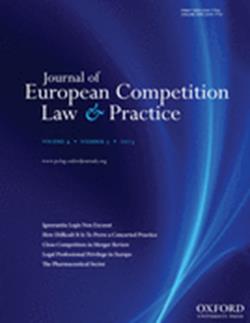
– Speaking of current antitrust debates: the last number of the Journal of European Competition Law and Practice (a great journal that has rightly earned a prominent place in a saturated? market) features various very good articles, including one by our guest blogger Pablo Ibañez on State aid litigation. At another level, it also features a brief piece of mine [the hyperlink only leads to the abstract] about Google’s commitments (you already know my views). Ironically, my comment was written in relation to the first version of the commitments but features in the “current intelligence” section of the journal. Fortunately I did explicitly envisage “likely further tweaks over specific details” and all comments are applicable to the new (leaked) proposal.
Nico wins best legal book of the year award

First it was the Jacques Lassier prize for his PhD thesis (see here).
Then the Antitrust Writing Award (thanks, btw, to the campaign I so well managed… ; see here).
And now (actually, last Saturday) Nico got the “Prix du livre juridique” to the best legal book published in France (see here), for his new textbook Droit européen de la concurrence.
The prize was awarded at the Constitutional Court in Paris; prestigious setting for a prestigious prize (see pic above; in case you were wondering, Nicolas is the one posing).
Judging by his mother’s comment on his Facebook wall, the prize has made the family happy. You know, there haven’t been so many ocassions to feel proud of the chap 🙂
Congrats to Nico for the prize and for his contribution to spreading the competition gospel in France. Hopefully new generations of French will gain a better understanding of competition law and, unlike the jury in this case, will be able to tell what’s sound legal competition reasoning and what’s not !
P.S. Contrary to what you might think, I’m not writing this simply to promote my co-blogger’s achievement. I’m doing it because the a****** said he won’t give me a free copy, so I’m hoping that some advertisement will earn me one from the publisher.
Preliminary thoughts on Google’s proposed commitments

As long anticipated, here are some comments on the proposed commitments in the Google case (I graciously granted myself an extension, like the one other third parties have received; it actually is convenient because I can comment on others’ comments as well).
Four caveats are in order:
- The views expressed below are written against the background of the Commission’s concerns as set out in the press release and the Q&A doc. accompanying the market testing of Google’s proposal. The relevant question to keep in mind is whether the proposed commitments –in their current form- are apt to address the concerns identified by the Commission in its preliminary assessment, not whether they are apt to lead to candy world for satisfy the wishes of all third parties.
- My views are necessarily incomplete and they’re also work in progress. I’ve only read the limited publicly available information and have not had access to any confidential info or documents that might be contained in the case-file. Moreover, I have allocated two flights time to draft this (and I should ideally also do some billable work, you see), so I’ll (i) update and improve this document on the basis of any new thoughts or possible feedback and (ii) refine my thoughts for a forthcoming piece on Oxford’s Journal of Competition Law and Practice
- My views are mine (sounds like a tautology, but don’t always take this for granted in our area of work…); some of my colleagues and clients may well have different opinions.
- I haven’t worked nor for Google nor for any of the 17 complainants.
In case I haven’t yet got you tired before even starting, here is a methodological explanation. This will be a five-pronged analysis; I will very succinctly summarize (i) DG Comp’s concerns; (ii) my take on the substantive concerns; (iii) the content of the proposed commitments; (iv) third-party criticism of the proposal (notably that read here, here, here or here) (I actually read some favorable comments as well); and (v) my take on the proposed commitments. And this for each of the four concerns flagged by the Commission (although only the two first ones raise interesting issues).
The structure will make this post longer. In order not to cram the page, click if interested.
More on antitrust and politics: Interview with CPI

As some of you may remember, a few months ago I wrote a post here on “Antitrust and Political Stupidity“. Competition Policy International asked me to develop the post for a special issue of the Antitrust Chronicle, which I did one-handedly during my extended Christmas break (the paper is available here). I was then asked to do a follow-up interview with CPI; the interview was published today (click here for the version in CPI’s web).
Asked about whether I was being too optmistic in the paper, I started my response saying that “my paper was written during the Christmas break, and it is not much more than a Christmas tale, a superficial exercise of wishful thinking” (see below for the complete answer). Little did I know that the mailing that was sent today to some thousands of people would summarize the interview saying that: “Lamadrid says his paper is ‘a superficial exercise of wishful thinking,’ and he tells CPI why“. So, here I am, promoting my work by saying that it’s really not any good (between us: it’s not a masterpice, but it’s somehow original and maybe not as crappy as my own quote suggests…). Man do I really need to work on my self-selling skills…. 😉
If anyone’s interested, you can click here to read the full interview:
Competition Policy and Happiness

Many of you have probably had a chance to read various texts on the goals of competition law (the one in Giorgio Monti’s book is particularly good; more recently, I also liked Kevin Coates’ approach).
For an original approach to this discussion, check out Maurice Stucke’s recent paper “Should Competition Policy Promote Happiness?” As noted in the abstract, the paper builds on recent academic literature on happiness and goes on to argue that “competition policy in a post-industrial wealthy country would get more bang (in terms of increased well-being) in promoting economic, social and democratic values, rather than simply promoting a narrowly-defined consumer welfare objective“,
Many thanks to Wouter Wils for the pointer!
P.S. And speaking of papers, Pablo Ibañez, Hans Zenger and myself could use some additional votes for Concurrence’s Antitrust Writing Awards 😉
Materials from the GCLC lunch talk on Google

Last Friday I was invited to speak on these issues at a GCLC lunch talk on “Google Search engines and competition law“. I truly enjoyed it.
I might develop the content of my presentation in a series of forthcoming posts, but today we’ll simply provide you with the presentations projected at the lunch talk.
I had the impression that the audience was a bit surprised at my rather unusual power point, which you can see here:
GCLC_Google_Lamadrid (looks better if you play the slide show; also, it’s password protected, so click “read-only”).
As I explained at the event, I decided to run the risk of projecting this ppp when I learnt that Google had pledged before the FTC not to ask for injunctions aimed at protecting its intellectual property 😉 Actually, I’m much more scared of my firm’s format-strict marketing department….
I shared the panel with Cédric Argenton (TILEC) and Anne Perrot (Mapp), both of whom did a great job. Here are their presentations: GCLC2013_Argenton & GCLC_Perrot
P.S. A necessary and fair disclosure. The power point I had in mind became real thanks to Enrique Colmenero, a terribly nice and smart guy, a techie and an entrepeneur who is now fortunately working with me on a few tech-related cases.
Antitrust Writing Awards- The campaign begins

(Since this post is about awards, we thought a pic form last night’s grammys ceremony would be appropriate. I randomly came accross this one, but it risked being inappropriate, so we’ve decided to go for a more politically correct one).
You may remember that last year we ran a campaign (see here) for Nicolas to win one of Concurrence’s Antitrust Writing Awards, which he did for his paper on Credit Rating Agencies.
This year the Editorial Committee at Concurrences has shortlisted 3 pieces written by people who have contributed to this blog, so we thought we’d ask you to please take a minute to give them your 5-star vote 😉
The nominees are:
– On the category for Academic paper on Anticompetitive Practices: Pablo Ibañez Colomo (LSE), for Market Failures, Transaction Costs and Article 101(1) TFEU Case Law, You can read it and vote for it at: http://awards.concurrences.com/academic-articles-awards/article/market-failures-transaction-costs By the way, Pablo gave a lecture on this topic at the IEB in Madrid a few days ago; the slides are available here: Making sense of Article 101 TFEU
– On the category for Academic papers on Economics: Hans Zenger (CRA) for Loyalty Rebates and the Competitive Process : You can read it and vote for it at: http://awards.concurrences.com/academic-articles-awards/article/loyalty-rebates-and-the
– On the category for Business papers on Economics, myself, for Economics in competition law, You can read it and vote for it at (no need to read this one, you can skip it provided that you vote for it): http://awards.concurrences.com/business-articles-awards/article/economics-in-competition-law (actually, the nominated post does not rank among the ones I’m proudest of, but I’m nevertheless grateful for the nomination).
– We are told that Chillin’Competition has also been shortlisted as one of the top 30 professional publications that will be reviewed by Concurrence’s editorial board, which will then come up with a ranking (for more info, click here). You cannot vote for us here, but we’d be thankful if you could please exert any sort of coercion on the jury


 Chillin'Competition