Archive for the ‘Uncategorized’ Category
Recent news (from London, Murcia and Brussels)

We are glad to share some news coming from all over Europe (in the spirit of the ongoing election to the European Parliament):
- From London, younger readers pursuing or considering an academic career will be pleased to learn that King’s College London is expanding its competition law team (lucky them). It is an entry-level position (lectureship). You have until 7 June to apply. More info here.
- From Murcia, our friend Jorge Piernas is keen to let us know that his home university (Murcia), in cooperation with the University of Padova and the European Commission, has put together a programme to train national judges in State aid matters. If you are a judge (or an apprentice judge), note that the first residential seminar will take place in Murcia on 30 and 31 May and that there are a few (very few) spots available. Interested? You can reach Jorge at jjpiernas@um.es.
- From Brussels, our friends from the eminent Global Competition Law Centre have organised a lunch talk, to take place on Monday of next week, in which to discuss the priorities of the next Commission. As part of the lunch talk, they have come up with the great idea of inviting the competition law community to share their views on the matter. You have until 25 May to fill their survey, which can be accessed here.
Update Chillin’ State Aid Workshop: Keynote by Viktor Kreuschitz (General Court)

Thanks very much everybody for the interest in our State aid workshop (14 June, Fondation Universitaire, Brussels).
As you will have seen, registrations are now closed. But please do sign up for the waitlist, which is still open. We hope to be able to accommodate everybody.
We are proud to be able to bring an update to our programme.
Viktor Kreuschitz, Judge at the General Court and renowned State aid specialist, has kindly agreed to give a keynote at 4pm, right after the last panel. La cerise sur le gâteau of what promises to be a great event.
The updated programme (and the link to sign up for the waitlist) can be found here.
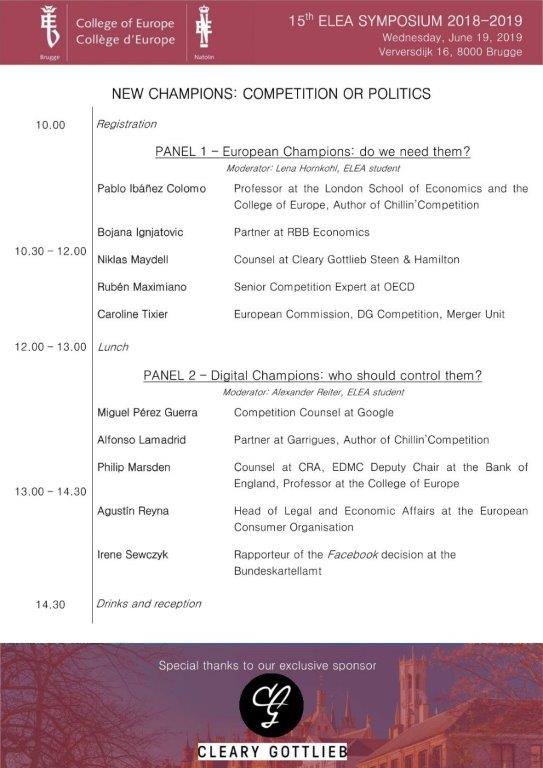
New Champions: Competition or Politics?, ELEA Symposium, Bruges, 19 June
On 19 June, the ELEA students at the College of Europe will be hosting a symposium focused on two of the main themes in competition law these days: Europen champions and industrial policy, and digital platforms.
They have managed to come up with an excellent line-up of speakers. Pablo and I will both be happy to join them.
There are only 10 seats left, so you better hurry up. For additional info and registration, click here.

Chillin’ State Aid Workshop (14 June) + Programme and registration info (it’s this Friday: stay tuned!)

As you know, we are a month away from our State aid event. You will find below the finalised programme. We are proud to have brought together a group of top experts (thanks again to all of them!).
The registration page will go live this Friday (17 May) at 10am London time and 11am Brussels time. You will find the link to the page via the blog, so watch this space!
Chillin’ State Aid Workshop: Charting the Territory
Where: Fondation Universitaire (Rue d’Egmont, 11 – 1000 Brussels)
When: Friday 14 June 2019
9am-9.15am | Registration and welcome
9.15am-11.15am | Selectivity and advantage
Introduction and chair: Pablo Ibáñez Colomo (LSE and College of Europe)
Speakers: José Luis Buendía Sierra (Garrigues), Jacques Derenne (SheppardMullin), Penelope Papandropoulos (European Commission) and Christina Siaterli (European Commission)
11.15am-11.30am | Coffee break
11.30am-1pm | Procedural and institutional issues
Introduction and chair: Alfonso Lamadrid de Pablo (Garrigues)
Speakers: Natura Gracia (Linklaters), Massimo Merola (BonelliErede), María Jesús Segura Catalán (Clayton & Segura) and Andreas von Bonin (Freshfields)
1pm-2.30pm | Lunch
2.30pm-4pm | State aid beyond the EU
Introduction and chair: Pablo Ibáñez Colomo (LSE and College of Europe)
Speakers: Juliette Enser (Competition and Markets Authority), Christian Jordal (EFTA Surveillance Authority) and Vincent Verouden (E.CA Economics)
4.00pm-4.45pm | Keynote speech: Viktor Kreuschitz (General Court)
4.45pm-5.15pm | Let’s find somewhere nice for a drink
The support of LSE Law is gratefully acknowledged
[New] Urgent Competition- 2 Millon Reward
The good news first: Chillin’Competition just went over 2 million visits. Thanks so much everyone for choosing to come here from time to time.
The competition that we improvised this morning (see here) didn’t quite work according to plan. We received over 1,500 visits in the first half an hour. (!); the system got stuck and did not update for a while, so unfortunately we don’t know who the exact 2 million visitor was.
We have received reports from readers who claim to have tried to refresh the page on several devices and networks. This situation raises important questions, mainly: didn’t you really have anything else to do?! 😉
To make up for it we offer two things:
-Since we know that what truly motivated you was the possibility to introduce more absurdity, some fun, a word in one of Pablo’s academic articles: please write as a comment to this post or in a tweet the word that you’d like Pablo to include in his next paper (I’d go for Oocephalus, my colleagues suggest Dracarys). We’ll then select the best ones and run a poll. The person who suggests the winning word will get the Chillin’Competition sports bag and t-shirt.
-A free round of beers at an open bar to be announced soon.
Urgent Competition- 2 Million Reward

Today Chilling’Competition will attain the 2 million visits mark, which is pretty amazing.
At 9.47 am we are roughly 500 visits away, and we just thought about creating a competition.
If any of you can prove with a screenshot of the blog’s homepage that you are the exact 2.000.000 visitor, you will win:
- A Chillin’Competition sports bag and t-shirt;
- Two tickets for our next conference;
- Most importantly, the possibility to decide on a word that Pablo will have to include in his next academic paper (he has just agreed; no kidding) 😉
(The headline of this post may admittedly constitute clickbait)
Persistent myths in competition law (I): ‘the pro-competitive aspects of an agreement can only be considered under Article 101(3) TFEU’

EU competition law keeps busy a growing number of officials, practitioners and academics. It is fascinating that, with so many professional lives devoted to it, with so many specialised conferences and journals, there are still many myths that refuse to die. Some received ideas are incredibly powerful. They keep being repeated as uncontroversial truths even when they are patently at odds with the case law.
I thought it would be a good idea to do something more than simply express my fascination: identify what these myths are and explain why they are unfounded.
The idea of writing a series of posts on myths in EU competition law came when I thought about the statement you find in the title. To this day, some people remain convinced that the pro-competitive aspects of agreements can only be evaluated under Article 101(3) TFEU. It is perhaps the most popular myth around.
According to this view, claims about the ways in which the agreement could create (or improve the conditions of) competition would have no role to play under Article 101(1) TFEU.
This mantra may be very popular. For better or worse, it is unambiguously contradicted by a consistent line of case law.
The pro-competitive aspects of an agreement play, and have always played, a central role under Article 101(1) TFEU
The abovementioned line of case law dates back to the very early days. In Societe Technique Miniere, the Court already ruled that an agreement that is ‘really necessary’ for a supplier to enter a new market is not restrictive of competition, whether by object or effect.
Another one of my favourite examples is Asnef-Equifax. You will remember that the case was about an information exchange system available to credit providers. The point of the system was to allow the said providers to figure out the likelihood of repayment by potential borrowers.
The Court concluded that the system was not restrictive by object. As part of the reasoning, it noted that information exchange mechanisms of that kind ‘are in principle capable of improving the functioning of the supply of credit’ (paras 46, 47 and 55) and ‘of increasing the mobility of consumers of credit’ (para 56). I do not believe the reasoning can get much more explicit than this.
A similar example (and another all-time favourite) is Gottrup-Klim. A group of competitors decide to buy an input in common. Cartel arrangement? Could be (buyers’ cartels do exist and are sanctioned as such), but not in the specific circumstances of this case. The joint purchasing agreement at stake in Gottrup-Klim was different from a cartel and thus not restrictive by object. Crucially, the Court noted, in this regard, that the agreement in question may ‘make way for more effective competition’ (para 32).
I could go on for a while, but it makes sense that I mention two relatively more recent cases.
Pierre Fabre is arguably as explicit at Asnef-Equifax. The Court held that clauses in an agreement that would otherwise be restrictive by object fall outside Article 101(1) TFEU if there is an ‘objective justification’ for them (para 39 of Pierre Fabre).
How do we figure out if an agreement is objectively justified within the meaning of Pierre Fabre? By ascertaining (para 40) whether the agreement in question aims at the ‘attainment of a legitimate goal capable of improving competition’ (in other words: by identifying its pro-competitive aspects).
Our last station in this overview has to be Cartes Bancaires. Just remember (para 74) that the crucial factor to rule out the ‘by object’ characterisation was the fact that the Court accepted that the contentious clauses could be understood as a means to tackle free-riding issues.
If the pro-competitive aspects of the agreement count under Article 101(1) TFEU, what is the role of Article 101(3) TFEU?
The above examples make it sufficiently clear that the pro-competitive aspect of an agreement are not only relevant, but crucial under Article 101(1) TFEU – and have always been. If there is anyone disputing this conclusion in spite of the examples given, please leave us a comment. I would really love to know your thoughts.
I believe I understand why the myth is so persistent in spite of the overwhelming evidence to the contrary. Article 101(3) TFEU is the forum in which the pro-competitive aspects of an agreement are balanced against its anticompetitive aspects. Would Article 101(3) TFEU not be completely devoid of purpose if the former were also considered in the first paragraph of the provision?
To which my answer is: no. And this, for two reasons.
First, the exercise conducted under, respectively, the first and the third paragraphs of Article 101 TFEU, is different. For the same reasons, the pro-competitive aspects of the agreement are considered for very different purposes too under each paragraph.
In the context of Article 101(1) TFEU, the pro-competitive aspects of an agreement are indispensable to figure out its object. Put differently: it is simply impossible to evaluate the objective purpose of an agreement (i.e. what it can objectively achieve, irrespective of the subjective intent of the parties) without considering whether it is a plausible source of pro-competitive gains.
This is something that the Court understood from the outset, and that has emerged as a pillar of the case law.
Second, the intensity of the analysis is very different under the first and the third paragraph. The pro-competitive aspects of an agreement are considered in two stages.
Asnef-Equifax, Pierre Fabre and Cartes Bancaires (as well as others like Delimitis or Pronuptia) all tell you that the analysis of the pro-competitive aspects of an agreement is relatively superficial under the first paragraph.
Under Article 101(1) TFEU, the question is whether the agreement is a plausible source of pro-competitive gains. A cursory analysis suffices, and no quantification is needed. The General Court in MasterCard (2012 judgment) made a similar point (para 80).
The analysis is much deeper under Article 101(3) TFEU (once the burden of proof shifts). Then, it is for the parties to show that it is likely that the pro-competitive gains generated by the agreement will weigh more than the anticompetitive effects resulting from it.
As can be seen, there is a role for the two paragraphs: they fulfil a different role and the intensity of the analysis is also very different.
If you ask me: the case law makes a lot of sense.
It makes sense for the the Court to say (as it does): if the agreement is a plausible source of pro-competitive gains, then it can only be prohibited if the authority or claimant establish that it is likely to have appreciable effects on competition. And it makes sense to engage in a full-blown balancing of the pro- and anticompetitive once the latter are shown.
It is also sensible that the burden of proof shifts when the agreement is not a plausible source of pro-competitive gains. Want to claim that a cartel is on balance pro-competitive? Well, experience and economic analysis tell us that such a claim is implausible, but the possibility of claiming the implausible exists under Article 101(3) TFEU. Just think of BIDS, another key judgment where this point is made.
12th Junior Competition Conference (JCC) 10 May 2019 (Competition Appeal Tribunal, London)
The Junior Competition Conference has become one of the great traditions of the London competition community (and one we are really glad to see back after a one-year hiatus).
It is a wonderful opportunity for junior lawyers and economists to share their thoughts on ongoing developments. The next edition will take place on Friday of next week, and the organisers have been kind enough to extend the deadline to register. Do not miss this great opportunity if you can make it! More info below:
The Editors of the Competition Law Journal are delighted to present the 12th Junior Competition Conference (JCC)
Recent developments in competition litigation and Vertical restraints in the online age: where next?
@Competition Appeal Tribunal, London (Friday 10 May 2019 at 2:00pm)
Link to full programme here
The JCC is open to all those involved in UK competition law, economics and policy, whether in practice, public service or academia. Admission to the JCC is free.
As in previous years we anticipate that demand will be very high: for those interested in attending, please email journals@e-elgar.co.uk with your name, position and organisation by no later than 5pm on 7 May.
Today in the FT: An open letter on EU competition policy

On Chillin’Competition we have always been for fair, objective, neutral and consistent rules and enforcement. Rules and cases should not be designed to favor (nor to challenge) only certain companies.
The debate surrounding the Siemens/Alstom deal triggered important debates around these issues at the legal and political levels. Both Pablo (here) and myself (here) contributed to that debate with our own views.
Today the Financial Times has published an open letter signed by 92 competition lawyers and economists (myself included), organised by Vanessa Turner, standing up for our current and time tested system, based only on the law and on the facts.
The letter is available here. For those with no access, here is a PDF version: Open letter on EU competition policy (FT)


