Archive for the ‘Uncategorized’ Category
The General Court annuls for the first time a settlement decision (Case T‑95/15, Printeos v Commission)

The (Extended) Fourth Chamber of the General Court annulled on Tuesday, for the first time, a Commission’s cartel settlement decision.The unusually brief Judgment is available here.
What happened in the case is essentially that, as if often happens with mono-product companies, the potential fines would have in principle exceeded the 10% turnover cap. In order not to exceed the said cap, the Commission granted reductions that ensured the fines would remain below it. The reductions granted were different for every company, but the fact is that the precise rates of reductions were undisclosed and that the decision did not explain the reasons for those differences (there was also one non-mono product company that benefited from an adjustment for equity reasons).The decreases in the fine resulted in adjusted basic amounts that revealed important discrepancies in terms of percentage as regards the 10% maximum.
According to yesterday’s Judgment, the Commission failed to meet its obligation to state reasons regarding the “weighting and assessment of the various factors taken into account in determining the amount of fines”, particularly when acting outside the framework set in the fining guidelines and in light of the obligation to have due regard to the principle of equal treatment. Since on the basis of this reasoning the parties would not have been able to dispute the merits of the decision with regard to the principle of equal treatment nor to ascertain whether equal treatment of different situations were objectively justified, the General Court annuls the decision.
A few comments beyond the newsletter headline:
A first, really? Actually, the issue had been brought to Court before in another settlement case (Euro Interest Rate Derivatives) but the appeal (by Société Générale) was withdrawn following an amended decision. It was then reported, however, that SG had submitted wrong turnover figures and that the new fine was calculated using new data but the same methodology as the earlier one. A related issue nevertheless did arise in Pilkington before the ECJ (see comment below) although it related to the General Court’s full jurisdiction rather than to the Commission’s fining powers.
–Is the General Court in annulment mood following the shortage of antitrust cases (only 11 last year)? Several judges (including Ian Forrester at the Chillin’Competition Conference) have recently encouraged more competition appeals and conveyed the message that companies and lawyers should not lose faith in the Courts and that appealing might well pay off. This could perhaps be seen as one more signal creating incentives.. Things may be different in the State aid front, particularly these days, given the political implications often at stake (some will understand what I mean).
-On the context and the effects on the Commission’s current policy. That fines reached the 10% used to be a bit of an oddity, but not so much for mono-product companies following the latest revision of the fining guidelines. This has given rise to concerns about compliance with the principle of non-discrimination between mono-product and non-mono product companies. Perhaps you remember that the impact of the current fining method was of particular concern to Commissioner Almunia. Back in 2011 he said in a few speeches that he was “examining how the mono-product ratio of companies – usually SME’s – can be taken into account when setting fines, so that they will not be treated in a discriminatory way”. The issue even attracted the attention of the European Parliament, which in a Resolution of February 2012 on the Commission’s competition annual report indicated that it “[a]waits an adaptation of the fining guidelines concerning ‘mono-product’ undertakings and SMEs, as announced by Commission Vice-President Joaquín Almunia“.In several cases (settlement or not) the Commission made sure to say that in those situations fines were reduced “taking into account the mono-product nature of the companies and their different degrees of involvement in the cartel” (see e.g. the window mountings). The policy, however, changed and the Commission does not do this anymore.
What now? The Commission is placed at a tough spot now if it wishes to grant reductions to mono-product companies or small and medium enterprises. And even if it does not, it still finds itself between a sword and a hard place in this case: what should it now do with the fine in this case? Paras 60-68 (in particular para. 66) of the Pilkington ECJ Judgment from September 2016 (which in a way may have anticipated this ruling) further complicate the issue as they could even suggest that reductions to mono-product companies are illegal (“the difference in the proportion represented by the fine in relation to the total turnover of the undertakings concerned does not, as such, constitute a sufficient justification for departing from the method of calculation that the Commission imposed on itself. That would be tantamount to conferring an advantage on the least diversified undertakings on the basis of criteria that are irrelevant in the light of the gravity and the duration of the infringement. When the amount of the fine is determined, there cannot, by the application of different methods of calculation, be any discrimination between the undertakings which have participated in an agreement or a concerted practice”). Admittedly the case law is not a paradigm of clarity in this regard.
–Reinterpreting the 10% limit? What it has seemingly done until recently is to (more or less, and in an admittedly opaque way) grant the reductions necessary for all companies to be below the cap (which necessarily implies very different reductions that are more related to turnover than to participation) and then, I guess, do some more or less sophisticated adjustments to reduce manifest differences in treatment between the different fined companies. The problem, of course, is that this reduction method may perhaps be commendable but cannot be exactly objective and proportionate and is therefore very hard to explain, as this case shows.
If from now onwards the Commission the Commission still wanted to reduce fines in this way (which, again, does not seem to be the case), then it would arguably have to set the max fine of 10% for the undertaking with the greatest turnover and participation, and none of the others could also reach the cap (unless their situation is pretty much the same as that of the “worst offender” in every case). Effectively, what this means is that at the very least in these cases the 10% limit would cease being a cap and will become the upper limit for the “worst” infringer. And this would somehow approach the re-interpretation of the limit to the interpretation given by the German Federal Supreme Court reinterpreted the cap in February 2013. As you may remember, despite the German cap being worded mirroring the EU text, the cap was reinterpreted as the maximum fining range precisely out of concern for discrimination of mono-product companies and SMEs (with the result that SMEs are now likely to face smaller fines and large companies, conversely, much larger fines).
In any event, and thinking about the bigger picture, it is pretty obvious that the 10% cap doesn’t guarantee that fines are no excessive or disproportionate to the finances of the sanctioned entity as it only looks at one –sometimes not useful- parameter of its financial status. Is it really a useful cap or should we think of alternatives?
–Judicial bias, really? -The reporting Judge in the case is Viktor Kreutschik, a former member of the Commission’s legal service whose appointment was doubted by some comments in this blog out of concern for a possible bias in favor of the Commission. As I wrote back then, it could actually be the other way around (see “Revolving doors: a contrarian view) and this Judgment suggests I may have had a point (for once). To be sure, I do have an issue with Judgments being annulled only for more or less important case-specific technicalities (I already said this not long ago, see here) and not so much when they deal with fundamental issues of principle and the stakes seem to be high (more on this coming soon).
–Want more? In the unlikely case that this post opened you appetite for more readings on fines, we suggest (aside from our usual self-promoted writings) that you take a look at this very recent OECD document.
-It’s all about the general principles. All these developments, by the way, confirm what I always say in my lectures on EU competition procedure, that when it comes to Court cases procedure (or rather general principles of law) often matters more than substance. So for more on this, we invite you to register for our module on procedure at the BSC 😉
Chillin’Competition Memes Competition (V)
And here goes the fourth selection of brilliant candidates for our competition memes competition with some strong candidates. For the previous sets see here, here and here. Nominations close tomorrow.
[And speaking of nominations, Pablo is nominated to 4, not 2, Antitrust Writing Awards. I only get one. He is therefore tied with Josh Wright. But since Pablo is not involved in the Trump transition team then Pablo wins hands down 😉 ….]












Capability vs likelihood in the context of Articles 101 and 102 TFEU: the difference exists, and matters

Many of you will remember the post I wrote on AG Wahl’s Opinion in Intel. One of the questions that were examined in the Opinion related to the standard of effects that applies in the context of Article 102 TFEU. Are potentially abusive practices prohibited when they are capable of having exclusionary effects? Or is it necessary to show, in addition, that they are likely to have an anticompetitive effect? Is there a difference between capability and likelihood? Does it matter?
If you have read the opinion, you will remember that, according to the Commission, there is a difference between capability and likelihood, and the difference matters. According to AG Wahl, such difference does not exist (and thus it does not matter). In addition, the Opinion defends that the bar is very high. AG Wahl suggests that the standard of capability/likelihood is met when it can be shown that, in all likelihood, a practice will have anticompetitive effects.
It seems to me that the Commission is right on this point of law. There is a difference between capability and likelihood, and this difference is a relevant one in practice. As the Commission seems to be arguing in Intel, it would be desirable to make the difference more explicit in the case law. This is in fact what I explained with Alfonso in our paper on the notion of restriction of competition.
When does the standard of capability apply? The standard of capability applies to restrictions of competition by object. As the law stands, this category includes, inter alia, cartels, pricing below average variable costs and exclusivity obligations imposed by a dominant firm.
It is not necessary to show that a practice is capable of restricting competition. When a practice is qualified as restrictive by object, the assessment of capability is implicit. If an authority concludes that an agreement amounts to a cartel, there is no point in showing, in addition, that it is capable of restricting competition. A cartel, by definition, can have anticompetitive effects.
What does capability mean? The case law suggests that the standard of capability is fairly low. As I understand the relevant judgments, it is sufficient that anticompetitive effects are plausible for the prohibition to apply. Even when the probability of anticompetitive effects is not very high, the practice will still be prohibited.
A clear example in this sense is Bananas. There is no doubt that the practices at stake in the case were not particularly likely to have anticompetitive effects. This is something that Alfonso (rightly) pointed out, and what Dole argued in its appeal. True, the exchange of information in question might not have affected prices in the end. As I understand the case law, however, this does not matter. After all, it is certainly plausible that an exchange such as the one examined by the Court in Bananas has anticompetitive effects. Therefore, there is every reason to prohibit it as restrictive by object under Article 101(1) TFEU.
Another example is found in Article 102 TFEU case law. It is plausible that an exclusivity obligation has anticompetitive effects when applied by a dominant firm, even though it covers a small part of the market. After all, Article 102 TFEU comes into play in instances where the conditions of competition are already weakened. What if the coverage of the practice is limited? It does not matter, as the Court pointed out in Tomra.
Tomra and Bananas have been criticised, but seem to be entirely consistent with the case law and with the way in which the EU courts understand the notion of capability.
Is it possible to show that a practice is NOT capable of having restrictive effects? When a practice is restrictive by object, it is not necessary to show that it has restrictive effects on competition. Is it possible to escape the prohibition? Several examples from the case law suggest that it is indeed possible. For instance, the parties can show that the agreement does not restrict competition that would have existed in its absence (i.e. in light of the counterfactual).
Take an example inspired from E.On Ruhrgas. A market sharing agreement between competitors is, very often, restrictive by object. It is possible to think of instances, however, when such an agreement is not capable of having restrictive effects on competition and is thus not restrictive by object. This would be the case when market entry is precluded by a (de iure or de facto) legal monopoly. In such circumstances, the agreement would fall outside the scope of Article 101(1) TFEU altogether.
When does the standard of likelihood apply? The standard of likelihood seems to apply to practices that are not restrictive by object. The category includes, inter alia, exclusive dealing (in the context of Article 101 TFEU) and (in the context of Article 102 TFEU) ‘margin squeeze’ abuses, selective price cuts – Post Danmark I – as well as standardised rebate schemes – Post Danmark II.
What does likelihood mean? I agree with the Commission that the standard of likelihood is higher. However, the meaning of the concept is not entirely clear from the case law. I am inclined to agree with AG Kokott. My impression is that the standard of likelihood is satisfied when it can be shown that it is more likely than not that the behaviour will have an anticompetitive effects. In other words, it would be necessary to show that the probability of an anticompetitive effect is above 50%.
Is it possible to show that a practice is NOT likely of having restrictive effects? The case law provides plenty of interesting hints of the instances in which a practice does not satisfy the standard of likelihood. It would be necessary to examine the issue by reference to several indicators. If the coverage of a practice is limited (<30-40%?) it is unlikely to have restrictive effects (see in this sense Post Danmark II). The same is true when the duration of the agreements is short (<3-6 months?), or when there is evidence suggesting that rivals have been able to remain on the market and gain back some customers (as in Post Danmark I).
Chillin’Competition Memes Competition (IV)
And here goes the third selection of brilliant candidates for our competition memes competition. For the previous sets see here and here. We’ll have more for you next week. Enjoy them, and have a great weekend!






Chillin’Competition Memes Competition (III)
We are getting lots of excellent competition memes for our competition, so many that there here goes a second selection. For the first tranche, see here; we will be posting a third set tomorrow
I hope you enjoy it as much as my colleagues, who might need to catch up on billables over the weekend to compensate for all the time they’ve spent discussing memes today (I hear them from my office even if they don’t realize…) 😉


A hasty comment on Microsoft/LinkedIn

The EC has authorized the acquisition of LinkedIn by Microsoft subject to conditions. The press release is available here. And since I have sneaked out of the office and I’m sitting at the back of the CRA conference (congrats again to Cristina Caffarra and her team for organizing the 2nd most successful free conference in town 😉 ), there is time for a second post today and for a quick comment about this development.
Not having been involved in this case, and since the decision is not yet publicly available, I can’t possibly comment on whether the Commission’s concerns in this particular case were justified or not (we might comment on those once the decision is out).
I do, however, observe a certain evolution in the Commission’s stance, as the concerns addressed by the conditions in this case are strikingly similar (or opposed, depending on how you look t it) to the Commission’s “non-concerns” at the time of the Microsoft/Skype decision. Having been on the losing side in that case (only in the judicial phase; see here for my comments), I can’t help but be surprised at the fact that the Commission defended one theory in its decision and in Luxembourg, was fully endorsed by the General Court and then suddenly makes an apparent 180 degree turn. It would be interesting to see how the decision reasons its concerns, but from a mere reading of the press release it would seem that there is a U turn concerning the assessment of network effects (see the references to “tipping” in the press release), integration of software, ease of entry and switching and interoperability.
One may only speculate about the reasons for this “new old” stance, which according to some commentators, has to do with other high-profile ongoing cases.
The question therefore is: does this merger decision change anything in the law? Well, we don’t see how this could be interpreted that way. Like we have noted in other recent cases having to do with unilateral concessions (see here ), the commitments offered by a given party for whatever reason (including financial issues or the desire to speed up a merger authorization), even if made binding, would have no precedent value and certainly cannot prevail over the case law of the EU Courts.
So whether one likes it or not, and unless the Court also decides to fully close the circle endorsing yet another U turn then the Cisco v Commission (Microsoft/Skype) Judgment remains the law of the land.
Again, I certainly am not objective on these issues so I would suggest, as always, that you take everything I say with a pinch of salt and that, when possible, you yourself compare the two decisions and the Judgment and check whether you see it the same way.
Chillin’Competition Memes Competition (II)
We have already received quite a few candidates for our meme competition and we thought they were too good to keep them to ourselves. So here goes a first round. Let us know which ones you like better! 🙂


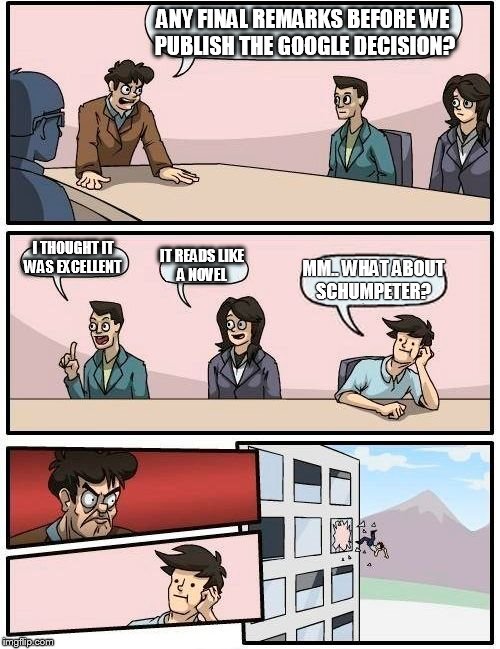


P.S. Those of you interested in participating, please send your memes our way (sam.villiers@garrigues.com). We also accept anonymous submission. If you need technical help creating your meme see e.g. here.
Chillin’Competition’s World Competition Day Competition
Today is World Competition Day.
Whilst we are not sure the world should be in a celebratory mood, we think it is useful to use this day to reflect on things we could do better.
On our part, we have thought long and hard about the way in which we could use this blog to effectively contribute to the cause of competition.
We now think we have the idea: a meme competition.
In adherence to platform neutrality principles this blog does not want to discriminate against people over 35 (who may not know what a meme is..); we’ll also run a caption competition for you soon, don’t you worry 😉
So, the idea is that you create your own meme (or find one) and send it to us. It can be about competition law or about the very notion of competition. A random example (found online):
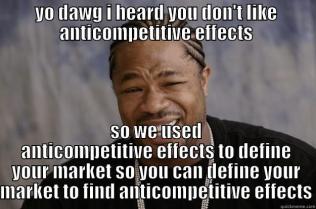
Since I’d rather not use my professional email for this I have asked my colleague Sam (who’s ok as a lawyer but excellent at memes and moreover cannot refuse my request) 🙂 to use his, collect all your absurd ideas and rank them.
Please send yours before December 16th to sam.villiers@garrigues.com. The two best memes get a private Post Danmark II discussion with Pablo and myself a selection of Christimas delicacies from my family’s bakery. A selection of our favorites will also be posted on the blog.
P.S. Those who do not get the free delicacies should not despair; there is an online shop too 😉 (please note that I’m only saying this selflessly to help the Commission’s efforts of bolstering e-commerce accross Member States…).
Nominations

It’s time for nominations in the competition world. If you are in a nominating mood, here are some possibilities:
- W@Competition– a new organization for women competition law professionals– is currently accepting nominations for its first “30 in their 30’s” list (a sensitive listing as it may require asking about age…). You can nominate exceptional women in four categories: private practice, in-house, enforcement and economics. To know more about the organization and to nominate your candidates click here. Chillin’Competition will be supporting the initiative.
- Who is Who and Global Competition Review are seeking nominations to identify “future leaders” in the field of competition law. You can nominate anyone under 45 to the “partner” or “non-partner” categories. The deadline is tomorrow. For more info, click here. If you have been invited lately to an open bar and/or a conference by anyone meeting this criteria, now it’s pay back time :p
- Today is also the last day to nominate articles for Concurrences’ Antitrust Writing Awards. You can nominate your favorite articles here. For Pablo and myself this is sort-of-like the Nobel Literature Prize for Roth or Murakami (well, with some nuances on all sides…); we are always shortlisted but never win 😉 This time we have a joint nomination for our article On the notion of restriction of competition (in the Academic/General Antitrust category), and Pablo has another for his article on Appreciability and de minimis in Article 102 (in the Business/Dominance category).
N. Petit on AG Wahl’s Intel Opinion

[Nicolas retains advertising rights on this blog, also for his publications, so he an exception to our new policy of not advertising publications and events (except the ones on which we participate…) on the home page of this blog. This change is driven by our inability to say no and by the fact that it was becoming hard to accomodate all requests. So from now on you will see a new section on the right side of the home page, just below our bios, called “Events and Publications“; we will be regularly feeding that section with interesting information that will still be visible from the home page without taking that much space. Please feel free to continue sending that info our way!]
***
Nicolas has been pretty prolific lately combining interesting writings with his new focus on artificial intelligence (not kidding). He has just posted on SSRN a new paper titled “The Advocate General’s Opinion in Intel v Commission: Eight Points of Common Sense for Consideration by the CJEU“.
His contention in this interesting paper (which as you might have expected suggests the ECJ to follow AG Wahl’s Opinion) is that improvements of the law on Article 102 TFEU are within reach, without a necessity to completely revamp the case-law. Suffice is it to apply logic, first principles and common-sense, and follow the trajectory delineated by Post Danmark I and II.
Nicolas has identified the following as the key 8 ideas developed in the paper:
1.An Effects Analysis underpins Hoffman-La Roche;
2.Category and “Super-Category” Mistakes;
3.The Non Sequitur of Exclusivity =Exclusion;
4.The Non Sequitur that Any Exclusionary Effect is Anticompetitive;
5.Capability, Likelihood and Probability Standards;
6.The AEC test is a legality test, not a priority test;
7.A More Economic Approach to the Enforcement of Article 102 TFEU improves Legal Certainty, the Rule of Law and the Uniform Application of EU law;
8.A More Economic Approach does not entail more Mathematics;
To better understand what these mean, we suggest you take a look at his paper, which can be downloaded at:


 Chillin'Competition