Archive for the ‘Uncategorized’ Category
A hasty comment on Microsoft/LinkedIn

The EC has authorized the acquisition of LinkedIn by Microsoft subject to conditions. The press release is available here. And since I have sneaked out of the office and I’m sitting at the back of the CRA conference (congrats again to Cristina Caffarra and her team for organizing the 2nd most successful free conference in town 😉 ), there is time for a second post today and for a quick comment about this development.
Not having been involved in this case, and since the decision is not yet publicly available, I can’t possibly comment on whether the Commission’s concerns in this particular case were justified or not (we might comment on those once the decision is out).
I do, however, observe a certain evolution in the Commission’s stance, as the concerns addressed by the conditions in this case are strikingly similar (or opposed, depending on how you look t it) to the Commission’s “non-concerns” at the time of the Microsoft/Skype decision. Having been on the losing side in that case (only in the judicial phase; see here for my comments), I can’t help but be surprised at the fact that the Commission defended one theory in its decision and in Luxembourg, was fully endorsed by the General Court and then suddenly makes an apparent 180 degree turn. It would be interesting to see how the decision reasons its concerns, but from a mere reading of the press release it would seem that there is a U turn concerning the assessment of network effects (see the references to “tipping” in the press release), integration of software, ease of entry and switching and interoperability.
One may only speculate about the reasons for this “new old” stance, which according to some commentators, has to do with other high-profile ongoing cases.
The question therefore is: does this merger decision change anything in the law? Well, we don’t see how this could be interpreted that way. Like we have noted in other recent cases having to do with unilateral concessions (see here ), the commitments offered by a given party for whatever reason (including financial issues or the desire to speed up a merger authorization), even if made binding, would have no precedent value and certainly cannot prevail over the case law of the EU Courts.
So whether one likes it or not, and unless the Court also decides to fully close the circle endorsing yet another U turn then the Cisco v Commission (Microsoft/Skype) Judgment remains the law of the land.
Again, I certainly am not objective on these issues so I would suggest, as always, that you take everything I say with a pinch of salt and that, when possible, you yourself compare the two decisions and the Judgment and check whether you see it the same way.
Chillin’Competition Memes Competition (II)
We have already received quite a few candidates for our meme competition and we thought they were too good to keep them to ourselves. So here goes a first round. Let us know which ones you like better! 🙂


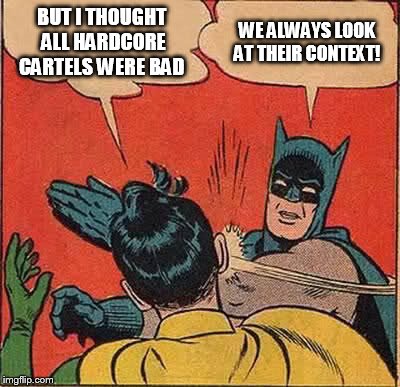
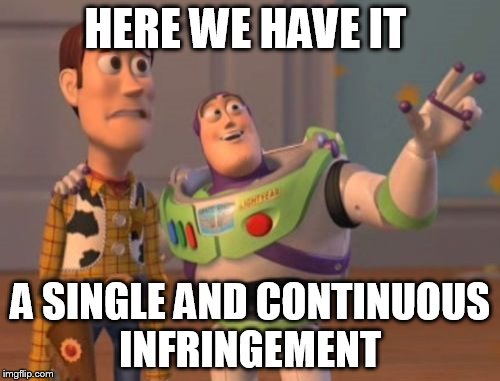
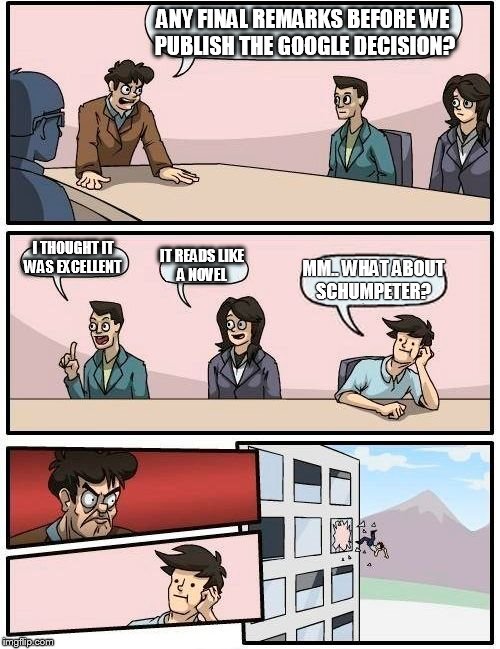


P.S. Those of you interested in participating, please send your memes our way (sam.villiers@garrigues.com). We also accept anonymous submission. If you need technical help creating your meme see e.g. here.
Chillin’Competition’s World Competition Day Competition
Today is World Competition Day.
Whilst we are not sure the world should be in a celebratory mood, we think it is useful to use this day to reflect on things we could do better.
On our part, we have thought long and hard about the way in which we could use this blog to effectively contribute to the cause of competition.
We now think we have the idea: a meme competition.
In adherence to platform neutrality principles this blog does not want to discriminate against people over 35 (who may not know what a meme is..); we’ll also run a caption competition for you soon, don’t you worry 😉
So, the idea is that you create your own meme (or find one) and send it to us. It can be about competition law or about the very notion of competition. A random example (found online):
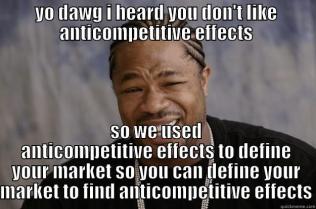
Since I’d rather not use my professional email for this I have asked my colleague Sam (who’s ok as a lawyer but excellent at memes and moreover cannot refuse my request) 🙂 to use his, collect all your absurd ideas and rank them.
Please send yours before December 16th to sam.villiers@garrigues.com. The two best memes get a private Post Danmark II discussion with Pablo and myself a selection of Christimas delicacies from my family’s bakery. A selection of our favorites will also be posted on the blog.
P.S. Those who do not get the free delicacies should not despair; there is an online shop too 😉 (please note that I’m only saying this selflessly to help the Commission’s efforts of bolstering e-commerce accross Member States…).
Nominations

It’s time for nominations in the competition world. If you are in a nominating mood, here are some possibilities:
- W@Competition– a new organization for women competition law professionals– is currently accepting nominations for its first “30 in their 30’s” list (a sensitive listing as it may require asking about age…). You can nominate exceptional women in four categories: private practice, in-house, enforcement and economics. To know more about the organization and to nominate your candidates click here. Chillin’Competition will be supporting the initiative.
- Who is Who and Global Competition Review are seeking nominations to identify “future leaders” in the field of competition law. You can nominate anyone under 45 to the “partner” or “non-partner” categories. The deadline is tomorrow. For more info, click here. If you have been invited lately to an open bar and/or a conference by anyone meeting this criteria, now it’s pay back time :p
- Today is also the last day to nominate articles for Concurrences’ Antitrust Writing Awards. You can nominate your favorite articles here. For Pablo and myself this is sort-of-like the Nobel Literature Prize for Roth or Murakami (well, with some nuances on all sides…); we are always shortlisted but never win 😉 This time we have a joint nomination for our article On the notion of restriction of competition (in the Academic/General Antitrust category), and Pablo has another for his article on Appreciability and de minimis in Article 102 (in the Business/Dominance category).
N. Petit on AG Wahl’s Intel Opinion

[Nicolas retains advertising rights on this blog, also for his publications, so he an exception to our new policy of not advertising publications and events (except the ones on which we participate…) on the home page of this blog. This change is driven by our inability to say no and by the fact that it was becoming hard to accomodate all requests. So from now on you will see a new section on the right side of the home page, just below our bios, called “Events and Publications“; we will be regularly feeding that section with interesting information that will still be visible from the home page without taking that much space. Please feel free to continue sending that info our way!]
***
Nicolas has been pretty prolific lately combining interesting writings with his new focus on artificial intelligence (not kidding). He has just posted on SSRN a new paper titled “The Advocate General’s Opinion in Intel v Commission: Eight Points of Common Sense for Consideration by the CJEU“.
His contention in this interesting paper (which as you might have expected suggests the ECJ to follow AG Wahl’s Opinion) is that improvements of the law on Article 102 TFEU are within reach, without a necessity to completely revamp the case-law. Suffice is it to apply logic, first principles and common-sense, and follow the trajectory delineated by Post Danmark I and II.
Nicolas has identified the following as the key 8 ideas developed in the paper:
1.An Effects Analysis underpins Hoffman-La Roche;
2.Category and “Super-Category” Mistakes;
3.The Non Sequitur of Exclusivity =Exclusion;
4.The Non Sequitur that Any Exclusionary Effect is Anticompetitive;
5.Capability, Likelihood and Probability Standards;
6.The AEC test is a legality test, not a priority test;
7.A More Economic Approach to the Enforcement of Article 102 TFEU improves Legal Certainty, the Rule of Law and the Uniform Application of EU law;
8.A More Economic Approach does not entail more Mathematics;
To better understand what these mean, we suggest you take a look at his paper, which can be downloaded at:
The Sharing Economy and Competition Law

The ECJ hearing in one of the main Uber cases (C-424/15 Asociación Profesional Élite Taxi v. Uber Systems Spain) took place this morning in Luxembourg. We were planning to comment on the possible implications of the case not only for competition law but for online platforms in general and for the Digital Single Market. However, as it often happens reality gets in the way and (i) I don’t really have the time today + (ii) I’m not sure of what I can say about it yet, so we’ll leave it for another day (apologies for the deceiving title of the post…).
I nonetheless did commit to advertise the workshop that our friends at ERA have organized next Thursday on “EU Competition Law and the Sharing Economy in the Age of Uber &Airbnb” (on which I quite unfortunately could not participate), so if you are interested in the topic and want to hear from some of the best in the field, click here for more info.
This is, by the way, a topic on which I spoke last year in Madrid, but more generally, in relation to the wider legal challenges posed by the sharing economy. It’s not that I said anything of much interest, but I’m so proud of my slides (which include an app to find lawyers near you; in Spanish, though) that I thought I would re-post them here: Sharing Economy _A.Lamadrid 😉
What I have been reading lately


The conference (and the blog, and the teaching and the papers) have not prevented me from reading a few interesting books lately. Many of the books have been biographies, which I have come to appreciate. When when well written and crafted, they combine the best of journalism and fiction.
It has been a while, but one of the most captivating biographies I have ever read is that of former US Supreme Court Justice David Souter. Souter is an interesting figure himself. He was appointed by Bush sr, but sided systematically with the liberal wing of the Court – including in antitrust matters. My own impression is that he is just someone who deeply believes in the law and takes it very seriously. The carefully researched book does not disappoint.
In my attempt to understand what is going on in the country where I now live, I have read this year Sonia Purnell’s biography of Boris Johnson. It is a page-turner that confirms the impression that Boris Johnson gives on TV: i.e. that he is a lazy and incompetent dilettante.
Having devoured Boris Johnson’s biography, I was expecting the best of the long-awaited monograph on Richard Posner. Unfortunately, it has been one of the great disappointments of the year. Besides some gossip about his time as a student at Harvard Law School – it looks like Posner managed to terrify and alienate the faculty as a 23 year-old – I do not believe there is anything in the book that has not been said (more graciously) elsewhere.
Anyone interested in Posner should instead read the classic piece published in the New Yorker, which is a good example of journalism at its very best. The way Posner demolished the arguments against gay marriage is another must read/listen.
Our friends – and generous sponsors – from Hart Publishing sent us a review copy of UK Merger Control, written and Jonathan Parker and Adrian Majumdar. I have now found the time to take a look at it and I have to say I am most impressed by it. Congratulations to the authors on an amazing achievement!
On the to-read list, I have Choice, edited by Paul Nihoul, Nicolas Charbit and Elisa Ramundo. It is always refreshing to reflect on the introduction of new approaches and paradigms.
Videos and photos from the Chillin’Competition Conference
Chillin’Competition productions is proud to present you with:
- A photo gallery of the event
that fortunately leaves out the post-conference drinks.To access the gallery, click here
- A short video with some of the conference highlights (with a bonus at the very end…):
- A video of part of my introduction to the conference [due to a technical error the first couple of minutes are missing, but you only miss the “thank yous” and a couple of bad jokes].
- A video of Commissioner Vestager’s much-talked-about keynote speech (the video includes the Q&As) (thanks again for doing this, Commissioner!)
Materials from the Chillin’Competition Conference
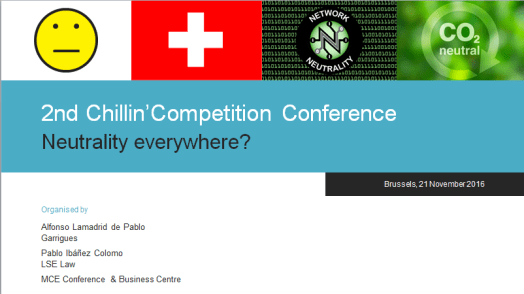
The 2nd Chillin’Competition conference took place yesterday; we very much enjoyed it and we hope all attendees and speakers did too. Once again, our gratitude goes to Commissioner Vestager, to Judge Forrester and to all other speakers; thanks to them we were able to have a deep but fun discussion about key issues arising in our discipline. Thanks also to our sponsors for having made possible a certain disruption of the conference market.
It’s not for us to evaluate the result of the conference, but it met our very own expectations. Any of you who attended is very welcome to write a review/suggestions/criticism as comments on this post. Next time, we warn you, we truly plan on changing competition law conferences as you know them; we may have been a bit too conservative this time. We have just received some excellent ideas from John Fingleton; if you have your own, please shoot them our way.
It was also great to meet a bunch of the readers of this blog [btw, the code word that we all used at the bar for the free drinks (“elephant”) does not work anymore; if you try it now people may look at you weirdly 😉 ]
In the course of the week we will be uploading some videos and pictures of the conference. For the time being, here are the presentations used by Pablo, Bill Batchelor, José Luis Buendía, Jorge Padilla and Scott McInnes:
chillin-competition_neutrality-everywhere_pablo-ibanez-colomo
chillin-competition_neutrality-in-distribution-batchelor
chillin-competition_neutrality-and-public-competition-law-jl-buendia
chillincompetition_neutrality-and-payments_mcinnes
chillincompetition_neutrality-in-distribution-j-padilla
A short selective summary of the event drafted by our friends at Gecic Law is also available here.
P.S. Some people have inquired about the use of the Swiss flag in the conference programme. As I explained in my introductory speech, the truth is that we did ask the Swiss embassy whether they had objections to us using their flag to illustrate the concept of neutrality, but they of course said they had no views one way or the other…
Full house at the 2nd Chillin’Competition Conference
We are having a great day at the Chillin’Competition conference. We will be reporting on the substance in due course, but here is a teaser video.
By the way, we will be having post-conference drinks at around 18.30 at the Red Monkey (Rue de l’Aqueduc 109); feel free to join even if you did not register for the conference. The first round is on us 😉


