Archive for the ‘Uncategorized’ Category
Chuck Norris Antitrust Facts (3)
- The most stable cartels are those to which Chuck Norris participates. No one cheats for fear of Chuck’s retaliation.
- Chuck Norris is both a structural and a behavioral remedy. He can break a leg (the structural component) just by turning to a mean face (the behavioral component).
Office supplies for the new academic year
We don’t know if you ever had the same feeling, but when we were students we kept on buying new notebooks, pens, folders, etc at the beginning of each academic year under the reasonable assumption that they would make us smarter..
I had a reminiscence of that last week. I was in London for the basketball games of the Olympics (where Spain was very close to beating the U.S. Dream Team!) and after visiting Pablo Ibañez’s office at LSE (btw, he has been awarded the Departmental teaching award; congrats!) I passed by a legal bookshop called Hammicks where I remembered having spotted some fun stuff. I couldn’t resist purchasing some office supplies for the new year:
A note pad

A cushion

And a new book for my shelf: What Every Lawyer Thinks About Apart from Sex? (it’s 200 blank pages are a must-read!)

Chuck Norris AT Fact of the Day
Antitrust agencies can eliminate all consumer harm. Except those inflicted by Chuck Norris.
Can Do Better

Whilst seating on the beach, I read last week’s (now) famous Economist piece on fines.
I was quite astonished to read that The Economist supports further increases in corporate fines. The conclusion of the paper speaks for itself: “To deter bad behaviour fines need to rise. The watchdog are biting, but some need sharper teeth“.
That said, I found the paper a little weak. Strangely enough, it says nothing of most issues that currently matter in respect of corporate fines:
- No word on sanctions for individuals, in the form of director disqualification orders;
- Some references to theoretical studies, including references to the economics of crime (G. Becker) and cartel overcharges (O’Connor & Helmers), but no word on principal-agent problems in large multinational corporations;
- No word on the issue of fines in times of economic crisis;
- No word on compliance programmes.
Is there a hidden agenda there or am I again reading newspapers like the devil reads the bible?
Arguably, those omissions may be explained by the fact that the paper is not antitrust-related only (quod non). The paper opens with some words on the economics of corporate fines, and follows with a brief discussion of the penalties inflicted to Barclays a few weeks ago. But after this, the meat of the paper really is a discussion of antitrust fines. And even if it were true that the paper takes a larger focus, it remains silent on a number of key issues. Think, for instance, to the trade-off that regulators are now facing, i.e. sanctioning banks with hefty fines v. ensuring banking stability with subsidies.
The bottom-line: The Economist can do better…
Microsoft v Commission (T-167/08) – The Magill-IMS Health Re-Animator?

I was about to fall asleep reading the Microsoft judgment of last week (T-167/08), when I stumbled into paragraph 139.
This paragraph implicitly reverses the CFI’s Microsoft I ruling on the legal standard of abusive refusal to supply (CFI, Case T-201/04, Microsoft Corp. v Commission, ECR [2007] II-3601).
Remember, in this judgment the CFI had departed from the IMS Health and Magill “new product” condition.
It had held that:
“§647. the circumstance relating to the appearance of a new product, as envisaged in Magill and IMS Health . . . cannot be the only parameter which determines whether a refusal to license an intellectual property right is capable of causing prejudice to consumers within the meaning of [Article 102(b) TFEU]”.
The CFI further added that it was sufficient for the Commission to prove that the refusal to supply interoperability information gave rise to a “limitation […] of technical development”.
This new concept was (and still is) rightly criticized by scholars and practitioners as a loose, elusive and murky legal standard. Many expressed regrets over the disappearance of the simple three-pronged Magill-IMS Health test. Others argued that the CFI’s “technical development” standard was wholly inapplicable, and advised to rely on the Magill and IMS Health judgments of the upper ECJ. Finally, some practitioners (amongst others, D. Waelbroeck) talked of a lex specialis Microsoft.
Interestingly, the latest Microsoft judgment no longer talks of the “limitation of technical development“.
Rather, in what reads like an obiter dictum, the GC explicitly refers to the “new product” condition, and quotes IMS Health as the sole source of precedent on refusals to supply involving IPRs.
“§139. In that regard, it should be recalled that, in order for the refusal by an undertaking which owns a copyright to give access to a product or service indispensable for carrying on a particular business to be regarded as abuse, it is sufficient that three cumulative conditions be satisfied, namely that that refusal is preventing the emergence of a new product for which there is a potential consumer demand, that it is unjustified and that it is such as to exclude any competition on a secondary market“
Of course, the Court would not acknowledge that it applied a wrong legal standard in 2007.
It thus goes on to state at §140 that those three conditions were met in the Microsoft I case (they were not).
That said, paragraph 139 marks a welcome evolution of the case-law on abuse.
Thoughts on Transfer of Technology, and More

At today’s GCLC lunch talk on transfer of technology agreements, a number of thoughts sprung to mind. Here they are.
- As part of our professional ethics, we competition lawyers should stop saying that IP confers a form of “monopoly” on its owner. Like property rights over tangible goods, IP – I talk here essentially of patents – confers property. A patent confers property over the usage of technical specifications, full stop. But – and this is a big But – IP does not imply, as the term monopoly suggests, the absence of alternative technical specifications. On many markets, several IP compete for a given product, service, functionality.
- Aren’t we over-regulating the issue of standard-essential patents? There’s no robust evidence that patent thickets are a widespread + harmful phenomenon. However, as a result of the mass-mediatization of several cases, and of the possible inability of the Commission to deal with those cases swiftly and thoroughly, we are heading towards the adoption of general rules in a range of soft law instruments. Last year, we got a new section on standardisation in the Guidelines on Horizontal Cooperation Agreements. The upcoming revised TTBER and its set of accompanying Guidelines may just bring about more rules. As a matter of principle, I would question such an approach, absent empirical case-related evidence.
- The use of “double negatives” in the list of hardcore restrictions should be avoided. D. Woods said the Commission would make some thinking on this. And I trust most EU competition law students would be grateful if the Commission made progress on this.
- The SEP=SMP shortcut is misconceived. It fails to grasp that several standards, or non-standardized technologies can compete for a given functionality, product, service. Moreover, standardization is a repeated game, so any attempt by a SEP holder to raise fees may be sanctioned at a later stage by other standard participants. And finally, SEP holders must often obtain licences from other SEP holders.
- A speaker made the point that it would be counterintuitive if participants to patent pools had to pay experts to determine on an ongoing basis whether the patents are valuable (or not) and in turn should (or not) stay in the pool. It is indeed a little weird to pay someone and entrust him with the mission, and power, to kick you out. And there are other risks: conflict of interest, bribes, etc. But aren’t most trade associations paid by their members, and yet keep a right to exclude participants if the membership conditions are no longer met?
- A popular policy argument to discard the need (and legitimacy) of antitrust intervention is that contemplated market failures are caused by regulatory frameworks. And the argument logically follows that regulatory defects should be solved by bringing changes to the regulatory framework, not by applying the competition rules. This argument has been made in virtually all sectors of the economy that have attracted antitrust scrutiny in the past decades, e.g. pharma, financial markets, telecoms, etc. I have, myself, made this point in a number of papers, but I have second thoughts on it now. Whilst I still believe that pieces of legislation adopted under a fully democratic procedure should not be undermined by ex post bureaucratic competition enforcement, I am also a pragmatist. In this respect, I tend to consider that antitrust enforcement may bring quicker, and better fixes, than protracted regulatory action (for instance, a reform of the IP system in the case of patent thickets). Plus antitrust enforcement is more reversible than regulatory action (in case of mistake). And finally reforms of regulatory regimes just have corrective effects for the future, and do not address existing problems…
Apologies
Alfonso and I owe a big apology to Francesco Carloni (Shearman & Sterling), Luca Crocco and Gianni de Stefano (Latham & Watkins).
Our friends organized yesterday an anniversary cocktail to celebrate the first year of existence of Italian Antitrust Association antitrustitalia.
I came back late from Bruges, where I gave a presentation at the 8th ELEA seminar. I learned there that Phedon Nicolaides will take over Jacques Pelkmans as the head of the economics department.
Alfonso had other, very good reasons.
PS: I just fixed the link to the BSC brochure.
Antitrust Parable (2) – The Kroes and The Almunia

A well-inspired friend sent us a new version of yesterday’s Antitrust Parable. We liked it, so we post it:
The Kroes. The Kroes’ job was to catch as many fish as possible, and the bigger the better. Every fish she caught she showed it off and was very proud. When she caught a really big fish the press would report in wonderment about Kroes’s great prowess. If another NCA got a bigger fish, she was embarrassed and immediately went after a fish that was even bigger. Smaller fishes she threw back because she wanted more fish. She saw to it that there were plenty of places for fish to breed and plenty of sources of food for them. Anything that prevented the fish from thriving and multiplying she opposed, because she wanted more and bigger fish.
The Almunia. The Almunia hated cases and wanted only to protect the business. He did not want to catch cases, but caught any he discovered. But he also encouraged staff to scare away cases [settlement?]. He sealed up the holes where cases could hide. He looked for any technique anywhere that would scare away cases [press releases, speeches, RFI…]. If something worked against having cases, he used it. If he caught a case he apologized to the townspeople because one had gotten through. He did everything he could so there would be no cases now or in the future. He wanted to protect the grain for the townspeople.
Antitrust Parable – The Fisherman, the Miller and DG Comp

Here is a little story about the fisherman, the miller and DG Comp (courtesy of a source that we will keep confidential):
The fisherman. The fisherman’s job was to catch as many fish as possible, and the bigger the better. Every fish he caught he showed it off and was very proud. When he caught a really big fish the press would report in wonderment about the fisherman’s great prowess. If another fisherman got a bigger fish, he was embarrassed and immediately went after a fish that was even bigger. Smaller fishes he threw back because he wanted more fish. He saw to it that there were plenty of places for fish to breed and plenty of sources of food for them. Anything that prevented the fish from thriving and multiplying he opposed, because he wanted more and bigger fish.
The miller. The miller hated rats and wanted only to protect the grain. He did not want to catch rats, but caught any he discovered. But he also encouraged cats to scare away the rats. He sealed up the holes where rats could hide. He looked for any technique anywhere that would scare away the rats. If something worked against the rats, he used it. If he caught a rat he apologized to the townspeople because one had gotten through. He did everything he could so there would be no rats now or in the future. He wanted to protect the grain for the townspeople.
DG Comp. DG Comp views its job as catching as many cartels as possible, and the bigger the better. Every cartel it catches it shows off and is very proud. When DG Comp catches a really big cartel the press reports in wonderment about DG Comp’s great prowess. If another government gets a bigger cartel, DG Comp is embarrassed and immediately goes after a cartel that is even bigger. Compliance programs it ignores because it wants to find more cartels. Compliance programs can seriously harm the places where cartels breed and endanger the sources of conspirators necessary for cartels. Company in-house lawyers can help prevent cartels from thriving and multiplying, so DG Comp opposes their professional privilege. Anything that prevents a cartel from thriving and multiplying DG Comp opposes, because it wants to catch more and bigger cartels.
Mixed Bag
Alfonso must be busy dealing with the negative externalities inflicted by my previous posts (with which he had nothing to do, btw),
It is thus my task to run the blog today. In brief, I have also inflicted a negative externality to my poor self 😦
A mixed bag of things:
- The spirit of emulation within the ECN is amazing. The endives saga is just over. But the veggie decisional roulette keeps spinnin’. A few days ago, the Dutch competition authority slapped a €14,000,000 on bell pepper and onion growers for unlawful cartel. With this focus on agricultural products, the conspiracy theorist that sleeps in me cannot help but thinking that the MS are trying to get their CAP money back. Thanks to D. Mamane (Schellenberg Wittmer) for the pointer;
- Some more results, of EU officials this time, at the 20K: An Renckens (1:26:35); Oliver Stehmann (1:32:09); Sébastien Thomas (1:35:20); Anthony Whelan (1:50:36); Guillaume Loriot (1:52:06); Piet Van Nuffel (1:54:50). I stopped under 2 hours, as the list was pretty lenghty. Please send me your time if you want to appear on this post;
- Dan Sokol (University of Florida and Ioannis Liannos (UCL) new book The Global Limits of Competition Law is out. Looks really nice. Chillin’Competition would welcome a review copy;
- The American Antitrust Institute has put together The International Handbook On Private Enforcement Of Competition Law. Same here, a review copy would be appreciated;
- Who monitoring trustees really are? I thought until now that they were specialised consultants. But in reading a commentary on Intel/McAfee this morning, I learned that former CEOs also make good candidates. In this case, Mr. Olli-Pekka Kallasvuo, former CEO of Nokia, was appointed as Monitoring Trustee;
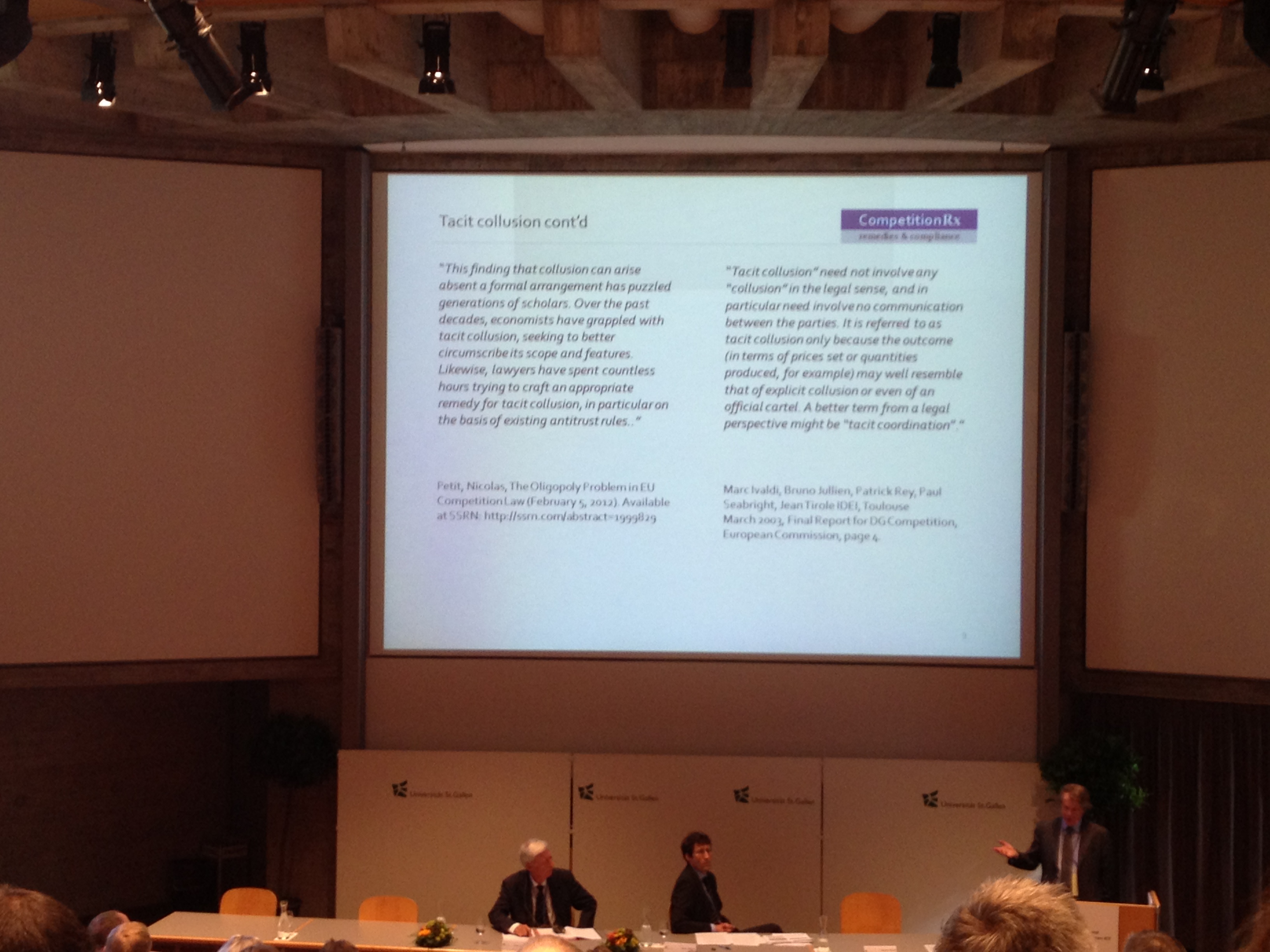
- Our friend David Mamane (him again) made my day in sending me a picture of today’s St Gallen competition conference. Apparently, my name was high on the screen (see picture on top of this post). Thanks to him, and to Tom Hoehn (the speaker), who quoted me in public;
- I was interviewed today in a local Belgian newspaper on what the concrete impact of the EU on Belgian’s daily life. A tricky question, which demanded quite some thinking. See the result here: Sudpresse – 7 juin 2012;
- Turning to less serious press, I was quoted in the LA Times on the Google case. From what I read, I disagree with Dennis Oswell (Oswell and Vahida). To me, the Commissioner’s move sends the signal that COMP’s case is weak. In line with past practice, the Commission could have simply requested a settlement behind closed doors it if it had had a strong case. My best scientific explanation of why the Commission departed from conventional practice? => it is trying to play some sort of poker game: with strong hands, try to look weak; with weak hands, try to look strong. And BTW, Regulation 1/2003 does not entitle the Commission to formally request Article 9 commitments. They must be proposed by the parties.
| 1:26:35 |


 Chillin'Competition