On patent suits, lawyers’ suits and Suits

As I was reading a few online pieces on Apple’s victory over Samsung in one of the multiple patent battles confronting them (btw, you can check out this interesting interview with Richard Posner, as well as this piece on how jury deliberations took place) I came accross an article that blames not the proliferation of trivial patents but “suit-and-tie lawyers” for stiffling creativity and innovation.
Leaving aside the easy attack on lawyers, the “suit-and-tie” expression has always intrigued me: I’ve heard it many times, but I seldom hear it applied to other “suit-and-tie” professionals. I did a quick search on it and quickly came up with some material for a post on lawyers and suits; it later expanded to more suit related stuff. Here it goes:
Patent suits
Before continuing with the suit talk, a quick remark on the proliferation of patent suits and on the accusation about lawyers’ destructing creativity. I agree that some degree of oddness may be inevitable when competition and the battle for innovation moves from the markets to the courts. And even though in some (many) cases such a move may also be inevitable (which not only is natural, but also convenient because otherwise most of us would be unemployed), the level of litigation that is taking place in relation to the smartphone industry is simply nuts. Posner has a point (there’s definately something wrong with the system that feeds “trolls” or that forces a company is forced to buy another just to acquire its patents to avoid future suits). Given the enormous cash reserves that these companies have ($110 billion in the case of Apple), legal fees and expenses derived from multiple and expensive parallell lawsuts are not a major concern, much less when these suits often pay-off (it’s hard to speak of sham litigation in this setting) and even have the potential to significantly alter the market. Patent lawyers are benefitting from this, but is it their fault? Nope, what happens is that companies are rationally exploiting the opportunities that an arguably ill-designed legal regime offers them. And speaking about system design, I admit that I also have issues with the fact that the outcome of cases like this one depends on the decision that 9 jurors take over highly technical matters.
[I said above that patent lawyers are doing well. Want to know the estimated legal fees of Morrison&Foerster, Wilmer (both representing Apple) and Quinn Emanuel (Samsung) for this case? You do, uh? 😉 Check here then (for the lazy ones: the range goes from $10 million to several hundred million dollars per party…).
Lawyers’ suits
Now back to the other suits (I bet Apple and Samsung’s lawyers will be buying some pretty expensive ones in preparation for the appeal). My saturday-morning Google search on “suit-and-tie lawyers” [btw, Google is searching for an in-house competition lawyer] made me realize how candent this issue is. The suit has traditionally been lawyers’ uniform (I’m sure you’ve heard about “power suits”; see here) but it is a fact that lawyers are “dressing down” these days (although some say the contrary). I, for one, typically feel like a living old-school reminiscence when I meet friends working for US firms and I’m the sole one wearing a tie (at my firm we’ve so far only managed to make inroads into casual Fridays and casual August…).
There are many pieces that pose the question of whether we should start dressing differently (see, e.g. here). The proliferation of such questions have spurred vehement reactions from those who claim that “Enough is enough, lawyers should look like lawyers!” . Does this look like a trivial issue to you? In some places it apparently isn’t. Just a few days ago, a lawyer from Pakistan wrote a piece in the Herald Tribune advocating for the abandonment of western-suits with the argument that “if we are able to achieve that (at least with our lawyers’ uniform) then we can be at the threshold of reconstructing a new, more culturally connected and logically sound society. This change can lead to a domino effect that results in the recapturing of other areas of society and public discourse that are being dominated by the colonial mindset“. No less!
Btw, if you want to know which is the world’s smartest law firm, click here.
I’m generally in favor of wearing suits for meetings, but I’m not so sure about the usefulness of doing it during those many days that we spend isolated in our offices (I sometimes have the feeling that I dress only for my next-door neighbor Napoleon; I think he likes my fashionable style, though…). I admit suit wearing is sometimes convenient, but other times it’s a pain (I was already an intern at Garrigues during my two last years of law school, and every day after class I had to run to my student’s residence to suit up for work -how many hours did I lose doing that??-; a more recent example, I came back from holidays last week and I had to spend x hours quite some time in an attemp to iron a suit for a meeting the following day (that really took time!)
Suits
In our post about legal movies and TV series we forgot to mention the much acclaimed Suits. I watched the pilot last night (what better to disconnet from a working weekend than to watch a series about a law firm, right?) and I can confirm that it’s pretty good.
P.S. This post was brought to you by Suit Supply.
The Saturday Morning Slot?

Woke up all too early this Saturday morning, cannot understand why.
As the summer quietness was interrupted yesterday by a raft of breaking news (Breivik’s 21y sentencing, the NY shooting, Armstrong’s decision to throw in the towel, and the death of JL Delarue), several pieces of information of AT interest reached my mailbox/ears last night:
- Ben Van Rompuy’s book is finally out. Ioannis Liannos (UCL) will give a speech on 28 September at the book launch reception.
- I will be finally flying to Hong Kong in October for this conference. Cannot wait.
- Edward Elgar has penetrated the blogosphere. Their blog has a section entitled “law” with good posts on antitrust (by Mark Furse) and intellectual property.
- Covington’s associates are better compensated than Cleary’s (I find this one hard to believe though).
To all, a very good WE.
On my side, I’ll be busy completing the move to my new place. And I’ll be eating pasta prepping for the 25K next week in Liege.
Facts of Life
Yesterday at Ashurst, the receptionist: “You must be the student taking the exam with Professor Waelbroeck right?” => I enjoyed this one.
Heard through the grapevine, two days ago, : “Nico still needs a breakthrough article” => liked this one a little less, but there must be some truth to it.
Last but not least. Despite my young age, I almost had a heart attack when I realized that the publisher of the latest issue of the Journal de Droit International had been published, and that virtually all the corrections that my assistant and I had made on the proofs or our paper had been ignored.
Competition Plagiarism?


A few weeks ago we posted a story about the “competition pills” that the Spanish Competition Authority (CNC) is distributing (see here). We remarked the “originality” of this promotional campaign. Yesterday, one of our readers (thanks, Luca!) posted a comment in which he questions such originality; the comment reads as follows:
“This is scandalous!! Plagiarism!!
They’ve copied the idea, the packaging, the leaflet, the design – literally, everything except the color, red instead of deep blue – from a record by Spiritualized of 1997 – “Ladies and Gentlemen, we’re floating in space”.
Am I the only one old enough to remember this masterpiece?
Still I’d be curious to know who’s the psychedelic case handler at the CNC who came up with the idea”.
Since our readers’ wishes are our commands, we are launching a quest to find the musically literate CNC official/s who came up with this idea, and we want to interview her/him/them here (about music, copyright and the promotion of competition).
The customary beer tasting reward applies to whoever gives us any information that may help us in our quest.
Beach reads 2012
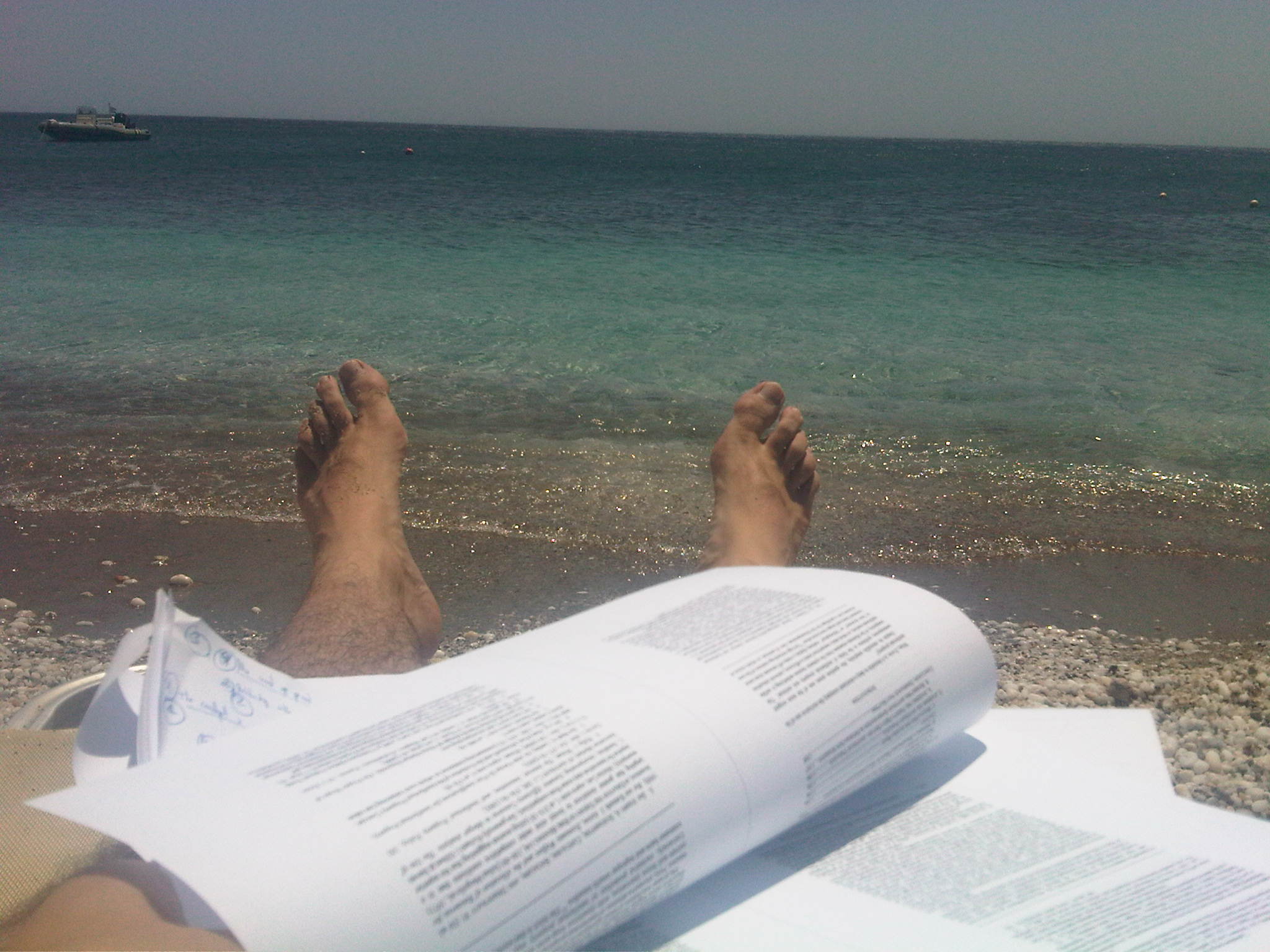
In order to stand up to our reputation of “competition geeks”, and following our own advice on the usefulness of “reading, not just consulting, competition law books“, both Nicolas and myself included some “professional readings” within our beach-reading-material [I also took some non-competition readings with me (American Pastoral and Soldiers of Salamis) and they were simply excellent, and perhaps a bit more fun…].
I chose to read several network-effects related pieces (which are useful both for my halted PhD research and for my current work). Some of what I read was crap perhaps not so useful (what’s going on with peer reviews these days?), but other pieces were very good. I’ll share some views on them (assuming that you don’t give a damn about what we read, but in the hope that we can help anyone interested on these matters to “sepparate the wheat from the chaff)”.
For instance, I re-read Pierre Larouche’s article “The European Microsoft Case at the Crossroads of Competition Policy and Innovation” and -regardless of whether one agrees with everything that is in it or not- I thought that it is a model of what a serious, balanced, well-though and well-written comment of a Judgment should be like. I also re-read (or read seriously for the first time) a somehow more difficult (given its economic nature and its lenght) but brilliant piece by J. Farrell and P. Klemperer “Competition and Lock-In: Competition with Switching Costs and Network Effects“. And I read for the first time a paper entitled “Monopolization via Voluntary Network Effects“, by Adi Ayal, that is both original and quite sensible.
Finally, I finished reading Competition Law and Regulation of Technology Markets, by Kevin Coates. In a previous post I said I would write a short review on it here, so here it goes. It may, however, come a bit late, since it’s most likely that you are already familiar with the existence of this work. Anyway…. Kevin Coates has produced a truly excellent book, and one that focuses on what is possibly the most timely subject in worldwide antitrust these days. The book deals with the application of competition law, intellectual property law, telecoms regulation, and data protectition law “accross the different layers of the value chain, from the underlying technology, through the networks and into services and applications in light of the disciplines“.
The book does a great job in presenting the reader with the particular features of technology industries (e.g. its rapidly evolving and innovation-driven nature, the existence of network effects, the multiplicity and complexity of market relationships or the crucial role of technical compatibility), and, most notably, in addressing the particular challenges that these features pose to antitrust enforcement.
The book’s analysis is lucid, its scope is comprehensive, its language is fresh and lively; it expresses some personal views, but objectively presents all possible sides to every debate. In no other book will you find a comparable coverage of the breadth of technology-related issues covered in this one. In sum, it’s a book that I would’ve loved to write myself, and that I would’ve been proud to write in the way it is written.
P.S. We have asked Kevin to develop in a guest post in Chillin’Competition some of the ideas that we found more interesting. We’ll let him rest for a few days, but we hope to have him here soon.
Brussels School of Competition

I had drinks last night with my good friend Charles Gheur from the Brussels School of Competition (“BSC”).
It sprung to mind that I had not yet advertised that the registration process for the 2012-2013 edition of the LL.M was opened .
There’s a bunch of new things for this third edition of the programme, not the leasts that (i) Fred Jenny stepped in and will co-teach the module on abuse of dominance, and that (ii) señor Lamadrid de Pablo has officially been drafted (he is a basketball fan) to join the team that teaches procedural matters.
Together with the fact that our studs are primarily in-house lawyers from large corporations (Microsoft, Umicore, Toyota, Mastercard, Basf KBC, Bayer, Distrigas, Verizon, etc.) this should convince young Brussels lawyers to relocate towards us instead of following the painful King’s College long distance programme.
Chuck Norris Antitrust Facts (3)
- The most stable cartels are those to which Chuck Norris participates. No one cheats for fear of Chuck’s retaliation.
- Chuck Norris is both a structural and a behavioral remedy. He can break a leg (the structural component) just by turning to a mean face (the behavioral component).
Office supplies for the new academic year
We don’t know if you ever had the same feeling, but when we were students we kept on buying new notebooks, pens, folders, etc at the beginning of each academic year under the reasonable assumption that they would make us smarter..
I had a reminiscence of that last week. I was in London for the basketball games of the Olympics (where Spain was very close to beating the U.S. Dream Team!) and after visiting Pablo Ibañez’s office at LSE (btw, he has been awarded the Departmental teaching award; congrats!) I passed by a legal bookshop called Hammicks where I remembered having spotted some fun stuff. I couldn’t resist purchasing some office supplies for the new year:
A note pad

A cushion

And a new book for my shelf: What Every Lawyer Thinks About Apart from Sex? (it’s 200 blank pages are a must-read!)

On competition and blogs

Competition seems to be moving moving to the blog arena.
Some of you may recall that a while ago we discussed the case of a Spanish professor who had been sued for accusing a Promusicae of anticompetitive behavior (see here). We are glad to report that the blogger has won the case, thereby establishing a good precedent to shield Nico and myself from possible similar attacks 😉
Another interesting blog-related development has taken in the U.S. In the context of a high-profile patent infringement case between Google and Oracle, district court judge Alsup has ordered these companies to diclose the identity of bloggers, journalists and consultants that they pay for favorable opinions or consultancy work (for more, see here or here).
This decision has been triggered by the revelation that Florian Müller a well-known IP blogger (from the blog FOSS Patents) had been hired by Oracle shortly after the trial begun.
This unprecedented move should cast light upon the problem related to the lack of transparency surrounding blog content. As the influence of certain blogs grows, it is necessary to start thinking whether the ethical rules governing traditional journalism should also apply in this area. It has certainly led Nicolas and myself to reflect on the way we want to do things.
In our case, we don’t pretend to be impartial informers. We are simply two young professionals who voice out subjective opinions in public to entertain and/or to spur some hopefully interesting debates. We see Chillin’Competition more like a diary than like a newspaper story or an academic paper, and therefore don’t feel under the pressure of being always perfectly informed, accurate, exhaustive and objective about what we write. Of course we try to do our best and to be as technically rigurous as possible, but we’re not afraid of posting first thoughts on some topics, even if our views may evolve afterwards (remember our disclaimer?) 🙂
The small dimension of the competition law community makes it practically unfeasible to continuously disclose personal links. We often know quite well, or are friends with, in-house counsel, external counsel, Commission officials, clerks or Judges involved in all sides of the cases on which we comment here. Disclosing friendship or other informal ties with the people involved in the cases on which we comment would be tremendously burdensome (and it would look a bit weird too…). As said above, we don’t pretend to be always objective. In fact, we generally try to be subjective, but we develop our reasons and we expose them to public criticism. For the time being, our policy is to indicate only the cases in which we are personally involved. Also, where we have written about a case and have later become involved in it, we have also publicly stated it. However, we are, as always, open to comments and suggestions on how to better do what we do.
Blogging law is getting increasingly complicated. Nico: we need a lawyer.
Light menu

Since these days we’re read mostly by those unfortunate people not enjoying August holidays, we’ve decided to publish a few light posts. This one is particularly light:
Some of you have conveyed to us your surprise about the fact that -despite our frequent attention to food cases (an attention which was prompted by the landmark endives case)- we missed the news about confectionery manufacturer Haribo being sanctioned by the Bundeskartellamt for exchanging competitively relevant information (see here).
The case actually appears to be a very interesting one (thanks to Gavin Bushell for pointing our attention to it). Not knowing more about it than what the press release says, the Bundeskartellamt’s application of two instruments developed for cartel cases (i.e. leniency and settlements) in a stand-alone exchange of information case appears to confirm the concerns I (I use the singular because Nico and I disagree on this) expressed in previous posts (see here) about the possibility of stand-alone information exchanges suddenly being treated as cartels. I stick to what I said back then: “enlarging the legal concept of cartel so as to encompass information exchanges, thereby applying to them all the instruments that were developed and justified in the framework of the fight against cartels is bad policy and a dangerous development”.
In our defense, we have to explain that there is actually a reason why we missed these news: it’s bikini time. We’re healthy guys, and therefore a few weeks ago we decided to get sweets and carbohydrates out of our enforcement menu saga. You may remember that the last of our post on competition and food related to shrimps; today we have a mushroom side complement (all very proteic and Dukan diet compliant as you can see): last Wednesday a U.S. federal judge sanctioned a company in multidistrict litigation alleging a conspiracy to hike mushroom prices, holding the mushroom seller liable for an affiliated distributor’s destruction of documents sought by the plaintiffs (see here) (Thanks to José Carlos da Matta for the pointer!).0
By the way, one our readers particularly liked the shrimp post; Eva, if you like mushrooms too we suggest you try this (pictured above).
Getting serious now, the fact that we’re recurrently joking about food cases is not only a consequence of the limited scope of our sense of humor, but is made possible by food having become an enforcement priority for competition authorities. I, for one, am currently involved in a few food-related cases. In fact, European competition authorities seem to be competing as to which one is toughest on food. The evidence: check out the European Competition Network’s very interesting report on its members activities in the food sector.


 Chillin'Competition