The Price of Secrecy
Chatham house is throwing a very cheap conference on what looks like a very well-thought, and focused topic: “Competition policy in global markets“.
Here’s the price menu for the conference:
| Standard Rates | ||
|---|---|---|
| Commercial Organizations: | £895 (£1074 inc VAT) | |
| Government Departments: | £650 (£780 inc VAT) | |
| NGOs and Institutions: | £395 (£474 inc VAT) | |
The bottom-line:
I still fail to understand how officials from competition authorities can accept to participate to such events.
Mixed Bag
Alfonso must be busy dealing with the negative externalities inflicted by my previous posts (with which he had nothing to do, btw),
It is thus my task to run the blog today. In brief, I have also inflicted a negative externality to my poor self 😦
A mixed bag of things:
- The spirit of emulation within the ECN is amazing. The endives saga is just over. But the veggie decisional roulette keeps spinnin’. A few days ago, the Dutch competition authority slapped a €14,000,000 on bell pepper and onion growers for unlawful cartel. With this focus on agricultural products, the conspiracy theorist that sleeps in me cannot help but thinking that the MS are trying to get their CAP money back. Thanks to D. Mamane (Schellenberg Wittmer) for the pointer;
- Some more results, of EU officials this time, at the 20K: An Renckens (1:26:35); Oliver Stehmann (1:32:09); Sébastien Thomas (1:35:20); Anthony Whelan (1:50:36); Guillaume Loriot (1:52:06); Piet Van Nuffel (1:54:50). I stopped under 2 hours, as the list was pretty lenghty. Please send me your time if you want to appear on this post;
- Dan Sokol (University of Florida and Ioannis Liannos (UCL) new book The Global Limits of Competition Law is out. Looks really nice. Chillin’Competition would welcome a review copy;
- The American Antitrust Institute has put together The International Handbook On Private Enforcement Of Competition Law. Same here, a review copy would be appreciated;
- Who monitoring trustees really are? I thought until now that they were specialised consultants. But in reading a commentary on Intel/McAfee this morning, I learned that former CEOs also make good candidates. In this case, Mr. Olli-Pekka Kallasvuo, former CEO of Nokia, was appointed as Monitoring Trustee;
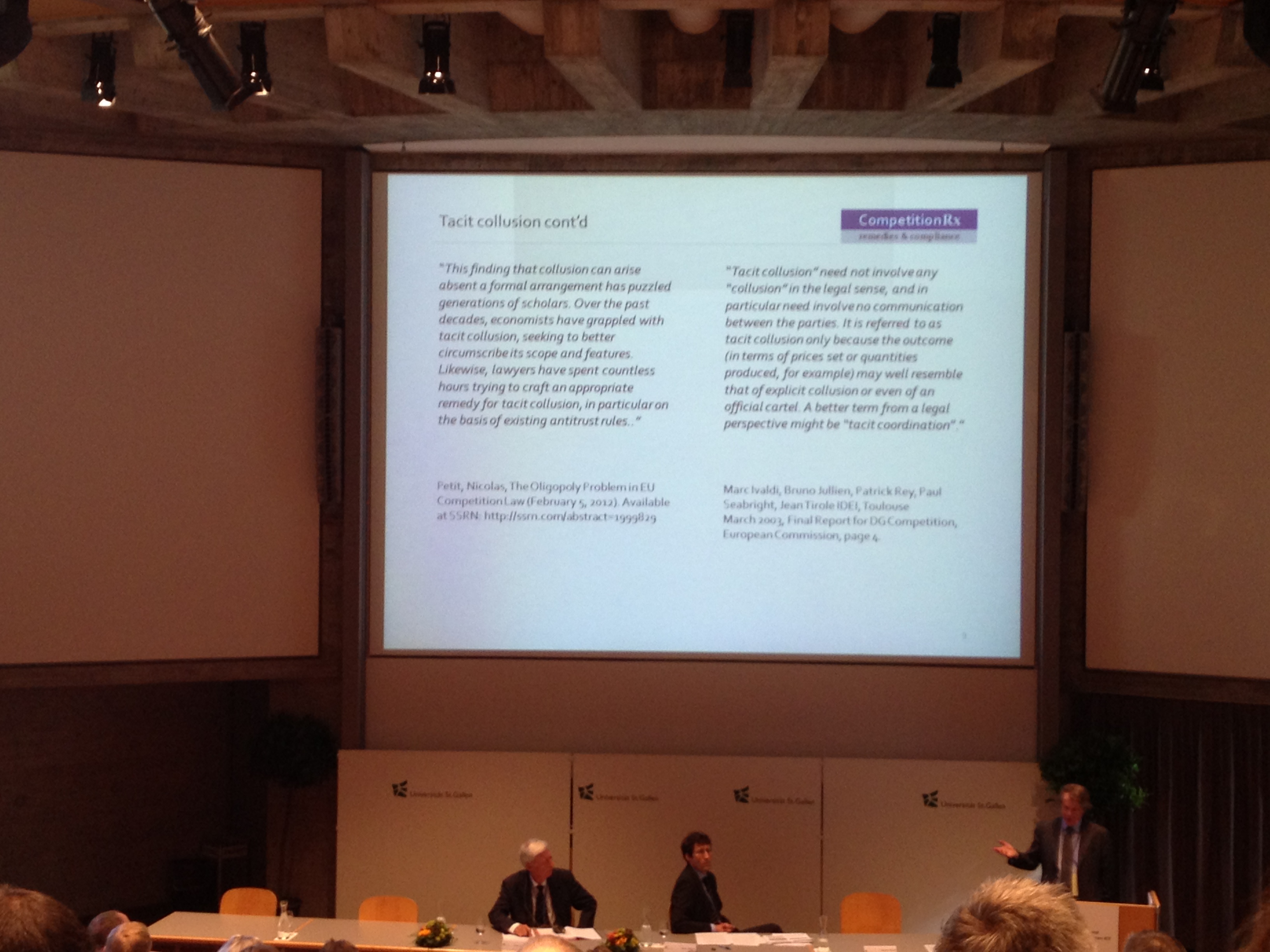
- Our friend David Mamane (him again) made my day in sending me a picture of today’s St Gallen competition conference. Apparently, my name was high on the screen (see picture on top of this post). Thanks to him, and to Tom Hoehn (the speaker), who quoted me in public;
- I was interviewed today in a local Belgian newspaper on what the concrete impact of the EU on Belgian’s daily life. A tricky question, which demanded quite some thinking. See the result here: Sudpresse – 7 juin 2012;
- Turning to less serious press, I was quoted in the LA Times on the Google case. From what I read, I disagree with Dennis Oswell (Oswell and Vahida). To me, the Commissioner’s move sends the signal that COMP’s case is weak. In line with past practice, the Commission could have simply requested a settlement behind closed doors it if it had had a strong case. My best scientific explanation of why the Commission departed from conventional practice? => it is trying to play some sort of poker game: with strong hands, try to look weak; with weak hands, try to look strong. And BTW, Regulation 1/2003 does not entitle the Commission to formally request Article 9 commitments. They must be proposed by the parties.
| 1:26:35 |
The Economist Corner (4) – Are Cartel Fines too Low?
Given today’s announcement, I suspect Alfonso has better to do than posting on this blog. Run, Alfonso (on the banks), run!
With this, it is thus my duty, and honour, to introduce the 4th edition of the Economist Corner. For this edition, Benoît Durand (RBB Economics) has sent us a good piece on a money-related issue, i.e. fines for cartel infringements. Enjoy!
In the last decade the European Commission has imposed higher fines on cartels, in particular under the helm of Neelie Kroes. The stated purpose for this increase was that fine levels were not sufficiently high to deter the formation of cartels.
In general, the deterrence property of sanctions is a key aspect of law enforcement. Becker (1968), who was the first to apply economic principles to crime and punishment, explains that the level of sanctions should be set so as to deter crime. A high level of sanction in turn contributes to minimise the costs of enforcing the law.[1]
Firms consider the expected benefits and costs of participating in a cartel. Under this logic, if the expected sanctions are higher than the collusive gains, then firms will not take the chance. Because there is always a significant probability that cartels slip through the net, the penalties should be several times larger than the gains such that no firm would dare try fixing prices. By way of example, consider that a cartel member expects to pocket 50 million euros extra every year for about 6 years, whilst the probability of being caught is 1 out of 5. In this setting, it would take a massive fine of slightly more than 1.5 billion euros to convince a firm not to collude.[2]
As cartels continue to exist, it must be the case that the current level of sanctions is ineffective. This is the conclusion that Combe and Monnier (2011) draw after reviewing the fines for 64 EC cartel decisions between 1979 and 2009. They show that in virtually all cases fines were set below the optimal deterrence level; i.e. in spite of the sanctions, the cartels were profitable.[3]
Is it therefore necessary to raise corporate fines above the current levels to deter the formation of cartels? It is hard to say, but to achieve full deterrence, competition authorities need not increase fines at stratospheric levels as suggested by the logic described above. First, they could adjust sanctions to give cartel members the incentive to undercut each other, which would trigger the collapse of cartels. Second, in complement to corporate fines, competition authorities could consider applying measures targeted at company officers who have brokered the cartel agreement.
Ruminations on the Google investigation

Over the past few months we have provided you with our views on the investigation undertaken by the European Commission with respect to Google. Here is an account of recent developments, thoughts, concerns, readings, ideas, and possible questions to be posed:
The developments. As you all may well know, the Commission has sent Google a preliminary assessment (a necessary formal step towards a commitment decision under Article 9 of Regulation 1/2003) and has requested Google to provide swiftly proposals of possible commitments that could address the concerns set out on that document. For the Commission’s statement identifying in broad terms the practices it objects to, see here.
In parallel, Google has lodged a complaint against Microsoft and Nokia. Google claims that “Nokia and Microsoft are colluding to raise the costs of mobile devices for consumers, creating patent trolls that side-step promises both companies have made. They should be held accountable, and we hope our complaint spurs others to look into these practices“. We have no additional information on this complaint and therefore do not have any opinion on whether it may be well-founded or not, but we regard it as something potentially interesting given that, until now, patent trolls had managed to stay more or less away from the antitrust spotlight in this bout of “patent wars” (note the IPCom settlement).
(By the way, the European Commission has excellent staff working on the unit dealing with cases related to IT, Internet and Consumer Electronics, but they must be incredibly swamped with so many complaints piling up on their desks).
The substantive concerns. We’ve already been quite vocal about our substantive concerns with regard to this case (note the caveat that we speak about matters of principle and on the basis of almost no case-specific information), so we won’t insist on them today.
The policy concern. We fully understand the policy rationale for changing the tone and attempting to address competition concerns in high-tech innovative markets swiftly and on the basis of “negotiated” solutions. However, the increasingly frequent recourse to such solutions also gives rise to several concerns. One of them is that commitment decisions do not contain a final position on the existence or non-existence of an infringement. If such decisions become the standard way of dealing difficult with cases –which would then be left substantively unresolved-, this would imply blurring the contours of the law. Laws should be clear. How can we expect the law on Article 102 to be clear when 14 out of the past 17 abuse of dominance cases were put to an end by virtue of brief and unconclusive commitment decisions? How does one strike the right balance between setting the law straight and addressing competitive concerns rapidly and effectively?
The doubt. (this one is not our’s but Pablo Ibañez’s): does publicly requesting a company to offer commitments fit with the letter and spirit of Article 9 of Regulation 1/2003?
The idea. We feel a bit frustrated by the fact that we’ve spent months thinking about this investigation having no information other than news clips and press releases. We’d love to see how the Commission has framed its concerns regarding Google under current competition law standards. We do not rule out the possibility that we may have been wrong all along, and maybe (although I have my doubts) having a look at the Commission’s preliminary assessment would convince us. How about requesting access to the non-confidential versions of the key documents in the file pursuant to Regulation 1049 as soon as the investigation is over? It could be an interesting exercise…
Competition law for kids

If you want to know how to teach the virtues of competition, the harms arising out of monopolies and the concept of an exclusionary abuse to 1-4 year old kids, this could do the trick: http://www.youtube.com/watch?v=3GZ5Yz97erE
Thanks to our yongest reader (Eduardo Guilbeau López, pictured below reading us) for the pointer [and congrats on his second birthday 😉 ]

More 20K results
More results, including several IP lawyers.
- Matthew Levitt (HoganLovells): 1:46:25
- Jean-Jo Evrard (former University of Liege and Darts IP): 1:47:31
- Enrique Gonzalez Diaz (Cleary): 1:48:44
- Norman Neyrinck (University of Liege): 1:48:52
- Alain Strowel (University of Liege): 1:49:01
- Thomas Wiese (Ashurst): 1:50:52
- Valentijn de Boe (Allen&Overy): 1:51:56
- Tom McQuail (Morrison Foerster): 1:54:59
- Damien Gerard (Cleary): 1:57:30
- Philip Bentley (Mc Dermott): 1:56:49
- Dirk Auer (Herbert Smith, former ULg student): 1:58:29
- Cedric Burton (Hunton & Williams): 2:01:45
- Maarten Meulenbelt (Sidley): 2:02:10
- Geert Zonekeyn (Ronse): 2:07:10
- Kristina Nordlander (Sidley): 2:10:05
- Philip Werner (Mc Dermott): 2:13:36
- Sarah Ashall (Shearman): 2:57:53
PS: I just selected the people I know. Apologies to those that I missed.
The Fastest Antitrust Expert Award

[If you’re reading this, it means that the above pic of Robocop Nicolas hasn’t scared you off, in which case you’ve earned my respect]
A few posts ago we referred to the proliferation of awards in the competition law world and we created what we referred to as the “first objective legal competition”: the Fastest Antitrust Expert Award. The idea was to give the award to the competition law expert who could run the Brussels 20k faster. We said that we would both participate. Nicolas did and I didn’t (a few days before I was told not to because I seem to have a herniated disc, a.k.a. a very convenient excuse, so I followed the maxim “when in doubt, chicken out“).
A bunch of you ran too. Some of you (mainly our friends who wanted to show off) have been kind enough to send their times. The contest is still open: you have until Friday to submit your results. The provisional semi-finalist readers/runners are the following:
1) Mark English (Shearman & Sterling): 1h 39′ 21” (it was about time that Mark earned a reputation for something other than endive bashing).
2) Nicolas Petit (Chillin’ Competition): 1h 42′ 02” (actually, there’s another (?) Nicolas Petit who apparently did not finish the race -see here ChronoRace20k-; who’s who?).
3) José Enrique Elías (Chief Economist Team): 1h 44′ 12′. We are told that José Enrique ran fast because he was being chased by some violent ordoliberals who were throwing stones at him.
4) Napoleón Ruiz (Garrigues): 1h 48′ 39”. Napoleón was, in fact, one of the ordoliberals throwing stones at José Enrique.
We are also told that Philip Lowe (former Director General at DG Comp, now Director General for Energy) did 1h 42′ 30” and that G.J. Koopman (Deputy Director General for State Aid) did 1h 49′ 27”. Very impressive.
Congrats to all others who took part in the race, and especially to those who signed up by commenting on the previous post, namely Philip Werner, Sandy Tsakiridi, Montse Adam and M. Fevzi Toksoy.
Once again: this post serves not only as a provisional set of results but also as a final call for any other readers to submit their times. We will publish a definitive list – and announce the winner of the coveted Friday slot and Li-ning shoes – in the coming days. So, who beats Mark English?
Job advertisement

Job Vacancy – Professor (100%) in the Department of European Legal Studies at the College of Europe (Bruges campus)
The College of Europe (Bruges campus) is seeking applications for the position of a full-time professor in the Department of European Legal Studies (www.coleurope.eu/law), starting on 1st September 2012.
Essential requirements are:
- a Ph.D. European Law with an excellent result
(applications of candidates who have already formally submitted but not yet defended their Ph.D-thesis at the date of application are also admissible ; however, the doctorate needs to be obtained before taking up duties on 1 September 2012) - a proven interest in European Law, demonstrated by a list of publications,
- university-level teaching experience,
- a very good command of English and French,
- the ability to work as part of a team,
- good organisational skills and a high measure of flexibility (working time can include evenings and week-ends).
Tasks include:
- teaching an LLM course in the field of European Law, including the supervision of Master’s theses,
- research and publication in the field of European Law, and
- assisting the Director of the Department in leading and supervising a team of assistants, the organisation of conferences, the management of the study programme (including the ELEA-specialization), and the selection of prospective LLM students.
The College offers:
- an excellent academic setting,
- the possibility of teaching and interacting with high-level graduate students,
- a stimulating and international working environment,
- a four-year contract under Belgian law, renewable, and
- remuneration in relation to qualification and experience of the successful candidate.
Mail or e-mail applications, either in English or French, comprising a detailed curriculum vitae, transcripts, a list of publications and courses taught as well as a letter of motivation and contact details of two references should be submitted at the latest by 1st June 2012 to
Professor Paul Demaret
Rector
College of Europe
Dijver 11, BE-8000 Bruges
Belgium
e-mail ann.verlinde@coleurope.eu
Successful applicants will be invited for an interview. Should you require any further information, please contact the Director of the Department, Professor Govaere (inge.govaere@coleurope.eu).
Nico’s fools day

I was the first victim of the scam. Here’s my version of the story:
I was having a particularly busy and tough week: swamped at work and unsuccesfully trying to give a hand to some close people who are having trouble coping with the crisis in Spain. So I didn’t have the time to write anything on this blog and, in full frankness, to a certain extent I didn’t feel like it (at times it feels weird to focus on this very narrow field of competition law when there are so many more important things going on out there). Last week was somehow similar, and we covered it with some “easy” brief posts. But since we are becoming increasingly more concerned about not sacrifying quality in exchange for output, I told Nicolas yesterday that I wouldn’t have time to write anything this week. He said he would take care of posting something. So far so good.
At around 18 pm I was at a meeting with Luis Ortiz, Marcos Araujo and Susana Cabrera when suddenly I started receiving a first set of weird emails entitled: “I’m so sorry“, “What happened?”, etc. So I first thought: has Spain collapsed or what on earth is going on??
Then I see another set of emails coming in asking “Is it a joke?“. I still had no idea of what they were talking about, but judging by the number of emails it looked like something big.
But then a minute later I get one from Nicolas entitled “Check out my post…” followed by some others asking what had I done to him (?!). It took a few hours until I was able to read the post, but then I read it and understood all the fuzz. Of course it was a joke (although the fact that it wasn’t funny might have misled you to believe it wasn’t!).
Since then I’ve received tenths of very kind emails from all kinds of people (most of whom I’ve actually never met, which is nice). I’ve tried to respond saying that everything was ok, but, once again, there was no time to respond to everyone.
Not only we’re not parting ways [although after this I’m starting to have second thoughts 😉 ] but we’re thinking about ways to make this blog better. Our problem is that there are now too many things on which we would like to write something sensible, and since you are a particularly informed and smart bunch of readers, we’re afraid not to have the time to stand up to the challenge (and perhaps the brains neither; don’t let the size of Nico’s head fool you) (sorry but it’s easy-joke-day around here!).
In sum, the show will go on, for whatever it’s worth.
A few additional comments:
– Whoever wrote the comment saying that after our divorce I should keep the blog has definetely earned a free dinner!
– Could the creator of chilledcompetition please identify himself? (No sooner has one gone that another comes along…). I’m impressed by the fast move. You deserve a guest post here!
– If what Nicolas wanted was traffic then the scam was a successful one; more than 3,000 visits in less than 24 hours is insane for a blog like this.
– Next time my dear co-blogger does something like this without consulting me first we’ll split up for good!
– We owe you one. Those interested in having one or a few beers on Sunday evening (post Brussels 20km + Street jazz festival) are welcome to join us. Everything is on Nicolas, of course. No kiddin’ here.
– This very timely scam has made me lose most of today’s morning. And now I’m leaving for the airport. My firm will take care of billing Nico for this (hourly rates apply).
Show must go on

The very existence of this post is proof that yesterday’s announcement was a scam.
The idea of this post germinated a year ago. Alfonso and I were pondering about the actual impact on the blog, and how would people react if we ever shut it. We thought we should one day announce that we had a fight (we mean a real one, after a heavy night out), and that the blog would close. For a whole bunch of reasons, we eventually never published this post.
Yesterday, it crossed my mind that the time was ripe for a post like this.
First, we had been silent for 5 days.
Second, we posted nothing on 1 April.
Third, and more importantly, my professional life lies at a juncture. I have taken way too many commitments in recent years, and I need to address a huge input>output situation. I have discussed the issue at length with friends, and I came to the conclusion that I have to scrap various things in my activities. The blog belongs to the list of activities, but for some reason, I keep on thinking that we should continue. This natural experiment just confirmed it, thereby leaving open the issue of how to calibrate an effective structural remedy (GCLC, my courses in Lille, BSC, etc.?).
Fourth, on Tuesday this blog was eventually accepted on Adwords publishing platform. With this, our incentives have changed :). We must now make sure that our posts generate a sizeable amount of traffic (how could we otherwise finance the chillincompetition conference?). And with more than 1000 visits and 17 comments, this post shows that we are up to the challenge. BTW: our decision to run ads has nothing to do with the somewhat weird, and coincidental Almunia ukaz on the very same day (or with other coincidental reasons).
Finally, whilst the mud throwers have been quite vocal on this blog in past months, the silent army of readers friends only occasionally gives feedback. With this post, we received many nice messages and comments from sad readers (in particular within the Spanish readership). In fact, I’d never have thought that there would be so many reactions. And the post has revealed a number of interesting things:
- Alfonso has a big fan, who will soon be invited for a free lunch;
- A complaint before DG COMP is apparently under way, with allegations that we abusively refuse to supply;
- Competition is one click away, and we now have a new competitor (http://chilledcompetition.wordpress.com);
- We are discussed daily at the university of Chicago, wow!;
- Bengoshi was the first to suspect a joke (he also gets a free lunch);
- M-Lex and Competition 360 have made no annoucement about our fake separation. We still need to get bigger !
Please note that the decision to publish this post was mine, and mine only. In no way, this reflects the opinions of my learned co-blogger and Friend Alfonso (who nonetheless suggested the title of this post).
To conclude, thanks to the very many of you who read us, and who will keep doing so.


 Chillin'Competition