AT Quote of the Day
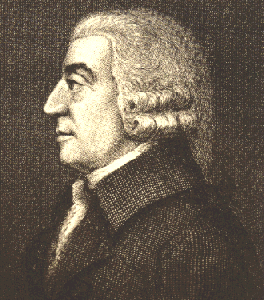
I can’t help but reading a good definition of “anticompetitive foreclosure” in this Adam Smith’s quote:
“To widen the market [NP’s note: through leveraging], and to narrow the competition [NP’s note: through exclusionary tactics] must always be against [the public], and can only serve to enable the dealers, by raising their profits above what they naturally would be, to levy, for their own benefit, an absurd tax upon the rest of their fellow citizens”.
Source: (1776) The Wealth of Nations, Book I Part III § 10.
New seminars in Madrid

This year’s edition of the EU and Spanish competition law course in Madrid has so far been a great success in terms of attendance, student’s evaluations and quality of presentations/discussions. Some of you have shown interest in the next seminars that will be held within the framework of the course, so here are the programs for:
– the seminar on recent developments in abuse of dominance and merger control (in theory I’m a co-coordinator together with Cecilio Madero but he’s actually the one who has put the program together) which will take place next Friday (click here: Seminar 24 February 2012);
– the seminar on the application of competition and state aid rules to public entities, coordinated by José Luis Buendía (Garrigues) and Jorge Piernas (EUI), and which will take place on March 1-2 (the program is available here: State aid and public intervention-1-2 March).
If any of you is interested in further info, you can contact me at alfonso.lamadrid@garrigues.com
The Friday Slot (5) – Jean-François Bellis

For this fifth edition of the Friday Slot, Chillin’Competition has interviewed a true master competition lawyer, Jean-François Bellis (Van Bael & Bellis, Brussels). The ITW tells it all, Jean-François is a person with many facets, i.e. litigator, entrepreneur, academic, teacher, etc. And the thing is, on all those fronts, he just stands out… It is a great honour for us to publish today his stimulating, inspirational interview.
“Oscar” of the best competition law book? Non-competition book?
Without question, the Van Bael & Bellis competition law book, now in its fifth edition, should win the prize! Seriously now, in my view, the most influential competition law book ever written is Robert Bork, “The Antitrust Paradox”, which so powerfully contributed to establishing the current accepted wisdom that the aim of competition law is to maximize consumer welfare. It is difficult to find a competition law book that has had as significant an effect on the practice of antitrust/competition law.
On the non-competition side, there is an embarrassment of riches. I have great respect for Orwell who, among other things, deserves the Oscar for the best opening line (“The idea really came to me the day I got my new false teeth” in “Coming up for Air”). But, as a lawyer, my vote will go to “The Trial” by Kafka. Quite fittingly, this book was one of the highlights of the course on literature in the first year of my law studies at the University of Brussels. Since I began practicing competition law, I had the impression of performing in it more than once.
“Oscar” of the best case-law development in the past year? “Oscar” of the worst case-law development?
The KME judgment issued by the Court of Justice on 8 December 2011 may turn out to be a landmark case in that it spells out the concept of full review in competition cases. To some extent, it mirrors the Strasbourg Court Menarini judgment issued on 27 September 2011 which affirmed the consistency with Article 6 of the Convention of administrative enforcement procedures provided that they are subject to full review by an independent court.
In terms of worst case-law development, I am concerned that the Court of Justice’s revisiting of parent liability issues last year may be generating uncertainty, and fear that this could potentially have unintended consequences in other areas of EU competition law (such as the possibility that Article 101 TFEU may be applied to intra-enterprise agreements between subsidiaries of the same group).
Antoine Winckler’s Quiz

Competition law quizzes are getting popular:
The International Committee of the ABA’s Antitrust Section is apparently running an Antitrust Trivia (thanks to Vera Sopeña for the pointer!)
As a follow-up of our quizz on the history of competition law, Antonie Winckler has proposed a quizz of his own to our readers:
He remembers having read somewhere that Baldus de Ubaldis – the greatest legal thinker of the Middle Ages – considered that the law against boycotts and restraint of trade was part of natural law, and thus pre-empted postive law and was universally applicable. Anybody finding the right quote is welcome to share a beer with Antoine.
As you see, the “beer reward” is becoming a tradition here 😉
Anthem

In her great fiction Anthem, Ayn Rand describes a word where humans cannot use the word “I” on pain of being sentenced to atrocities. This is part of a greater effort of the dictatorship to suppress the concept of individuality.
To some extent, EU competition law shares analogy with Rand’s novell. It is sometimes as if Commission officials were forbidden by the EU Courts’ case-law to use the language of economics. This could be allegedly part of a larger plan to undermine the relevance of economic concepts.
An example: in 2008, a Lithuanian Court asked the Commission whether the proof that an information exchange agreement infringed Article 101 TFEU was conditional on evidence that the market structure was “oligopolistic“. In accordance with Article 15(1) of Regulation 1/2003, the Commission released its opinion.
In an ideal world, where economic reasoning would freely inform legal interpretation, the answer would be a resounding yes.
Yet, according to the Commission, the case-law of the EU Courts does not explicitly request the proof of an “oligopolistic” market structure for a finding of an unlawful information exchange agreement. Given this, and in stark contradiction with modern economic theory, the Commission denies that “oligopoly” is a necessary pre-condition for a restriction of competition to occur in a such setting. Blinded by obedience to murky judicial court-speak, the Commission thus turns its back on a basic economic concept.
This is even more suprising given that in the following paragraph, the Commission itself recognizes that the level of concentration and the structure of supply are important features in the analysis.
Very disappointing.
Strike?

No post last Thursday, Friday and Monday, what happened? Did we try a strike (not at bowling, like on the pic above) to see how a 4 days WE looks like?
Nothing of this kind really: Alfonso and I just got insanely busy. Sorry for this.
Two things nonetheless sprung to mind in the past days:
1. Old (students) habits die hard. At a conference last week, I drove the competition John Turturo mad. I was chatting with my assistants in the back of the room, essentially commenting on speeches. He was working. He did not like it. Misbehavior from me. Am truly sorry.
2. DG COMP’s webpage on cooperation with national courts contains a wealth of relevant information on Article 15(1) and 15(3) of Regulation 1, i.e. requests for information or for an opinion + amicus curiae. It is very unfortunate, however, that this webpage is not translated in EU languages other than English. I can see the point of using English as the competition esperanto in Brussels, but when it comes to national courts seeking online information on what they can do, it would help to provide translation.
Antitrust Writing Awards

The Institute of Competition Law – the publisher of the journal Concurrences and the e-Competitions Bulletin – and George Washington University Law School, are giving, for the first time, Antitrust Writing Awards. Congrats to Concurrences (with whom, by the way, we have a “partnership” agreement) and to GW University for this great initiative.
Now, the competition for these awards takes place within two distinct relevant markets: there is a category for “Academic Articles” (articles published in academis journals) and another for “Business Articles” (published in professional magazines, alert memos or newsletters). As with all market definitions, this one also entails some debatable elements: in the category for “Academic Articles” thereare 5 pages online papers competing against 50 papers published on reputed journals? Do these belong within the same relevant market?
The decisions with regard to the shortlist of eligible articles were made by the Editorial Committee and then by the Steering Committe of the Institute for Competition Law. The final decisions on the winners are made by the members or the Board of the Institute, who take into account reader’s votes as registered by the Concurrences website.
Nicolas is nominated in the category for Academic Articles. You can click here to vote for his article on Credit Rating Agencies, the Sovereign Debt Crisis and Competition Law
P.S. I’ve never said this here, but if I wasn’t an antitrust lawyer I wouldn’t have mind being a campaign manager, so this is my chance to put at test the use of blogs in campaigning 😉
Students’ Bests

My ULg students took their oral exam last week. It went fairly well for most of them.
That said, as usual during exams, I heard a bunch of puzzling things. In response to a question on alternatives to fines for competition infringements, I got the following answers:
- Dissolution of the infringing company (or the “slayer” remedy) =>think of the consequences in industry-wide cartels;
- Bringing the infringing company under Commission control (or the “bureaucratic” remedy) => science fiction or just augmented reality?
- Divulge all patents and other trade secrets to other market participants, with the particular illustration of Coca-Cola abusing a dominant position (or the “an eye for an eye” remedy) => you steal market share, we steal your IPRs.
I forgot, I also had a very candid answer when I asked what could be done to foster private enforcement =>make justice free and forbid legal professionals from making money out of cases…
PS: I am the culprit. I spent countless hours encouraging them to be creative.
The Friday Slot (4) – Richard Whish

For this fourth edition of the Friday Slot, Prof. Richard Whish has taken the time to address our questions. As everyone knows, Prof. Whish is the author of the ultimate EU competition book, a book with a big B which is a model of clarity and accuracy. Amongst other things, in this ITW, Prof. Whish takes distance with the dominant view on Tomra and TeliaSonera and alludes to encounters with mutant economists. Thanks to him for accepting to appear in the Friday Slot. A great honour for chillin’competition.
“Oscar” of the best competition law book? And of the best non-competition law book?
Well, obviously I cannot say Whish on Competition Law! I greatly admire Oke Odudu’s The Boundaries of EC Competition Law for incisive and original thinking and for in-depth research. On procedure there is nothing to match the series of essays written by Wouters Wils and published in a series of books since 2002. As for other books, where to start! I suppose if it had to be just one I would go for George Eliot’s Middlemarch for a view of all things English (good and bad). I am not aware of a finer character in literature than Dorothea Brooke.
“Oscar” of the best case-law development in the past year? “Oscar” of the worst case-law development?
I very much liked the judgment of the Court of Justice in TeliaSonera, a view that is not widely shared, it would seem. To suggest that a margin squeeze cannot be an abuse in the absence of a duty to deal, to my mind, would emasculate Article 102 and to limit it to the control of monopoly rather than dominance.
Let’s do it like economists => assume that you could change 3 rules, principles, judgments, institutions in the current EU competition system. What would you do?
I wish that we could start over again on refusal to supply and on rebates. I am not a critical as some commentators about the current law in these areas, but I do think that it is difficult to explain quite how we got to where we now are. I have difficulties with Commercial Solvents, which is where the law on refusal to deal started: to what extent was the Court really concerned that Commercial Solvents had discontinued a customer who had become dependent upon it? The national laws on economic dependency do not, to my mind, qualify as ‘competition’ laws, but their existence has percolated into the competition rules. As for rebates, some of the judgments contain statements that suggest per se illegality, which cannot be correct. Tomra and Intel will be very important judgments on this: to what extent, I wonder, will the Commission’s Guidance document have an influence on the Courts dealing with those appeals?
A different point is that I think that changes are needed at the General Court as to the way that it conducts its review of Commission decisions: I am not thinking so much of the intensity of the review as the actual procedure.
New seminars in Madrid (and a secret)

I´m flying to Madrid today to speak tomorrow at a seminar coordinated by Eric Gippini and Fernando Castillo de la Torre (both from the European Commission´s Legal Service) within the XV European and Spanish Competition Law Course directed by Luis Ortiz.
The day program for tomorrow features (i) a discussion on “Investigative meaures and fundamental rights” with Ralf Sauer (European Commission´s Legal Service), Salomé Santos (British Foods), Rafael Baena (Ashurts) and Diego Castro Villacañas (Spanish Competition Authority); (ii) a panel on the functioning of the European Competition Network and the evolution of the decentralized enforcement system during 2011 with Ewoud Sakkers (Head of Unit at DG Comp), Rafael Allendesalazar (MLAB) and Diego Castro Villacañas (CNC); and (iii) a debate on novelties and case-law developments with regard to vertical agreements with Andrés Font (Gibson Dunn), Bernard Mongin (European Commission´s Legal Service) and myself. All the panel discussions will be moderated by Eric and Fernando. Registrations are now closed, but if any of our Spain-based readers is interested in attending you can drop me a line and we can try to arrange it.
Not that I´m objective, but coming to Madrid for this is always great fun. I´ll tell you a secret: one of the greatest attractives of coming to speak at this course are the post-conference dinner+drinks social events (in fact, Nicolas is still on a diet since his last visit two weeks ago; he´s back on Tuesday, so he´ll have to quit soon). The pic illustrating this post is actually from the entrance of the place where such events generally kick-off. (It´s also probably one of the places where I spend more time when I´m around, right after the office and home).
On February 24th there will be another seminar on “Recent Developments on Abuse of Dominance and Merger Control” coordinated by Cecilio Madero (Deputy Director General at DG Comp) and myself. Amongst other topics, this seminar will feature an interesting discussion on the prohibition decision adopted by the Commission in the Deutsche Borse/NYSE Euronext merger. The program for this seminar will soon be out. We´ll keep you posted.


