Chillin’Competition Conference 2019- Updated Program + Live Stream
The 5th Chillin’Competition conference is fast approaching!
We have received many requests for additional tickets, particularly from those of you on the waitlist. We can’t unfortunately accommodate any more attendees (Pablo is even concerned that we might not be able to accommodate those currently registered).
Here’s the good news: to make up for this, we have arranged for the conference to be accessibe via a Youtube live stream.
We will be posting a (functioning) link on the blog around 9.am next Monday that will enable you to follow all the action.
We have had to make a few tweaks to the program. Please see the final version below. Those watching from the office/home will at least be able to take a break at some point in the morning 😉
THE CHILLIN’COMPETITION CONFERENCE 2019
9.00-9.30: Registration
9.30-9.45: The 10-Year Challenge
Alfonso Lamadrid (Garrigues)
9.45-10.30: Keynote by GC President Marc van der Woude
10.30-11.30 TED@Chillin’Competition
Philip Marsden (Bank of England, College of Europe, CRA)
Frank Montag (Freshfields)
Jorge Padilla (Compass Lexecon)
Maurits Dolmans (Cleary Gottlieb)
11.30-12.15: Keynote by Commissioner Margrethe Vestager
12.15-13.30: 10 Years of Enforcement by the European Commission
Kim Dietzel (Herbert Smith Freehills)
Lars Kjolbye (Latham & Watkins)
Kai-Uwe Kühn (University of East Anglia and The Brattle Group)
Nicolas Petit (University of Liège)
Vanessa Turner
Chair: Lewis Crofts (MLex)
13.30-15: Lunch
15.00-16.00: A New Competition Law for a New Decade? Chillin’ with:
Renata Hesse (Sullivan & Cromwell)
Heike Schweitzer (Humboldt University Berlin, Special Adviser to Commissioner Vestager)
John Sutton (LSE)
16.00-17.15: Articulating the Effects-Based Approach
Christian Ahlborn (Linklaters)
Svend Albaek (European Commission)
Avantika Chowdhury (Oxera)
James Killick (White & Case)
Christian Riis-Madsen (GibsonDunn)
Chair: Pablo Ibáñez Colomo (LSE and College of Europe)
17.15-17.45: Coffee Break
17.45-19: Meeting or Shifting- The Burden of Proof
Eric Barbier de la Serre (Jones Day)
Kevin Coates (Covington & Burling)
Leigh Hancher (Baker Botts)
Kristina Nordlander (Sidley)
Nigel Parr (Ashurst)
Chair: Alfonso Lamadrid (Garrigues)
19-21.00 Drinks
NEW PAPER: Pay-for-delay and the structure of Article 101(1) TFEU: points of law raised in Lundbeck and Paroxetine

People sometimes ask me how much time I devote to the blog. And I almost invariably answer by saying that the correct question is how much I benefit from the blog.
I have just uploaded a draft paper on ssrn (see here). This is a piece I would never have written had it not been for the blog. It has been inspired by the many discussions on pay-for-delay we have had in the past few years.
The comments I received were invariably thoughtful, and were sometimes outright passionate. I learnt a great deal from them. Something I learnt was that, for better or worse, the message I wanted to convey did not always come across as clearly as I would have wanted it to. The paper just poured out of me in an attempt to bring clarity to the issues.
These comments also gave me the – right or wrong – impression that I had something to contribute to the debate. There is a rich line of case law addressing the relationship between Article 101(1) TFEU and intellectual property that had gone virtually unnoticed.
Of these cases, two of them – Nungesser and BAT (Toltecs-Dorcet) – provide, in my view, the structure to analyse the lawfulness of pay-for-delay agreements. Other crucial cases include Coditel II, Ottung and Micro Leader.
One of the points I wanted to clarify is that I am not interested in the outcome of individual cases. This is something I have often emphasised on the blog. In spite of this, many commentators assumed that I was challenging the outcome in Lundbeck.
That was never my intention. I will say more: it is very difficult for a moderately attentive reader of the Lundbeck decision to avoid the impression that the agreements at stake in the case were restrictive by object and deserved a fine. But again: I am interested in principles, not outcomes.
Another point that I felt needed clarification: some commentators thought I endorsed Roberts’ dissent in Actavis. Nothing further from the truth. The more I think about theat dissent, the more I am persuaded that it is intellectually indefensible.
Stephen Breyer’s majority opinion, which rejected the prima facie unlawfulness of genuine settlements and proposed a case-by-case approach, comes across as more reasonable (more on this below).
As rightly observed by one of our commentators, John Roberts’ dissent seems to be based on the idea that, since patents are presumed valid, we can presume that, in the context of a dispute, they have been infringed. But there is no such thing as a presumption of infringement.
Main points raised in the paper
On the notion of (potential) competition and restriction by object
So how does my paper go about the analysis of pay-for-delay agreements? I thought the right approach was to go step by step: I start from the fundamentals and then progressively move to the specifics of Lundbeck and Paroxetine.
Thus, I discuss the fundamental notions at stake in these cases (competition, potential competition and restriction by object); I move on to the discussion, in general, of the relationship between Article 101 TFEU and intellectual property to finally explain the controversy behind Lundbeck and Paroxetine.
On the fundamentals, I believe the case law is consistent and unequivocal since the 1960s. The Court defined the notion of competition early on, in Societe Technique Miniere.
It is clear from this case and subsequent ones that the notion of competition under the Treaty should be understood as meaning ‘actual or potential lawful competition which would have existed absent the practice’.
One of the implications is that the evaluation of the counterfactual is of course relevant when assessing restrictions of competition (whether by object or by effect). I recently addressed this question on the blog (see here).
Another implication is that the evaluation of the object and/or effect of a practice is a case-specific inquiry. Restrictions by object do not exist in the abstract, and can never be established without considering the relevant economic and legal context (both AG Kokott – see here – and AG Bobek – in his Opinion discussed here – have recently emphasised the importance of context).
On the relationship between Article 101(1) TFEU and intellectual property
There is a wealth of case law addressing the relationship between Article 101 TFEU and intellectual property.
Nungesser provides the principle. The Court distinguished between two scenarios: (i) one in which the scope of the agreement does not go beyond the range of acts that the right holder would be able to authorise or prohibit by virtue of its intellectual property and (ii) one in which the agreement allows the right holder to obtain protection that it would not have been able to obtain by enforcing its intellectual property.
Agreements falling under the first (i) scenario are not necessarily restrictive of competition, and may sometimes (e.g. Coditel II, Micro Leader) fall outside the scope of Article 101(1) TFEU altogether. Agreements falling under the second (ii) scenario (e.g. Ottung) may restrict competition, and are often restrictive by object.
The principle set out in Nungesser was applied to intellectual property settlements in BAT (Toltecs-Dorcet). The Court, uncontroversially, concluded that the settlement at stake in the case was not a genuine one, and thus pertained to the second (ii) scenario.
Indeed, BAT had sought to obtain via the settlement what it would not have been able to obtain via the enforcement of its (dormant) trade mark. The object of the agreement was the restriction of competition.
On the application of the principle to pay-for-delay agreements
The framework described above fits pay-for-delay cases particularly well. One can distinguish between settlements that address a genuine patent dispute and those that do not. The object of the former would not be the restriction of competition; the latter are likely to infringe Article 101(1) TFEU by its very nature.
Lundbeck shows how this framework would work in practice. The originator itself admitted during the proceedings that its process patents did not block all possibilities of entry. Accordingly, it sought to obtain by means of the agreements a degree of protection that its patents would not have afforded. The conclusion that the agreements in Lundbeck are restrictive by object is in principle inevitable as a result.
Why the controversy, then? Again, it is not about the outcome. The reasoning of the Commission in Lundbeck, and of the CMA in Paroxetine, suggests that a settlement addressing a genuine dispute would also be restrictive by object.
It follows from this reasoning that there would be a prima facie infringement of Article 101(1) TFEU even when it has not been shown, to the requisite legal standard, that generic producers need to rely upon a patented process to enter the market.
As I have suggested in the past, the approach in Lundbeck and Paroxetine heralds a new relationship between competition law and intellectual property (these are not the only cases, hints at this new relationship can be found elsewhere).
This new approach is not obvious to square with the principle whereby EU law does not question the existence of the rights, but only their exercise. It is also difficult to square with the principle whereby registered titles are presumed valid.
Exciting times ahead! I very much look forward to your comments.
As ever, I am delighted to clarify, in accordance with the ASCOLA declaration of ethics, that I have nothing to disclose.
Shortcuts and Courts in the Era of Digitization

The October issue of Competition Policy International’s Antitrust Chronicle featured a short article of mine titled “Shortcuts and Courts in the Era of Digitization“. It is now freely accesible here, courtesy of CPI:
CPI-Shortcuts and Courts in the Era of Digitization (Lamadrid)
The article sketches some thoughts regarding the proposals to facilitate competition law enforcement in digital markets that will be familiar to readers of this blog, using the Special Advisers’ Report as a conducting thread. It focuses mainly on two related elements: the proposals to reverse the burden of proof in certain cases, and the vision of Courts and consolidated case law as an inconvenient.
My presentation on fiscal State aid (tax rulings and more) at Les Mardis de la Concurrence
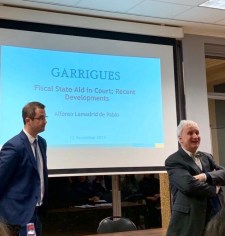
Fiscal State Aid In Court (Brussels, Tuesday 12 November)

In a week’s time I will be delivering a talk at the ULB’s great (except for this session) conference cycle “Les Mardis de la concurrence”, focusing on fiscal state aid, arguably the area of competition law where the case law of the EU Courts has recently experienced a more significant evolution.
We will do our best to extract clear lessons the most recent line of case law (including on tax rulings), and to better understand how the Courts and the Commission are likely to address these questions in the future. Anyone interested in attending and joining the chat can still register following the instructions available here.
Very much looking forward!
Chillin’Competition 2019- REGISTRATION IS NOW CLOSED

Thanks so much once again! Immediately after opening up registrations (and in spite of a malfunctioning link) the conference was already sold out and we have 300 people in the waitlist. Within the first 10 minutes we had over 10.000 clicks, which sets a record.
We know that many people experienced technical trouble during the first 4 minutes while others were able to register. Our apologies. We don’t know what this was due to, but we’ll do our best to release as many tickets as possible from the waitlist.
Thanks a million once again; we hope the conference will live up to the expectations!
Meeting and Shifting- The Burden of Proof (in Digital and Beyond)

This is the title of the last panel we will be hosting at our upcoming Chillin’Competition conference. The proposals floated to shift the burden of proof in relation to certain companies and practices were also the subject of a topical piece published yesterday in the Financial Times.
They were also the main issue I discussed in this recent piece for Competition Policy International: “Shortcuts and Courts in the Era of Digitization” (accessible to CPI subscribers; in a few days we will also make it freely available here). And it was also the topic on which I focused my intervention at a talk that Pablo and I had a couple of weeks ago with the great staff of the EFTA Surveillance Authority.
In spite of recent case law, talks like this one, books like this one, and papers like this one [note the relevant contributions from two brilliant young women in academia], there’s still a surprising amount of confusion as to what this burden entails, and as to when it falls upon the authority/plaintiff and on the defendants. These are questions we will address at our conference.
I say that the reigning confusion is surprising because most complex cases eventually hinge on this question. This is THE obstacle that authorities/plaintiffs need to satisfy in any given case. At times this has not seemed to be an issue, because enforcement has traditionally focused on clear-cut cases, and because in those cases we resort to presumptions that alleviate the burden (e.g. the “by object label”).
But the greater the complexity and the competitive ambiguity of the practice, the greater the importance of the burden of proof. Indeed, a number of decisions have been annulled with regard to more ambiguous practices (e.g. for failing to properly assess the relevant legal and economic context or the counterfactual or, in other words, for trying to shift the burden too soon).
It is certainly no coincidence that there are currently two opposite trends in our field, and that these changes are being suggested precisely at the time where EU Courts are placing greater emphasis on the Commission’s obligations in this regard (this was actually the lesson of Intel and Cartes Bancaires). And it is not surprising that many of the people suggesting these changes also advocate “Taking antitrust away from the Courts” (that is actually the name of the piece!).
And it is by no means an accident that the current proposals relate to practices that have ambivalent effects (my take on that is available here). This would not be necessary in situations (e.g. cartels) where a practice can only do harm. This is not about presuming harm in the light of clear lessons from economics and experience. It is about presuming harm absent those lessons, or against those lessons. It is about a dogma, believing in what we cannot see or prove. It may be somehow contradictory to argue that there is an abundance of obvious anticompetitive practices in the digital sector, but then recommend that their existence and anticompetitive potential be presumed, not shown on the basis of evidence. If a practice is truly anticompetitive, the evidence will be there.
But, of course, in the era of digitization we cannot bother with complexity, we have grown accustomed to immediate solutions and easy fixes that address our impulses.
The problem, however, is that the law doesn’t really work like that. As observed by President van der Woude in in this must-read JECLAP piece:
“[W]here the contested conduct of the public authorities is repressive in nature, it is hard to conceive, at least in free democratic societies, that citizens and firms can be condemned on the basis of estimates, approximations or guesses, even if they are informed ones. Uncertainty must then be balanced against the requirements of the presumption of innocence […]. [T]his balance is struck by relying on legal concepts, such as the burden of proof”.
Shifting the burden of proof in a quasi-criminal context is unheard of in jurisdictions subject to the rule of law and would set a first and dangerous precedent. Would the European Court of Human Rights, the EU Courts and Courts from Member States ever accept overturning the presumption of innocence? And, in the most unlikely scenario that they did, how could one confine ripple effects beyond digital platforms, and indeed beyond competition law?
Implementing these changes would certainly make enforcement much easier. No need to bother with foreclosure, effects, indispensability or causality. We could do away with those (and, in passing, with lawyers and judges too, as they also are annoying). I guess I have more trust in competition authorities: they don’t need this to bring up good cases.
Implementing these proposals would radically transform competition, but at a cost to basic legal principles that is just too high.
Chillin’Competition Conference 2019- The Program

It’s time to start disclosing some details:
The Chillin’Competition conference marking our 10th anniversary will take place on 9 December 2019 at L’Arsenal (Chaussée de Wavre 950, 1040 Bruxelles, pictured above). Registrations will open up next Tuesday (5 November) at 10.am Brussels time via a link that will be made available on the blog.
We are thrilled that the conference will feature keynote interventions by Commissioner Vestager and General Court President Marc van der Woude. We are also very grateful to all speakers for accepting our invitation to focus on what we believe are the current key themes in competition law, and to our soon-to-be disclosed sponsors (anyone interested can still drop us a line).
And this is this the program:
THE CHILLIN’COMPETITION CONFERENCE 2019
9.00-9.30: Registration
9.30-9.45: The 10-Year Challenge
Alfonso Lamadrid (Garrigues)
9.45-10.30: Keynote by GC President Marc van der Woude
10.30-11.30 TED@Chillin’Competition
Philip Marsden (Bank of England, College of Europe, CRA)
Frank Montag (Freshfields)
Jorge Padilla (Compass Lexecon)
Maurits Dolmans (Cleary Gottlieb)
11.30-12.15: Keynote by Commissioner Margrethe Vestager
12.15-13.30: 10 Years of Enforcement by the European Commission
Kim Dietzel (Herbert Smith Freehills)
Lars Kjolbye (Latham & Watkins)
Kai-Uwe Kühn (University of East Anglia and The Brattle Group)
Nicolas Petit (University of Liège)
Vanessa Turner
Chair: Lewis Crofts (MLex)
13.30-15: Lunch
15.00-16.00: A New Competition Law for a New Decade? Chillin’ with:
Renata Hesse (Sullivan & Cromwell)
Heike Schweitzer (Humboldt University Berlin, Special Adviser to Commissioner Vestager)
John Sutton (LSE)
16.00-17.15: Articulating the Effects-Based Approach
Christian Ahlborn (Linklaters)
Svend Albaek (European Commission)
Avantika Chowdhury (Oxera)
James Killick (White & Case)
Christian Riis-Madsen (GibsonDunn)
Chair: Pablo Ibáñez Colomo (LSE and College of Europe)
17.15-17.45: Coffee Break
17.45-19: Meeting or Shifting- The Burden of Proof
Eric Barbier de la Serre (Jones Day)
Kevin Coates (Covington & Burling)
Leigh Hancher (Baker Botts)
Kristina Nordlander (Sidley)
Nigel Parr (Ashurst)
Chair: Alfonso Lamadrid (Garrigues)
19-21.00 Drinks
Comments on Android (II): follow-up questions on market definition (+ thanks for the comments!)

I received wonderfully interesting comments to my first post on market definition in Android . That was really the blog at its best. I am really grateful
I felt I would not do full justice to the involvement of these readers if I just added a comment of mine to the pile. The insights are so powerful that it makes sense to give them more exposure (and hopefully lead to yet more comments).
Would a merger between Apple’s and Android’s app stores be unproblematic?
Chris was the commentator to break the ice. The inevitable consequence of the definition of a separate market for Android’s app stores emerged from our exchange. Taken to its logical consequences, Chris explained, the Commission’s approach implies that a merger between Apple’s and Android’s app stores would be unproblematic.
This is a counterintuitive outcome. The fact that it is counterintuitive, however, does not mean anything. Rigorous economic analysis often surprises us with outcomes that contradict our instincts. However, this conclusion could also mean that there is something funny going on.
Any thoughts in this regard would be most welcome. If there is indeed something funny going on, what is it? One possibility is that the assessment of competitive constraints cannot focus on switching alone. A second possibility is that there is scope for refining the assessment of switching (which is what Nicolas was suggesting in his comment). I will focus on the first point.
Competitive constraints: is it all about switching?
The idea that Apple’s app store does not exercise a sufficient constraint on Android’s app store (paras 652-673) relies, by and large, on switching (switching from the end-users’ perspective and the app developers’ perspective).
My immediate question here is: is there something beyond switching opportunities that we may need to consider when assessing competitive constraints? Another commentator, Andrew, gave an excellent example on supermarkets that comes across as a wonderful starting point for this discussion.
Suppose there are two supermarkets that do not compete at the retail level: each one operates in a different geographic area. However, they compete on the upstream market where they buy inputs from providers. Suppose, further, that they are the only buyers on the upstream markets, so suppliers have nowhere else to go, and cannot give up either.
Would a merger-to-monopsony between the two supermarkets of the example be unproblematic? My instinct tells me that, in all likelihood, such a merger would be blocked absent appropriate remedies (and Gianni, in his comment, makes it clear that of course it would be blocked). As a telecoms nerd, the Liberty Global/Ziggo merger, the underlying facts of which are not fundamentally different from those sketched by Andrew, came to mind.
Liberty Global/Ziggo appears to confirm that it is not all about switching (it does not seem to be framed in terms of switching anyway). The Commission identified a series of potential negative effects that would arise even when the suppliers lack the ability to switch from one to the other (or have no choice but to deal with the two buyers). The question was whether the transaction would increase the buyers’ bargaining power.
If a merger-to-monopsony could be problematic even absent switching opportunities for suppliers, perhaps competitive constraints faced by powerful buyers are indeed manifested in other ways (that is, it is not all about switching).
If this is the case, my question is: what are these other ways? Is it, for instance, buyers’ ability to refuse to carry certain products from certain providers? Why would a merger-to-monopsony reduce competitive constraints if suppliers lacked switching opportunities prior to the transaction?
Thanks a lot in advance for sharing your thoughts.
And please feel free to comment on Nicolas’ points. I understand his comments as suggesting that it may be tricky to define markets involving goods such as smartphones, which are not acquired everyday.
It could be interesting to compare the analysis in Android with the analysis of retail markets in the network industries (after all, end-users do not change providers every day, and may be faithful to some providers, in particular incumbent ones).
If you have found an embarrassing number of typos, at least you should know why by now.


 Chillin'Competition