A thought on Microsoft/Nokia

As you know, a few days ago the European Commission unconditionally authorized the Microsoft/Nokia deal. I’m looking forward to reading the decision, which isn’t yet public. Whereas I expect to see nothing odd in there, a doubt did spring to mind when reading the press release last week.
When explaining its approach to the concern that Nokia could become a troll-like entity, the Commission’s Press Release says the following:
“The Commission considers that any possible competition concerns, which might arise from the conduct of Nokia, following the transaction, in the licensing of the patent portfolio for smart mobile devices which it has retained falls outside the scope of the EU Merger Regulation. The Commission cannot take account of such concerns in the assessment of the current transaction. Indeed, Nokia is the seller whereas the Commission’s investigation relates to the merged entity. However, the Commission will remain vigilant and closely monitor Nokia’s post-merger licensing practices under EU antitrust rules, in particular Article 102 (…)”. (Emphasis added).
Please correct me if I’m wrong, but isn’t that a wrong/arguable over-simplification? (although, to be sure, it wouldn’t be a crime for a press release to over-simplify). Does merger control really relate solely to the merged entity to the exclusion of other actors in the market? Isn’t it rather about the effect that the transaction may have on the structure of the market? I mean, can’t the Commission assess the effects that a concentration would cause on the market power of parties to the transaction as well as on that of third parties? Perhaps the press release only intended to refer to the Commission’s remedial powers, and not to its assessment powers, but even assuming that, the short explanation may be incorrect. Although infrequent, third party post-merger conduct may be potentially relevant in deciding a case.
Look, for instance, at recital 25 of the horizontal merger guidelines “under certain circumstances, concentrations involving the elimination of important competitive constraints that the merging parties had exerted upon each other, as well as a reduction of competitive pressure on the remaining competitors, may even in the absence of a likelihood of coordination (…) result in a significant impediment to effective competition”.
Don’t get me wrong: I’m not challenging the outcome of the Decision (it seems prima facie reasonable for the theory of harm at issue in that case to be monitored ex post), but, in my view, the explanation would have had to do with “causality” (à la Tetra Laval or GE/Honeywell), not with the scope of merger control. Perhaps this would seem to make no practical difference in principle (as we’ve learnt recently, in real life ends justify means, and reasonings aren’t really worth paying attention to), but inconsistencies in the formulation of policy positions might eventually come at a cost.
P.S. Following the advice of some of you, last night I created a Twitter account: @LamadridAlfonso; it’d now be nice to know how to use it and what for!
[Image possibly subject to copyright]
The Concept of Abuse in EU Competition Law
Note: The new release of Competition Law Journal features a book review that I wrote this past summer about Pinar Akman’s interesting book: The Concept of Abuse in EU Competition Law: Legal and Economic Approaches. I took advantage of the opportunity to voice out some perhaps not-so-frequent views on competition law in general and Article 102 in particular, mainly casting doubt on the convenience of upholding efficiency as its single, sacred, overarching goal and raison d’être. It is reproduced below:
The interest, apparent complexity and the peculiar nature of competition law stem to a great extent from the abstract nature and impreciseness of its main concepts. Most other areas of law have settled and well understood central notions. Competition law, by contrast, is premised upon particularly nebulous or malleable concepts (fortunately for those of us that make a living out of it, and perhaps not so much for those directly subject to it). Ask most lawyers about what a ‘restriction of competition’ is and you will get a surprising variety of theories, and most likely some striking silences. And whereas competition law concepts are open enough to accommodate different – often conflicting – interpretations, no other concept gives rise to the same level of controversy as the notion of ‘abuse of dominance’.
Indeed, despite longstanding efforts – including some notable recent ones by enforcers on both sides of the Atlantic – we still lack a precise idea of what an abuse of dominance is. Moreover, it has become common for partisans of different schools or viewpoints to point at the obvious irrationality of their counterparts: those ‘irrational ordoliberals’ on the one side, or those ‘irrational neoliberals’ on the other, both cross-criticized for obviously lacking any merit in their arguments. Article 102 elicits passions that move discussions away from ideally Cartesian legal debates and closer to those touching on more profound and vital issues such as religion, politics and football.
Our inability to come up with satisfactory rules to distinguish legitimate and illegitimate unilateral conduct by dominant firms has provided fertile ground for the creativity of both practicing lawyers and academics (and, to be sure, of competition enforcers as well). Focusing only on the academic domain, Pinar Akman’s book is preceded by an endless list of publications having as their object – but perhaps not as their effect – the clarification of Art 102 TFEU.
Against this background, Pinar Akman’s book stands out as a particularly original contribution to this debate, and one that is definitely worth reading. The book is very innovative in its approach, it is well written, and it visibly is the result of thorough research, reflection and drafting. Akman’s work is deliberately theoretical; it is not aimed at providing a systematic and thorough account of cases; it stays true to its stated purpose of proposing a ‘completely fresh approach’ to Art 102 TFEU, and it does indeed submit thought-provoking ideas.
The Concept of Abuse in EU Competition Law is grounded on the author’s arguable assumption that “the approach that has been adopted by EU authorities to date is far from desirable or appropriate and sometimes is even far from rational“. Consistent with this critical stance, the book seeks not to provide an analysis of the case law and decisional practice, but rather to propose its radical overhaul. This is boldly announced in its very first paragraph:
“The reader of this book is invited to put to one side her preconceptions of the prohibition of abuse of a dominant position in Article 102 TFEU, in particular those directly resulting from the judgments of the Court of Justice (ECJ). Fortunately, this is not asking for too much; after all, the ECJ is not legally bound by precedent.”
It is often said that the first phrase in any literary work should create a tension prompting the reader to continue the story. I acknowledge that the bold view of precedents as preconceptions made me read the rest of the book with increased interest.
News

Next week:
- On 17 December, we’ll have a GCLC lunch talk on the Aegean/Olympic merger decision. S. Simon (COMP), B. Durand (RBB) and A. Guttermuth (Arnold & Porter) will be our speakers. Registration here.
- On 18 December, we will have the graduation ceremony of the Brussels School of Competition. This is an open ceremony, and you can register here. There will be tons of good food and top notch tier antitrust lawyers. Not sure which of the two is the seller :). Above, some of last year freshly graduated studs.
Recently, our friend David Henry and his friend David Ashton have published a timely, thorough, thoughtful book on Competition Damages Actions in the EU. The book is impressive, it makes a thorough exploration of how the main EU MS have dealt with antitrust damages to date. Congratulations to them.
Yesterday: I was at a conference in Paris giving a presentation on IP and antitrust law. And I finally spoke of lions, black swans and butterflies. For more, see below (2 files, read 1 before 2).
Presentation ASPI – Rappel des grands principes applicables à la relation DEC-DPI (2) Presentation ASPI – Rappel des grands principes applicables à la relation DEC-DPI (1)
Thought of the day

The Law and judicial review would improve significantly if Court submissions were public.
The ultimate conference on competition law and technology
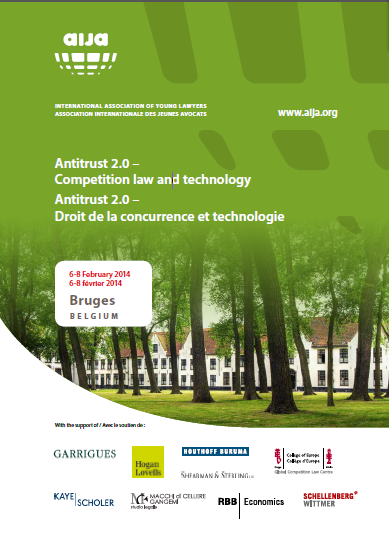
As anticipated a few days ago, on 7-8 February AIJA -with the collaboration of the College of Europe- will be holding a two-day conference on: Antitrust 2.0- Competition and Technology.
The conference will cover all hot issues in current antitrust enforcement in the IT sector, and will feature an impressive line-up of panelists (and then also Nicolas and myself).
It will be very much worth the visit to Bruges. The program is available here: Antitrust 2.0- Competition law and technology
P.S. Two other not-to-be-missed events (ones that I’ve been anxiously awaiting for quite some time) will be taking place in the next 24 hours: see here and here 😉
AG Wathelet’s Opinion in the Greek lignite case

The Opinion of Advocate General Wathelet in the very interesting Greek lignite case came out yesterday. This is the second time in recent weeks that the AG’s Opinion makes an impact in the competition scene with a tightly argued proposal (the previous one was his Opinion in Teléfonica).
You might remember that sometime ago we held our first and so far only ménage à trois debate precisely in relation to the General Court’s Judgment in the Greek lignite case:
For the moment, the AG’s Opinion essentialy sides with what José Luis Buendía wrote in his contribution to this debate a year ago (see here), and criticizes the solution adopted by the General Court.
There are however other very valid contrarian arguments, all brilliantly outlined in the pieces we published from Marixenia Davilla (part I ), and Assimakis Komninos (part III).
Television Rights, Matches – pun intended – and Bad Competition Law
[Guest post by Pablo Ibañez Colomo]

It would seem that the Spanish super-quango is more active than one would have assumed (in particular given what is currently going on within the tax authority of the country). The newly-created CNMC has fined four football teams (including Real Madrid and Barcelona) and the broadcaster Mediapro EUR 15 million for concluding exclusive licensing agreements for a period exceeding three years. Such terms contravened a previous decision adopted by the – then – CNC in 2010.
The case is interesting, first, because the Spanish government passed (in 2010, at pretty much the same time that the original decision was adopted) legislation that set a four-year term for exclusive licensing agreements between teams and broadcasters. One could claim that, insofar as the contentious agreements complied with the relevant sector-specific legislation, they were concluded in good faith. Accordingly, the fine would be unjustified. In light (pun intended) of Consorzio Industrie Fiammiferi (pun intended, I’m on fire!), it is clear, however, that this is not a valid defence. Legislation did not preclude undertakings from concluding agreements for a shorter period and thus from complying with Article 101 TFEU (which was clearly applicable in this case).
A second reason why the case is interesting is because it shows that the three-year limit for exclusive licensing agreements is now set in stone. There is no reason why this should be the case. A three-year term is not necessarily pro-competitive. It all depends on the context in which the licensing agreement is concluded. If the goal of this bright-line rule is (as I assume) to preserve the contestability of markets for the acquisition of television rights, then it may sometimes be too short. A new entrant (as BSkyB was back in the early 1990s) may need a longer period to reduce uncertainty and recoup its investments. By ruling out any flexibility, a rigid interpretation of Article 101(1) TFEU can very well have the perverse effect of protecting the incumbent. These are the problems of applying competition law as regulation, which I highlighted elsewhere, and of assuming that UEFA Champions League, Bundesliga and Premier League were rightly decided, in spite of the overwhelming evidence suggesting the opposite.
An eventful day

On 20 November we wrote a post on cartel fines saying the following:
“In spite of temporary appearances, though, one should not expect these figures to remain as they are. The upcoming LIBOR decision will certainly inject some significant (record breaking?) “capital” into this years’s numbers. On top of that, there appear to be a number of cartel decisions stuck somewhere in the pipeline (interestingly, only one cartel decision has so far been adopted in 2013)!.
We got it right (not that it was very difficult):
On the 27th, the Commission adopted a cartel decision fining North Sea shrimp producers [BAD JOKE ALERT] -what you’d call shellfish cartellists- with 28 million euros.
And yesterday, the Commission imposed the highest fine ever (1.7 billion euros) on a number of banks within the framework of the LIBOR investigation (still ongoing in relation to a number of parties who chose not to settle).
An interesting coincidence: yesterday representatives of the troika “advising” Spain on economic issues recommended that banks avoid any price wars (no kidding). Anyone sees mixed signals??
Also yesterday, the Commission unconditionally authorized the Microsoft/Nokia deal. It’ll be interesting to appeal (this time I’m kidding… or not) read the decision once it’s published 🙂
Finally, yesterday we had a reception to celebrate the launching of the procedural bible. A great evening all round.
The Groupe Gascogne Judgment (see both sides of the story)

Last week I wrote a post about the Groupe Gascogne Judgment (and other stuff) which has elicited some interest. Somehow oddly, I will now present counter-arguments against all those who… actually agreed with me.
Given that I wrote about the Judgment within minutes of its publication I obviously hadn’t thought the issue through. My initial reaction was (and regarding these points it still is) that by endorsing the De Grüne Punkt solution (i.e. choosing actions for damages as the procedural path to compensate breaches to the right to be judged within a reasonable time) instead of the Baustahlgewebe one (under which the ECJ itself would reduce a fine on account of the said breach when ruling on an application brought before it), the Court of Justice was adopting the less practical solution, and one that could provoke strange situations. Some of you have developed this last point in several comments to that post.
Now, after some reflection (although not much, to be frank) I think I may see what the Court and one of the commentators to the post meant, even if the Judgment’s reasoning may perhaps not have been crystal clear (please note the understatement).
In my post I only gave one view, and I believe that it’s good that readers also get to see the contrarian arguments. Not that I’m second guessing myself, but I don’t like it when we criticize Judgments/decisions without trying to understand first the reasons underlying the choice of a given approach (believe it or not Judges, clerks and Commission officials are actually clever enough not to be producing absolute nonsense all the time, as some lawyers like to claim). In other words, in some cases they may choose the wrong solutions (particularly if they ever rule against me in one of my cases -not that this actually would ever happen-; please note the implicit advertising claim), but there are always reasons for every approach they chose, and it’s healthy for us to try to identify them and debate them on their merits.
Cutting to the chase: it could be argued that endorsing Baustahlgewebe would have implied creating a specific regime that could only address the problem (a) only in competition cases [given that it is the sole area where the Commission enjoys the power to impose sanctions; in all other cases (frozen assets, for instance) actions for damages would be the only practicable solution], and (b) only in cases where a given company were to lose a first instance appeal before the General Court. Also, c) an assessment of damages by the ECJ would require it to rule on factual issues (namely harm quantification), when its jurisdicion is limited by the Treaty to points of law only. Furthermore, d) by providing that excessive delay in itself may open the door for an action for damages/a remedy, the ECJ could be effectively avoiding the possibility that “victims” might go to the ECHR (according to the ECHtR’s case law, there’s no “victim” in the sense of Art. 34 of the ECHR when the national legal system already envisages a remedy/compensation for the breach).
I can see how all these might have resonated within a Court like the ECJ. And it is probably true that Gascogne may be more “legally perfect”, albeit arguably at the cost of practicality and risking the odd situations pointed out in the previous post.
In spite of those perfectly valid arguments, I think I liked other solutions better, for instance:
a) one under which both Courts could assess the existence of excessive delays without it being necessary for parties to bring an additional action (the Commission, in fact, has done this in several past cases, and Courts could too). This is not legally unorthodox; it would not not be a matter of damages as such, but a reason to mitigate an initial sanction made more burdensome by the passing of time in the absence of judicial review. A solution of this sort is common to many national criminal law systems and is justified not on the actual damages suffered, but rather on the fact that there was an additional element (excessive time) subsequently added to the intended outcome of condemnation (i.e. the sanction). To counter-argue again against myself: admittedly, the quasi criminal nature of competition law may not be criminal enough for these purposes.
or
b) a compromise, middle-way and probably less legally controversial solution under which the ECJ would be competent to declare a violation of the right to a fair proceeding by account of excessive delays on the part of the GC (as it arguably did in this specific Judgment). Only quantification would then be left to the GC itself should the party wish to lodge an additional action for damages. For full disclosure: this is an alternative solution that we’re actually advocating before the ECJ in a pending case. But it’s reasonable, isn’t it? 😉
The Unintended Consequences of the Case Law on Restrictions by Object

On second thoughts, the recent bad case law on the notion of “restriction by object” may incidentally, and unexpectedly, fetter the margins of the Commission, and in particular its ability to handle all cases under the obese Article 9 procedure.
As hinted recently by DG Italianer in a most interesting speech, cases such as Irish Beef (C-209/07), Expedia (C-226/11), Slovak Banks (C-68/12) and Allianz Hungary (C‑32/11) all suggest that agreements which are devoid of the “obvious” capacity to harm competiton are nonetheless “restrictions by object” because they are “serious” violations of the law.
In other words, those infringements are restrictions by object because they are sinful – in competition cases, the Court says “by nature injurious to the proper functioning of normal competition” – so sinful that they should be prosecuted even absent anticompetitive intent or effects.
This line of judicial precedents brings restrictions of competition close to the notion of “infractions objective” known in criminal law. Take murder: you can be convicted of homicide even if you unsuccessfully or unwittingly try to kill someone (in some legal orders, it is even illegal to shoot a dead body). Closer to competition law, take insider trading. You can be sentenced even if you use insider information unknowingly or ineffectively.
The bottom line: such infringements are so morally sinful that they should be prosecuted just for the sake of it. Regardless of their impact. Regardless of their motives. Full stop.
Now, let us revert to competition law. If the concept of a restriction by object means infringements that are morally sinful or morally so “serious” that they should be unlawful for the sake of it, then the Commission should no longer be free to settle such cases and decline to reach a finding of infringement.
This is the rule applied in most criminal law systems, where in principle the gravest infringements (eg crimes such as homicide, rape, etc.) cannot be subject to settlements.
The same should apply in competition proceedings. Restrictions by object ought to be treated under Article 9. If restrictions by object are that bad, then the sole procedural way to handle them is under Article 7 . Full stop.


