Book Review – Soft Law in Court
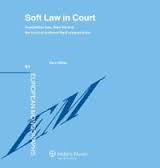
Oana Stefan (HEC Paris) has kindly sent us a copy of her book on soft law in competition and state aid law.
This book is the first monograph ever devoted to this issue.
Amongst other things, the book uses quantitative data to confirm that the judgments of the EU Courts abundantly refer to soft law instruments.
It also argues that the distinction between binding and non binding effects is too crude.
Lastly, it shows that the EU courts have created legal hybrids when endorsing soft law instruments on the ground that they are the expression of general principles of law. This generates, in the author’s words, a “judicialization” of soft law.
A must read. Apparently, Oana will in the future focus on how national courts deal with soft law instruments.
A full description of the book can be found here.
Two final remarks. First, I’d love to read Oana’s views on the appalling Expedia judgment (Expedia Inc v Autorité de la concurrence and Others C-226/11). Second, this book review does not mean that we are “sokolizing” this blog. Our tacit understanding with Dan is that he focuses on the scholarship reviews, we concentrate on the rest (including the nonsense).
Cases that never will be (I) – Hynix (Case T-148/10)

Last week one of the most knowledgeable people in the EU competition law world (Commission official whose name I can’t disclose) tipped me to a new series of blog posts:
His words were “someone should one day write on a blog the story of competition cases that could have had a significant impact on the law had they not been withdrawn”. Since the number of competition law bloggers is not that high (even though it’s rapidly increasing…), and since I was the addressee of the message, I sort of got the point.
Actually, I very much like the idea of writing about cases that never were or, rather, that never will be.
There are a few candidate cases to be discussed; a non-exhaustive tentative list of non-cases could include: Siderca, Chi Mei, Suez-Environment, Formula One, Oulmers, BIC Deutschland, Balog or Van der Weerd. [Additional suggestions would be welcome].
Today we’ll start with Hynix (Rambus), a case in which the hearing was scheduled for 2 July but that was withdrawn a few days ago following a settlement.
The Judgment that will never come to light in this case would have constituted a most important precedent in relation to some important general enforcement issues, as well as in relation to an eventual judicial review of the current investigations concerning Google or Samsung.
A bit of background:
In 2002 Hynix filed a complaint alleging that Rambus had engaged in deceptive conduct in a standard setting procedure in relation to DRAM chips by not disclosing the existence of the patents and patent applications which it later claimed were relevant to the adopted standard, and that it had later charged excessive royalties for the use of those patents (i.e. royalties higher than those that it would have been able to claim had it not engaged in deceptive conduct). This is what is generally referred to as “patent ambush”.
The case was interesting because the deceptive conduct at issue had made Rambus acquire dominance (it preceded dominance), and the charging of high royalties could be regarded as the natural consequence of such dominance. Given that EU law does not target “monopolization” practices (those use to achieve dominance), the Commission had attempted to close this enforcement gap by targeting exploitative pricing under Art. 102 under the argument that dominance had been unlawfully attained. This was a brave and controversial move on the part of the Commission.
On 27 July 2007 the Commission adopted a statement of objections setting out its concerns. Rambus responded to the SO and a hearing was held.
Almost two years later, however, Rambus submitted preliminary commitments, those were later market-tested, revised, and eventually made binding on December 2009 (in a nutshell, Rambus committed (i) not to charge royalties for the two standards adopted while Rambus engaged in the deceptive conduct; (ii) to set a maximum royalty of 1,5% for the later generation of standards and to offer thus maximum rate to all market participants). (Note that the commitments concerned only future payments, not those already made).
As you know, in a case like this (or in a case like Google’s), once the Commission accepts commitments it must (a) adopt an Article 9 decision making them binding; and (b) adopt a decision rejecting any complaints stating that there are no longer grounds for action.
Hynix appealed both of these decisions.
In essence, Hynix argued that the Commission violated Article 9 of Regulation 1/2003 by choosing the procedure envisaged in that article where its concerns related to a serious violation of Art. 102.
In its SO, the Commission had envisaged a finding that the charging by Rambus of capped royalties is incompatible with Article 102 (82 back then). However, the corollary of the commitment decision was to make royalty caps binding, thus endorsing their legality.
The Judgment that will never on this case would have shed light on some of the hottest current topics in EU competition law (abuse of dominance in high-tech sector, misuse of patents, the circumstances in which the Commission can or cannot adopt commitment decisions…). In the past we have devoted lots of ink pixels to discussing these issues, and it’s a pity for the law that questions like the following will, for the time being, remain unaddressed:
What constitutes an abusive practice with respect to standardization, in particular so far as concerns patent ambushing?
Were commitments in the form of future royalty caps sufficient to eradicate the competitive problems found by the Commission?
What guiding principles (beyond Alrosa) are to be taken into account when assessing the appropriateness and adequacy of commitments?
Can the Commission address what it had perceived as a serious violation by means of a commitments decision? In that context, may the Commission adopt remedies which are only prospective in nature? Is the Commission entitled to have recourse to a commitment (Article 9) decision after having adopted a Statement of Objections? And in this case, can a Statement of Objections be considered as a valid “preliminary assessment” for the purposes of Art. 9 of Regulation 1/2003?
Back in Business

with two presentations:
Number 1: evidence in oligopoly settings (or can tacit collusion be proved ex post)? My submission is yes. I give examples of papers that proved tacit collusion, and try to explain how economists do this . I gave this presentation 10 days ago at the IMEDIPA conference in Athens. Looking back at the success of the event, Greek competition law is NOT in crisis.
Evidence in Oligopoly Settings – IMEDIPA N Petit 8 June 2013
Number 2: under what substantive standard of abuse should the Commission deal with injunctions on FRAND-encumbered SEPs? I gave this presentation at GCR’s conference last week. A nice but pricy event + quite one-sided. I got some free tickets for my LLM studs.
Injunctions for FRAND encumbered SEPs – GCR Conference – June 2013 – Petit
Preliminary thoughts on Google’s proposed commitments

As long anticipated, here are some comments on the proposed commitments in the Google case (I graciously granted myself an extension, like the one other third parties have received; it actually is convenient because I can comment on others’ comments as well).
Four caveats are in order:
- The views expressed below are written against the background of the Commission’s concerns as set out in the press release and the Q&A doc. accompanying the market testing of Google’s proposal. The relevant question to keep in mind is whether the proposed commitments –in their current form- are apt to address the concerns identified by the Commission in its preliminary assessment, not whether they are apt to lead to candy world for satisfy the wishes of all third parties.
- My views are necessarily incomplete and they’re also work in progress. I’ve only read the limited publicly available information and have not had access to any confidential info or documents that might be contained in the case-file. Moreover, I have allocated two flights time to draft this (and I should ideally also do some billable work, you see), so I’ll (i) update and improve this document on the basis of any new thoughts or possible feedback and (ii) refine my thoughts for a forthcoming piece on Oxford’s Journal of Competition Law and Practice
- My views are mine (sounds like a tautology, but don’t always take this for granted in our area of work…); some of my colleagues and clients may well have different opinions.
- I haven’t worked nor for Google nor for any of the 17 complainants.
In case I haven’t yet got you tired before even starting, here is a methodological explanation. This will be a five-pronged analysis; I will very succinctly summarize (i) DG Comp’s concerns; (ii) my take on the substantive concerns; (iii) the content of the proposed commitments; (iv) third-party criticism of the proposal (notably that read here, here, here or here) (I actually read some favorable comments as well); and (v) my take on the proposed commitments. And this for each of the four concerns flagged by the Commission (although only the two first ones raise interesting issues).
The structure will make this post longer. In order not to cram the page, click if interested.
Competition law and sport: we need more, not less ‘financial fair play’ in Europe
 This time I do not have particularly good excuses for squatting the blog, but I do so nonetheless. This said, thanks to Alfonso and Nicolas!
Basketball fans like myself are probably following the NBA playoffs. Those basketball fans that are also interested in competition law and in statistics (no doubt a substantially smaller fraction) will have realised that the teams reaching the conference finals this year are based in relatively small metropolitan areas. Only Miami is in the US top ten (9th). Indianapolis (29th), San Antonio (31st) and Memphis (45th) are far behind. Just because there is always a good excuse to point out how incredibly good Kevin Durant is, I will also mention that Oklahoma City is right behind Memphis in the ranking. It is safe to say that the fans of any NBA franchise can realistically hope to see their team win the championship one day.
There was a time where a team based in a comparable European city could aspire to win the UEFA Champions League — Nottingham Forest, which won the European Cup two years in a row (1979 and 1980) is the archetypal example in this sense. Not any longer. Or maybe it could, if a tycoon decided to pour billions of euro into the team overnight. Starting probably with Chelsea FC, we are now used to the stories of teams becoming instant winners. Monaco, just promoted to the top division in France, is the latest (and one of the most outrageous) examples. In parallel, the Spanish football championship has become unbearably boring. Only Barcelona and Real Madrid can aspire to win. We have witnessed yet another freak show record-beating championship this year.
And yet, the celebrity sports lawyer, Mr Dupont, complains about the modest attempt by the FIFA to introduce ‘financial fair play regulations’. I thought this is a good occasion to point out why more measures actively promoting competitive balance, not less, would be needed in Europe. It has been said thousands of times, but one cannot emphasise enough the fact that competition among sports teams is fundamentally different from competition among firms in most other markets. Teams are interdependent. Without teams against which to compete, clubs are worth nothing (even the Harlem Globetrotters need the Washington Generals!). This means that one big team’s success is only partly attributable to it. In this sense, I have no doubt that Real Madrid and Barcelona are taking a free ride on competing Spanish teams by capturing around 45% of the income coming from the sale of television rights. It also means (and this will look obvious to the readers, but competition authorities tend to ignore this fact when convenient) that fan interest lies in the championship taken as a whole, not the individual teams.
What are the implications of these features? They look obvious to me. There are very good reasons to set a stringent ‘salary cap’ to preserve the competitive balance among teams. Similarly, transfers of star players from relatively poor to relatively wealthy teams should be severely restricted (just as they are in the US). I prefer a championship in which Tottenham Hotspur (to clarify, West Ham is my London team!) can build a winning team around Gareth Bale instead of seeing this player leaving for Manchester City or Real Madrid as soon as he achieves superstar status. Finally, television rights should be more evenly distributed among teams. I believe we will progressively get there, and I hope that, when the moment comes, the Commission will take account of the objective features of sports competitions (which are measurable differences, not some sort of tailor-made exception) so that European sports become genuinely interesting and the outcomes of competition truly difficult to predict and vary from year to year just as they do in the US.
Back to blogging + post hearing thoughts
![European-Court-2-620x250[1]](https://chillingcompetition.com/wp-content/uploads/2013/05/european-court-2-620x2501.jpg)
I’m back to blogging after my leave of absence from for work.
As some of you know, on Wednesday we had the oral hearing in case T-79/12, Cisco v Commission (Microsoft/Skype) . I will of course not write anything about the merits of the case, notably because (i) I shouldn’t –which is quite a good reason to start with-; and (ii) I’m deeply involved in the case, and therefore you should take anything I say with a huge grain of salt [however objective and accurate it would’ve been 😉 ]
But since this blog is about personal thoughts, I nevertheless figured that I could share some not substance related thoughts on the experience.
Regardless of what might happen, the hearing was intense, interesting and even fun. If you like competition law, litigation, technology and opponents who are challenging, it can’t get much better.
There’s always an intra-story behind every case, and here there are a few interesting coincidences I can safely tell you about:
1) We had to go to Luxembourg to discuss about one of its “national champions” (they had home court advantage!). In case you didn’t know, Skype’s headquarters are located in Luxembourg, at 23-29 Rive de foreclausen (bad joke, but couldn´t resist it..)
2) I’ve been a student of both my partners (Luis Ortiz Blanco and José Luis Buendía), of one of our client’s counsels (Alvaro Ramos) and of our opponent (Jean Yves Art was a truly good merger control professor in Bruges).
3) The very issues dealt with were actually the subject of my LLM thesis and of my interrupted PhD research, which was convenient. I’ve to thank Pablo Ibañez for initially suggesting the topic;
4) Another coincidence is that literally a few minutes after the hearing, while we were having lunch at the canteen (decent grill, actually), Microsoft announced and explained the activation of the Lync-Skype bridge of which we had been talking about all morning (no kiddin’; that’s what I call interesting timing…). I’m trying to set it up in my computer at work right now (even after 4 months of fights with our IT department we were never allowed to download Skype at work…)
After the hearing I made the joke that I should now find a new purpose in life. This earned me a couple of gentle reminders: one from my partners, who gently pointed out to the pile of pending stuff that I’ve waiting, and another from my girlfriend, who subtly reminded me that I’ve some wedding planning pending too…
Forthcoming Events

A bunch of interesting events:
– 7 June, Athens: 7th International IMEDIPA Conference on Competition Law and Policy (I. Liannos has also sent us information on three other interesting events: one on evidence in competition proceedings (in London); a course on innovation and competition by Herb Hovenkamp (in London too); and a conference on regulatory impact assessments (in Paris))
– 10 June, Brussels: Half Day Conference on the new Belgian Competition Law+Agency jointly organised by the Brussels School of Competition;
– 14 June, Brussels: GCR IP and Antitrust conference. This event focuses on SEPs and injunctions essentially. Amongst other things, speakers have been asked to discuss the ongoing Samsung, Motorola and ZTE cases. The programme looks great, as does as the list of speakers. The downside: the conference fee. We, at chillingcompetition, do not like that. Upon request, the organisers have offered free tickets to my students. Not too bad.
PS: talking bout students, congrats’ to my former stud D. Auer who was just admitted to the LLM programme at the university of Chicago. We are very proud.
New Belgian Competition Agency – Open Positions

The much awaited reform of the Belgian competition authority is now out in the open.
New positions are being created (see here for more):
– President;
– Chief Economist;
– General Counsel;
– General Prosecutor;
– 20 part time Assessors, i.e. 10 French speaking + 10 Dutch speaking => the assessors will hear cases within decisional chambers; those chambers will be composed of 2 assessors + the President).
All the info can be found in the Belgian Official Journal of 27 May 2013.
Now, the talk of the town about this recruitment process:
1. A puzzling feature of this call for application is that French will be tested for Dutch speaking applicants to the position of assessor (although they won’t hear cases in French), and vice versa; but no such test will take place for the Chief of Legal Affairs and the Chief Economist, who can be unilingual. Query why.
2. Some people have discretely lamented that (i) as usual in Belgium, the process will be heavily politicized; (ii) that the future organigram of the agency would be already decided; and (iii) that several of strong candidates would in turn be dissuaded to participate to the beauty context.
I have sought information on this. I have been repeatedly told that NOTHING has yet been decided. There is apparently no obvious candidate for any of those jobs => put simply, incumbents will not be favoured over new entrants and anyone interested shall apply.
3. Nothing seems to disqualify lawyers from private practice to apply for a job as part time assessor. Some rules on conflicts of interests, which to date do not exist, will need to be adopted, if the new authority wants to avoid endless procedural problems.
4. Nothing is said of the confidentiality of applications and of the members of the selection committee.
5. The deadline for applications is tight: 10 June. RUN!!!
Lost Parrot

Our friend and former boss Trevor Soames has lost his parrot Bombolini a dozen days ago.
Trevor and Camilla offer a €1,000 prize to anyone who will found him.
I attach below the notice that Trevor and Camilla put together.
You may contact Trevor at +32.491.378.946 or Sergio à Mondocane at +32.2.660.96.56
You can also email Trevor and Camilla at: trevorandcamilla@ymail.com
See here for the notice: Lost Parrot
What went wrong with Article 102 TFEU? A procedural-institutional hypothesis

My writing in the blog is not the only side effect of Alfonso’s long working hours. We should have run the Brussels 20k together (I bet he even forgot about that). Maybe next year!
As I have devoted part of my Sunday to update an article, I thought It could be a good idea to ask your views about one of my forthcoming pieces. The view that there is something wrong with Article 102 TFEU is far from unanimous, but it is certainly widespread. There is not even a consensus as to what exactly is wrong with the said provision. In my view, the problem with existing case law is not in any way economic, as many authors believe, but legal. Cases addressing the same questions (say, price cuts) follow different rationales (just compare AKZO and Compagnie Maritime Belge). The substantive standards of intervention also vary across practices. Sometimes, the mere potential of foreclosure is sufficient to trigger the application of Article 102 TFEU (rebates and exclusive dealing are a classic example). Other practices require concrete evidence of foreclosure (just think of the case law on refusals to deal and that on margin squeezes).


