Summer Conference on the Merger Review

On Friday, the GCLC will hold a half-day conference entitled “EU Merger Control in Review – Taking Stock“.
The seller: Commission officials will present the reform.
I attach the programme below. A registration form can be found here.
Light summer reading

It’s July; the weather is good even in Brussels; you should be either on holidays, enjoying outdoors, or finishing off work in order to be able to go out and to do some photosynthesis; but nevertheless you’re reading a competition law blog… (yes, writing it is even worse, but we aren’t talking about us now…).
So, there is cogent, consistent and sufficient evidence to indicate that you’re a bit of a geek. If that’s the case, these are 3 recommendations of short reads, all of which deal with issues on which we’ve touched in the past:
– Wouter Wils, Ten Years of Regulation 1/2003, A retrospective– A very good and concise overview of the history and results of the procedural modernization of EU competition law (my only negative comment is that, for some unknown reason, it doesn’t cite my masterpiece, excellent, quite good, good, decent? more or less tolerable paper on the issue…)
– Thomas Graf – who together with Maurits Dolmans (click here for his Friday Slot interview) is the main lawyer for Google in the framework of the Commission’s investigation- has written a blog post about Google’s proposed commitments., available here. It’s always interesting to know the impressions of those with first hand knowledge of cases. My own post on this subject is referred to as a one among three “thoughtful comments”; not sure if that is because my post was any good or because we actually have similar views on the main issues…
– Also on Google, last week I received a piece published in the Financial Times positing that “true progressivists” would seek Google’s break up.
Actually, this was of quite some interest to me, since (as frequent skimmers may remember) I’ve devoted a few posts to what “true progressivism’ or “radical centrism”should mean to the antitrust world: see here (for the original post), here (for the short article developing the post), and here (for an interview in which I’m quoted saying that both the post and the article are superficial exercises of wishful thinking -I’ve original marketing techniques, you see..-).
Not being a fan of labels, I would have more or less defined myself as a radical centrist, and nevertheless I fail to see the reasons for Google’s breakup; query: does that make me a bad centrist?! The author of this interesting piece is Prof. Richard Sennet, a LSE professor. Since I didn’t recognize the name I “Googled” it and saw that he’s professor and expert in urban sociology.
Now, this is a worrying development for most competition lawyers. First it was economists who (quite successfully) started to eat “our cake” become antitrust experts, and now it’s urban sociologists!! I guess it’s time to retaliate and send the FT my expert piece on the effects or rural migration in postmodern Spain.. 😉
A handy copyright infringement
(Warning: this is a fairly uninteresting post with no legal content whatsoever, so feel free to skip it. The reason why I’m posting it comes at the last paragraph)
I’d anticipated another post on reverse payments today, but it will have to wait until Monday. With only one week to go before the holidays I’m swamped at work and accumulating significant delays on a bunch of non-work stuff (several articles, book reviews, paper grading, etc.) which, for some reason, I had committed to do before the holidays.
It makes you reflect. This is one of the peculiar features of private practice; you try to do your best in work-related matters and you end up doing all other stuff hastily and sometimes badly. It’s never bothered me that much, but it probably bothers others (the ones you pay less attention to, or the ones that suffer your delays). I don’t know to what extent this is inherent to the profession or to my irrational tendency to embark in all sorts of projects (or most likely both), but it clearly is an area in need of improvement, at least in my case. Tips welcome!
I won’t bore you with details on what keeps me busy and what I’m being unable to do (it actually was my initial plan, but I then I realized that with a too personal post I’d risk ending up appearing as another whining-while-at-the-same-time-bragging lawyer). Actually, even this actual post may be enough to convey that impression, but that’s not the intention. Anyway, let me give you an example of me doing non-work things at the last minute badly and how I resorted to Nico to fix it.
I spent this whole week travelling because of work (right now ,Friday at 16.20, I’m writing from the Court’s library in Luxembourg; by the way, the food was worse today…) and had to lecture yesterday at ERA (Academy of European Law) on the interface between Intellectual Property Article 101. It’s always a challenge to explain the Technology Transfer BER in a way that doesn’t induce people to suicide, but I think I succeeded: only two people tried, one by jumping out of the window, the other by attempting to read the actual guidelines on technology transfer (despite my warnings) 😉
As usual, preparations were done at the last minute. The problem, however, is that I was asked to deliver a fairly detailed ppt in advance (smart trick to force speakers to prepare in advance..). And that was a bit of challenge; so I resorted to Nico.
He has an excellent and incredibly detailed power point presentation on IP and competition law (I hate using power point, and not only because of its lack of interop with 3rd party applications… yes, cheap pun, but I couldn’t avoid it..) so I basically copy-pasted it in a Garrigues template ppt and used it (actually, I didn’t even do the copy-pasting myself; I’ve to thank Rocío de Troya for that).
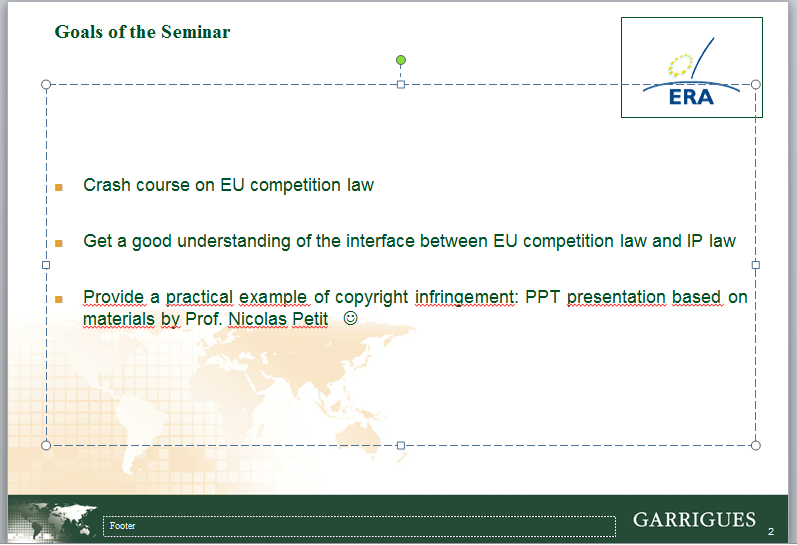
It ended up being a good idea, as I explained to the students, my use of Nico’s materials was useful to illustrate several concepts that are very relevant to IP law, such as a copyright infringement, free-riding and follow-on innovation (btw, the term “based” that you see in the slide above -the 2nd in my (his) presentation was actually a euphemism).
You most likely don’t give a damn about this story, but put yourself in my shoes: I had to (i) thank Nico and acknowledge his authorship of the materials; (ii) write something quick and light for a summer Friday afternoon; and (iii) minimally and superficially reflect on the absorbent (for good and for bad) aspects of the profession.. Have a good weekend!
Collusion?


Odd pricing pattern.
My book and its main competitor at the FNAC (Vogel, Dalloz) both sell for €48.
Collusive RPM? Tacit, explicit?
At least, this will channel consumer choice on quality only. Not sure I’ll win on this ground :(.
Reverse payments (Pay for delay settlements) in EU and US antitrust law (Part I)

I’ve somewhat of a bad conscience for not having been able to cover this topic before (not least because one of you has been pestering me with emails asking when I’d write about it…)(btw, the same person has also gently and repeatedly reminded me to post a link to his new –and actually very interesting (really)- paper, so here it is; titled The Law of Abuse of Dominance and the System of Judicial Remedies).
As you may have read, within a lapse of two days the US Supreme Court (SCOTUS) and the European Commission issued, respectively, an opinion (in FTC v Actavis) and a decision (against Lundbeck and others) addressing reverse payments.
Most of the superficial client alerts analyses I’ve seen merely note the time coincidence and suggest a certain convergence in the US and EU approaches to the issue. The headline goes that the Commission imposed its first fine for this practice, and that the SCOTUS reversed a Circuit clash, holding that reverse payments are subject to the rule of reason and dismissing the “scope of the patent test”. In my view, this reading, although right, is also incomplete and hides a few of the interesting issues that have surfaced in these cases.
If I were to start explaining what reverse payments are, the background to these cases and the content and implications of the opinion and the decision you’d probably be tempted to stop reading after a few lines. In order to avoid that, instead of following the normal structure of a post, this will be a reverse post on reverse payments:
Today we will provide you with some comments on these developments and of why they can be relevant beyond their specific context. Tomorrow (if I’ve time) or on Friday (more likely) we’ll offer you our vision on the background to these cases and an overview of the opinion and the decision. I trust this will enable (i) connaisseurs to skip the background stuff; and (ii) those not initiated in these issues to grasp their relevance and to become interested in reading more about them.
Some reactions to the SCOTUS opinion and to the Commission’s decision
– Leaving the pharma sector aside, and looking at things from a broader perspective, the underlying philosophy of the Opinion in relation to the IP regulation/antitrust interface (condensed in this statement: “it would be incongruous to determine antitrust legality by measuring the settlements anticompetitive effects solely against patent law policy, rather than by measuring them against procompetitive antitrust policies as well”) appears to be at odds with the principles governing the interface between sector-specific regulation and antitrust established in Trinko . It’s therefore not surprising that Justice Scalia, that wrote the majority opinion in Trinko, has joined Roberst and Thomas in a dissenting opinion here. So, does this signal a change of trend in the way the SCOTUS interprets antitrust law? The 3 dissenting Justices at least do seem to see it that way, and argue in strong terms that the opinion overturns understood antitrust.
– On a very related but more specific note, although I haven’t read any comments on this point I see common link between these two recent cases on reverse payments and other landmark cases like Linkline US) and Telia Sonera (one of the most controversial EU cases in recent years). In all these cases some party relied on the idea that “he who can do the most can do the least”. In Actavis and Lundbeck the argument was that a patent holder was entitled to exclude competition provided that it remained within the limits of the “scope of the patent”; and in TeliaSonera and Linkline it was that if refusing to supply would not be deemed abusive, there could be no room to find an abusive margin squeeze.
This argument, however, had only been accepted by the SCOTUS in Linkline, with European Courts taking a different line in the most criticized TeliaSonera Judgment, so it’s not surprising (at least to me) that the Commission has rejected it in Lundbeck, but it’s remarkable that the SCOTUS has taken a different line in Actavis.
By the way, I leave one provoking thought I heard from someone the other day discussing TeliaSonera: “I don’t have an obligation to let anyone into my home, but once they’re inside it would be illegal for me to kick them out violently…”. (I expect some virulent reactions to this; happy to discuss).
– Are the EU and US approaches converging with regard to reverse payments, or even with regard to the assessment of horizontal agreements more widely? Not really (leave aside the synchronized summer desk cleaning timing coincidence). Sure, both the SCOTUS and the Commission see a margin for potential restrictions of competition in reverse payments, but they have chosen very different approaches. And whereas the theoretical difference does not appear to be large, the practical consequences hugely differ. In the US reverse payments will need to be assessed under the rule of reason –which imposes a very considerable burden on plaintiffs- (as we will explain in our forthcoming post, the Supreme Court has dismissed the “quick look approach” proposed by the FTC). In Europe, on the contrary, the Commission has decided to take the usual “object” shortcut. This is key, for an “amorphous rule of reason” (an expression actually used in the dissenting opinion in Actavis) analysis normally means difficulties for the plaintiff, whereas a “bifurcated” 101(1) / 101(3) analysis generally results in condemnation because of the (anticipated and worrysome) death of Art. 101 (3).
(Interestingly, the FTC wasn’t able to give a satisfactory answer to a very pertinent question asked by Justice Sotomayor at the hearing: “Why is the rule of reason so bad?”)
If you ask me, I would have no objection to the EU solution if Art. 101(3) were an effective possible way out (this was basically the ECJ’s stand in GlaxoSmithkline) and I would have no objection to the US approach if the burden of proof incumbent upon plaintiffs was a bit less burdensome. As things stand, it was probably not feasible to strike the right solution in theory (where I think the SCOTUS’ one is preferable) as well as in practice (where the Commission’s will likely yield better results) for these cases.
To be continued…
Economics 1.01

The publication of this book confronts me to THE elementary issue at the core of economics: how to best allocate scarce resources?
My editor has sent me 10 free copies of the book. What shall I do?
Option 1 => Auction them, and let the market decide;
Option 2 => Reward friends, out of my political discretion. This option is tricky. Assuming I have more than 10 friends (I guess I have), how to pick those that should receive the book without p****g off disincentivizing other from being my friends?
Option 3 => Reserve part of them for the university library out of “universal service” considerations + sell the remainder
Option 4 => Do nothing, and shelve them, like a lazy monopolist

Lamadrid & Petit LLP

We live in a world of “experts“.
Readers, corporations, public institutions all crave for expert advice.
And the beauty of it is that we are all experts at something, including at unexpected subjects.
Take a look at what landed in my mailbox last week:
“Dear Nicolas,
Chambers & Partners is producing a new guide for clients which provides practical insights into doing business around the world.
We are currently doing research for the guide on Merger Control. The contributing editor is John Doe of Doe, Doe & Doe LLP.
I am writing a chapter in the guide which will give useful advice to clients who are new to undertaking mergers in Spain. Given your experience in merger control proceedings in Spain, I was hoping you might talk to me for a few minutes to pass on some of the insights that you’ve gained.
The interview would be in complete confidence.
If you are willing to be interviewed, please let me know a time that would be convenient for me to ring you. My email is: JohnQ@chambersandpartners.co.uk. Or please feel free to call my direct line: +__________.
With thanks for your consideration.
Kind regards,
John Q.
Legal Practice Guides
Chambers and Partners”
I guess the selling argument in this email is the “Given your experience in merger control proceedings in Spain“.
John Q must have been confused by my credentials as a founding partner of Lamadrid & Petit LLP.
To me, this says it all about the reliability of those “guides“.
On second thoughts, I should have taken the interview to prove my point.
Book Review – Soft Law in Court
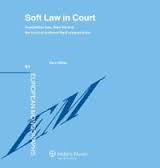
Oana Stefan (HEC Paris) has kindly sent us a copy of her book on soft law in competition and state aid law.
This book is the first monograph ever devoted to this issue.
Amongst other things, the book uses quantitative data to confirm that the judgments of the EU Courts abundantly refer to soft law instruments.
It also argues that the distinction between binding and non binding effects is too crude.
Lastly, it shows that the EU courts have created legal hybrids when endorsing soft law instruments on the ground that they are the expression of general principles of law. This generates, in the author’s words, a “judicialization” of soft law.
A must read. Apparently, Oana will in the future focus on how national courts deal with soft law instruments.
A full description of the book can be found here.
Two final remarks. First, I’d love to read Oana’s views on the appalling Expedia judgment (Expedia Inc v Autorité de la concurrence and Others C-226/11). Second, this book review does not mean that we are “sokolizing” this blog. Our tacit understanding with Dan is that he focuses on the scholarship reviews, we concentrate on the rest (including the nonsense).
Cases that never will be (I) – Hynix (Case T-148/10)

Last week one of the most knowledgeable people in the EU competition law world (Commission official whose name I can’t disclose) tipped me to a new series of blog posts:
His words were “someone should one day write on a blog the story of competition cases that could have had a significant impact on the law had they not been withdrawn”. Since the number of competition law bloggers is not that high (even though it’s rapidly increasing…), and since I was the addressee of the message, I sort of got the point.
Actually, I very much like the idea of writing about cases that never were or, rather, that never will be.
There are a few candidate cases to be discussed; a non-exhaustive tentative list of non-cases could include: Siderca, Chi Mei, Suez-Environment, Formula One, Oulmers, BIC Deutschland, Balog or Van der Weerd. [Additional suggestions would be welcome].
Today we’ll start with Hynix (Rambus), a case in which the hearing was scheduled for 2 July but that was withdrawn a few days ago following a settlement.
The Judgment that will never come to light in this case would have constituted a most important precedent in relation to some important general enforcement issues, as well as in relation to an eventual judicial review of the current investigations concerning Google or Samsung.
A bit of background:
In 2002 Hynix filed a complaint alleging that Rambus had engaged in deceptive conduct in a standard setting procedure in relation to DRAM chips by not disclosing the existence of the patents and patent applications which it later claimed were relevant to the adopted standard, and that it had later charged excessive royalties for the use of those patents (i.e. royalties higher than those that it would have been able to claim had it not engaged in deceptive conduct). This is what is generally referred to as “patent ambush”.
The case was interesting because the deceptive conduct at issue had made Rambus acquire dominance (it preceded dominance), and the charging of high royalties could be regarded as the natural consequence of such dominance. Given that EU law does not target “monopolization” practices (those use to achieve dominance), the Commission had attempted to close this enforcement gap by targeting exploitative pricing under Art. 102 under the argument that dominance had been unlawfully attained. This was a brave and controversial move on the part of the Commission.
On 27 July 2007 the Commission adopted a statement of objections setting out its concerns. Rambus responded to the SO and a hearing was held.
Almost two years later, however, Rambus submitted preliminary commitments, those were later market-tested, revised, and eventually made binding on December 2009 (in a nutshell, Rambus committed (i) not to charge royalties for the two standards adopted while Rambus engaged in the deceptive conduct; (ii) to set a maximum royalty of 1,5% for the later generation of standards and to offer thus maximum rate to all market participants). (Note that the commitments concerned only future payments, not those already made).
As you know, in a case like this (or in a case like Google’s), once the Commission accepts commitments it must (a) adopt an Article 9 decision making them binding; and (b) adopt a decision rejecting any complaints stating that there are no longer grounds for action.
Hynix appealed both of these decisions.
In essence, Hynix argued that the Commission violated Article 9 of Regulation 1/2003 by choosing the procedure envisaged in that article where its concerns related to a serious violation of Art. 102.
In its SO, the Commission had envisaged a finding that the charging by Rambus of capped royalties is incompatible with Article 102 (82 back then). However, the corollary of the commitment decision was to make royalty caps binding, thus endorsing their legality.
The Judgment that will never on this case would have shed light on some of the hottest current topics in EU competition law (abuse of dominance in high-tech sector, misuse of patents, the circumstances in which the Commission can or cannot adopt commitment decisions…). In the past we have devoted lots of ink pixels to discussing these issues, and it’s a pity for the law that questions like the following will, for the time being, remain unaddressed:
What constitutes an abusive practice with respect to standardization, in particular so far as concerns patent ambushing?
Were commitments in the form of future royalty caps sufficient to eradicate the competitive problems found by the Commission?
What guiding principles (beyond Alrosa) are to be taken into account when assessing the appropriateness and adequacy of commitments?
Can the Commission address what it had perceived as a serious violation by means of a commitments decision? In that context, may the Commission adopt remedies which are only prospective in nature? Is the Commission entitled to have recourse to a commitment (Article 9) decision after having adopted a Statement of Objections? And in this case, can a Statement of Objections be considered as a valid “preliminary assessment” for the purposes of Art. 9 of Regulation 1/2003?


 Chillin'Competition