Archive for October 2009
Anti-Monopoly
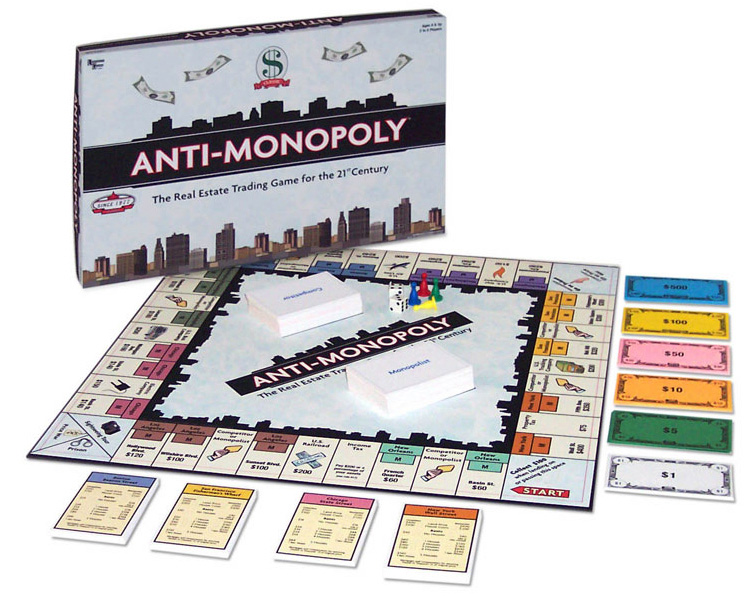
As anticipated in previous posts, we continue feeding up a ‘leisure time for competition geeks’ section.
This post is about a board game, ‘Anti-Monopoly’, a different version of ‘Monopoly’ with an ‘anti-monopolistic’ theme.
In Anti-Monopoly®, players play either by or competition rules fixed at the beginning of the game:
COMPETITORS … charge fair rents, build as soon as they own a property, put five houses on their properties and occasionally go to Price War.
MONOPOLISTS… extort monopoly-high rents from their poor tenants, build only after they have monopolized a color grouping, restrict supply by putting only four houses on their properties and occasionally go to Prison.
The good guys are the small business entrepreneurs and the bad guys are the monopolists. Since players do not play by the same rules, fairness is achieved by a patented probability technique, has given each side equal chances to win.
OBJECT OF THE GAME: To be the richest competitor after all monopolists have been bankrupted or to be the richest monopolist after all competitors have been eliminated.
There is actually a great deal of controversy surrounding the creation of the game, which includes a 10 year long legal battle between the creator of Anti-Monopoly (Ralph Anspach) and the owners of the ‘Monopoly’ trademark. After more than 37.000 copies of ‘Anti-Monopoly’ were destroyed pursuant to a District Court’s order which found a trademark infringement in the use of the word ‘Monopoly’, the 9th Circuit Court of Appeals ruled in 1979 that the trademark ‘Monopoly’ was generic and thus unenforceable. Nonetheless, this wasn’t the end of the story. Soon after the 9th Circuit’s decision, the US Congress amended the Trademark Act to protect longstanding marks against generic claims, thereby allowing Hasbro to assert again its rights to the mark ‘Monopoly’ and its variants.
A settlement was eventually reached and the game is now marketed under a license from Hasbro.
For more info on the game as well as on the underlying legal story, click here
Thanks to Anne Dostert for the pointer (and indirectly to Scott Hemphill, from Columbia, who apparently has a copy of the game in his office) .
Did we chill competition?

See here. We were a few days ahead on this story.
It is quite well known that competition in the news market is not primarily about price, but almost equally about being the first to report a news. And even on price, our stories are freely accessible…
Bloggerhood
 A fellow blogger, Juan David Gutierrez from Derecho de la competencia has asked me to post on this blog the following research proposal:
I am conducting a research on the Latin American antitrust community as part of the investigation projects of the Competition Law Study Center (CEDEC) at U. Javeriana in Bogota. In particular we are interested in studying how competition law is taught in our region and the impact of Universities in the development of competition law.
To this end, we are collecting information regarding courses on competition law and policies (and related areas, such as industrial organization and regulation) in Latin America. I published a first draft in the “Boletín Latinoamericano de Competencia” N°26, (titled “La comunidad académica y la defensa de la libre competencia: Bases para una propuesta en América Latina”) which explains the rationale for the research topic and academic proposal.
We hope to collect more data with the help of Latin American Universities, professors and practitioners. The information per course that we require is the following:
- University’s name.
- Geographical location of the University.
- School or department that offers the course (law school, economics, management).
- Title of the course.
- Type of course. Undergraduate (mandatory or optional), Graduate (specialization, masters or Phd) or a short course (seminar, certificate, etc:).
- Course length and class hours per week
- Teacher’s name and e-mail.
- Teacher’s academic experience and studies.
- Syllabus (subjects studied during the course) for each course.
- Number of students (average or per course)
- Since when it has been taught.
- Periodicity of the course. (once every two years, once a year, twice a year, monthly, etc).
- Additional information. Website, events, publication, concluded researches or on going, etc.
I cordially invite to send us the information, to the following e-mail addresses: jdg@cable.net.co and cedec@cable.net.co
All the data collected will be made available at http://derechodelacompetencia.blogspot.com/. Once the information has been processed, we will get in touch with all those who participated in the research in order to share the results and strengthen the bonds between them.
Recent Output

- A French Competition Commissionner? The results of our poll are as follows. Out of 45 votes, 21 readers voted for C. Lagarde, 12 for N. Kroes (in spite of clear signals that she will not stay in charge) and 7 for V. Reding. (Image source here)
- My assistant and I have co-authored in La Libre an Op-Ed on the Lisbon Treaty and the failing communication strategies of our political leaders when it comes to European affairs (in French).
- Dr. Theodor Thanner (Director of the Austrian NCA) and I, last week in Vienna:

- To date, we have received a few, robust, submissions for the latest antitrust law development prize. Please do not hesitate to send yours.
- I just received the latest edition of competition law international (the journal of the antitrust committee of the IBA). It comprises a collection interesting papers by antitrust enforcers (Varney, Leibowitz, Lasserre, Badin and Krasnodebska-Tomkiel)
Spanish Court of Appeal strikes down CNC’s Inspection Practices

The Audiencia Nacional (‘AN’) – i.e. the Spanish Court in charge of the review of acts and decisions adopted by the Spanish National Competition Commission (‘CNC’) – recently delivered an important judgment quashing some of the CNC’s investigatory practices, which had elicited a great deal of controversy over the past few months.
Background: In a raft of recent cases, the CNC investigatory branch made use of the new investigatory powers provided for under Competition Act 15/2007. Those cases triggered a stern opposition from the legal community, which voiced that the CNC’s inspections might have deviated (i) from the standards set out by the ECJ in relation to inspections under EC competition rules, as well as (ii) from the limitations imposed by Spanish Courts with regards to police/and or administrative inspections, thereby breaching the rights of defense of the inspected undertakings. Disregarding the criticism, the CNC’s Council nonetheless adopted a number of decisions supporting the interpretation of the CNC’s Investigation Directorate.
The judgment: the AN’s Judgment originates in an appeal against one of those decisions. In essence, it can be summarised as follows:
1) The Court observes that many of the documents obtained -collected pursuant to the copying of computer hard drives- are unrelated to the sector under investigation as identified in the mandate as well as in the judicial authorization granted to the CNC, and therefore cannot be deemed to be covered by them. Consequently, the Judgment declares that there was a breach of the right to inviolability of the domicile of the undertaking inspected.
2) As to the consequences of the said breach, the Court rejects the claim that the whole inspection should be declared void. Instead, it holds that the documents related to the subject matter of the investigation did fall within the scope of the mandate and of the judicial authorization and were thus lawfully collected, and orders the CNC to return all other documents.
3) The Judgment affirms the rights of firms subject to an inspection to have access to the search criteria used to retrieve information stored in hard drives (allegedly no search criteria had been used in the inspection at stake).
4) The AN dismisses the claims related to the alleged violation of legal privilege arguing that the CNC has merely collected possibly privileged documents but has not made use of them.
5) The arguments related to a possible breach of the rights to privacy of correspondence of the undertaking’s employees are also dismissed on the basis that the inspection was not aimed at collecting such documents. Accordingly, the Court holds that any extra-limitation with regards to employee’s private documents stored in computers located at the undertaking’s premises must be subsumed within the breach of the rights of the undertaking inspected.
In my view, this is a most welcome judgment if only because it narrows the gap between the standards applied by the CNC and those of the European Commission.
However, the non-conformist lawyer that sleeps inside me has a couple of comments:
– First: the AN’s argument that there cannot be a breach of the rights of defense unless privileged documents are effectively used as evidence seems to be at odds with the ECJ’s ruling in Akzo with regards to the ‘cursory glance’ practice.
– Second: in this case, unlike in a number of other recent ‘dawn raids’ in Spain, the subject matter of the investigation had been clearly defined in the mandate as well as in the judicial authorization. Both identified the specific conduct under investigation, the product and geographic market affected, as well as the years during which the agreement was thought to have been implemented. Nevertheless, for the purpose of determining which documents can be deemed to be comprised within the scope of the mandate, the Judgment prescinds of those and merely takes into consideration whether it is related or not to the sector under investigation without any further qualifications, which is arguably still a wide criterion.
See below for link to the judgment.
(Image possibly subject to copyright. Source)
New Entry in the Market for Competition Law Journals

I heard in Vienna that Oxford University Press (OUP) will be launching in 2009 the Journal of European Competition Law & Practice. This new bi-monthly journal intends to have a strong practical flavour. It will be edited by T. Lubbig and P. Nihoul and seeks, from what I am told, to compete head-to-head with the well-known European Competition Law Review (ECLR) from Sweet & Maxwell. Yet, I understand that ECLR has lately focused a lot on national competition law, and that this journal’s purpose is to deal primarily with EC competition law.
Interestingly,it ought to be noted that this new journal is not pure, greenfield, entry for OUP, but expansion with a new title besides, amongst others, OUP’s Journal of Competition Law and Economics (JOCLE). Whilst some may think that OUP’s move is not necessarily safe because the new journal may partly eat away some of the JOCLE readership, I understand the two journals are not substitutes, but complements (with the JOCLE focusing primarily on longer studies, with a stronger scientific, economic and comparative – EC/US – flavour).
My feeling is that OUP’s agressive, ambitious, expansion strategy should be welcome. I have indeed often deplored the paucity of european competition law journals. Let’s just hope that the pricing of this new title will be affordable.
New GCLC Working Papers on Vertical Mergers

A. Ramos, T. Mohan and F. Carloni (Howrey LLP)’s paper on vertical mergers has just been accepted for publication in the GCLC WP Series. Their paper discusses the Commission’s practice in applying the 2008 guidelines on non-horizontal mergers. It focuses on two cases on which, to date, there has been only little literature, i.e. Nokia/Navteq and Tom Tom/TeleAtlas.
Please note that the GCLC welcomes submissions for publications into the WP series. Papers should be sent directly to me. Publication in the WP series in no way prevents later publication in a regular competition law journal. On the contrary, publishers generally appreciate when a paper undergoes some empirical testing through a WP, prior, publication.
New book on EC and Spanish Competition Law
Volume X of ‘Derecho de la competencia europeo y español‘ is already out (volume IX was also published a few weeks ago). This edition, edited by Luis Ortiz and Eulalia Sanfrutos, includes contributions in English, French and Spanish on different aspects of both EC and Spanish competition law. No review because my objectivity is severely compromised: there are several good friends amongst the authors and I am the co-author of a contribution on the new Chinese Anti-Monopoly law (there’s always a ‘black sheep’ who doesn’t stick to the book’s title). This is the table of contents:
– Problemas prácticos derivados de las nuevas facultades de investigación de la Comisión Nacional de la Competencia / Carmen M. Cerdá Martínez-Pujalte
– La confidencialidad de las comunicaciones entre abogado y cliente: un intento de definición válido para el ordenamiento jurídico español / Violeta Tomás Gutiérrez
– Will the new Commission leniency and fining policy appeal to multi-jurisdictional lenency applicants? / Luis Ortiz Blanco, María Muñoz de Juan and Ángel Givaja
– An offer you can´t refuse? An analysis of EC cartel settlement / Mark English
– Foreign consumers and private antitrust litigation / Charlotte Leskinen
– Competencia y comercialización de derechos de televisión: ¿y si la intervención de las autoridades de competencia fuese el único problema? / Pablo Ibáñez Colomo
– Les mesures structurelles à la lumière du Règlament 1/2003 et du Règlament 139/2004: analyse comparative / Franz Stenitzer
– La regulación de la recuperación de las ayudas de Estado españolas y sus carencias: ¿un exceso de confianza en la autonomía procesal? / Pedro Cruz Yábar
– Defensa de la competencia “Made in China” / Alfonso Lamadrid de Pablo y Napoleón Ruiz García
LIDC Conference in Vienna – 22-25 October

I am flying to Vienna tomorrow for the LIDC (International League of Competition Law) annual congress. I have the great honour of being one of the two 2009 international reporters.
I attach below the programme of the conference as well as the latest draft of my international report. Looking forward to it.
LIDC – Programme Annual Congress
International Report – LIDC – Question A – Nicolas PETIT (12 10 09)
The “Last Hundred Days” Strategy – Is the Qualcomm Case Over?
Milton Friedman and his wife Rose Friedman are known for having theorized that recently elected governments generally enjoy a period of political immunity following elections, which allows them to push reforms, including tough ones, relatively easily (see Tyranny of the Status Quo, New York: Harcourt Brace Jovanovich, 1984). This theory is often related to the “first hundred days” honeymoon period enjoyed by political leaders.
My intuition is that this theory also applies to administrations reaching the term of their mandate and, in particular, the current European Commission. In this regard, Neelie Kroes, the Commissioner for competition, certainly enjoys an unprecedented ability to increase output in the last months of her mandate in deciding/closing cases. This is partly due to the fact that the repeated game of political interaction – where disgruntled colleagues, rivals, parties, etc. might retaliate in the future (and kill proposed decisions/legislative proposals) – comes to an end. At this stage, Neelie Kroes, who most likely will not be reappointed as Commissioner for competition (and, if I understand correctly, whose domestic carreer is largely over), has thus a relatively large margin of enforcement manoeuvre. In addition, ending administrations face lower exposure than newly appointed administrations: (i) other Commissioners might also be busy cleaning their desk, and in turn unable to scrutinize competition enforcement initiatives; (ii) journalists, medias, citizens, MEPs, etc. primarily care for the yet to be appointed Commission and its programme, and no longer pay much attention to what the present Commission is doing.
In this context, the Commissioner has given indirect signs that she may soon close the long-standing, high-profile, Qualcomm case (full disclosure: my former law firm, Howrey LLP has been working intensively on this case over the past years). In a nutshell, this case is about the amount of royalties charged by the US firm Qualcomm for its 3G WCDMA technologies, deemed to be excessive by a number of complainants, some of which are big EU telcos manufacturers. The case exhibited a number of interesting, controversial, features. To name only a few: should the cryptic, unpractical, case-law on exploitative abuses be applied to dynamic, R&D-driven markets?; does an ex ante FRAND commitment go beyond a mere commitment to negotiate licensing terms in good faith?; should the Commission get involved in a case that exhibits a strong revenue distribution (or “revenue sharing”) dimension, as well as industrial policy features (the classic US v. EU trade war story)?
In a speech entitled “On ex ante standards setting and new horizontal agreement guidelines ” delivered last week, Neelie Kroes unusually emphasized the difficulties encountered by enforcers in bringing forward excessive pricing cases:
In my view, there are a number of ways to assess whether there has been an excessive pricing abuse under Article 82 EC and the methodologies used will depend on the factual matrix. One method is to compare the (ex-ante) market value of the relevant IPR with the ex post royalty rate, if the evidence clearly permits such a comparison. If the ex post royalty is significantly and unjustifiably higher than the ex ante price, then we may have an excessive pricing case. In practice, such assessments may be much more complex than this brief description of the issues implies, and any antitrust enforcer has to be careful about overturning commercial agreements without a clear and coherent evidence base.
Matthew Newman, a Bloomberg journalist further reported:
When asked whether there’s enough evidence to pursue the Qualcomm case, Kroes said that “as a commissioner for competition policy, it’s always good to recognize if it’s well thought over, if it’s proven. If it’s not really proven, we should be careful — you can read between the lines.” Kroes added that the case has been “fascinating” and that she used a panel, known as a devil’s advocate, to weigh the nearly 4-year-old investigation.
In supporting negotiated solutions that are allegedly in the interest of both consumers and business, and dismissing unproven cases, the current Commissioner may also seek to raise her profile in the history of EC competition enforcement, in particular in defusing criticism that her enforcement record is only about harsh, tough, negative competition enforcement (read hefty fines), sometimes at the expense of the rights of defense.


 Chillin'Competition