Archive for October 2009
The Spanish Competition Authority declares a collective bargaining agreement contrary to EC and Spanish competition law

The CNC (Spanish Competition Authority) recently adopted a decision sanctioning a stevedoring trade association (over 900.000 euros) and several labor unions (with fines ranging from 3.000 to 168.000 euros) for having concluded a collective bargaining agreement contrary to Articles 81 EC and 1 LDC (Spanish Competition Law).
Nobel Prize in Economics for Oliver Williamson

On top of his work refining the Coase “make it or buy it” theorem, Oliver E. Williamson, is also the author of two absolute must reads for all antitrust lawyers:
- “Economies as an Antitrust Defense: The Welfare Tradeoffs.” 58 American Economic Review. 1, 18-36 (1968).
- Market and Hierarchies: Analysis and antitrust Implications, New York, Free Press, 1975
Week-End Ruminations
 1. The fact that the Glaxo case took 11 years to solve irritates me. Is it reasonable to expect market players from both sides – pharmaceutical companies and parallel traders – to remain in a state of commercial uncertainty for so long?
2. In retrospect, the Glaxo saga demonstrates that, for more than ten years, the law of Article 81(3) EC (and also of Article 81(1) EC) has been in a state of flux, thereby undermining the Commission’s optimistic contention that the law of Article 81(3) EC is – and was at the time of the adoption of Regulation 1 – crystal clear. With such conflicting judgments being handed down every now and then, one may really question whether Article 81(3) exhibits the necessary features to have direct effect (clarity, precision, and unconditional nature).
3. Why is the table of contents of French law books systematically located at the end? This is really inconvenient.
4. And a note of satisfaction. At the European Competition Day in Sweden (7 October 2009), P. LOWE has apparently endorsed the views presented by the GCLC, during its last annual conference.
LOWE is reported to have said:
“It is essential for business […] to know what is acceptable and what is not“;
He added:
“we recognise the need for guidance – to know what behaviour is anticompetitive.”
Too bad LOWE is leaving COMP in the next weeks. And thanks to C. HUMPE for the pointer. Christophe and I have been – amongst others – drafting the first chapter of the forthcoming GCLC book on Regulation 1/2003. Our main area of concern lies in the Commission’s overreliance on negative enforcement, and the absence of any sort of positive enforcement whatsoever.
Image – Source: Wikimedia
Seminar on Current Issues in Merger Enforcement – Warsaw
On 29 October 2009, the Office of Competition and Consumer Protection of Poland will organize a Seminar on Current Issues in Merger Enforcement. Seminar takes place in Warsaw. More info can be found hereafter: program
Webcast of the EC Competition Day – 7 October 2009

The full webcast of the EC competition day can be found here.
Tougher Article 81(1) EC, Laxer Article 81(3) EC? – ECJ, C‑501/06 P, GlaxoSmithKline Services Unlimited v. Commission, 6 October 2009
 11 years ago (!), in the good old times of the notification procedure, Glaxo had notified to the Commission its ‘General sales conditions of pharmaceutical specialities to authorised wholesalers’ with a view to obtaining a negative clearance or an exemption. On 8 May 2001, the Commission (i) found that the notified agreement infringed Article 81(1) EC; and (ii) refused to grant an exemption pursuant to Article 81(3) EC.
Glaxo challenged this decision before the CFI. In an unexpected judgment, the CFI annulled the second part of the Commission’s decision that refused to grant an exemption.
Glaxo, however, lodged a further appeal before the ECJ, seeking to obtain also annulment of the first part of the Commission’s decision that had deemed the agreement unlawful pursuant to Article 81(1) EC. The Commission lodged a cross-appeal, asking the court to set aside parts of the judgment of the CFI (notably those viewing the refusal to grant an exemption unfounded).
The judgment handed down by the ECJ yesterday in this case exhibits two points of particular importance. First, it delivers an authoritative interpretation of the concept of a “restriction by object” under Article 81(1) EC (I). Second, it clarifies the burden of proof, in terms of process and substance, under Article 81(3) EC (II).
I. On the concept of a “restriction by object”
Glaxo’s contended that, contrary to the CFI’s view, the agreement was not unlawful pursuant to Article 81(1) EC. In its judgment the CFI had opted for an innovative case-by-case appraisal of the concept of restriction by object. According to the CFI, there was no such thing as a predefinite list of restrictions by object. A restriction can only be deemed a restriction by object upon analysis of its “legal and economic context“. On this basis, the CFI found that the impugned restriction of parallel trade was not restrictive by object (absent obvious proof of consumer harm – parallel traders pocket in the price differential), but was restrictive by effect. Glaxo agreed with the absence of a restriction by object, but contested the existence of a restriction by effect. The Commission, by contrast, challenged the view that there was no restriction by object.
The first important point which the ECJ makes is to reject as erroneous the CFI’s contention that a restriction by object hinges of the identification of consumer harm:
“62 With respect to the Court of First Instance’s statement that, while it is accepted that an agreement intended to limit parallel trade must in principle be considered to have as its object the restriction of competition, that applies in so far as it may be presumed to deprive final consumers of the advantages of effective competition in terms of supply or price, the Court notes that neither the wording of Article 81(1) EC nor the case-law lend support to such a position.
63 First of all, there is nothing in that provision to indicate that only those agreements which deprive consumers of certain advantages may have an anti-competitive object. Secondly, it must be borne in mind that the Court has held that, like other competition rules laid down in the Treaty, Article 81 EC aims to protect not only the interests of competitors or of consumers, but also the structure of the market and, in so doing, competition as such. Consequently, for a finding that an agreement has an anti-competitive object, it is not necessary that final consumers be deprived of the advantages of effective competition in terms of supply or price (see, by analogy, T-Mobile Netherlands and Others, cited above, paragraphs 38 and 39).
64 It follows that, by requiring proof that the agreement entails disadvantages for final consumers as a prerequisite for a finding of anti-competitive object and by not finding that that agreement had such an object, the Court of First Instance committed an error of law”.
The ECJ thus quashes the CFI judgment on this point. In so doing, the ECJ sticks to a textualist reading of Article 81(1) EC: The wording of Article 81(1) EC does not talk of consumer harm. The appraisal of the restrictive object of an agreement must thus be established on the basis of”the content of its provisions, the objectives it seeks to attain and the economic and legal context of which it forms a part“, and only on this basis.
II. On the burden of proof under Article 81(3) EC
Turning, subsequently to the Commission’s contention that the CFI misapplied the case-law in quashing its decision’s refusal to grant an exemption, the ECJ makes a number of interesting points.
First, as to the burden of proof under Article 81(3), the ECJ upholds my analysis the iterative analysis process:
“82 The Court notes, first, that in paragraphs 233 to 236 of the judgment under appeal, the Court of First Instance referred to the case-law, principles and criteria governing the burden of proof and standard of proof required in relation to requests for exemptions under Article 81(3) EC. It correctly stated that a person who relies on that provision must demonstrate, by means of convincing arguments and evidence, that the conditions for obtaining an exemption are satisfied (see, to that effect, Case 42/84 Remia and Others v Commission [1985] ECR 2545, paragraph 45).
83 The burden of proof thus falls on the undertaking requesting the exemption under Article 81(3) EC. However, the facts relied on by that undertaking may be such as to oblige the other party to provide an explanation or justification, failing which it is permissible to conclude that the burden of proof has been discharged”
Second, the Court seems to relax, to a certain extent, the conditions under which parties may be able to prove in substance that they meet the conditions for an exemption (to date, those conditions, as enshrined in the Article 81(3) Guidelines, are almost impossible to meet in practice). In its cross appeal, the Commission argued that “that the Court of First Instance committed an error of law in finding that it is sufficient that an undertaking wishing to obtain an exemption under Article 81(3) EC show that it is probable that gains in efficiency may occur”.
In this context, the ECJ notes that:
“92 … in paragraph 247 of the judgment under appeal the Court of First Instance rightly observed that, in order to be capable of being exempted under Article 81(3) EC, an agreement must contribute to improving the production or distribution of goods or to promoting technical or economic progress. That contribution is not identified with all the advantages which the undertakings participating in the agreement derive from it as regards their activities, but with appreciable objective advantages of such a kind as to compensate for the resulting disadvantages for competition (see, to that effect, Consten and Grundig v Commission, cited above, p. 348 and 349).
93 As the Advocate General observed in point 193 of her Opinion, an exemption granted for a specified period may require a prospective analysis regarding the occurrence of the advantages associated with the agreement, and it is therefore sufficient for the Commission, on the basis of the arguments and evidence in its possession, to arrive at the conviction that the occurrence of the appreciable objective advantage is sufficiently likely in order to presume that the agreement entails such an advantage.
Furthermore, at §94, the ECJ indicates that the standard of proof hinges on the “balance of probabilities (51/49), rather than on a proof “beyond reasonable doubts” standard:
“The Court of First Instance therefore committed no error of law in paragraph 249 of the judgment under appeal in holding that the Commission’s approach may entail ascertaining whether, in the light of the factual arguments and the evidence provided, it seems more likely either that the agreement in question must make it possible to obtain appreciable advantages or that it will not”.
Finally, the Court clarifies a number of issues related to Article 81(3) EC but which, in my opinion, are of lesser relevance.
As surmised by Alain Ronzano a few days ago, this case holds the potential to influence the ongoing verticals review, where the Commission proposes an inversion of the traditional burden of proof. Here, the ECJ relaxes the conditions for the applicability of Article 81(3) EC and, indicates that restrictions by object require a careful appraisal. Whilst it does not follow the ambitious CFI proposition that a hardcore restriction implies proof of harm to consumer, it nonetheless indicates that a careful prior assessment must be done (my point a few days ago). As far as parallel trade is concerned, the consequence of this judgment is very simple: the “no consumer harm defence” invoked by drug manufacturers to justify their anti parallel trade strategies does not disqualify a finding of restriction by object (this argument hinges on the view that fact that parallel traders pocket-in the margins, and that by virtue of price regulations, parallel trade does not lead to lower prices, and thus has no beneficial effect on consumers).
In brief, a tougher Article 81(1) EC and a laxer 81(3) EC .
(Image possibly subject to copyrights. Source here)
Case C-501/06 P, GSK v. Commission

The ECJ has handed down its much awaited judgment in the ‘Glaxo Spain’ case, yet another case on the EC competition law assessment of practices aimed at curbing parallel trade in pharmaceuticals.
In a nutshell:
– The ECJ reaffirms its traditional stance regarding the fact that an agreement aimed at limiting parallel trade shall be considered as restrictive of competition ‘by its object’.
The Court thus holds that the CFI committed an error of law when it asserted that such agreements could only be regarded as restrictions ‘by object’ provided that their object or effect was shown to be the restriction of competition ‘to the detriment of the final consumer’ (which, in a way, was paradoxically akin to saying that those agreements would be a restriction by object only after having determined they constitute a restriction by effect).
– The judgment upholds the CFI’s finding that the Commission failed to carry out a sufficient assessment of the possible efficiencies derived from the agreements in the light of Article 81(3).
Now, from a pure “policy” standpoint: big pharmas have welcomed this judgment as a resounding victory. In this context, can it be assumed that, from now on, parallel traders will no longer escape the panoply of obstacles devised by pharmaceutical companies? I don’t see it that way.
The CFI’s Judgment explicitly accepted the contention that the pharma industry exhibited special and specific features which deserve a somewhat particular treatment, and lambasted the Commission for having failed to take proper account of those peculiarities.
By contrast, the ECJ’s reasoning is much less sector-specific driven. It stresses the Commission’s failure to thoroughly deal with the arguments and evidence put forward by parties claiming an exemption under Article 81(3), regardless of the particular sector at stake. In this sense, the ECJ Judgment could be read within the stream of case law having raised the standard of proof incumbent upon the Commission in other areas of competition law enforcement.
Therefore, I don’t view this ECJ judgment as providing definitive support for any of the arguments regarding the alleged specificities of the pharmaceutical sector, but rather as requiring a stronger reasoning if the Commission wishes to rebut those arguments. Interestingly, the specific features of the pharma industry were recently examined – and found of little particular relevance – by the ECJ and by AG Ruiz Jarabo in the Lelos (Glaxo Greece) case. In light of this, I would thus say that nothing precludes the Commission from adopting and reflecting in its Decision a stricter effects assessment and reaching the same outcome it reached in 1998.
One last note: I don’t view the judgment as bearing the potential to have an incidence on the way the Commission currently undertakes 81(3) assessments. This case referred to agreements which had been notified to the Commission pursuant to Regulation 17/62, and since the passing away of the notification system the Commission arguably undertakes a more detailed assessment of the cases it decides to initiate on its own motion. Would a similar judgment have come out when the Commission was still entrusted with reviewing hundreds of agreements per year?
Unrelated: thanks to Nicolas for the invitation, and I hope you enjoy the blog.
(Image possibly subject to copyrights)
Introducing Guest Blogger – A. Lamadrid
 I have invited Alfonso Lamadrid, a LLM student at Harvard Law School and former associate at Garrigues, to chill competition blog on this website. Alfonso is a brilliant competition lawyer but, more importantly, is a very open minded person with a strong taste of humour. In this sense, Alfonso precisely personifies what this blog intends to be: something insightful, but also relaxed and open to new ideas.
Welcome Alfonso!
PS: Alfonso belongs to the authors a very good book on antitrust law (in Spanish though) that was published last year.
Slides of THE Best Conference on Verticals of the Year
 We had 168 registered participants to our conference on verticals last week. Let’s see who has the Best conference on verticals in terms of turnout.
Now, more seriously, I attach hereafter the slides presented at the conference.
A. VANDENCASTEELE The 30 % market share
C. CAFFARRA Selective Distribution and Restrictions of Online Commerce An Economic Perspective
E. KAIRIS & E. VAN PARYS The future of the Car Block Exemption Regulation
F. GALARZA Online Distribution
F. WIJCKMANS A Practitioner s Perspective on Regulation 279099
J. HOLTZ Impact of the draft guidelines on online advertising
J. RATLIFF Buyer-Related Vertical Restraints (Upfront access payments and category management)
L. PEEPERKORN Review of the Vertical Restraints Framework
P. LUGARD Resale Price Maintenance
R. NASH Review of the Vertical Restraints
T. VERGE Economic Review of the Current Regime and of the Draft Guidelines
The Normans Theory of Innovation?
A striking finding, whilst preparing a class for my new students in EDHEC (a French Business School located in Lille). I propose to relabel the Aghion et al. inverted U curve of innovation/competition the Normans’ theory of innovation.
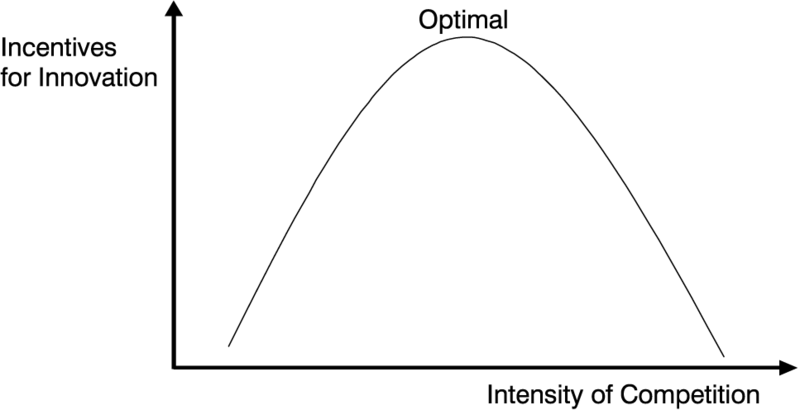
A word of explanation: In my home country, France, Normans (the people from Normandy) are said to be very moderate persons. When asked a question calling for a clearcut reply, a typical norman would refuse to give a brightline answer, and rather express a soft “maybe yes, maybe not”. On close examination, the Aghion et al. inverted U curve has a taste of Normandy. Let’s rephrase the question to which those authors sought to answer in their seminal paper: ” Is competition good for innovation?” Now, let’s look at their answer: too much competition kills innovation, to little competition kills also innovation… Very Norman indeed… and only helpful to the extent that it moderates the somewhat extreme positions of Schumpeter and Arrow. But not more helpful than this.


 Chillin'Competition

