Archive for September 2010
EP to discuss fines in competition cases
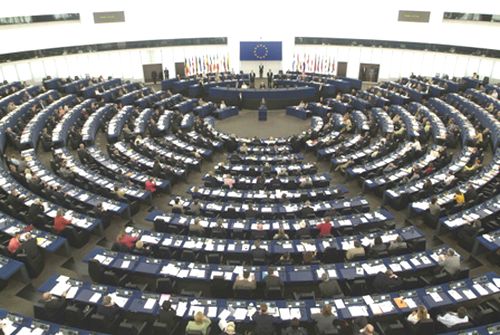
Looks quite unusual, but the European Parliament will host a debate on fines for competition infringements. A well informed friend sent me an email indicating:
“The following items are on the agenda of next week mini-Plenary session, Wednesday afternoon, 6 October:
– […]
– Commission statement – Commission fines in antitrust cases”
Not sure what to expect from this… At any rate, please note that the first conference of the BSC will come shortly, and will be devoted to sanctions for competition law infringements. My own personal viewpoint is that disqualification orders are the most efficient and fair possible penalty.
(Image possibly subject to copyrights: source here)
Chillin’Competition on the Conference Market?

EVENING POLICY TALK
DR. ALEXANDER ITALIANER, DIRECTOR-GENERAL, DG COMPETITION
EUROPEAN COMPETITION POLICY ON THE ROAD TO 2020
12 October 2010 – Marriott Hotel, 3-7 Rue August Orts, 1000 Brussels
See link below for more.
And a question :): with the lunch talk last week, the annual conference next week, and this EPT on 12 October, aren’t we chilling competition?
Evening Policy Talk by Dr. ITALIANER – EUROPEAN COMPETITION POLICY ON THE ROAD TO 2020
A somewhat original objective justification

In reading a French Phd dissertation, I just found a strange case, which dates back to 2005 and was decided by the French NCA.
The facts: a cistercian congregation located on the Island of St Honorat owned a monopoly over maritime transport services between the continent and the island. The congregation had apparently refused to authorize third parties to provide additional transport services, thereby stiffling competition. The French NCA dismissed allegations of unlawful abuse. It found that the limitation of tourists was justified by the necessity to preserve the quietness of the monks. See Cons. Conc. 8 novembre 2005, n° 05-D-60, relative à des pratiques mises en oeuvre par la congrégation cistercienne de l’Immaculée Conception, la société Planaria, l’État et la commune de Cannes.
First day in class today
… and I am exhausted. I have a good group of students (around 50 attending the EU competition law course), and about 23 LL.M. students.
I am also busy preparing for the GCLC annual conference, as well as the first lecture at the Brussels School of Competition.
Slides – GCLC Lunch Talk on Quantification of Damages

I attach the slides presented by A. Lofaro at today’s lunch talk. A great event, which triggered a very interesting discussion.
Some things that arose from the debate with the audience + some ruminations:
- The non binding guidance on which the Commission works will include something on exclusionary abuses
- The Commission is not incline to provide guidance on quantification in its decisions
- The Commission does not intend to make a specific, pro-active use of the instruments under Regulation 1 (article 15) to provide guidance on compensation
- Peter Roth suggested that as part of settlement discussions, the parties to a cartel could also commit to a certain amount as compensation
- On passing-on, I would advise consulting the non-competition EU case law
- In terms of counterfactual price, why not use the price that follows Commission enforcement as the competitive benchmark?
Slides Lofaro – GCLC Lunch Talk – Estimating damages 22 September
FIDE Congress 2010
 The FIDE (Fédération Internationale de Droit Européen) will be holding its XXIV Congress in Madrid between the 3rd and the 6th of November. One of the three topics discussed will be “The Judicial Appliccation of Competition Law”. The other two topics will focus on “The Role of National Parliaments in the European Union” as well as on ““Public Capital and Private Capital in the Internal Market”.
The program for all three topics is most appealing. As it´s customary in FIDE, the discussions will be based on reports prepared by representatives of national associations members of FIDE. The General Report on Competition Law is authored by Santiago Martínez-Lage and Rafael Allendesalazar (Howrey-Martínez Lage); the EU Report has been written by André Bouquet (from the Commission´s Legal Service); and discussion sessions will be chaired by Judge Koen Lenaerts, Assimakis Komninos (Greek Competition Authority), and Ulf Bernhand Bernitz (Stockholm University).
For more info see here.
Duopoly – A Real Life Example

The idea of this post came while having lunch in the centre of Brussels (I am definitely a competition geek).
Until recently, Noordzee (on the left side of the picture) enjoyed a local monopoly on the market for fast fish-seafood standing meals in the centre of Brussels (my shot at this somewhat original market definition). Their business concept was simple: you eat and drink outside, standing.
I was, with loads of other customers, a great fan of Noordzee. Yet, ordering there involved queuing, eating in uncomfortable conditions,and possibly supra competititive pricing.
A while ago, a restaurant located on the other side of the street (ABC on the right side) decided to replicate Nordzee’s business concept. ABC installed tables on the outside and started to serve customers just as Noordzee had done in the past.
Everyone, including Noordzee seems to withdraw benefits from this expansion/entry. Noordzee has reduced queuing time and increased consumer satisfaction. In addition, the optics of having an increased number of people around the restaurants is good in terms of brand image and advertisement. I am not sure, however, that prices have plummeted. Tacit collusion may be the reason there.
(Picture subject to copyrights. Source: taken with my mobile phone earlier in the day)
Subversive Readings?

In reaction to one of my recent papers, a very good friend said that I was a “neo-chicagoan” (friends can be tough…).
This morning, I came accross a masterpiece of NON-chicagoan scholarship (L. Kaplow, “Antitrust, Law & Economics and the Courts”, (1987) Vol. 50, 4, Law and Contemporary Problems, 181). I thought I should share with you several powerful quotes, with which I fully concur.
“The price theory widely hailed by the Chicago School as its heart and soul, although a useful starting point, is in fact the earliest and simplest for of economic analysis of industry” p.189
“Antitrust law is necessarily based on the contrary assumption that courts at times can punish detrimental practices better than markets will” P.192
“One of the most widely noted shortcomings of Chicago School antitrust analysis is that it uses static models even when examining effects that are intrinsically dynamic – as in the case of all exclusionary practices …” P.192
“[a]ll calls for the rule of reason should be understood as either intentionally or unconsciously disguised attempts to remove the area from antitrust scrutiny” P.196 (I am not sure I 100% agree with this one though)
(Image possibly to copyrights: source here)
New merger guidelines in the UK and the US/ Upward Pressure on Price Index


The OFT and the Competition Commission released their joint merger guidelines yesterday. Perhaps the most significant novelty brought by the guidelines is the explicit move towards the direct assesment of effects on competition to the detriment of the classic detailed assessment of market definition.
This shift, which is logically most apparent in sections 5.4.6 to 5.4.12 of the guidelines, which deal with the analysis of unilateral effects in markets with significant product differentiation, is in line with the prevailing trend in the U.S, as reflected in the new DOJ/FTC merger guidelines (also released less than a month ago; see particularly section 6.1). Both the US and the UK guidelines seem to be strongly inspired by, and leave ample room for the application of, the “Upward Pressure on Price” index proposed by Joseph Farrell and Carl Shapiro, the leading economists at the FTC and DOJ respectively (pictured above).
In essence, the UPP index moves away from the rigidness of structural analysis (which ignores the degree of actual substitutability between heterogeneous products) towards a greater focus on diversion ratios and the value of diverted sales. A detailed explanation about this tool doesn´t belong here, but for those interested in learning some stuff about it, here are some links to the original 2008 proposal by Farrell and Shapiro as well as to an interesting paper by Joseph Simons and Malcolm Coate proposing certain refinements. Unfortunately for non-Spanish speakers, the best short summary for non-economists that I´ve read on the UPP index -authored by Eric Gippini (who has a remarkable ability to identify hot topics)- appeared in the last number of the Gaceta Jurídica de la UE y de la Competencia (not available online). We´ll certainly be hearing a lot about the “UPP” index from now onwards.
Fermat

In our small epistemic community, many people view antitrust law as a superiorly complex subject – one which laymen cannot understand. Also, I have noticed that many antitrust professionnals display little humility, and view themselves as superiorly intellectual (I hope I am not concerned).
Now, if you wanna see real “brains“, please check this truly superb documentary on Fermat’s theorem.
Found on optimum.


 Chillin'Competition


