Archive for February 2013
Antitrust Writing Awards- The campaign begins

(Since this post is about awards, we thought a pic form last night’s grammys ceremony would be appropriate. I randomly came accross this one, but it risked being inappropriate, so we’ve decided to go for a more politically correct one).
You may remember that last year we ran a campaign (see here) for Nicolas to win one of Concurrence’s Antitrust Writing Awards, which he did for his paper on Credit Rating Agencies.
This year the Editorial Committee at Concurrences has shortlisted 3 pieces written by people who have contributed to this blog, so we thought we’d ask you to please take a minute to give them your 5-star vote 😉
The nominees are:
– On the category for Academic paper on Anticompetitive Practices: Pablo Ibañez Colomo (LSE), for Market Failures, Transaction Costs and Article 101(1) TFEU Case Law, You can read it and vote for it at: http://awards.concurrences.com/academic-articles-awards/article/market-failures-transaction-costs By the way, Pablo gave a lecture on this topic at the IEB in Madrid a few days ago; the slides are available here: Making sense of Article 101 TFEU
– On the category for Academic papers on Economics: Hans Zenger (CRA) for Loyalty Rebates and the Competitive Process : You can read it and vote for it at: http://awards.concurrences.com/academic-articles-awards/article/loyalty-rebates-and-the
– On the category for Business papers on Economics, myself, for Economics in competition law, You can read it and vote for it at (no need to read this one, you can skip it provided that you vote for it): http://awards.concurrences.com/business-articles-awards/article/economics-in-competition-law (actually, the nominated post does not rank among the ones I’m proudest of, but I’m nevertheless grateful for the nomination).
– We are told that Chillin’Competition has also been shortlisted as one of the top 30 professional publications that will be reviewed by Concurrence’s editorial board, which will then come up with a ranking (for more info, click here). You cannot vote for us here, but we’d be thankful if you could please exert any sort of coercion on the jury
The ‘Tu Quoque’ Fallacy – Some more thoughts on Commission v Google
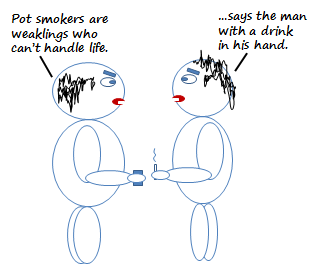
Heard at today’s GCLC lunch talk, seemingly in defense of Google’s search manipulation tactics: Bing is also linking preferentially to its own related services (maps, etc.). So the complainants, and Microsoft in the first place, should take a pass.
On further thoughts, this is a pretty weak argument.
First, the idea underpinning this argument seems to be that Google’s strategy is standard industry practice. And the upshot would be that Google’s conduct has a rational business justification. But the fact that a course of conduct is frequent within an industry, and that it has been replicated by rivals, does not make it presumably lawful. Many drivers breach the law by speeding everyday, yet this is no reason to hold their conduct lawful. Similarly, the fact that conduct is rational is not a cause of antitrust immunity. Collusion is often rational, yet it is strictly forbidden.
Second, this argument actually works in favour of Microsoft’s allegations. It is precisely because preferential placement of links on search engines has the ability to steal competitors’ market share – and in turn to foreclose – that Microsoft uses this strategy. But Microsoft does this to penetrate the market and/or avoid market marginalisation. And there’s no cause for concern here: given Bing’s very low market share, the preferential placement of links at best yields minor foreclosure effects. You may call this procompetitive foreclosure. In contrast, Google has a paramount market position. Hence its conduct is likely to exert anticompetitive foreclosure effects.
On the link between the magnitude of dominance and the intensity of anticompetitive effects, see §20 of the Guidance paper:
“in general, the higher the percentage of total sales in the relevant market affected by the conduct, the longer its duration, and the more regularly it has been applied, the greater is the likely foreclosure effect”
And on the fact that not all foreclure is unlawful, see §22 of the CJEU ruling in Post Danmark:
“not every exclusionary effect is necessarily detrimental to competition”
Finally, the argument surmises that competition law should treat market players equally. But in this industry, Google is seems dominant, Bing not. Those two firms are thus in distinct situations, and the argument again does not fly. It is indeed well settled that pursuant to Article 102 TFEU, dominant firms are subject to a “special responsibility” (whatever this means) possibly for the reason set out in my second point. Like it or not, competition law imposes higher constraints on dominant firms than on non-dominant firms.
The sole possible way to make sense of this argument boils down to a moral issue, best expressed in the maxim: “nemo auditur propriam turpitudinem allegans”. But it is well known that this argument has no traction in competition law, which has no moral content, a point forcefully made by Bork – a late pro-Google advocate – in his early Antitrust Paradox. And this, in any case, would not bar the Commission from taking over the investigation on its own motion.
Overall, by trying to counter argue that Bing also manipulates search results, Google is falling into the well-known Tu Quoque fallacy.
PS: the Lunch Talk was great. We heard two economists, Anne Perrot and Cedric Argenton, speaking very clearly to lawyers. We also watched a lawyer, Alfonso, morphing into a complete hi-tech geek. The introduction of his presentation was simply hilarious. I rarely laughed so much at a conference. The slides will appear on the blog very soon.
PS2: link to the above pic here.
Reform of Private Enforcement of Competition Law in the UK: the Government’s Proposals
[Our friends Christopher Brown (Matrix Chambers and Eutopialaw) and Scott Campbell (Stewarts Law LLP) have kindly offered us a very interesting post on the reform of private enforcement of competition law in the UK. To the best of my knowledge, this is the first written piece commenting on the substance of the proposed reform. With those proposed changes, the UK may be trying to position itself as the leading forum for private actions in Europe. An absolute must read].
A while back, one of us blogged on the UK Government’s consultation, launched in April 2012, on possible reform of the private actions regime in the UK. The consultation was wide-ranging and included several radical proposals designed to facilitate redress for victims of anti-competitive conduct – most notably, the introduction of an ‘opt-out’ collective actions mechanism. Reaction to the consultation from lawyers and business was extensive: the Government received 129 formal responses, and opinion was sharply divided on some issues.
It has inevitably taken some time for the Government to take on board the responses and consider the way ahead, but, since the publication last week of its response to the consultation, we now know what it intends to do. In summary, the Government proposes to
- Strengthen the private law jurisdiction of the specialist judicial body, the Competition Appeal Tribunal (CAT);
- Introduce a “limited” opt-out collective actions regime, with “safeguards” designed to prevent frivolous or unmeritorious claims being brought;
- Promote alternative dispute resolution (ADR); and
- Take some limited action designed to ensure that private enforcement complements public enforcement.
In this post, we take a look at the main proposals, considering some of the likely practical implications of the reforms in the event that they are passed into law.
1. Putting the CAT front and centre of private enforcement in the UK
The first broad proposal is one on which most respondents agreed, at least in broad outline: to make the CAT the ‘go-to’ venue for private competition litigation in the UK. Since acquiring its private law ‘follow-on’ jurisdiction upon the entry into force of the Enterprise Act in 2003, the Tribunal has seen relatively little action, and much of the action it has seen has been in the form of procedural skirmishes relating to the ambit of that jurisdiction (several of which have gone on appeal to the higher courts). In many cases, claimants have preferred to commence follow-on proceedings in the High Court instead.
Revolving doors

Those days, I feel strongly about conflicts of interests.
Not those that affect lawyers and economists. Almost inevitably, their prose is influenced by the business interests of their clients. We all know this. And subject to full disclosure, I see no evil in the fact that lawyers and economists publish papers in academic journals.
No, those that affect the EU institutions. Yesterday, M-Lex reported a blatant example of “revolving door“.
V. Kreuschitz will succeed to J. Azizi as the Austrian Judge at the General Court.
In a previous life, Kreuschitz served as a Commission legal adviser on State aid and antidumping.
It certainly makes sense to have this kind of expertise at the Court. But the cumulative effect of appointing previous Commission officials as judges, plus the very many référendaires who have spent some time in the EU administration may give rise to a pro-Commission bias at the Court. This, in turn, is not in line with the right to equality of arms in legal proceedings, as protected under Article 6 ECHR.
There would also be much to say about the conflicts of interests that plague academia. On this, I leave you with a reference to the great documentary the “Inside Job“, where Ferguson showed how the banking industry litteraly “bought” dozens of influential US scholars, to shut out any sort of academic criticism against nefarious financial practices.
Search engines and competition law
Just in case you haven’t yet registered…. 😉
Lunch Talk Series – Searh Engines and Competition Law- Friday 8 February 2013
Programme
12:00 – 12:30: Sandwich lunch and socializing
12:30 – 13:45: Presentations and comments
- Mr Cédric ARGENTON, TILEC – Tilburg University
- Mr Alfonso LAMADRID, Garrigues
- Ms Anne PERROT, MAPP
13:45 – 14:00: Q&A
Registration
Please register online at: http://63rdgclclunchtalk.eventbrite.com
Registration is open until 6 February 2013.
Standard rate: 35 EUR (VAT incl.) – free seats available for sponsors.
Inquiries
Global Competition Law Centre
College of Europe, Bruges
E-mail: info.gclc@coleurope.eu
Website: gclc.coleurope.eu
The Odds of Commission v Google

A few days ago, a funny post of mine scheduled for publication was deleted by my one-handed friend Alfonso.
With his dysfunctional arm he can’t write. But he certainly can press the erase button.
I will not ressuscitate this post on pain of causing him a heart attack.
But I have decided to write something in the same spirit. After all, we (luckily) don’t live in North Korea. I leave it to our readers to guess what my censored post was about.
So here we go. With the expiration of Commissioner Almunia’s ultimatum on 31 January 2013, journalists were star crazy yesterday.
Habemus papam “It has arrived” said today a popelike Joaquin Almunia, alluding to Google’s proposed settlement package.
Now the question is as follows. In Commission v Google:
I will try to run more polls of this kind in the future (subject to the prior authorization of my learned co-blogger).


 Chillin'Competition