Author Archive
I made it
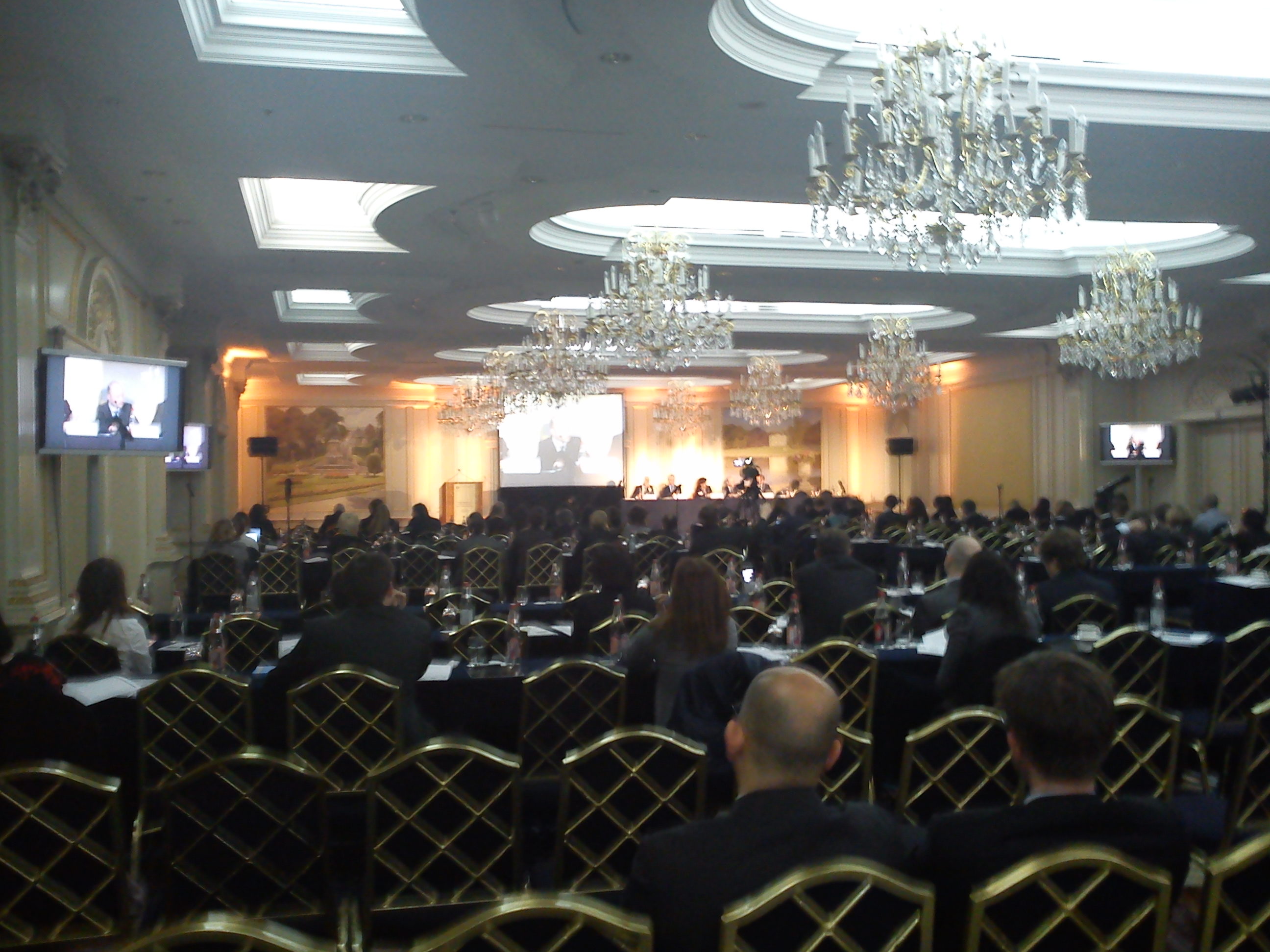
The above picture is proof that I eventually attended the expensive conference which triggered a post on price discrimination two days ago
And guess what: I made it for free :)… I belong to the happy few who got a free pass from a very important institutional player in the field (not a law firm).
More seriously, I understand my benefactor shares my concerns on (i) the pricing of such conferences; and (ii) on the necessity to entitle the little number of academics active in the field to participate to such events.
Now a teaser: the next big issue in the merger area relates to minority shareholdings. Is there a gap in the EUMR, and should it be closed? Commissioner Almunia referred to this issue in his speech, and I trust the Commission will start to do some thinking on this in coming months.
Many thanks again to my colleagues who helped me get a free ticket.
Price Discrimination (and the Brussels Conference Market)
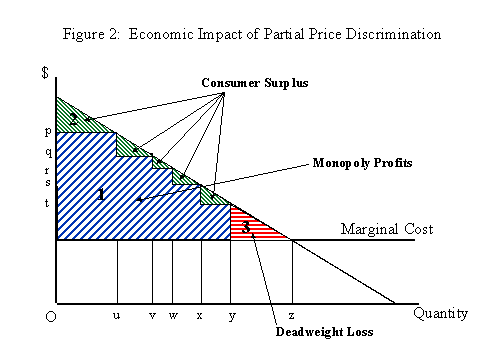
A thought on something that lawyers – including myself – often have a hard time to understand.
Conventional economic theory posits that price discrimination by a monopolist is conducive to allocative efficiency.
This is because price discrimination entails a welcome departure from uniform monopoly pricing. With price discrimination, the monopolist undercuts its own uniform price to the benefit of certain customers (or to categories of customers as shown in the above picture). With price discrimination, customers that could not initially take the uniform monopoly price now get a chance to be served.
Furthermore, the monopolist increases output and, assuming fixed costs, achieves economies of scale. Price discrimination is thus also conducive to productive efficiency.
With this background, I was last week confronted with an odd price discrimination scheme which, in my opinion, brings little – if no – improvements in terms of allocative efficiency. A famous conference organizer has the following price menu for a forthcoming competition law event:

On cursory examination, this conference organizer has designed the above price menu to attract academics, judges and young lawyers. However, I doubt this price scheme will attract many of them, simply because those fees are well beyond the average reservation price of such customers. Saving appearances?
An additional remark: given that this conference is sponsored (law firms essentially) and that most speakers are brussels-based (means no transport/accomodation costs), I do not see the cost basis for such rates. Although I am not a huge fan of excessive pricing cases, the Brussels competition conferences market could make an interesting candidate for Article 102 TFEU proceedings. Still to see whether there is a dominant player on this market. Food for thought.
Forthcoming GCLC Lunch Talk on the Energy Sector

The 51th Lunch Talk of the GCLC will be devoted to recent enforcement trends in the energy sector.
The speaker are Céline Gauer (DG Competition) and John Ratliff (WilmerHale ).
It will take place on 18 March 2011 at The Hotel (formerly the Hilton), 38 Boulevard de Waterloo, 1000 Brussels.
See link below for registration form.
51th GCLC Lunch Talk – 18 March 2011
My slides
Am in Paris with limited access to the Internet.
I attach the slides I used today in support of a presentation on EU and French competition law at the Association Française d’Etude de la Concurrence (AFEC). Nothing groundbreaking.
Actualité du droit matériel des pratiques anticoncurrentielles – AFEC
My WE Readings…

… involved approximately 5000 pages of case-law (see list below).
I am currently preparing for a conference this Thursday. I have 40 minutes to brief the audience on the main developments in EU and French competition law over 2010.
Now that I have read all that stuff, I should certainly start monetizing my knowledge by making presentations for law firms in Brussels and Paris. I heard a god of competition law used to do this in the past. Any clue?
Next BSC Module

In the forthcoming weeks, the Brussels School of Competition (“BSC”) will host a series of three weekly lectures on “The Procedural and Institutional Framework of EU Competition Enforcement”
Our speakers are Fernando Castillo de la Torre (Legal Service, European Commission) and our friend Luis Ortiz Blanco (also Alfonso’s boss ).
We still have a few seats free. See registration form and details below.
Important for Alfonso’s growing fan-club: our co-blogger will most likely make a “not to be missed” guest appearance at the BSC.
Mercato

Some time ago, we have been informed of a forthcoming large, big, huge move on the Brussels legal market.
The story is now official:
Our friends Trevor Soames, Miguel Rato, Stephen Mavroghenis, Götz Drauz and Geert Goeteyn are joining Shearman and Sterling as partners.
They take with them a bunch of top notch associates (we’ll report on that in the next days).
Best of luck to all of them at S&S.
Nicolas/Alfonso
Unfaithful

Shame on me: I cheated on chillin’competition.
Yesterday, a short piece emanating from my computer was posted on adjudicating europe, a blog commenting on the case-law of the Court of Justice.
I attach hereafter a longer version of this post in the form of a working paper. As usual, I’d be happy to have your comments.
And BTW, it deals with the judgment of the ECJ in VEBIC, a case that we covered on this blog a few weeks ago.
Nut Complaint

After MSFT I and II, bringing an Article 102 TFEU case against the Redmond giant may have seemed an easy shot.
This is probably what prompted the Omnis Group to lodge in December 2009 a complaint with the Commission alleging violations of Article 101 and 102 TFEU.
The Commission rightly dismissed the complaint in December 2010.
From both a factual and legal standpoint, the complaint looks indeed like a (bad) competition joke.
Read and judge for yourself:
- The allegations relating to Article 102 TFEU concern a market (Enterprise Resource Planning software) on which MSFT had a market share<5%. When the Commission disputed the complainant’s dominance allegation, Omnis Group had this to reply: the Commission’s data – which is based on market intelligence from Gartner and IDC – is flawed. Microsoft lied to market research companies. Quotes from wikipedia confirm Microsoft’s important market position…
- Besides invoking all the existing types of antitrust violations under Article 101 and 102 (tying, refusal to deal, discrimination, cartel (!), monopoly (!)), the complainant took issue with a number of exotic antitrust infringements: misuse of European funds, violations of public procurement rules and corruption by Microsoft. No comment.
- Last, but not least, the complainant requested a oral hearing pursuant to Regulation 773/2004.
Omnis Group lawyers should be commended for their knowledge of competition law, and their impressive mastering of legal strategy.
This, to me, is one of the nuttiest cases of 2010.
Much Ado about Nothing

Some topics exercize a somewhat irrational fascination on competition lawyers and should not.
Take, for instance, “hub and spoke agreements“. Lately, this topic has been amongst the trendiest issues in competition law circles.
However, those are just ordinary vertical agreements with horizontal anticompetitive effects (read collusion). Conceptually, they should be dealt with along the lines of multi-agency contracts, english clauses, single branding agreements and so on.
Viewing hub and spoke agreements as a novel kind of agreements is purely formalistic reasoning.
The bottom-line: I will fight any proposal to organise an event on hub and spoke agreements :).


 Chillin'Competition
