Author Archive
Lamadrid & Petit LLP

We live in a world of “experts“.
Readers, corporations, public institutions all crave for expert advice.
And the beauty of it is that we are all experts at something, including at unexpected subjects.
Take a look at what landed in my mailbox last week:
“Dear Nicolas,
Chambers & Partners is producing a new guide for clients which provides practical insights into doing business around the world.
We are currently doing research for the guide on Merger Control. The contributing editor is John Doe of Doe, Doe & Doe LLP.
I am writing a chapter in the guide which will give useful advice to clients who are new to undertaking mergers in Spain. Given your experience in merger control proceedings in Spain, I was hoping you might talk to me for a few minutes to pass on some of the insights that you’ve gained.
The interview would be in complete confidence.
If you are willing to be interviewed, please let me know a time that would be convenient for me to ring you. My email is: JohnQ@chambersandpartners.co.uk. Or please feel free to call my direct line: +__________.
With thanks for your consideration.
Kind regards,
John Q.
Legal Practice Guides
Chambers and Partners”
I guess the selling argument in this email is the “Given your experience in merger control proceedings in Spain“.
John Q must have been confused by my credentials as a founding partner of Lamadrid & Petit LLP.
To me, this says it all about the reliability of those “guides“.
On second thoughts, I should have taken the interview to prove my point.
Book Review – Soft Law in Court
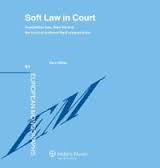
Oana Stefan (HEC Paris) has kindly sent us a copy of her book on soft law in competition and state aid law.
This book is the first monograph ever devoted to this issue.
Amongst other things, the book uses quantitative data to confirm that the judgments of the EU Courts abundantly refer to soft law instruments.
It also argues that the distinction between binding and non binding effects is too crude.
Lastly, it shows that the EU courts have created legal hybrids when endorsing soft law instruments on the ground that they are the expression of general principles of law. This generates, in the author’s words, a “judicialization” of soft law.
A must read. Apparently, Oana will in the future focus on how national courts deal with soft law instruments.
A full description of the book can be found here.
Two final remarks. First, I’d love to read Oana’s views on the appalling Expedia judgment (Expedia Inc v Autorité de la concurrence and Others C-226/11). Second, this book review does not mean that we are “sokolizing” this blog. Our tacit understanding with Dan is that he focuses on the scholarship reviews, we concentrate on the rest (including the nonsense).
Back in Business

with two presentations:
Number 1: evidence in oligopoly settings (or can tacit collusion be proved ex post)? My submission is yes. I give examples of papers that proved tacit collusion, and try to explain how economists do this . I gave this presentation 10 days ago at the IMEDIPA conference in Athens. Looking back at the success of the event, Greek competition law is NOT in crisis.
Evidence in Oligopoly Settings – IMEDIPA N Petit 8 June 2013
Number 2: under what substantive standard of abuse should the Commission deal with injunctions on FRAND-encumbered SEPs? I gave this presentation at GCR’s conference last week. A nice but pricy event + quite one-sided. I got some free tickets for my LLM studs.
Injunctions for FRAND encumbered SEPs – GCR Conference – June 2013 – Petit
Forthcoming Events

A bunch of interesting events:
– 7 June, Athens: 7th International IMEDIPA Conference on Competition Law and Policy (I. Liannos has also sent us information on three other interesting events: one on evidence in competition proceedings (in London); a course on innovation and competition by Herb Hovenkamp (in London too); and a conference on regulatory impact assessments (in Paris))
– 10 June, Brussels: Half Day Conference on the new Belgian Competition Law+Agency jointly organised by the Brussels School of Competition;
– 14 June, Brussels: GCR IP and Antitrust conference. This event focuses on SEPs and injunctions essentially. Amongst other things, speakers have been asked to discuss the ongoing Samsung, Motorola and ZTE cases. The programme looks great, as does as the list of speakers. The downside: the conference fee. We, at chillingcompetition, do not like that. Upon request, the organisers have offered free tickets to my students. Not too bad.
PS: talking bout students, congrats’ to my former stud D. Auer who was just admitted to the LLM programme at the university of Chicago. We are very proud.
New Belgian Competition Agency – Open Positions

The much awaited reform of the Belgian competition authority is now out in the open.
New positions are being created (see here for more):
– President;
– Chief Economist;
– General Counsel;
– General Prosecutor;
– 20 part time Assessors, i.e. 10 French speaking + 10 Dutch speaking => the assessors will hear cases within decisional chambers; those chambers will be composed of 2 assessors + the President).
All the info can be found in the Belgian Official Journal of 27 May 2013.
Now, the talk of the town about this recruitment process:
1. A puzzling feature of this call for application is that French will be tested for Dutch speaking applicants to the position of assessor (although they won’t hear cases in French), and vice versa; but no such test will take place for the Chief of Legal Affairs and the Chief Economist, who can be unilingual. Query why.
2. Some people have discretely lamented that (i) as usual in Belgium, the process will be heavily politicized; (ii) that the future organigram of the agency would be already decided; and (iii) that several of strong candidates would in turn be dissuaded to participate to the beauty context.
I have sought information on this. I have been repeatedly told that NOTHING has yet been decided. There is apparently no obvious candidate for any of those jobs => put simply, incumbents will not be favoured over new entrants and anyone interested shall apply.
3. Nothing seems to disqualify lawyers from private practice to apply for a job as part time assessor. Some rules on conflicts of interests, which to date do not exist, will need to be adopted, if the new authority wants to avoid endless procedural problems.
4. Nothing is said of the confidentiality of applications and of the members of the selection committee.
5. The deadline for applications is tight: 10 June. RUN!!!
Lost Parrot
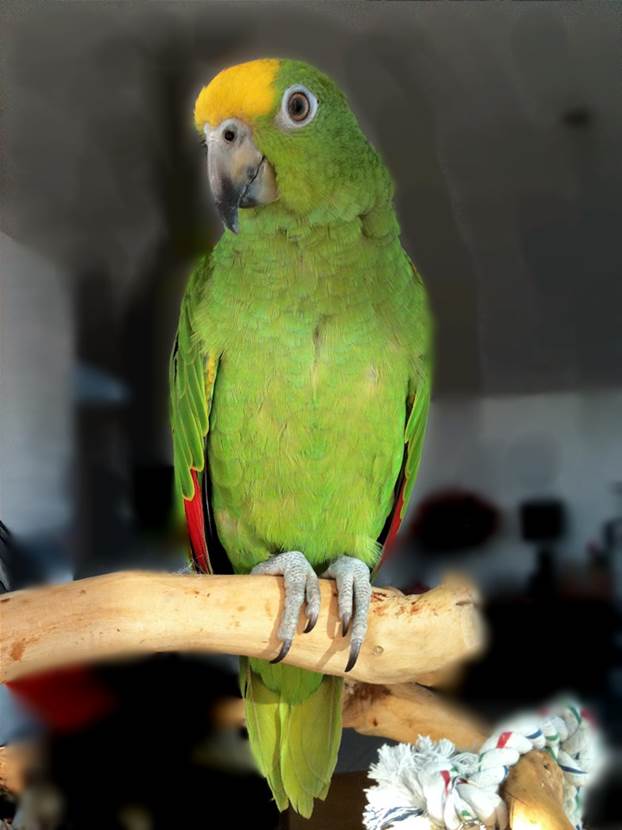
Our friend and former boss Trevor Soames has lost his parrot Bombolini a dozen days ago.
Trevor and Camilla offer a €1,000 prize to anyone who will found him.
I attach below the notice that Trevor and Camilla put together.
You may contact Trevor at +32.491.378.946 or Sergio à Mondocane at +32.2.660.96.56
You can also email Trevor and Camilla at: trevorandcamilla@ymail.com
See here for the notice: Lost Parrot

A post on food and competition law dedicated to our friend Alfonso, who is busy prepping for the big hearing in Cisco v. the two best antitrust friends Commission+Microsoft.
One of our readers has informed us that the Bundeskartellamt has conducted dawn raids at firms active in the potato sector (growing and distribution). Although lengthy, the press release does not say much of the substance of the case. Apparently, the BKartA suspects price fixing.
Neither does it mention whether there was a leniency application. Yet, we are told that the BKartA never gives such info at this stage of a case.
Thanks to Andrea for the pointer.
The Bon Jovi Defense

I gave a presentation last week at the Intertic conference organised by F. Etro in Rome (see link hereafter:Recent Developments in Article 102 TFEU – Intertic Conference – Final).
This was a very good event, with many great speakers.
One of the main points in my presentation was to exort the Commission, as a best practice, to avoid working on the new “hi tech” cases under the “likely” effects framework, and prefer to investigate them under an “actual” effects framework.
A Commission official rightly remarked, however, that agencies cannot wait to have dead bodies on the floor to intervene.
So I gave some thinking to the remark. On face value, this is a commendable suggestion.
Yet, when one thinks about it, this is a bit of a rethorical, oversimplistic defense: a company is either dead or alive, full stop (we may call it the “Bon Jovi defense“, after the band’s classic “dead or alive” gem).
Bu this wholly fails to understand that there is – and this is fortunate – something between life and death, and that companies do not exit markets instantly.
On top of this, most players in the hi tech sector are big corporations with deep pockets – they all accuse each other of being dominant – that are unlikely to disappear overnight.
That said, I understand the Commission’s concerns. To help the agency, I would argue in favour of the use of interim measures. After all, those measures may give the Commission the time necessary to amass empirical proof of anticompetitive effects, meanwhile mitigating the harm on alleged victims of the dominant company.
Besides this, it would be probably more satisfactory to think about this issue in terms of threshold, and ascribe a well-defined probabilistic threshold to the concept of “likely” effects, drawing for instance inspiration from the discussion that took place in merger control in the Tetra Laval case (“in all likelihood” v. “balance of probabilities“). Given the escalation of sanctions for infringements of Article 102 TFEU, I’d set the bar quite high.
A last thing: no one can predict the future… and I trust antitrust agencies are no exception to this. So again, the principle of enforcement humility (we mentioned it in a previous post) calls for a modest, empirical approach to fast moving markets, as advocated by J. Wright in a recent excellent speech.
PS: a question for our readers: I am looking for real life evidence of firm exit out of anticompetitive exclusionary conduct. Can anyone help? Examples shall not necessarily come from antitrust cases. I am thinking of running some case studies with my students.
CCP Conference on 6 and 7 June
Our friends from the University of East Anglia Centre for Competition Policy (CCP) have put together an original and attractive conference (see link at the end of this post).
This is not yet another conference on competition enforcement. The programme tackles institutions for competition enforcement, but offers to do this through several lenses: historical, comparative, economics, etc.
Besides this, there’s a significant number of enforcers on the programme, which promises well informed discussions.
A must attend.
Patent Settlements and Rules of Inference

We had this morning at the GCLC a half day conference on pay for delay arrangements in the pharmaceutical sector.
This was a great event, which triggered the following thoughts.
On the law, the problem is not the conduct in itself, i.e. the payment arrangement (also referred to as a “settlement” agreement). Any agreement which consists in paying to seclude a competitor can be unlawful. The FTC apparently talked of a “classic violation” in old documents. We see such agreements all the time in the area of vertical restraints, when firms pay distributors in exchange for exclusivity so as to keep rivals off the market.
The problem lies elsewhere, in the proof of the anticompetitive impact of the agreement, actual or potential (the second component of an infringement). Economists talk about a credible theory of competitive harm.
Now, a settlement payment from originator to generic can only be deemed to restrict competitive entry if the judge would invalidate the patent. In other words, a settlement payment can only be anticompetitive if the patent is invalid. Otherwise (if the patent is valid), competitive entry could just NOT occur, and the payment question is irrelevant.
If I understand correctly, the Commission apparently assumes invalidation. In other words, it assumes that judges would invalidate litigated patents. This stance on what the judge is poised to do is similar to that found in the abuse cases involving Standard Essential Patents, where the Commission seems also to assume that the judge will grant injunctions.
My take on this: this is a meritorious assumption to make if only because patents are deemed presumptively valid once granted. And this weak assumption is not good practice when one has to formulate new policy. As J. Wright, FTC Commissioner, explains beautifully in a recent speech: the formulation of new theories of harm should be based on empiricism, not on guesswork.
Now, the one funny thing here is that to overcome what I may call the weak assumption problem (and to make the case for enforcement), the Commission relies on classic Chicago school reasoning (or if you prefer on basic rational incentives theory). The idea is as follows: an originator cannot rationally be paying a generic firm to stay out of the market if its patent is valid. The sole rational explanation is that the patent is invalid.
This line of reasoning has some teeth in conventional EU competition law. The AKZO “sacrifice test” in predation cases is one example of this: a dominant firm cannot be rationally pricing below costs. The sole rational explanation is that it is seeking to predate.
I believe, however, that one should err on the side of caution when it comes to crafting such “rules of inference”. Indeed, inferential equations of the AKZO kind are not mundane in EU competition law. They are exceptional, based on rich doctrinal debate as the AKZO ruling shows (it transposes the AREEDA and TURNER test) and on years of judicial precedents. Moreover, the problem is that there are many other possible explanations to the originator payment (irrationality, aversion to risk, etc.), including a whole raft of behavioral economics reasons.
So for patent settlement cases, I would actually apply a different type of “rule of inference”, such as the one applied in Woodpulp or CISAC, whereby the Commission can only find infringement if it proves the conduct has no other purpose than the restriction of competition, and thus must dispel all alternative explanations.
Funnily enough, most of the discussion on patent settlements has not touched upon this issue, and has instead focused on the “object-effect” distinction. This debate is, however, an uneasy one, given the lax state of the case-law. Maybe discussing about patent settlements under a “rules of inference” angle could help reach new ground.


 Chillin'Competition