Archive for the ‘Uncategorized’ Category
Anti-Monopoly
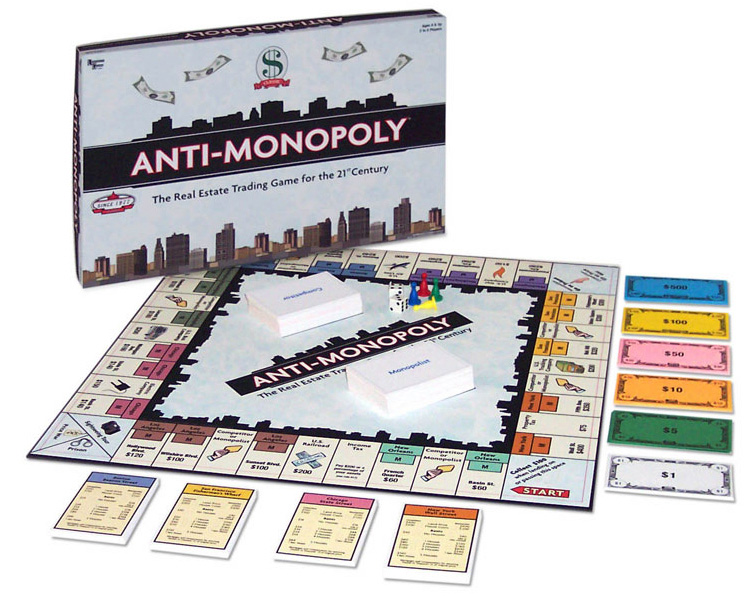
As anticipated in previous posts, we continue feeding up a ‘leisure time for competition geeks’ section.
This post is about a board game, ‘Anti-Monopoly’, a different version of ‘Monopoly’ with an ‘anti-monopolistic’ theme.
In Anti-Monopoly®, players play either by or competition rules fixed at the beginning of the game:
COMPETITORS … charge fair rents, build as soon as they own a property, put five houses on their properties and occasionally go to Price War.
MONOPOLISTS… extort monopoly-high rents from their poor tenants, build only after they have monopolized a color grouping, restrict supply by putting only four houses on their properties and occasionally go to Prison.
The good guys are the small business entrepreneurs and the bad guys are the monopolists. Since players do not play by the same rules, fairness is achieved by a patented probability technique, has given each side equal chances to win.
OBJECT OF THE GAME: To be the richest competitor after all monopolists have been bankrupted or to be the richest monopolist after all competitors have been eliminated.
There is actually a great deal of controversy surrounding the creation of the game, which includes a 10 year long legal battle between the creator of Anti-Monopoly (Ralph Anspach) and the owners of the ‘Monopoly’ trademark. After more than 37.000 copies of ‘Anti-Monopoly’ were destroyed pursuant to a District Court’s order which found a trademark infringement in the use of the word ‘Monopoly’, the 9th Circuit Court of Appeals ruled in 1979 that the trademark ‘Monopoly’ was generic and thus unenforceable. Nonetheless, this wasn’t the end of the story. Soon after the 9th Circuit’s decision, the US Congress amended the Trademark Act to protect longstanding marks against generic claims, thereby allowing Hasbro to assert again its rights to the mark ‘Monopoly’ and its variants.
A settlement was eventually reached and the game is now marketed under a license from Hasbro.
For more info on the game as well as on the underlying legal story, click here
Thanks to Anne Dostert for the pointer (and indirectly to Scott Hemphill, from Columbia, who apparently has a copy of the game in his office) .
Did we chill competition?

See here. We were a few days ahead on this story.
It is quite well known that competition in the news market is not primarily about price, but almost equally about being the first to report a news. And even on price, our stories are freely accessible…
Bloggerhood
 A fellow blogger, Juan David Gutierrez from Derecho de la competencia has asked me to post on this blog the following research proposal:
I am conducting a research on the Latin American antitrust community as part of the investigation projects of the Competition Law Study Center (CEDEC) at U. Javeriana in Bogota. In particular we are interested in studying how competition law is taught in our region and the impact of Universities in the development of competition law.
To this end, we are collecting information regarding courses on competition law and policies (and related areas, such as industrial organization and regulation) in Latin America. I published a first draft in the “Boletín Latinoamericano de Competencia” N°26, (titled “La comunidad académica y la defensa de la libre competencia: Bases para una propuesta en América Latina”) which explains the rationale for the research topic and academic proposal.
We hope to collect more data with the help of Latin American Universities, professors and practitioners. The information per course that we require is the following:
- University’s name.
- Geographical location of the University.
- School or department that offers the course (law school, economics, management).
- Title of the course.
- Type of course. Undergraduate (mandatory or optional), Graduate (specialization, masters or Phd) or a short course (seminar, certificate, etc:).
- Course length and class hours per week
- Teacher’s name and e-mail.
- Teacher’s academic experience and studies.
- Syllabus (subjects studied during the course) for each course.
- Number of students (average or per course)
- Since when it has been taught.
- Periodicity of the course. (once every two years, once a year, twice a year, monthly, etc).
- Additional information. Website, events, publication, concluded researches or on going, etc.
I cordially invite to send us the information, to the following e-mail addresses: jdg@cable.net.co and cedec@cable.net.co
All the data collected will be made available at http://derechodelacompetencia.blogspot.com/. Once the information has been processed, we will get in touch with all those who participated in the research in order to share the results and strengthen the bonds between them.
Recent Output

- A French Competition Commissionner? The results of our poll are as follows. Out of 45 votes, 21 readers voted for C. Lagarde, 12 for N. Kroes (in spite of clear signals that she will not stay in charge) and 7 for V. Reding. (Image source here)
- My assistant and I have co-authored in La Libre an Op-Ed on the Lisbon Treaty and the failing communication strategies of our political leaders when it comes to European affairs (in French).
- Dr. Theodor Thanner (Director of the Austrian NCA) and I, last week in Vienna:

- To date, we have received a few, robust, submissions for the latest antitrust law development prize. Please do not hesitate to send yours.
- I just received the latest edition of competition law international (the journal of the antitrust committee of the IBA). It comprises a collection interesting papers by antitrust enforcers (Varney, Leibowitz, Lasserre, Badin and Krasnodebska-Tomkiel)
2009 Worst Antitrust Law Development Prize

With the awards season coming to a close, it is perfect timing to introduce the prize for the worst antitrust law development of the year. For the first time this year, this prize will reward a ruling, article, speech, career-move, research issue, policy initiative, or any other thing that has been undertaken, said or written that is stupid, infamous, crazy.
The prize will be awarded by the end of December 2009. Please refer to me anything that could qualify for it. I will keep all the info absolutely confidential, and will set up a jury of lawyers to award the prize (Alfonso and myself will be part of it). If you’d like to join, please let me know.
To give you an example: in 2005, a Dutch judge stated in 2005 that the Commission had exclusive competence to exempt an agreement under Article 81(3) EC (Rechtbank Zwolle-Lelystad, 4 April 2005, case n° 106345 / KG ZA 05-92, Walstock / Polar Electro). Surely, a strong candidate for this prize, had it been awarded in 2005.
(Image source: http://upload.wikimedia.org/wikipedia/en/c/c2/NobelPrize.JPG)
Call for papers
The Next Generation of Antitrust Scholarship Conference NYU School of Law January 29, 2010 Co-sponsored by NYU School of Law, American Association of Law Schools – Antitrust and Trade Regulation Section and the American Bar Association – Antitrust Section
Conference Co-organizers
Harry First – NYU School of Law
Ilene Knable Gotts – Wachtell, Lipton, Rosen & Katz Edward Cavanaugh – St. John’s School of Law
D. Daniel Sokol – University of Florida Law Levin College of Law
This conference is the first ever conference for the Next Generation of Antitrust Scholars. Much has changed in both the law and economic theory of antitrust in the past 30 years. The purpose of this event is to convene a conference of the next generation of antitrust law professors (people who started their teaching career in or after 2000) and provide them an opportunity to present their latest research. Senior antitrust scholars and practitioners in the field will comment on the papers.
Submissions are open to professors around the world. Papers will be accepted based upon the highest scores given to the 1,000-2,000 word abstract or full article submitted. Speakers who are accepted by an abstract must have a completed draft of the paper ready two weeks before the conference.
The conference organizers will not pay for any expenses for speakers or discussants. Refreshments at the conference, however, will be provided free of charge.
Please send abstracts of papers or completed drafts to nyuantitrustconference2010@gmail.com. Please email any questions about the conference to nyuantitrustconference2010@gmail.com.
The deadline for submissions is November 20, 2009. Participants will be notified by November 30, 2009.
For more see here.
No comment
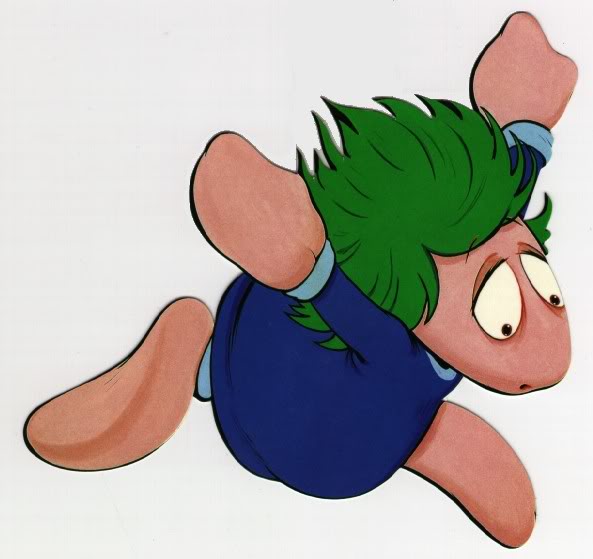
Unrelated to EC competition law, but could not resist to post it. In its conclusions under Case C-246/07, Commission of the European Communities v Kingdom of Sweden, 1 October 2009, Advocate General Poiares Maduro made a surprising reference:
Sweden did not let that decision-making process take its natural course and culminate in a Council decision either for or against the addition of PFOs to the Convention. Sweden should have engaged in the Community decision-making process until such a decision was reached, even if, politically, it felt that its efforts to achieve a common proposal on the addition of PFOs to the Convention were as doomed as lemmings heading towards the edge of a cliff.
Plain excellent. Thanks to Cedric Cheneviere for the pointer.
Nobel Prize in Economics for Oliver Williamson

On top of his work refining the Coase “make it or buy it” theorem, Oliver E. Williamson, is also the author of two absolute must reads for all antitrust lawyers:
- “Economies as an Antitrust Defense: The Welfare Tradeoffs.” 58 American Economic Review. 1, 18-36 (1968).
- Market and Hierarchies: Analysis and antitrust Implications, New York, Free Press, 1975
The Normans Theory of Innovation?
A striking finding, whilst preparing a class for my new students in EDHEC (a French Business School located in Lille). I propose to relabel the Aghion et al. inverted U curve of innovation/competition the Normans’ theory of innovation.
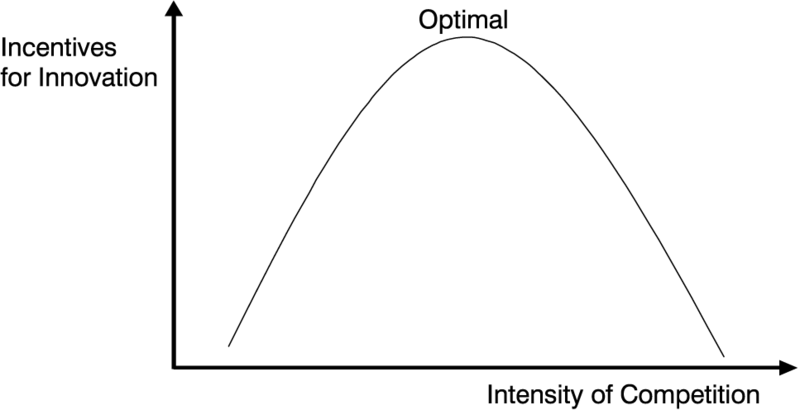
A word of explanation: In my home country, France, Normans (the people from Normandy) are said to be very moderate persons. When asked a question calling for a clearcut reply, a typical norman would refuse to give a brightline answer, and rather express a soft “maybe yes, maybe not”. On close examination, the Aghion et al. inverted U curve has a taste of Normandy. Let’s rephrase the question to which those authors sought to answer in their seminal paper: ” Is competition good for innovation?” Now, let’s look at their answer: too much competition kills innovation, to little competition kills also innovation… Very Norman indeed… and only helpful to the extent that it moderates the somewhat extreme positions of Schumpeter and Arrow. But not more helpful than this.
Hardcore Legal Interpretation
 In its proposed Vertical Guidelines, the Commission’s interpretation of the concept of a “hardcore restriction” at §43 seems somewhat at odds with (i) the letter and spirit of Article 81 EC and (ii) traditional case-law:
“Including such a hardcore restriction in an agreement gives rise to the presumption that the agreement falls within Article 81(1). It also gives rise to the presumption that the agreement is unlikely to fulfil the conditions of Article 81(3), for which reason the block exemption does not apply. However, this is a rebuttable presumption which leaves open the possibility for undertakings to plead an efficiency defence under Article 81(3) EC in an individual case. In case the undertakings substantiate that likely efficiencies result from including the hardcore restriction in the agreement and that in general all the conditions of Article 81(3) are fulfilled, this will require the Commission to effectively assess – and not just presume – the likely negative effects on competition before making the ultimate assessment of whether the conditions of Article 81(3) are fulfilled“.
Four points here.
First, in essence, firms are now deemed guilty before being proven innocent. Whilst this may be ok in so far as clearcut hardcore restrictions are at stake (e.g., market sharing), the case-law shows – and the vertical guidelines contain – many examples of non-direct, hardcore, restrictions, which can only (or not) be deemed to be hardcore so following a careful, first, assessment under Article 81(1) EC: dual pricing, rebates conditioned on observance of recommended price, etc. Now, here’s my question: how can one reconcile the need for such a preliminary assessment under Article 81(1) EC, with the Commission’s assertion that Article 81(3) EC comes first?
Second, under the applicable 81(3) EC principles, efficiencies must be quantified and meet many other drastic conditions. This, in practice, implies that under the current standards, no firm can seriously articulate an efficiency defense, so that the principle that you can save hardcore restrictions will, de facto, remain dead letter. See here for more on this.
Third, saying that the appraisal process under Article 81 EC is binary (Article 81(3) EC for defendant, then Article 81(1) for Commission) is overly simplistic. As a matter of principle, there are at least five steps: (1) Commission proves 81(1) EC; (2) Defendent challenges 81(1) EC; (3) Commission meets objections and proves 81(1) EC; (4) Defendent proves 81(3) EC; (5) Commission dismisses/accepts the 81(3) EC defense. The Guidelines recognize this… in a footnote: “What is described here as two distinct legal steps may in practice be an iterative process where the parties and authority in several steps enhance and improve their respective arguments”. As nicely coined by A. Font Galarza at Wednesday’s conference, does the method whereby important principles are relegated to footnotes meet the EC standards of “Better Regulation”?
Fourth, is this also true from a self-assessment perspective (the Commission’s perspective here is about administative proceedings), that firms must go first through the lengthy, cumbersome, Article 81(3) EC assessment?
Will come back with more on another intriguing issue: buyer-related vertical restraints.
(Image possibly subject to copyrights. Source: http://www.houstoncriminallawjournal.com/uploads/image/Houston,%20Harris%20County%20Jail(1).jpg)


 Chillin'Competition


.jpg)