Archive for the ‘Uncategorized’ Category
Call for papers
The Next Generation of Antitrust Scholarship Conference NYU School of Law January 29, 2010 Co-sponsored by NYU School of Law, American Association of Law Schools – Antitrust and Trade Regulation Section and the American Bar Association – Antitrust Section
Conference Co-organizers
Harry First – NYU School of Law
Ilene Knable Gotts – Wachtell, Lipton, Rosen & Katz Edward Cavanaugh – St. John’s School of Law
D. Daniel Sokol – University of Florida Law Levin College of Law
This conference is the first ever conference for the Next Generation of Antitrust Scholars. Much has changed in both the law and economic theory of antitrust in the past 30 years. The purpose of this event is to convene a conference of the next generation of antitrust law professors (people who started their teaching career in or after 2000) and provide them an opportunity to present their latest research. Senior antitrust scholars and practitioners in the field will comment on the papers.
Submissions are open to professors around the world. Papers will be accepted based upon the highest scores given to the 1,000-2,000 word abstract or full article submitted. Speakers who are accepted by an abstract must have a completed draft of the paper ready two weeks before the conference.
The conference organizers will not pay for any expenses for speakers or discussants. Refreshments at the conference, however, will be provided free of charge.
Please send abstracts of papers or completed drafts to nyuantitrustconference2010@gmail.com. Please email any questions about the conference to nyuantitrustconference2010@gmail.com.
The deadline for submissions is November 20, 2009. Participants will be notified by November 30, 2009.
For more see here.
No comment

Unrelated to EC competition law, but could not resist to post it. In its conclusions under Case C-246/07, Commission of the European Communities v Kingdom of Sweden, 1 October 2009, Advocate General Poiares Maduro made a surprising reference:
Sweden did not let that decision-making process take its natural course and culminate in a Council decision either for or against the addition of PFOs to the Convention. Sweden should have engaged in the Community decision-making process until such a decision was reached, even if, politically, it felt that its efforts to achieve a common proposal on the addition of PFOs to the Convention were as doomed as lemmings heading towards the edge of a cliff.
Plain excellent. Thanks to Cedric Cheneviere for the pointer.
Nobel Prize in Economics for Oliver Williamson

On top of his work refining the Coase “make it or buy it” theorem, Oliver E. Williamson, is also the author of two absolute must reads for all antitrust lawyers:
- “Economies as an Antitrust Defense: The Welfare Tradeoffs.” 58 American Economic Review. 1, 18-36 (1968).
- Market and Hierarchies: Analysis and antitrust Implications, New York, Free Press, 1975
The Normans Theory of Innovation?
A striking finding, whilst preparing a class for my new students in EDHEC (a French Business School located in Lille). I propose to relabel the Aghion et al. inverted U curve of innovation/competition the Normans’ theory of innovation.
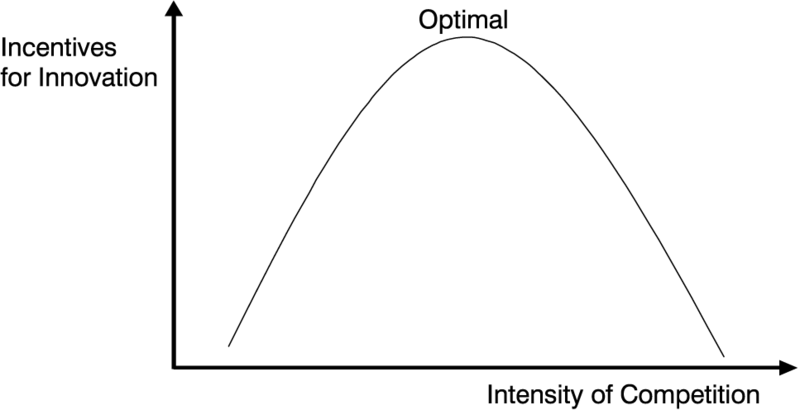
A word of explanation: In my home country, France, Normans (the people from Normandy) are said to be very moderate persons. When asked a question calling for a clearcut reply, a typical norman would refuse to give a brightline answer, and rather express a soft “maybe yes, maybe not”. On close examination, the Aghion et al. inverted U curve has a taste of Normandy. Let’s rephrase the question to which those authors sought to answer in their seminal paper: ” Is competition good for innovation?” Now, let’s look at their answer: too much competition kills innovation, to little competition kills also innovation… Very Norman indeed… and only helpful to the extent that it moderates the somewhat extreme positions of Schumpeter and Arrow. But not more helpful than this.
Hardcore Legal Interpretation
 In its proposed Vertical Guidelines, the Commission’s interpretation of the concept of a “hardcore restriction” at §43 seems somewhat at odds with (i) the letter and spirit of Article 81 EC and (ii) traditional case-law:
“Including such a hardcore restriction in an agreement gives rise to the presumption that the agreement falls within Article 81(1). It also gives rise to the presumption that the agreement is unlikely to fulfil the conditions of Article 81(3), for which reason the block exemption does not apply. However, this is a rebuttable presumption which leaves open the possibility for undertakings to plead an efficiency defence under Article 81(3) EC in an individual case. In case the undertakings substantiate that likely efficiencies result from including the hardcore restriction in the agreement and that in general all the conditions of Article 81(3) are fulfilled, this will require the Commission to effectively assess – and not just presume – the likely negative effects on competition before making the ultimate assessment of whether the conditions of Article 81(3) are fulfilled“.
Four points here.
First, in essence, firms are now deemed guilty before being proven innocent. Whilst this may be ok in so far as clearcut hardcore restrictions are at stake (e.g., market sharing), the case-law shows – and the vertical guidelines contain – many examples of non-direct, hardcore, restrictions, which can only (or not) be deemed to be hardcore so following a careful, first, assessment under Article 81(1) EC: dual pricing, rebates conditioned on observance of recommended price, etc. Now, here’s my question: how can one reconcile the need for such a preliminary assessment under Article 81(1) EC, with the Commission’s assertion that Article 81(3) EC comes first?
Second, under the applicable 81(3) EC principles, efficiencies must be quantified and meet many other drastic conditions. This, in practice, implies that under the current standards, no firm can seriously articulate an efficiency defense, so that the principle that you can save hardcore restrictions will, de facto, remain dead letter. See here for more on this.
Third, saying that the appraisal process under Article 81 EC is binary (Article 81(3) EC for defendant, then Article 81(1) for Commission) is overly simplistic. As a matter of principle, there are at least five steps: (1) Commission proves 81(1) EC; (2) Defendent challenges 81(1) EC; (3) Commission meets objections and proves 81(1) EC; (4) Defendent proves 81(3) EC; (5) Commission dismisses/accepts the 81(3) EC defense. The Guidelines recognize this… in a footnote: “What is described here as two distinct legal steps may in practice be an iterative process where the parties and authority in several steps enhance and improve their respective arguments”. As nicely coined by A. Font Galarza at Wednesday’s conference, does the method whereby important principles are relegated to footnotes meet the EC standards of “Better Regulation”?
Fourth, is this also true from a self-assessment perspective (the Commission’s perspective here is about administative proceedings), that firms must go first through the lengthy, cumbersome, Article 81(3) EC assessment?
Will come back with more on another intriguing issue: buyer-related vertical restraints.
(Image possibly subject to copyrights. Source: http://www.houstoncriminallawjournal.com/uploads/image/Houston,%20Harris%20County%20Jail(1).jpg)
EC Competition Law as a Trade Protection Instrument?
This is the claim made my 22 US Congresmen in a letter (see FinalSignedLetters) adressed to the US AAG, Christine Varney. An excerpt:
As you know, the EC ruled last month that Intel Corporation violated its competition law, but failed to cite evidence of actual consumer harm in its ruling. That ruling is the latest evidence of a troublesome trend in Europe toward regulatory protectionism. Other successful US technology companies – such as Microsoft, Qualcomm, Google, and IBM – have either faced significant fines, are under investigation, or reportedly are being scrutinized by the Directorate General of Competition (DG Comp) as a consequence of their successes
Now, there is an issue that this letter somewhat overlooks. Most of those cases originate from firm’s complaints, often lodged by rival US companies. To me, those cases look rather like attempts by firms that have lost the market battle, to regain a competitive advantage through regulatory procedures/judicial action. Preston Mc Afee and Nicholas Vakkur have written a great paper on this issue: “The strategic abuse of the antitrust laws”, Journal of Strategic Management Education, Vol. 2, no. 1, 2005. And of course, DG Comp should refrain from following suit, on pain on disturbing the free market process. In addition, one may ponder whether DG Comp, and other regulators, are “ideally-placed” (in line with the wording of Reg 1/2003 and the applicable notices) to deal with issues that primarily involve US firms. A final issue that is clearly overlooked by the letter: there is no European industry to protect from Intel, Microsoft, Google, and the likes…
For more on” strategic” complaints, see here.
(Image possibly subject to copyright. Source: Flickr)
Opinion of AG Kokott in Alrosa is out
 See below for the text.
And an open question: Is there still a point in challenging Article 82 EC decisions before the EC Courts, but for creating unhelpful case-law?
Image possibly subject to copyright. Source: http://www.outils-cuisine.fr/img/cocotte-minute.jpg
The End of Lawyers?
 In a forthcoming book, Richard Susskind predicts the end of lawyers. A few good quotes of Chapter 1, extracted from the Times online:
These articles will point to a future in which conventional legal advisers will be much less prominent in society than today and, in some walks of life, will have no visibility at all. This, I believe, is where we will be taken by two forces: by a market pull towards commoditisation and by pervasive development and uptake of information technology. Commoditisation and IT will shape and characterise 21st century legal service.
Against this backdrop, I should be honest about one issue from the outset. I do not believe lawyers are self-evidently entitled to profit from the law. As I have said before, the law is not there to provide a livelihood for lawyers any more than ill-health exists to offer a living for doctors. Successful legal business may be a bi-product of law in society, but it is not the purpose of law.
…
I will argue that the market is increasingly unlikely to tolerate expensive lawyers for tasks (guiding, advising, drafting, researching, problem-solving and more) that can equally or better be discharged, directly or indirectly, by smart systems and processes. It follows that the jobs of many traditional lawyers will be substantially eroded and often eliminated. At the same time, I foresee new law jobs emerging which may be highly rewarding, even if very different from those of today.
…
My scepticism here should be evident. No lawyers should feel exempt from assessing whether at least some of their current workload might be undertaken differently in years to come. And no lawyers should shirk from the challenge of identifying their distinctive capabilities
(Picture possibly subject to copyright, the four horsemen of the apocalypse, source: http://eastwoodclint.free.fr/clint_mystique/apocalypse.jpg )
The horrors of PowerPoint

See here.
I tend to share the viewpoint that slides do not necessarily make a good speech.
The article does not mention, however, that busy speakers often try to sell “back of the enveloppe” presentations as a surrogate for drafting a paper ahead of a conference (the typical reply being, “Apologies, I cannot write a paper for the conference, but I will come with some slides…“).
Presentation on Recent Developments in EC Competition Law

I attach below the slides of a presentation I delivered yesterday at the Federation for Enterprises in Belgium. Nothing groundbreaking, simply an overview of current EC law developments.
Actualité des droits communautaire et belge de la concurrence – FEB Commission juridique


.jpg)