Archive for the ‘Uncategorized’ Category
2009 Worst Antitrust Law Development Prize
The end of the year is approaching fast. I copy, again, our call for suggestions re. the worst 2009 development in antitrust law. To date, I have received several submissions, and I would like to thank those of you who referred cases and quotes. For those who have not yet sent me an email, please note that I commit to treat confidentially all referred items and will under no circumstance disclose the identity of referrers.
With the awards season coming to a close, it is perfect timing to introduce the prize for the worst antitrust law development of the year. For the first time this year, this prize will reward a ruling, article, speech, career-move, research issue, policy initiative, or any other thing that has been undertaken, said or written that is stupid, infamous, crazy.
The prize will be awarded by the end of December 2009. Please refer to me anything that could qualify for it. I will keep all the info absolutely confidential, and will set up a jury of lawyers to award the prize (Alfonso and myself will be part of it). If you’d like to join, please let me know.
To give you an example: in 2005, a Dutch judge stated in 2005 that the Commission had exclusive competence to exempt an agreement under Article 81(3) EC (Rechtbank Zwolle-Lelystad, 4 April 2005, case n° 106345 / KG ZA 05-92, Walstock / Polar Electro). Surely, a strong candidate for this prize, had it been awarded in 2005.
The New Faces of Europe

The appointment of Herman Van Rompuy and Catherine Ashton as the visible faces of the EU has come as a surprise both within and outside Europe. The public reaction –or rather the media reaction- following the announcement has criticized their appointment on the basis of their ‘low profile’ and lack of EU-related experience, has highlighted the fact that neither of them has ever been elected to public office, and has even focused –not very kindly- on their physical appearance (!).
Although this blog doesn’t deal primarily with European politics, this is an issue which surely deserves a comment. Moreover, it reveals an endemic problem which, amongst other implications, also affects the ability of DG Comp to perform its role adequately. I do not host any criticism towards Mr. Van Rompuy or Mrs. Ashton. In fact, the contrary would be odd, since so far I know very little about them, about their previous accomplishments or about the agendas they intend to pursue. No elements can so far rebut the presumption that these are able people who may defeat the low expectations which seem to have followed their appointment. We should hopefully recall that similar criticisms arouse when Delors was appointed, and he certainly prevailed over skeptics.
My first concern is purely political (and leaves aside the Belgian problem of having to wake up, again, without a Prime Minister). The rationale of many commendable policies and actions in the European field has been to reinforce the EU’s legitimacy, to enhance transparent and democratic decision-making and, in essence, to approach it to the citizen. This was also one of the reasons for deciding in the first place to name one visible permanent President of the European Council. However, even a passionate pro-European can’t help but wonder whether we are asking the citizens too much when we intend them to feel attached to a project whose new faces are unknown not only to them but also to many of the leaders who have appointed those people. This is no doubt a rather interesting way of reinforcing the link between the citizens and the European institutions.
My second and main concern is a different one, and relates to a worrying tendency that is by no means new in the European environment, but which seems to be getting more acute with time. It seems that in order to be promoted to any higher post subject to political approval a ‘flexible’ profile is often a pre-requisite (it should go without saying that there are also numerous exceptions to this rule). Many are conscious that a meteoric career at the institutions partly depends on one’s willingness not to step on anyone’s foot, to bend or accommodate to national political pressures, and to always consider the political implications (i.e. the interest of larger Member States) relating to any action or decision, sometimes at the expense of more important considerations.
Such dynamic also has an impact on the DG-Comp and on its ability to undertake cases in the light of their economic relevance or pursuant to the need of establishing precedents and providing guidance on technically complex matters. Many of our readers are probably familiar with the experience of presenting a reasonable problem to the Commission and being rejected because of the presumable lack of political support on the part of specific powerful Member States. Ironically such refusals may eventually be effected under the cover of an alleged ‘lack of Community interest’.
The problem is therefore much larger than this isolated appointment episode, which only evidences the prevailing attitude. It is certainly no easy task to achieve consensus between 27 national political interests, but this should be no excuse for implying that consensus requires converging on the minimal common denominator. That, I believe, is comfortable, irresponsible and short-sighted politics. The European project was grounded on the vision and will of true statesmen who held political views and aspirations much higher than those currently prevailing. At a time when Europe needs to define its future role in the world stage, when audacious politics are needed more than ever, that’s when we –by failing to demand our leaders to abandon self-complacency and to act boldly as needed- are screwing it all up.
10,000 Visits
We officially launched this blog on 9 September 2009. In a little more than 2 months, we got 10,000 visits.
Thanks to all of you for reading us.
Nicolas and Alfonso
Why Law Matters – Evidence from PepsiCo’s Secretarial Failures

Law has become a truly important aspect of firms’ business strategies (apologies for stating the obvious but similarly to poor good antitrust papers, an attractive post must start with a sweeping strong statement).
Yet, in the view of a significant share of firm’s personal, legal matters remain often perceived as secondarily important, “support”, matters as compared to finance, marketing, etc. A recent story shows that it is crucial to raise personal awareness to the fact that legal matters/risks are almost equally as important as other “core business” issues. As reported by Reuters recently:
A Wisconsin judge has ordered PepsiCo Inc to pay $1.26 billion to two men who said it stole their idea to sell purified water after a secretary mislaid a document alerting the world’s No. 2 soft drink maker the lawsuit existed.
It is reported that the sum of $1.26 billion represents 20% (!) of PepsiCo’s average yearly profit (BTW: an amount which is in the range of the fines now imposed by the EC antitrust authorities). It is also reported that the secretary was too busy preparing a board meeting, of a supposedly higher importance…
For more on the fact that firms’ legal performance (in terms of compliance processes, litigation strategy, etc.) may influence their market competitiveness, see the innovative research carried out by Christophe Roquilly and Christophe Collard from LegalEDHEC as well as a book published under the direction of Antoine Masson earlier in the year.
Lapsus

The Commission’s prosecutorial bias in official writing… I did not immediately notice, but this is undeniably a big, important, mistake.
At § 12 of its Guidance Communication on its enforcement priorities in applying Article 82 to abusive exclusionary conduct by dominant undertakings, the Commission explains the objective methodology that it will follow to assess dominance.
Read carefully:
The assessment of dominance will take into account the competitive structure of the market, and in particular the following factors: • constraints imposed by the existing supplies from, and the position on the market of, actual competitors (the market position of the dominant undertaking and its competitors);
Read again:
The assessment of dominance will take into account the competitive structure of themarket, and in particular the following factors:• constraints imposed by the existing supplies from, and the position on the market of, actual competitors (the market position of the dominant undertaking and its competitors);
In other words, the Commission pretends it will systematically review whether there is dominance, but meanwhile implies that this three stages approach is entirely redundant, because it has already reached this finding. A strong candidate for the 2009 worst antitrust law prize?
Anti-Monopoly
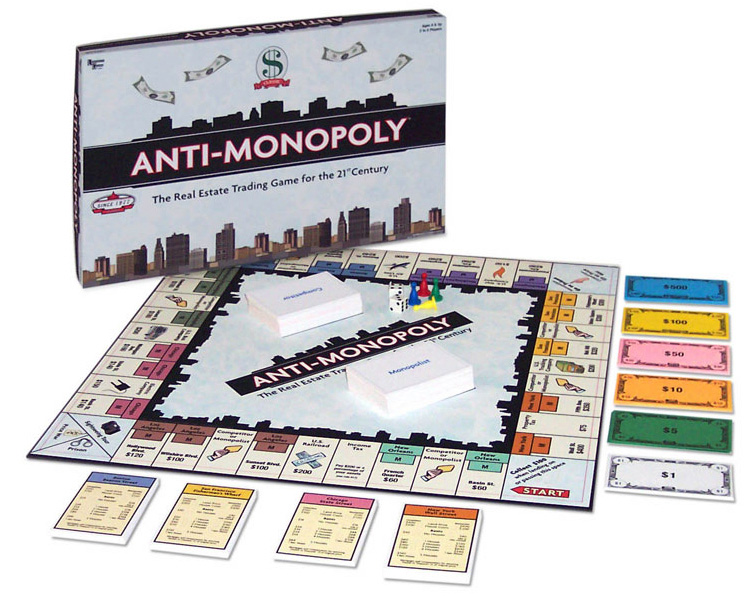
As anticipated in previous posts, we continue feeding up a ‘leisure time for competition geeks’ section.
This post is about a board game, ‘Anti-Monopoly’, a different version of ‘Monopoly’ with an ‘anti-monopolistic’ theme.
In Anti-Monopoly®, players play either by or competition rules fixed at the beginning of the game:
COMPETITORS … charge fair rents, build as soon as they own a property, put five houses on their properties and occasionally go to Price War.
MONOPOLISTS… extort monopoly-high rents from their poor tenants, build only after they have monopolized a color grouping, restrict supply by putting only four houses on their properties and occasionally go to Prison.
The good guys are the small business entrepreneurs and the bad guys are the monopolists. Since players do not play by the same rules, fairness is achieved by a patented probability technique, has given each side equal chances to win.
OBJECT OF THE GAME: To be the richest competitor after all monopolists have been bankrupted or to be the richest monopolist after all competitors have been eliminated.
There is actually a great deal of controversy surrounding the creation of the game, which includes a 10 year long legal battle between the creator of Anti-Monopoly (Ralph Anspach) and the owners of the ‘Monopoly’ trademark. After more than 37.000 copies of ‘Anti-Monopoly’ were destroyed pursuant to a District Court’s order which found a trademark infringement in the use of the word ‘Monopoly’, the 9th Circuit Court of Appeals ruled in 1979 that the trademark ‘Monopoly’ was generic and thus unenforceable. Nonetheless, this wasn’t the end of the story. Soon after the 9th Circuit’s decision, the US Congress amended the Trademark Act to protect longstanding marks against generic claims, thereby allowing Hasbro to assert again its rights to the mark ‘Monopoly’ and its variants.
A settlement was eventually reached and the game is now marketed under a license from Hasbro.
For more info on the game as well as on the underlying legal story, click here
Thanks to Anne Dostert for the pointer (and indirectly to Scott Hemphill, from Columbia, who apparently has a copy of the game in his office) .
Did we chill competition?

See here. We were a few days ahead on this story.
It is quite well known that competition in the news market is not primarily about price, but almost equally about being the first to report a news. And even on price, our stories are freely accessible…
Bloggerhood
 A fellow blogger, Juan David Gutierrez from Derecho de la competencia has asked me to post on this blog the following research proposal:
I am conducting a research on the Latin American antitrust community as part of the investigation projects of the Competition Law Study Center (CEDEC) at U. Javeriana in Bogota. In particular we are interested in studying how competition law is taught in our region and the impact of Universities in the development of competition law.
To this end, we are collecting information regarding courses on competition law and policies (and related areas, such as industrial organization and regulation) in Latin America. I published a first draft in the “Boletín Latinoamericano de Competencia” N°26, (titled “La comunidad académica y la defensa de la libre competencia: Bases para una propuesta en América Latina”) which explains the rationale for the research topic and academic proposal.
We hope to collect more data with the help of Latin American Universities, professors and practitioners. The information per course that we require is the following:
- University’s name.
- Geographical location of the University.
- School or department that offers the course (law school, economics, management).
- Title of the course.
- Type of course. Undergraduate (mandatory or optional), Graduate (specialization, masters or Phd) or a short course (seminar, certificate, etc:).
- Course length and class hours per week
- Teacher’s name and e-mail.
- Teacher’s academic experience and studies.
- Syllabus (subjects studied during the course) for each course.
- Number of students (average or per course)
- Since when it has been taught.
- Periodicity of the course. (once every two years, once a year, twice a year, monthly, etc).
- Additional information. Website, events, publication, concluded researches or on going, etc.
I cordially invite to send us the information, to the following e-mail addresses: jdg@cable.net.co and cedec@cable.net.co
All the data collected will be made available at http://derechodelacompetencia.blogspot.com/. Once the information has been processed, we will get in touch with all those who participated in the research in order to share the results and strengthen the bonds between them.
Recent Output

- A French Competition Commissionner? The results of our poll are as follows. Out of 45 votes, 21 readers voted for C. Lagarde, 12 for N. Kroes (in spite of clear signals that she will not stay in charge) and 7 for V. Reding. (Image source here)
- My assistant and I have co-authored in La Libre an Op-Ed on the Lisbon Treaty and the failing communication strategies of our political leaders when it comes to European affairs (in French).
- Dr. Theodor Thanner (Director of the Austrian NCA) and I, last week in Vienna:

- To date, we have received a few, robust, submissions for the latest antitrust law development prize. Please do not hesitate to send yours.
- I just received the latest edition of competition law international (the journal of the antitrust committee of the IBA). It comprises a collection interesting papers by antitrust enforcers (Varney, Leibowitz, Lasserre, Badin and Krasnodebska-Tomkiel)
2009 Worst Antitrust Law Development Prize

With the awards season coming to a close, it is perfect timing to introduce the prize for the worst antitrust law development of the year. For the first time this year, this prize will reward a ruling, article, speech, career-move, research issue, policy initiative, or any other thing that has been undertaken, said or written that is stupid, infamous, crazy.
The prize will be awarded by the end of December 2009. Please refer to me anything that could qualify for it. I will keep all the info absolutely confidential, and will set up a jury of lawyers to award the prize (Alfonso and myself will be part of it). If you’d like to join, please let me know.
To give you an example: in 2005, a Dutch judge stated in 2005 that the Commission had exclusive competence to exempt an agreement under Article 81(3) EC (Rechtbank Zwolle-Lelystad, 4 April 2005, case n° 106345 / KG ZA 05-92, Walstock / Polar Electro). Surely, a strong candidate for this prize, had it been awarded in 2005.
(Image source: http://upload.wikimedia.org/wikipedia/en/c/c2/NobelPrize.JPG)