Archive for the ‘Uncategorized’ Category
Case C-230/16, Coty: a straightforward issue with major implications

Among pending cases before the Court, Coty certainly stands out. Its practical implications are difficult to overestimate. The judgment will have important consequences for online commerce and the luxury industry, on the one hand, and major Internet players, on the other. Coty is so sensitive that most practitioners (including my co-blogger extraordinaire) are particularly cautious not to comment publicly about it. Enjoy the silence, some say. For those who like to break it, here are some thoughts on the case.
The fundamental question raised in Coty is in fact fairly straightforward. The Oberlandesgericht Frankfurt am Main asks, in essence, whether a prohibition on the members of a selective distribution system to sell via online marketplaces amounts to a restriction of competition by object. In the same vein, the national court asks whether the preservation of a ‘luxury image’ is an aspect of competition that is compatible with Article 101(1) TFEU.
The point of selective distribution is to ensure that only retailers that satisfy certain criteria are entitled to sell a given product. By definition, this method of distribution only works if the retailers that are members of the system are prevented from selling to third parties that are not. Accordingly, a clause prohibiting resales to non-members is a textbook example of an ancillary restraint that falls outside the scope of Article 101(1) TFEU altogether.
Against this background, one key issue in Coty is whether prohibiting retailers from selling via online marketplaces is comparable to a clause prohibiting sales to third-party retailers. It is not unreasonable to argue, in this sense, that the objective purpose of the two clauses is the same. From this perspective, an online marketplace ban is simply an adaptation of a contractual device to the challenges that are specific to e-commerce. If so, there would be no reason to treat the two clauses differently – again, it is all about legal consistency.
According to the case law, however, it would not be sufficient to conclude that a marketplace ban is identical in its nature and purpose to a clause prohibiting resales to non-members of the system. The creation of a selective distribution system only falls outside the scope of Article 101(1) TFEU if it relates to a ‘legitimate aim’. If it does not, any clauses would be restrictive of competition by object. This is something that the Court emphasised in Pierre Fabre. It is a sensible point that captures the essence of the case law on restrictions by object particularly well.
The reason why manufacturers of luxury products rely upon selective distribution systems is not a secret. When products are sold through independent retailers, their reputation may suffer. There is also a risk that end-users’ experience is not the same in all stores. By imposing a set of a criteria to be satisfied by retailers, a manufacturer of luxury products can preserve the reputation of its products and a uniform end-user experience without resorting to vertical integration (which can be costly and thus limit its ability to expand or even enter the market).
So does a clause – for instance, an online marketplace ban – that seeks to preserve the reputation of a product and the uniformity of a distribution system (or a ‘luxury image’, if one prefers) relate to a ‘legitimate aim’ within the meaning of Pierre Fabre? The Court ruled in Pronuptia that a clause aimed at achieving these two objectives is not restrictive of competition. It would be reasonable to argue that what is true of franchising agreements must also be true of selective distribution. After all, a franchise constrains retailers’ freedom considerably more than a selective distribution system.
This analysis would also need to consider the counterfactual (about which Alfonso wrote last week). Is it reasonable to assume that manufacturers of luxury products would rely upon independent retailers even if they are not entitled to use contractual mechanisms aimed at preserving the reputation of their products and a uniform end-user experience? Is it unreasonable to lay down a rebuttable presumption whereby clauses aimed at preserving the brand image of a product are objectively necessary and thus compatible with Article 101(1) TFEU?
As far as I have been able to gather, the Commission appears to agree with the above and does not see online marketplace bans as hard-core restraints (which I understand also means, in this case, they are not a ‘by object’ infringement either). Apparently, it has made this clear in its submission to the Court.
There is case law supporting the perspective of the Commission (the Court dealt with three cases on ‘luxury selective distribution’ back in 1980 that implicitly endorse the above). However, a passage in Pierre Fabre can be interpreted as suggesting that a selective distribution system is not justified if it seeks to preserve the brand image of a product (the Court held in that case that ‘the aim of maintaining a prestigious image is not a legitimate aim for restricting competition’).
Thus, Coty will have to address the seeming tension between these rulings. This is not unusual in preliminary references. If Pronuptia suggests that clauses aimed at preserving reputation and uniformity within a distribution system are (presumptively) compatible with Article 101(1) TFEU, Pierre Fabre suggests the opposite. Perhaps the scope of Pierre Fabre is confined to outright online sales bans (which is what the case was about), or perhaps not. The answer, in a few months.
Antitrust Spring Meeting in Madrid (10 March)

It can hardly get better. This year we are celebrating the 20th anniversary of the competition law course that Luis Ortiz Blanco and I co-direct in Madrid (I was first involved in its 10th edition, as a student), and we wanted to do something special to commemorate it. And what we will be doing is bringing the Spring Meeting to Madrid, or sort of (and giving you a perfect excuse for a deductible getaway that does not involve travelling to D.C.)
On the 10th of March we will be hosting a seminar to discuss 20 years of case law in competition law with a truly stellar line-up of speakers including the current US Assistant Attorney General for Antitrust (Renata Hesse, appointed by Barack Obama, sigh…), the Commission’s Deputy Director General for Antitrust (Cecilio Madero, who is among the very few having participated in all 20 editions of the course), the ECJ Judge (Andreas O’Keefe) who wrote, among many others, Cartes Bancaires and Mastercard which have been recurrent themes in this blog, some of the Commission’s officials most closely connected to the most important cases in recent years (namely Nick Banasevic from DG Comp and Nicholas Khan and Eric Gippini from the Legal Service), Milan Kristof as representative of the ECJ référandaires behind the big cases, academic/blogosphere stars (like our very own Pablo and Jesús Alfaro), a selection of the new generation of top-notch Spanish economists and lawyers (Susana Cabrera, Elena Zoido and Alfonso Gutiérrez) and the most-up-to-date person in competition law and future literary star Lewis Crofts.
An overview of 20 years of competition case law
Introduction: Luis Ortiz Blanco and Alfonso Lamadrid
15.30-16.40- Cartels and other anticompetitive agreements: Alfonso Lamadrid (moderator), Andreas O’Keefe (former Judge at the European Court of Justice), Nicholas Khan (Legal Service, European Commission), Jesús Alfaro (Professor of Law, Universidad Autómoma and Linklaters).
16.40-18- Unilateral conduct: Milan Kristof (Référendaire, ECJ; moderator), Pablo Ibañez (LSE and College of Europe), Nick Banasevic (Head of Unit, DG Comp, European Commission), Eric Gippini-Fournier (Legal Service, European Commission).
18.20-19.30 –Merger control: Lewis Crofts (Chief Correspondent, MLex; moderator), Susana Cabrera (Partner, Garrigues), Elena Zoido (Senior Vice-President, Compass Lexecon), Alfonso Gutierrez (Partner, Uría Menéndez).
19.30- Closing keynotes: Renata Hesse (Acting Deputy Attorney General for Antitrust, US Department of Justice) and Cecilio Madero (Deputy Director General, DG Comp).
***
For further information, click here: An overview of 20 years of case law (10 March 2017)
Remembering Giuliano Marenco

A lot happens in EU competition law, and very fast. As a result, we tend to forget discussions, doctrines and authors all too soon. One of the (many) upsides of being an academic is that I am less subject to this ‘tyranny of the present’ (read: I have more time). I take great pleasure in reading distinguished authors, even if it often leads to some embarrassment – we think we have just come up with a new idea only to find out that someone has already developed it, and more eloquently that one would ever be capable of doing.
I have recently been reading some of Giuliano Marenco’s work. I thought of saying a word about him since some of our readers – many of whom are undergraduate or postgraduate students – may never have heard this name before. Giuliano Marenco is probably one of the biggest brains ever to have worked at the Legal Service of the European Commission (he retired about a decade ago). It transpires from his crystal clear writing (irrespective of the language) that he was an effective advocate.
As a lot of good writing, some of Giuliano Marenco’s articles have not lost a bit of their topicality. They are as lucid and relevant today as they were 20 or 30 years ago. This is so because they display a very rare understanding of the underlying issues. Here is a personal top three that I would recommend to any competition law student (note to self: find an excuse to include at least one of them in future years’ syllabi):
- ‘Competition Between National Economies and Competition Between Businesses–A Response to Judge Pescatore’: The great Pierre Pescatore sometimes held controversial views, for instance in relation to the direct effect of GATT/WTO provisions and about the scope of EU competition law (which he argued could be used to strike down national legislation with anticompetitive effects). In this article, Marenco skilfully challenges the second of these claims and, in the process, displays a lucid vision of the interaction between the EU and national legal systems, and of the limits of what can be achieved under EU law. That is an eternal topic, and the paper will definitely make some readers think about some ongoing debates…
- (with Karen Banks) ‘Intellectual property and the Community rules on free movement: discrimination unearthed’ (1990) 15 European Law Review 224: Anyone who follows the blog knows that I have a keen interest in the interface between EU law and intellectual property. This is one of the best two or three articles I have read on the question. It is very useful to understand the debates about the exhaustion of intellectual property rights, which is not the easiest of topics (and which, I concede, is not the most attractive of topics either, but this fact does not make it any less important). It also does what good legal research should do: uncover guiding principles that are implicit in the case law.
- ‘La notion de restriction de concurrence dans le cadre de l’interdiction des ententes’, published in the Melanges en hommage à Michel Waelbroeck (Bruylant 1999). I keep a paper copy of this piece preciously, as it is difficult to find. I include it because it presents an approach to Article 101(1) TFEU that is almost forgotten (the piece is likely to be very different from any article that is published these days). The interpretation advanced did not win the day (or so I think, at least), but it is thoughtful and sophisticated. It is also useful to understand where we come from.
[The picture is an example of the wonders of Google images: it seems that it dates back from his years as a High School student, and it is the only picture of him I was able to find!]
Academic Excellence Awards and more
Global Competition Review has just opened the voting window for its annual awards.
Among the 5 nominees for the Academic Excellence Award (given to “an academic competition specialist who has made an outstanding contribution to competition policy in 2016“) are my current and former co-bloggers, Pablo Ibañez Colomo and Nicolas Petit, which is great news and a testimony to their influential work, also here. They are joined by Wouter Wils, Ariel Ezrachi and the University of East Anglia’s Centre for Competition Policy. You can vote for one of them here.
Also, today is the last day to vote for the Antitrust Writing Awards. You only have to click on this link and then on the 5 stars.
Finally, the clock is ticking for those of you interested (you should be) in attending W@competition’s upcoming conference on contemporary competition developments; you can register here. The 30-in-their-30s lists will be disclosed then.
And speaking of awards, today we delivered the prizes to the 3 co-winners of the meme competition. We just received the meme below from one of them in Copenhaguen…

A priceless precedent for multi-sided platforms (and beyond)- The UK’s High Court Judgment in Mastercard and the key relevance of the counterfactual analysis (PART I)

Few seem to have remarked the great importance of the Judgment issued by the UK’s High Court of Justice on Monday this week in the Mastercard private litigation case.
This case is the most relevant instance of practical application of the legal criteria set out by the ECJ in its two leading cases so far on multi-sided platforms. It constitutes highly relevant guidance for the future, including for several high-profile ongoing cases (in some of which I disclose to be involved) (for more on this see in particular prior discussions on Pay-TV and Android, here and here). It also fits exactly with the arguments Pablo and I developed in our piece on The Notion of Restriction of Competition regarding the key importance of the counterfactual assessment (see particularly section 2.1.1 of the piece).
As you will remember the ECJ’s Judgments in Cartes Bancaires and Mastercard –issued on the same day- converged in the message that multi-sided considerations should not play a role at the tail-end of the analysis, but rather be considered as part of the economic and legal context prior to examining whether a restriction exists in the first place under 101(1) (see Cartes Bancaires, paras. 73-99) and Mastercard (paras. 179-182). Importantly, at this stage the burden of proof lies on the Commission.
What this means in practice is that one cannot examine a practice that affects one side of the market in isolation; one also needs to look at how it contributes to balancing all sides of the platform. In other words, would the business model be viable in the absence of the practice at issue? That is the counterfactual assessment.
This exercise may show that the practice is indispensable, or that it could be indispensable for the platform to operate (and in the face of “uncertainties” the practice will be considered legal, as shown by the GC’s Judgment in O2) [which ties very well with the limiting principles I proposed here (in writing) and here (in ppt format; slide 13), as well as with what Pablo explained last week in his GCLC presentation on dynamic markets; see here, slide 8]
In the Mastercard Judgement the ECJ actually used this analytical framework for the analysis of the counterfactual (para. 161, also distinguishing it from ancillary restraints at para. 173). And it also identified an error of law in the Commission’s choice of the counterfactual in the absence of the agreements, as it had failed to consider whether it was a “likely” counterfactual. (para. 169). Importantly, the reason the Court ultimately did not annul the GC’s ruling and the decision was because Mastercard had failed to “claim” that its scheme would have collapsed in the counterfactual scenario (para. 173). The ECJ did therefore rule that the MIF at issues was restrictive of competition in the sense of Art. 101(1) and could not be exempted under 101(3) [for our comments on the also very interesting 101(3) leg of this case, see here and here].
Several large retailers decided to initiate follow on actions in the UK on the basis of the Commission’s decision as confirmed by the ECJ Judgment. It may have seemed like a home-run.
On Monday, however, the High Court ruled against them concluding, contrary to the ECJ, that the MIF was not restrictive of competition in the sense of Art.101(1) relying precisely on a counterfactual assessment.
There seems to be some surprise at this apparently diverging outcome but, frankly, it is not that surprising. Why? Because Mastercard did learn the lessons from the ECJ’s Judgment. As I explained before, para. 173 of the Judgment explains that “it was not in any way claimed before the General Court that MasterCard would have preferred to let its system collapse rather than adopt the other solution” and the key para. 180 says that the counterfactual argument had only been invoked by an intervener too late before the ECJ but was not part of the arguments submitted before the General Court. The ECJ therefore did not consider it.
As revealed by an MLex headline from last year, Mastercard learnt the procedural lesson very well:

As you will notice, this is exactly what the ECJ said Mastercard did not do before it. In the damages case, by contrast, Mastercard did put all the eggs in the basket of the counterfactual argument, and it won.
Actually, the word “counterfactual” is used about 190 times in the High Court’s Judgment.
And the winning argument was indeed what the Court refers to as the “death spiral” argument, pursuant to which in the counterfactual scenario other platforms would have killed Mastercard, whose scheme “would not have survived (…) in a materially and recognisably similar form“.
For an analysis of how this analysis was conducted on Monday’s (pretty lengthy but excellently written) Judgment (including on important issues related to the burden of proof or the differences with the notion of ancillarity), stay tuned for the second part of this post.
Trump on Pablo
We read this last night on Twitter. Since we take our blogging responsibility seriously we thought we owed our readers a reality-check.

Fact check:
Pablo did actually speak yesterday at the GCLC annual conference and discussed The Ubiquity and Limits of Competition Policy in Dynamic Markets. The slides are available here: ibanez-colomo-ubiquity-and-limits-of-competition-policy He did very well and he was literally “elegant” as he was wearing a tie I lent him (and it would be nice to have it back). We have checked with experts and it is a fact that there were more attendees at the Chillin’Competition conference, so the claim that yesterday featured the largest audience ever is only an “alternative fact”. And needless to say, if anyone disagrees they certainly are not losers and should not keep their mouth shut; polite and public disagreement is healthy; the law, as many other things, only evolves through exchanges of ideas. The conference was truly excellent, so congrats to the GCLC (mainly to Damien Gerard) for putting it together.
New Book: Private Power, Online Information Flows and EU Law – Mind The Gap, by Angela Daly
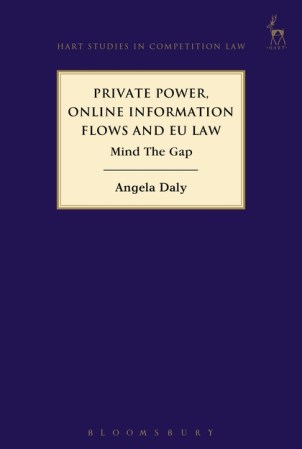
I was delighted to receive, a few days ago, a review copy of Angela Daly’s Private Power, Online Information Flows and EU Law – Mind The Gap. Angela is currently Vice Chancellor’s Research Fellow at Queensland University of Technology. She has been in Australia for a while, but did her PhD at the European University Institute, where we overlapped for some time.
I remember vividly our first meeting a few weeks after she arrived to Florence, where we exchanged ideas about her project and our common interest in the regulation of the media and, in general, of digital technologies. It is wonderful that the work she started at the time can now be enjoyed as a book. I really look forward to reading it, no less because her views are not always in line with mine.
Angela will be presenting her book in London on Tuesday of next week, and our friend Orla Lynskey will be one of the discussants. It is a pity that Alfonso and I will be missing what promises to be a great event. All the best to the two!
A year in review: competition law developments in 2016 (selected issues)

One of the yearly highlights of the competition law course that I co-direct in Madrid is the seminar coordinated by Fernando Castillo (the author of the most downloaded materials in competition law in 2016; see here) and Eric Gippini (one of our Friday slot interviewees; see here).
On this edition the seminar will take place on Friday 3 February under the title “A year in review: competition law developments in 2016 (selected issues)”, and the programme is the following:
12:30 – 14:30: “The year in Brussels”
- Gero Meessen (Member of the Legal Service, European Commission)
- Eric Van Ginderachter (Director, Cartels Directorate, DG Competition, European Commission)
- Mariarosaria Ganino (MLAB Abogados)
16:30 – 18:30: “The year in Luxembourg”
- Fernando Castillo de la Torre (Legal Advisor, Legal Service, European Commission)
- Nils Wahl (Advocate General, European Court of Justice)
- Cani Fernández (Cuatrecasas)
A not-to-be-missed event and a perfect excuse to spend a weekend in Madrid…
For further information and registration (at predatory prices), please write to competencia@ieb.es or drop me a line at alfonso.lamadrid@garrigues.com
Competition Law and Big Data: Do Competition Authorities Know How To Do It? #CPIChronicle

You may remember that just before Christmas I wrote a post saying that Pablo was putting pressure on me to write a joint article on selectivity in State aid during the holidays? Well, it should not surprise you to know that we never got around to it (it will happen, though).
We nevertheless did take the time to do some other non-work writing: Pablo did his thing (probably wrote the majority of his forthcoming books) and I did mine (wrote a couple of short pieces on general issues), namely one editorial for the next issue of the Journal of European Competition Law and Practice on “Competition Law and Fairness” (more on this soon), and one piece on competition and big data (co-written with my colleague Sam) for Competition Policy International’s special Antitrust Chronicle issue on “Competition in Digital Markets”.
The latter contribution -which builds on the Dan Ariely quote above…- can be freely accessed here, courtersy of CPI: cpi-lamadrid-villiers
UPDATE: Pablo tells me that Common Market Law Review has published today an article on this topic by our friends Francisco Costa Cabral and Orla Lynskey; it will certainly provide you with insightful thoughts and views that may moreover diverge from the ones developed in our piece.
What drives academic writings in competition law and economics?

Are academic writings in competition law and economics driven by the (pecuniary) interest of commentators? Wouter Wils raised this important question in his instant classic on the Intel judgment. He speculated that the popularity of the so-called ‘more economic approach’ might be driven by an attempt of practitioners and practice-oriented academics to feed their own business and to re-shape the law in a manner that is advantageous to their (generally large and powerful) clients – and at the expense of smaller businesses and consumers. This intuition has recently been explored by Jan Broulik in a working paper. He comes to the conclusion that, indeed, it is plausible that scholarly commentators are driven by self-interest.
This question is relevant outside the narrow area of competition law. It should be discussed more often (and more openly), just as it is done in the US (see here for a recent example, from which I took the picture above). It is the sort of issue that may be widely acknowledged but rarely ever finds its way in articles and/or conferences. In this sense, the effort of the two authors is valuable and should be commended.
As any first attempt to explore an issue, these two papers raise a number of questions, which I hope will be explored in future work. Here are some thoughts.
The premise of the two articles
One key question relates to the premise on which the articles are based. If one reads them carefully, it appears that their central thesis rests on the idea that their preferred approach to the interpretation and enforcement of EU competition law is the only reasonable one. The prima facie prohibition of exclusivity agreements, Wils argues, is ‘legally but also economically sound, whereas the alternative so-called “more economic approach” is unsound and not fit for the purpose of interpreting Article 102 TFEU’. Similarly, Broulik claims that advocates of a case-by-case analysis of certain practices favour the ‘supra-optimal’ use of economics.
These substantive positions are reasonable and defensible. More controversial, however, is the conclusion that the authors draw from them. The two papers appear to suggest that, since their approach is the only reasonable one, advocates of alternative approaches must be driven by spurious motivations. But is it really the case that no reasonable and impartial person would favour the case-by-case analysis of some practices? Is it axiomatic that bright-line rules provide the optimal approach to the interpretation and enforcement of EU competition law? I am not sure many readers will find these claims particularly persuasive.
I like to think of myself as a reasonable and impartial person, and I do not agree that a rule-based approach makes sense in relation to certain (in fact, most) practices. And I believe that other people can reach this same conclusion without being driven by spurious motivations. For instance, I also like to think of the judges at the ECJ as reasonable and impartial, and they have in several occasions refused to adopt a rule-based approach when expressly invited to do so. In judgments like Delimitis, Coditel II, Post Danmark I and Deutsche Telekom, just to name a few milestones, they took the view that a case-by-case approach was appropriate.
In a different vein, I note a certain tendency by the two authors to equate ‘case-by-case’ and ‘fully-fledged economic analysis’. I believe it is dangerous to conflate the two, as it may obscure the discussion. The case-by-case analysis need not resort to full-scale balancing. It can – it should – be structured around a series of administrable proxies that give a sense of the likely effects of a practice. Just think of usual factors like market shares, the coverage of the practice or its duration.
The importance of the administrability of standards (and thus the need to rely on proxies and to avoid full-scale balancing) has always been acknowledged by economists with a solid grasp of the law (like Jorge Padilla) and even by the most Chicagoan of Chicagoans (like Frank Easterbrook and Richard Posner). In fact, those who argue in favour of a ‘fully-fledged economic analysis’ are, I guess, a small minority.
What is in the mind of an academic?
Another aspect that is worth exploring systematically in future work relates to the way academics think. The authors model only imperfectly the incentives of academics – who they are and what drives their activities. If this modelling is to be done rigorously, it is necessary to take into account that academics – typically talented students – willingly forego lucrative careers because they place more value on independence of thought and on freedom to work on whatever they find interesting.
In this sense, it is also necessary to take into account that a successful academic career – and, in the same vein, respect among academic peers – depends on work that has little or nothing to do with consulting. In fact, consulting work is more likely than not to be a distraction and a hindrance.
I would have been interested to see in one of the papers an attempt to match the theoretical intuitions of the authors with an empirical analysis of the work of leading academic lawyers and economists. Does the actual work of individual academics support their tentative conclusions?
It should be possible to address this question. The substance of academic work could be classified in accordance with certain criteria. As I write this, I think of some of the leaders of the profession in Europe (e.g. Ariel Ezrachi, Ioannis Lianos, Giorgio Monti) and I do not believe their work supports the proposition that academic research is generally – not even on average – pro-big business or anti-intervention.
What is the contribution of the pieces?
I was left thinking, after reading the two pieces, whether they had an important point to make after all. One possibility is to interpret the two articles as claiming that academic research in competition law and economics should be presumptively distrusted as it might be driven by the pecuniary interests of the authors. If that is the case, I am not sure that casting pre-emptive doubts over all research work on the basis of mere speculation counts as a meaningful contribution to our understanding of any phenomenon, whether simple or complex.
Another possibility is that the authors intend to highlight the fact that some research by some academics is specifically prepared to serve the interests of a particular client. If that is the point, it is one that we all knew before the two papers came out. I guess the real question is not whether this happens – because it does and it is not a secret – but whether it is a problem in the first place. That, I think, is a most important debate that it is worth having.
My own impression is that it is always preferable to play the ball, not the man. For instance, I do not believe that the idea of patent hold-up should be rejected simply because it might have originated in research funded by Intel. It should be taken seriously, and its validity tested theoretically and empirically, as many have done in the past few years. As Judge Forrester pointed out at the end of our conference back in November, we get closer to the truth by engaging with conflicting (and sometimes biased) ideas, not by summarily dismissing them.


 Chillin'Competition