Archive for the ‘Uncategorized’ Category
Conferences (including the theme of the 2nd Chillin’Competition conference)

We have already decided on the topic of the next Chillin’Competition conference. The common thread will be “Neutrality Everywhere“. The dates are yet to be determined (not likely to happen until after the summer). If any of you have original ideas (for a panel, for a paper you would like to present, for sponsors or even for a venue), please send them our way!
And speaking of conferences:
On 27 May the Brussels School of Competition will host a morning briefing on the very timely topic of mobile network consolidation. For more, see here.
On 2 June there wil be a couple of most interesting events in Brussels. First, Global Competition Review, Baker Botts and Shearman&Sterling will be holding the GCR Live 4th Annual IP and Antitrust event, and have managed to come up with a great program. That same day, a bit later, the Academy of European Law (ERA) will host a seminar under the title: What’s New in Art 102 TFEU? Latest Issues on Price and Non-price Related Conduct: for more info, see here.
On 8 June the GCLC and UCL have organized a conference under the title Competition Policy at the Intersection of Equity and Efficiency Honoring the Scholarship of Eleanor Fox. The programme is available here.
On 10 June Pablo will follow my footsteps 🙂 and will address the Association of European Competition Law Judges which this time is meeting in Madrid. The conference will address the competition – IP interface.
On 13 June Concurrences will host the New Frontiers of Antitrust Conference in Paris. The conference has been promoted with a teaser-interview with Nicolas Petit, available here.
On 14 June the College of Europe will hold the annual symposium organized by the ELEA (European Law and Economic Analysis) students. There will be a panel on geo-blocking that will feature big names such as Thomas Kramler and Mike Walker and small names like Pablo 😉
The big global event on 23 June will be the British referendum my intervention in a symposium titled Online platforms, Big Data and privacy: What role for competition policy?. It will be hosted by the Centre for Studies on Media Information and Telecommunication (SMIT) & the Brussels Centre for Competition Policy (BCCP) at Vrije Universiteit Brussel (VUB), Brussels. Those of you interested can download the program here.
On 4-8 July I will also be teaching at the College of Europe’s Summer Course on Competition Law taking place in Bruges. For more info, click here. I will also be lecturing at the College of Europe’s Summer Competition Law School for Chinese officials, but I fear you may not be eligible for that one…
And during 2016/2017 (and beyond) Pablo will be… Actually, he can tell you himself.
EU Net Neutrality Policy and the Mobile Sector: The Need for Competition Law Standards, by Peter Alexiadis

Peter Alexiadis needs no introduction. He is one of the leading competition and telecoms lawyers in Europe. He also runs a seminar on Competition Law & Regulated Network Industries down the road from the LSE, at King’s College London. Peter is in fact one of the most academically-minded practitioners that I know, and one from whom I have always learnt a great deal (including at the Chillin’ Competition conference, where he shared his thoughts on copyright licensing).
Alfonso and I are delighted that he has chosen Chillin’ Competition to issue his new paper, entitled ‘EU Net Neutrality Policy and the Mobile Sector: The Need for Competition Law Standards’. Click here to access it.
The paper is really timely. As most readers will know, net neutrality has progressively found its way into EU telecoms regulation. Regulation 2015/2120, which entered into force on 30 April, deals specifically with the so-called ‘open Internet’. The net neutrality provisions enshrined in this text are part of the zeitgeist, according to which there is always a good reason to impose strict non-discrimination obligations on firms.
Peter’s paper is a useful reminder that an overly zealous approach to net neutrality can have unintended consequences, in particular in mobile markets. He points out that EU competition law has been dealing with the same or related questions (‘access’, ‘non-discrimination’, ‘objective justification’) for decades. Accordingly, it is only sensible to interpret the provisions of the Regulation in light of the experience acquired by courts and competition authorities.
Here’s a hint of what the paper is about:
The much-awaited EU Net Neutrality rules contained in the TSM Regulation entered into force on 30 April 2016. These rules have the overarching aim of safeguarding the open Internet and, in doing so, seek to strike a balance between the interests of consumers and Internet Service Providers (“ISPs”). However, the natural consequence of seeking such a compromise is legislative uncertainty. Given the fact that the various Articles of the TSM Regulation offer very little by way of unambiguous guidance, there is a serious risk that many broadly formulated provisions of that Regulation are amenable to a restrictive interpretation, resulting in the over-regulation of ISPs. If that scenario were to materialise, the author believes that there would be a risk of consumer welfare benefits being unwittingly sacrificed on the otherwise laudable altar of the open Internet. Given the breadth of the language used in the TSM Regulation, the risk of over-enforcement is tangible, especially given the constantly evolving Internet value chain, the multi-sided nature of Internet-related markets and the disruptive nature of new Internet business models.
Enjoy the read!
The ECJ’s very own smartphone app
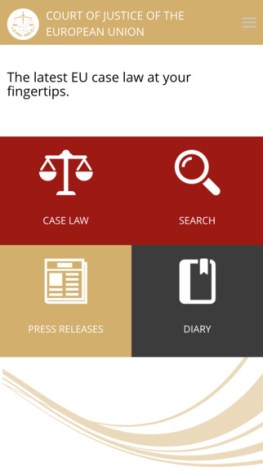
The ECJ has just launced its own app, CVRIA for smartphones and tablets, running on both iOS and Android. And no, we are not kidding.
As noted in the ECJ’s press release (see here), the app is available in 23 languages and has several functionalities, giving easy access to recent case law, press releases, judicial calendar and the Courts very own search tool covering all its case-law.
It is available here and here.
Not everyone must be happy about this app coming out. People like my-co-blogger Pablo or like Fernando Castillo, who know by heart case numbers, dates and paragraphs will from now onwards have it more difficult to impress people while having beers. All Court info is now a click away.
Hutchison/Telefónica UK blocked: BT wins, all the others lose. What lessons for competition law and regulation?

The prohibition of the Hutchison/Telefónica UK deal, which has been made official earlier today (see here), is a bit like Leicester City winning the Premier League. As the months passed, the impossible became likely, up to the point when it was certain that it would actually occur. So no big news today, as the only remaining question was when the decision to block the deal would be announced.
While we wait for the decision to be published, I can think of a couple of issues for discussion:
- The Commission powers in horizontal merger cases – law or discretion?: The Commission has the power to block horizontal mergers in a very broad range of scenarios. ‘Four to three’ mergers in telecoms markets illustrate this very well. The Commission does not need to establish (single or collective) dominance to block a merger between competitors (or non-competitors, for that matter). In the so-called ‘gap’ cases, it is enough to show that some parameters of competition will be significantly affected by the transaction.
This background is useful to understand why some commentators have started to ask whether the Commission has in fact too much power in horizontal merger cases, in particular in ‘gap’ ones. James Venit has recently written an article making this point (see here). Can the Commission prohibit just any horizontal merger it wants? It may be the case that the reasons to block Hutchison/Telefónica UK were compelling. The outcome may be perfectly sound. However, the decision might fuel the debate in this sense.
I see where the arguments of these commentators come from. The assessment of unilateral effects in merger cases is the privileged realm of the so-called ‘complex economic assessments’. Intervention depends on forecasts about post-merger effects (which, again, may be perfectly accurate).
The problem with ‘complex economic assessments’ is that they come with a ‘margin of appreciation’, and with a ‘margin of appreciation’ comes limited judicial review. Is it then a matter of discretion, and not of law, as it is in theory and it is meant to be? I guess it would probably help if the EU courts defined a set of principles and proxies for the assessment of mergers in ‘gap’ cases at some point.
- BT is the big winner: The overall effect of a series of individual decisions has been to tilt the game in favour of BT. After the acquisition of EE, BT is the only truly integrated operator in the UK. It has the largest fixed network and is the leader in retail mobile and fixed broadband. This landscape is not necessarily problematic in itself, but it is probably not ideal either.
Of the series of decisions that have been adopted in the past few years, there is only one that I would qualify as ‘manifestly incorrect’. I have written about it a few times (see for instance here). Some of you may remember that Ofcom created a brand new doctrine of non-essential facilities to force Sky to supply its premium sports channels to its rivals, including BT. In doing so, it neutralised an important source of competitive pressure. BT’s life is much easier after this decision, and the ability of Sky to challenge the position of the incumbent has been significantly impaired.
Some of you might react by saying that this obligation was formally removed in November last year. Well, yes and no. If you take a look at it, you will see Ofcom wrote something along the lines of: ‘I remove the duty to supply, but you better continue supplying’. Once an obligation to supply is imposed, it is likely that it is there to stay. Which is probably why the debate about interim measures has also become popular. My guess is that many people have the secret hope that a quick and dirty provisional measure will become permanent (it works for Uber when it enters new cities, so I guess some people have figured out it could work elsewhere).
NEW PAPERS: on market integration, Article 102 TFEU and network industries
Three new papers of mine have just been made available on ssrn. They touch upon some of the issues I discuss regularly on the blog, so they will not surprise frequent readers. As usual, I would very much welcome your comments (e-mail: P.Ibanez-Colomo@lse.ac.uk).
Article 101 TFEU and Market Integration: Entire libraries have been written about EU competition law and parallel trade. Some of the landmark judgments were handed down more than three decades ago. I wrote this paper because I realised that, in spite of the above, there is still considerable confusion about some key aspects of the case law. Has the Court of Justice ever ruled that absolute territorial protection is NOT restrictive by object? It has, for instance in Coditel II. Why did the Court rule that absolute territorial protection is acceptable in Coditel II but not in Nungesser? The two judgments were delivered at pretty much the same time, is there a contradiction between the two? If the Court confirmed Coditel II in Murphy, why do the two judgments seem to contradict each other?
My paper, forthcoming in the Journal of Competition Law & Economics, seeks to explain the case law and gives an answer to the above questions. I develop a framework based on the counterfactual. I find the approach of the Court of Justice to be consistent and persuasive. Agreements aimed at partitioning national markets are deemed restrictive by object except when the analysis of the counterfactual shows that they do not restrict competition that would have existed in their absence. This simple framework explains cases like Coditel II and Murphy, mentioned above, and provides insights for ongoing ones. I test the framework against leading rulings, including Glaxo Spain, Nungesser and Micro Leader.
Beyond the ‘More Economics-Based Approach’: A Legal Perspective on Article 102 TFEU Case Law: It might sound strange to provide a legal perspective on Article 102 TFEU case law. But scholars and practitioners have focused so much on economic considerations that many of them are no longer interested in what the Court of Justice actually does. My article seeks to identify trends in the case law and provides a framework to address the frictions that have emerged over the years. Some authors like to think about Article 102 TFEU as an epic battle between good and evil. My paper shows that ongoing controversies are more modest. They relate to minor inconsistencies that can be addressed as such. Cartes Bancaires provides a most useful template in this regard.
The paper, forthcoming in the Common Market Law Review, consolidates many of the ideas that I have published here and in the form of working papers. The first key idea I wanted to develop is that the object/effect divide exists also in the context of Article 102 TFEU. It is important that this reality is acknowledged in the literature. It is now clear that some practices, like exclusive dealing, are put on a par with cartels. The implementation of these practices is sufficient to trigger the prohibition. Other conduct is put on a par with ‘by effect’ agreements. This makes it necessary to show not only that the practice has been implemented, but also that it is likely to have an anticompetitive effect.
There are frictions in Article 102 TFEU case law. Again, this is a reality that cannot be denied. Some legal inconsistencies have emerged in the case law. Like practices are not always treated alike within Article 102 TFEU. Similarly, the same practice is not always treated in the same way across provisions. Suffice it to think of the 2007 GC ruling in Microsoft (Article 102 TFEU) and its 2013 ruling on the Microsoft/Skype transaction. These frictions are natural and inevitable in a field like EU competition law. More importantly, they are not fundamental ones. They can be addressed on an incremental basis, drawing from the lessons of experience and economic analysis.
EU Competition Law in the Regulated Network Industries: This piece is a contribution to a collection put together by Jonathan Galloway (Newcastle) that is forthcoming with Oxford University Press. The volume examines the intersection of competition law with other disciplines. My contribution focuses on the interface with the network industries, which is a topic in which I have long been interested. It examines three dimensions of the interaction between the two fields: (i) convergence (the two fields pursue compatible objectives); (ii) tension (the objectives may be compatible, but are not identical); and (iii) complementarity (EU competition law can achieve what sector-specific regulation alone may not be able to achieve).
Have a great weekend!
Copyright and the Digital Single Market: geo-blocking is here to stay (or so it seems)

Last time Alfonso wrote on the Cross-Border Pay TV case (and the commitments offered by Paramount), he mentioned that the geo-blocking of copyright-protected content is not really a competition law issue. It is an intellectual property matter that should be addressed as such.
As the law stands, online providers can lawfully offer copyright-protected content only in the Member States for which they hold a licence. If they reach Internet users based in other Member States, they will infringe copyright. This reality will not change simply by declaring geo-blocking clauses to be restrictive of competition. The copyright infringement will not be less of a copyright infringement simply because some licensing agreements are amended.
Geo-blocking will only become a thing of the past if the Commission is able to persuade Member States to amend copyright legislation so that the ‘country of origin’ principle applies to online content. Where the ‘country of origin’ principle applies, a broadcaster that holds a licence to offer content in one Member State can reach users in the whole of the EU. This principle applies to satellite broadcasting. It is in light of this principle that the ECJ judgment in Murphy can be understood.
As part of the Digital Single Market Strategy, the Commission consulted last August on the possibility of extending the ‘country of origin’ principle to online transmissions. The results of the consultation have now been published, and can be checked here. In light of the responses, it looks like geo-blocking is here to stay. I do not have the impression that the idea gathers the necessary consensus, in particular considering the impact it would have on right holders and licensees.
The pro-status quo (or pro-blocking, if you prefer) side includes: right holders (no surprise), commercial broadcasters (read: Sky, Mediaset and all the others who devote substantial resources to buy content) and collective management organisations. More importantly, Member States appear to be, at best, lukewarm about the initiatives (the Commission report says that ‘there is a strong call for caution’ on their part). Certain Member States (can you guess which?) appear to oppose the initiative outright.
The pro-change (or anti-blocking) side includes: users (no surprise), public service broadcasters, commercial radios and ISPs.
If there is no enthusiasm for copyright reform, the open question is of course whether the case against the major studios and Sky has a point. Interestingly, many of the participants in the consultation (and in particular Member States) insisted on the need to respect ‘contractual freedom’. A bon entendeur…
Glamour: Cement? Star Wars, Hollywood and lawyers’ rankings
Last week Pablo wrote a post describing his week of talks around Europe (Athens, Amsterdam for the Competition day, Bruges, etc) where he had been invited to discuss about the effects-based approach, recent 102 case law and online platforms.
My longest trip of the week was to Rue Ravensteim in Brussels (at the premises of the Brussels School of Competition –BSC-) to talk about cement. Life is unfair.
The talk at the BSC on the ECJ’s Judgments in the cement case was very interesting. I participated in the panel together with Manuel Kellerbauer (from the EC`s legal service) and Christian von Koeckritz, from Gleiss Lutz (the downside of speaking with two Germans is that I was the only one who didn’t get to be called “Dr.”). I did not innovate much from what I already said in my three posts on this case (here, here and here). Essentially, and given that –most likely due to procedural economy reasons- the ECJ annulled the decisions on the grounds of lack of motivation (only plea common to all applicants), the best we got out of this case were the sensible and well-reasoned Opinions of AG Wahl. If only for their persuasiveness, those are likely to be very influential in the future with regard to issues that, despite their importance, are unlikely to be raised before the Court again in the near future (certainly not in a case as extreme as this one). Most important of all, I believe that in the light of the General Court’s Judgment in case T-296/11 (see the first hyperlink above) and the Opinions (see second hyperlink), the criterion of “necessity” contained in Art. 18 of Regulation 1/2003 might from now on be interpreted objectively and, in my view, correctly. The slides presented at the talk are available here: Dr. Christian von Köckritz, Dr. Manuel Kellerbauer, Alfonso Lamadrid.
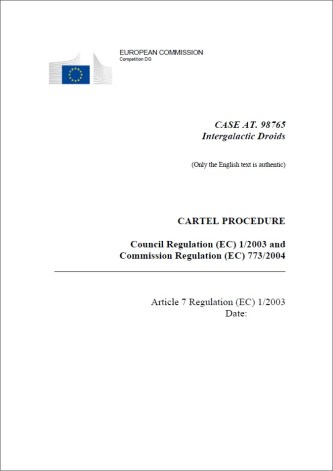
Btw, I had also been lecturing at the BSC a couple of weeks before and on that occasion I did innovate a bit more. We spent practically the whole 4 hour lecture on procedure, running a practical case (from inspections to decision) where students took different roles and were free to set strategies; they did great. I’m likely to repeat that a few times in the future, if only for the vast amount of materials (evidence, fake evidence, Commission documents) that were created for students to do the case. The case involved intergalactic droids, and all documents and email chains related to “real” characters and companies that exist at the very least in the Star Wars Wikipedia (or so I’m told by the extremely competent geek who helped me). The result of this exercise is pictured above.
And speaking of Hollywood. If my cement lecture in rainy Brussels was not as glamorous as Pablo’s trips through Europe, I compensated a bit with some extensive quotes in the Hollywood Reporter this week. At first, when my colleagues tried to transfer the call from the publication I thought it was a prank (we run a prank scoreboard at the office in which I hold an unassailable lead 🙂 sorry Sam….), but it turned out that it was true. This time it was not about the rumors linking me to Monica Bellucci (please respect our private life), but about the Commission’s Pay TV case. Should you be interested, the piece is available here.
Also this week the new Chambers Europe 2016 guide came out ranking lawyers, including competition lawyers. I was very well treated, as “star associate” in Spain and sole “associate to watch” in Brussels (the office teasing that followed is actually what led me to suspect the Hollywood call was a joke..). I read this week that happy people don’t talk badly about others. If that’s the case Chambers researchers must be very happy people, as it is remarkable to find such an extensive publication that only says positive things about so many lawyers about whom there are not so many positive things to be said 😉 So I would take all that with many pinches of salt. Not that I complain, but I wouldn’t mind losing a title that only identifies me as the lowest paid guy in the rankings! 😉 Be that as it may, this reminded me of two earlier posts I wrote some time ago on What makes a great lawyer, and on Sunshine lawyering; there you’ll see my views on all these things.
Enjoy the weekend!
Android meets Pronuptia, or why software licensing is like a franchising agreement

Imagine the European Commission issued a Statement of Objections against McDonald’s saying:
‘The McDonald’s brand is commercially important for McDonald’s franchisees. In its franchising agreements, McDonald’s has made the licensing of its trade mark conditional on selling only its own products. As a result, competing products cannot become the default fast food served at McDonald’s restaurants. These clauses deprive consumers of more interesting, potentially superior, fast food combinations. Just think of how amazing it would be to have McDonald’s, Chipotle and Pizza Hut all in the same store. In addition, the Commission is concerned that McDonald’s insists on making money out of its licensing activities’.
The EU competition law community would unanimously disapprove such a Statement of Objections. Yet, if you think about it, this is pretty much what the Commission argues in its press release on Android. Arguably, the press release is more controversial, as it goes further (as if the above example did not go far enough).
It took me a while to realise, but the agreements concluded by Google and mobile phone manufacturers are essentially franchising agreements. Apple is a vertically-integrated operator that sells its own phones to create a unique ‘look and feel’. As is well known, it does not rely on third-party manufacturers. Google (like McDonald’s, Pizza Hut and Subway) uses various contractual mechanisms to mimic vertical integration and create a competing ‘look and feel’.
Android and the Pronuptia conditions
The Court of Justice realised early on, in Pronuptia, that franchising agreements are pro-competitive in the sense that they enhance inter-brand rivalry. It ruled that some clauses included in franchising agreements do not violate Article 101(1) TFEU at all. The Court did not say that they are not restrictive by object. It ruled that they are never restrictive of competition, irrespective of the market power enjoyed by the supplier (or franchisor).
In particular, the Court held in Pronuptia that any clauses that relate to the protection of the (i) know-how of the franchisor and (ii) the reputation and uniformity of the franchise are not caught by Article 101(1) TFEU. The restraints challenged by the Commission in Android could be examined in this light. Is the purpose of the alleged bundling of Google applications to create a uniform brand image across devices? Do the ‘anti-fragmentation’ clauses seek to preserve the reputation and integrity of the network?
Some people might react to the above by saying that the Android agreements are far less restrictive than the typical franchising agreement. Generally, a franchisor requires exclusivity from franchisees. Even then, the agreement does not fall within the scope of Article 101(1) TFEU. In Pronuptia, the Court accepted that (outright) exclusivity obligations may be necessary to protect the reputation of the franchise.
In Android, the Commission does not claim that Google requires (outright) exclusivity from third-party manufacturers. At most, the concerns relate to an alleged obligation to exclusively pre-install Google Search. This requirement, if established, would be considerably less stringent. If outright exclusivity would be acceptable in the context of a franchising agreement, why would a less stringent restraint be an issue?
The importance of the counterfactual
The Court understood in Pronuptia that, if a supplier were not able to protect its know-how and brand image, it would not use franchising. In the absence of some core clauses, franchising would simply not exist, which is why these core clauses are never caught by Article 101(1) TFEU. As other cases, Pronuptia is all about the analysis of the counterfactual: does the practice restrict competition that would have existed in its absence?
It is difficult to gather from the Android press release whether the Commission has assessed the conditions of competition with and without the restraints. This is (or should be) a fundamental step in the analysis. Google – it is not a secret to anyone – makes most of its money through advertising. By challenging, inter alia, its ability to bundle applications, the Commission is in fact challenging Google’s very business model.
Against this background, it would be necessary to consider what would have happened if Google had not been able to make money through bundling and/or by requiring that applications be pre-installed on third-party devices. Would Google have invested in the development of an ecosystem rivalling Apple’s if it had not been able to monetise its efforts?
If the answer to this question is no, then Google’s practices cannot be contrary to Article 102 TFEU. If the Android ecosystem would not have been created absent the clauses challenged by the Commission, the said clauses do not restrict competition that would otherwise have existed.
Now that Android is up and running the Commission may believe that the world could be a better place if some contractual restraints were removed. But looking at the matter from an ex post perspective alone is misleading. One cannot have it both ways. A world with the restraints may look imperfect to some, but it is definitely better than a world without Android. A proper analysis of the counterfactual should look at the practice from an ex ante and an ex post perspective.
Ex ante thinking transpires from Pronuptia and other Article 101(1) TFEU rulings such as Nungesser. An ex ante approach to the analysis of practices also explains why a refusal to license an intellectual property right is only abusive in ‘exceptional circumstances’. If the Court had looked at the matter solely from an ex post perspective in Magill, every refusal to license would be abusive: ex post, every single compulsory licensing obligation promotes competition and benefits consumers.
Yes, but Google is dominant: a ‘special responsibility’ not to make money?
One could argue that all of the above is irrelevant, because Google is allegedly dominant in one or more of the markets covered by its practices. Some people like to claim that, when a firm is dominant, anything goes. After all, it is argued, Article 102 TFEU cases are very different from each other and dominance is an exceptional occurrence.
I do not see things that way. It would be a mistake to stop thinking rationally simply because a case is about a dominant firm. The logic behind Pronuptia is not less compelling just because Article 102 TFEU is potentially applicable to an agreement. Arguably, the case for protecting the know-how, reputation and uniformity of a franchise is stronger when it has become really successful.
I am also uneasy with intervention that questions the business model of a company, even if the company is dominant. The ‘special responsibility’ under Article 102 TFEU is a nebulous concept. But I do not believe the concept can be stretched as far as to support the claim that dominant firms have a ‘special responsibility’ to give up their way of making money (and thus to subsidise rivals).
Back from the conference tour: presentations and thoughts

I arrived yesterday from a pretty long conference tour (probably my longest one to date): in the course of a week I have been in Athens, Amsterdam and Bruges. This is the definitely the last time I do this… until next time I do this. The conferences were all very interesting and, more importantly, very varied in their context and approach.
IMEDIPA Conference (Athens)
In Athens, I attended the 9th IMEDIPA Conference, organised by the London-based Ioannides (Kokkoris, from Queen Mary; and Lianos, from UCL). Those who have attended their events know well they are amazing hosts. I was invited to take part in a panel discussing the rise (and demise?) of the effects-based approach in EU competition law.
Victoria Mertikopoulou and Lia Vitzilaiou gave an overview of recent Article 102 TFEU case law from different perspectives. See here for Victoria’s presentation and here for Lia’s. After the presentations I took part in a panel, chaired by Ioannis Lianos (the other speakers were Damien Gerard, Yannis Katsoulacos, Giorgio Monti and Renato Nazzini).
The fundamental idea I sought to emphasise is that the purpose of the effects-based approach is to preserve values that are dear to lawyers. This approach is indeed first and foremost about ensuring legal certainty and consistency (treat like practices alike). Economic analysis is only an instrument that serves these aims. In the same vein, I reminded the audience that the form-based approach came under attack primarily because it failed to provide a set of stable and predictable legal principles.
European Competition and Consumer Day (Amsterdam)
In Amsterdam, I took part in the European Consumer and Competition Day, organised in the context of the Dutch EU Presidency. A different city and a wholly different event, albeit not necessarily because of the speakers. President Bruno Lasserre and President Jacques Steenbergen, who were also in Athens, took part in the panel in which I shared my thoughts (see here) on the application of EU competition law to online platforms. The other participants were Thomas Kramler (aka Mr Digital Single Market) and Guido Lobrano (Business Europe).
The point of my presentation is quite simple. I tried to show how relying on fairly simple and well-established principles of EU competition law can take us a long way in the analysis of restrictions in the online world. One of this basic principles is the counterfactual (does the practice restrict competition that would have existed in its absence?), which is particularly relevant to scrutinise concerns with geo-blocking. I also explained that, following Cartes Bancaires, it is clear that, as a rule, restraints that are a plausible means to address free-riding are not restrictive by object. This principle is key to understand the approach of the French authority in Booking.com.
To be sure, our panel was not the high point of the European Consumer and Competition Day. That was instead Commissioner Vestager’s speech in the morning. The Commissioner hinted at what was going to happen on Wednesday (and which Alfonso reported, as usual, on the very day) and gave a good sense of future reforms in the field of merger control.
The Division of Competences in the EU Legal Order: a Post-Lisbon Assessment (Bruges)
The tour ended at my second academic home, the College of Europe in Bruges. Sacha Garben and Inge Govaere managed to attract a truly impressive line-up of senior academics, judges and officials. It is pointless to mention any of them because I would have to mention them all, but you can take a look at the programme here. The conference was the most academic of the three, and the one that was emphatically not devoted to competition law. Still, the organisers were able to find two competition lawyers interested in institutional and constitutional matters. Damien Gerard, another member of the ‘flying circus’ (to use Jacques Steenbergen’s expression), was invited to take part in a panel discussion. The presentation I gave can be found here.
Have a great weekend!
Breaking news: Pay-TV investigation- Paramount offers commitments

It has just been announced that Paramount Pictures has offered commitments to address the Commission’s concerns in the context of the high-profile Pay-TV investigation (in which, for full disclosure, I represent a third party, PACT -British Independent Producers-). Pablo has also in the past commented on this case in some detail (see here and here).
This looks like surprising news, as until now Paramount, like every other affected party, strongly disputed the Commission’s allegations. As you may remember, the allegations in this pilot case (with potential huge ramifications) relate to clauses present in bilateral agreements between Hollywood majors and Sky pursuant to which Sky must ensure that content is not broadcast outside of the territory covered by its license. The case relates both to satellite transmission and to online transmission, even if the two are subject to different copyright regimes (more on this in a second).
This is being portrayed as big news in the press, but is it really that relevant? Let’s see:
-For Paramount: I can’t judge on whether yielding makes business sense for Paramount. Surely they have their reasons (which are seemingly financial rather than legal). They are paying a price but they’re the only one who can judge whether the compensation is worthy from a business standpoint. Thus, logically, no comments on our part.
-For other companies: If this were a standard poker game appearances could suggest that Paramount is folding in the light of a strong hand on the part of the Commission. I doubt this is the case given the specificities of Paramount’s situation, but arguably that’s only an outsider’s impression. The only objective, legally relevant fact is that commitments do not imply the admission of an infringement, so the debate remains entirely open and this does not legally place others in a worse position.
Much to the contrary, it could even be argued that once the Commission has accepted commitments with regard to one undertaking, it could now not impose fines on others for exactly the same practices. This is because, as you know, commitments are only appropriate in cases where the Commission does not intend to impose fines. In fact, unless I’m mistaken there has never been a case or cases involving the same practices where the Commission accepted commitments and imposed fines. Last time a “hybrid” comparable scenario arose (in the Samsung and Motorola cases; see here for my comment on this point), the Commission decided not to impose fines on Motorola but rather to limit itself to declaring an infringement.
-For the Commission: For the Commission this means good press (it did get something out of the case), a bit less work (but not that much less since most of the work was done). As explained, it also arguably could mean that perhaps it cannot now impose fines on others. At the same time, it could also be argued that this move would somehow set the Commission on a pre-judged inevitable path (as it would appear odd that charges were withdrawn with regard to others after one has yielded), but in my personal view that would be a great mistake, as cases are not to be decided on the basis of a company’s strategy, but rather on the merits, and the Commission should continue examining the feedback it received in the replies to the SO and at the hearing, as I’m sure it is doing.
But forget about PR, and about winning or losing a specific case; is this offer something that changes anything in the marketplace or that achieves the Commission’s wider objectives? I’m not so sure.
Even if every major studio (or even every copyright holder in the world) were to offer similar concessions -which imply renouncing to given clauses that enforce their IPRs in a given way- the copyright legislation would still be in place (unless changed by the legislature, which is unlikely). This means that even if all geo-blocking clauses were suppressed, the “passive sales” that the Commission would like to see would not exist, because they would still be precluded by the regulatory framework (which in the online world grants copyright holders the right to authorize or prohibit communications to the public in every territory of broadcast; see Art. 3.3 of the Copyright Directive). I already hinted at this here.
That is why, at least in my view, the only concessions with which the Commission could achieve something meaningful in this case would be those of Member States in the context of the legislative process.


