Archive for the ‘Uncategorized’ Category
Awards

Vote for me friends: here.
And three questions/remarks:
1. Why wasn’t Alfonso’s great piece on “Antitrust and the policital center” selected in the Business section? This was the single most read piece in CPI last year.
2. Will the prize be effectively awarded this year? I was one of the laureates two years ago, but I am still awaiting my invitation to GWU. It goes without saying that if I win again this year, I am happy to give two lectures at GWU on the same trip.
3. Why has the voting count disappeared this year? 2 years ago, you could see the number of votes attracted by papers. This year not.
Conference on Preliminary rulings in EU Competition Law

In Bruges, on 17 January, the GCLC will celebrate its 10 years with a conference on preliminary rulings in EU competition law.
For more, see here.
Exclusionary Effects in Google: Are They Relevant at All for the Outcome of the Case?

[Thanks to Alfonso and Nicolas for allowing me to post yet more thoughts on the Google investigation]
We have now entered the fourth year of the investigation into Google’s practices (and this without even a statement of objections being issued). The latest statements by the Commissioner suggest that the final decision will most probably not be issued any time soon. Because the proceedings are taking (objectively speaking) so long, one is tempted to think that, were Google’s practices truly exclusionary, negative effects in the marketplace would have already materialised. Arguably, the time elapsed since the opening of the investigation is long enough to establish whether the initial concerns were justified.
As a complete outsider, I do not have the means to know whether action by the Commission is based on figures suggesting the likely exclusion of rival services. But I know that I make compulsive use of Amazon (the immense success of which is no secret to anyone), that I regularly check reviews on Tripadvisor (which seems to be a healthy business with a growing number of unique visitors) and that, every now and then, I use Expedia (which is facing increased competition, including from Tripadvisor). As everybody else, I read newspapers mostly online, and I notice that the above and other search-related services advertise their sites prominently through the media. And I also know that some firms are alive enough to claim before the Commission that the concessions offered by Google are insufficient.
If it were really based on the exclusionary effects of Google’s practices on competing services (or if the Guidance were to be taken as the expression of a serious long-term commitment), the likelihood of these effects would be the central aspect of the investigation. However, I am again – I cannot help it – under the impression that the outcome of the case depends on other factors. As is true of the legal framework (Where’s the Law?) under which they are (if at all) being assessed, the likely effects of the alleged practices seem plain irrelevant in this regard. The only question that seems to matter –and this is a real pity, given the exciting and novel issues raised – is whether the commitments offered by Google are acceptable for the Commission.
Happy 2014 everyone!
Paper on Injunctions for FRAND-pledged SEPs and Article 102 TFEU

The “smartphone war” has reached the Court of Justice in Luxemburg (and before it the Commission).
With it a whole host of funny acronyms have made a foray in EU competition law = FRAND, SEPs, NPEs, etc.
But more importantly, the smartphone war raises many interesting questions on the appropriate legal standard under Article 102 TFEU.
I just posted a paper on ssrn.com about it:
This paper discusses the legal test under which owners of Standard Essential Patents (SEPs) who have pledged to grant licences to those SEPs on Fair Reasonable and Non-Discriminatory (FRAND) terms can be held guilty of an abuse of a dominant position under Article 102 of the Treaty on the Functioning of the European Union (TFEU) by seeking, or threatening to seek, injunctions against unlicensed implementers of their technology.
To that end, we use the theoretical framework described in a previous paper on rule-making in EU competition law (Petit, 2012). First, we sift through the various tests of abuse potentially applicable in positive EU competition law (I). Second, we show that an objective criterion should command the selection of a test of abuse, and suggests using the notion of ‘consistency’ (II). Third, we rank the applicable tests of abuse on grounds of consistency (III). Fourth, our paper generalizes those results to propose a framework for the assessment of new forms of conduct under Article 102 TFEU (IV).
Link here and comments welcome.
A thought on the failing division defense, industrial policy, and commitments

The EU Commission has often been – in our view incorrectly – criticized for its blindness to industrial policy considerations.
Caution: propaganda With my assistant Norman, we wrote a lenghty paper explaining how such considerations can, and should, play a – circumscribed – role in EU antitrust law.
A recent case suggests that industrial policy arguments are not devoid of all traction.
In Nynas/Shell’s Harburg Refinery, the Commission cleared the acquisition of distressed oil refineries by Nynas (a nice an EU firm) on the basis of the failing division defense.
Interestingly, the reasoning seems based on the conjecture that absent the merger, the refineries would be shut down. As a result, there would be “reduce[d] production capacity in Europe for a number of specific oil products”. And the closure of those refineries would expose European consumers to the full exploitative might of Ergon, a bad US importer.
Of course, the reasoning remains competition based. The Commission stresses that absent the merger, prices would likely increase. And assumes that with the merger, prices will not.
But this is only true if Nynas keeps the refineries in business.
My question then is: shouldn’t failing division defenses be systematically accompanied with a commitment from the acquiring firm to keep (all or part of) the acquired assets in operation?
After all, some companies do purchase fledging entities to shut them down, and meanwhile acquire technology, know-how, other intangible assets. This may be part of a strategy to actually gain control over supply and reduce capacity (think of Mittal Steel).
DG Comp releases a show-off comic
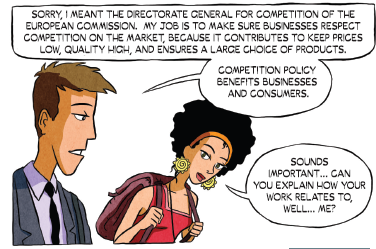

Those of you who have been following this blog for a while might remember our series of posts about antitrust-related entertainment (videos, comics, etc).
Well, a couple of hours ago Aoife White (Bloomberg) sent us the ultimate comic, one that has actually been done by DG Comp.
I was planning to write a few jokes about it even before having read it (my first idea was a fake news story, along the lines of “Belgian association of comic drawers sues DG Comp for giving away comics for free at Christmas time”) but I’ve just read the actual comic (it’s 9 pages and takes 3 minutes, no more), and I wouldn’t know where to start!
The story is about a busy, handsome (I guess, although I’m not really an expert on the beauty of drawn men) and passionate DG Comp official who wants to pick up a girl at an airport with the chat-up line “I work at DG Comp” and then starts showing off about how important his job is.
And I’m not kidding.
It’s available here: DG Competition Comic
“I work at DG Comp”, the ultimate pick-up line…
A thought on Microsoft/Nokia

As you know, a few days ago the European Commission unconditionally authorized the Microsoft/Nokia deal. I’m looking forward to reading the decision, which isn’t yet public. Whereas I expect to see nothing odd in there, a doubt did spring to mind when reading the press release last week.
When explaining its approach to the concern that Nokia could become a troll-like entity, the Commission’s Press Release says the following:
“The Commission considers that any possible competition concerns, which might arise from the conduct of Nokia, following the transaction, in the licensing of the patent portfolio for smart mobile devices which it has retained falls outside the scope of the EU Merger Regulation. The Commission cannot take account of such concerns in the assessment of the current transaction. Indeed, Nokia is the seller whereas the Commission’s investigation relates to the merged entity. However, the Commission will remain vigilant and closely monitor Nokia’s post-merger licensing practices under EU antitrust rules, in particular Article 102 (…)”. (Emphasis added).
Please correct me if I’m wrong, but isn’t that a wrong/arguable over-simplification? (although, to be sure, it wouldn’t be a crime for a press release to over-simplify). Does merger control really relate solely to the merged entity to the exclusion of other actors in the market? Isn’t it rather about the effect that the transaction may have on the structure of the market? I mean, can’t the Commission assess the effects that a concentration would cause on the market power of parties to the transaction as well as on that of third parties? Perhaps the press release only intended to refer to the Commission’s remedial powers, and not to its assessment powers, but even assuming that, the short explanation may be incorrect. Although infrequent, third party post-merger conduct may be potentially relevant in deciding a case.
Look, for instance, at recital 25 of the horizontal merger guidelines “under certain circumstances, concentrations involving the elimination of important competitive constraints that the merging parties had exerted upon each other, as well as a reduction of competitive pressure on the remaining competitors, may even in the absence of a likelihood of coordination (…) result in a significant impediment to effective competition”.
Don’t get me wrong: I’m not challenging the outcome of the Decision (it seems prima facie reasonable for the theory of harm at issue in that case to be monitored ex post), but, in my view, the explanation would have had to do with “causality” (à la Tetra Laval or GE/Honeywell), not with the scope of merger control. Perhaps this would seem to make no practical difference in principle (as we’ve learnt recently, in real life ends justify means, and reasonings aren’t really worth paying attention to), but inconsistencies in the formulation of policy positions might eventually come at a cost.
P.S. Following the advice of some of you, last night I created a Twitter account: @LamadridAlfonso; it’d now be nice to know how to use it and what for!
[Image possibly subject to copyright]
AG Wathelet’s Opinion in the Greek lignite case

The Opinion of Advocate General Wathelet in the very interesting Greek lignite case came out yesterday. This is the second time in recent weeks that the AG’s Opinion makes an impact in the competition scene with a tightly argued proposal (the previous one was his Opinion in Teléfonica).
You might remember that sometime ago we held our first and so far only ménage à trois debate precisely in relation to the General Court’s Judgment in the Greek lignite case:
For the moment, the AG’s Opinion essentialy sides with what José Luis Buendía wrote in his contribution to this debate a year ago (see here), and criticizes the solution adopted by the General Court.
There are however other very valid contrarian arguments, all brilliantly outlined in the pieces we published from Marixenia Davilla (part I ), and Assimakis Komninos (part III).
An eventful day

On 20 November we wrote a post on cartel fines saying the following:
“In spite of temporary appearances, though, one should not expect these figures to remain as they are. The upcoming LIBOR decision will certainly inject some significant (record breaking?) “capital” into this years’s numbers. On top of that, there appear to be a number of cartel decisions stuck somewhere in the pipeline (interestingly, only one cartel decision has so far been adopted in 2013)!.
We got it right (not that it was very difficult):
On the 27th, the Commission adopted a cartel decision fining North Sea shrimp producers [BAD JOKE ALERT] -what you’d call shellfish cartellists- with 28 million euros.
And yesterday, the Commission imposed the highest fine ever (1.7 billion euros) on a number of banks within the framework of the LIBOR investigation (still ongoing in relation to a number of parties who chose not to settle).
An interesting coincidence: yesterday representatives of the troika “advising” Spain on economic issues recommended that banks avoid any price wars (no kidding). Anyone sees mixed signals??
Also yesterday, the Commission unconditionally authorized the Microsoft/Nokia deal. It’ll be interesting to appeal (this time I’m kidding… or not) read the decision once it’s published 🙂
Finally, yesterday we had a reception to celebrate the launching of the procedural bible. A great evening all round.


 Chillin'Competition