Archive for the ‘Uncategorized’ Category
A thought on the failing division defense, industrial policy, and commitments

The EU Commission has often been – in our view incorrectly – criticized for its blindness to industrial policy considerations.
Caution: propaganda With my assistant Norman, we wrote a lenghty paper explaining how such considerations can, and should, play a – circumscribed – role in EU antitrust law.
A recent case suggests that industrial policy arguments are not devoid of all traction.
In Nynas/Shell’s Harburg Refinery, the Commission cleared the acquisition of distressed oil refineries by Nynas (a nice an EU firm) on the basis of the failing division defense.
Interestingly, the reasoning seems based on the conjecture that absent the merger, the refineries would be shut down. As a result, there would be “reduce[d] production capacity in Europe for a number of specific oil products”. And the closure of those refineries would expose European consumers to the full exploitative might of Ergon, a bad US importer.
Of course, the reasoning remains competition based. The Commission stresses that absent the merger, prices would likely increase. And assumes that with the merger, prices will not.
But this is only true if Nynas keeps the refineries in business.
My question then is: shouldn’t failing division defenses be systematically accompanied with a commitment from the acquiring firm to keep (all or part of) the acquired assets in operation?
After all, some companies do purchase fledging entities to shut them down, and meanwhile acquire technology, know-how, other intangible assets. This may be part of a strategy to actually gain control over supply and reduce capacity (think of Mittal Steel).
DG Comp releases a show-off comic
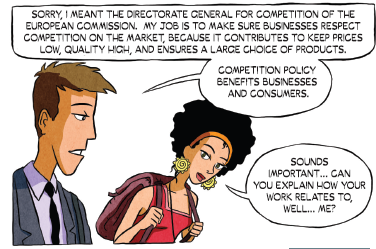

Those of you who have been following this blog for a while might remember our series of posts about antitrust-related entertainment (videos, comics, etc).
Well, a couple of hours ago Aoife White (Bloomberg) sent us the ultimate comic, one that has actually been done by DG Comp.
I was planning to write a few jokes about it even before having read it (my first idea was a fake news story, along the lines of “Belgian association of comic drawers sues DG Comp for giving away comics for free at Christmas time”) but I’ve just read the actual comic (it’s 9 pages and takes 3 minutes, no more), and I wouldn’t know where to start!
The story is about a busy, handsome (I guess, although I’m not really an expert on the beauty of drawn men) and passionate DG Comp official who wants to pick up a girl at an airport with the chat-up line “I work at DG Comp” and then starts showing off about how important his job is.
And I’m not kidding.
It’s available here: DG Competition Comic
“I work at DG Comp”, the ultimate pick-up line…
A thought on Microsoft/Nokia

As you know, a few days ago the European Commission unconditionally authorized the Microsoft/Nokia deal. I’m looking forward to reading the decision, which isn’t yet public. Whereas I expect to see nothing odd in there, a doubt did spring to mind when reading the press release last week.
When explaining its approach to the concern that Nokia could become a troll-like entity, the Commission’s Press Release says the following:
“The Commission considers that any possible competition concerns, which might arise from the conduct of Nokia, following the transaction, in the licensing of the patent portfolio for smart mobile devices which it has retained falls outside the scope of the EU Merger Regulation. The Commission cannot take account of such concerns in the assessment of the current transaction. Indeed, Nokia is the seller whereas the Commission’s investigation relates to the merged entity. However, the Commission will remain vigilant and closely monitor Nokia’s post-merger licensing practices under EU antitrust rules, in particular Article 102 (…)”. (Emphasis added).
Please correct me if I’m wrong, but isn’t that a wrong/arguable over-simplification? (although, to be sure, it wouldn’t be a crime for a press release to over-simplify). Does merger control really relate solely to the merged entity to the exclusion of other actors in the market? Isn’t it rather about the effect that the transaction may have on the structure of the market? I mean, can’t the Commission assess the effects that a concentration would cause on the market power of parties to the transaction as well as on that of third parties? Perhaps the press release only intended to refer to the Commission’s remedial powers, and not to its assessment powers, but even assuming that, the short explanation may be incorrect. Although infrequent, third party post-merger conduct may be potentially relevant in deciding a case.
Look, for instance, at recital 25 of the horizontal merger guidelines “under certain circumstances, concentrations involving the elimination of important competitive constraints that the merging parties had exerted upon each other, as well as a reduction of competitive pressure on the remaining competitors, may even in the absence of a likelihood of coordination (…) result in a significant impediment to effective competition”.
Don’t get me wrong: I’m not challenging the outcome of the Decision (it seems prima facie reasonable for the theory of harm at issue in that case to be monitored ex post), but, in my view, the explanation would have had to do with “causality” (à la Tetra Laval or GE/Honeywell), not with the scope of merger control. Perhaps this would seem to make no practical difference in principle (as we’ve learnt recently, in real life ends justify means, and reasonings aren’t really worth paying attention to), but inconsistencies in the formulation of policy positions might eventually come at a cost.
P.S. Following the advice of some of you, last night I created a Twitter account: @LamadridAlfonso; it’d now be nice to know how to use it and what for!
[Image possibly subject to copyright]
AG Wathelet’s Opinion in the Greek lignite case

The Opinion of Advocate General Wathelet in the very interesting Greek lignite case came out yesterday. This is the second time in recent weeks that the AG’s Opinion makes an impact in the competition scene with a tightly argued proposal (the previous one was his Opinion in Teléfonica).
You might remember that sometime ago we held our first and so far only ménage à trois debate precisely in relation to the General Court’s Judgment in the Greek lignite case:
For the moment, the AG’s Opinion essentialy sides with what José Luis Buendía wrote in his contribution to this debate a year ago (see here), and criticizes the solution adopted by the General Court.
There are however other very valid contrarian arguments, all brilliantly outlined in the pieces we published from Marixenia Davilla (part I ), and Assimakis Komninos (part III).
An eventful day

On 20 November we wrote a post on cartel fines saying the following:
“In spite of temporary appearances, though, one should not expect these figures to remain as they are. The upcoming LIBOR decision will certainly inject some significant (record breaking?) “capital” into this years’s numbers. On top of that, there appear to be a number of cartel decisions stuck somewhere in the pipeline (interestingly, only one cartel decision has so far been adopted in 2013)!.
We got it right (not that it was very difficult):
On the 27th, the Commission adopted a cartel decision fining North Sea shrimp producers [BAD JOKE ALERT] -what you’d call shellfish cartellists- with 28 million euros.
And yesterday, the Commission imposed the highest fine ever (1.7 billion euros) on a number of banks within the framework of the LIBOR investigation (still ongoing in relation to a number of parties who chose not to settle).
An interesting coincidence: yesterday representatives of the troika “advising” Spain on economic issues recommended that banks avoid any price wars (no kidding). Anyone sees mixed signals??
Also yesterday, the Commission unconditionally authorized the Microsoft/Nokia deal. It’ll be interesting to appeal (this time I’m kidding… or not) read the decision once it’s published 🙂
Finally, yesterday we had a reception to celebrate the launching of the procedural bible. A great evening all round.
The Groupe Gascogne Judgment (see both sides of the story)

Last week I wrote a post about the Groupe Gascogne Judgment (and other stuff) which has elicited some interest. Somehow oddly, I will now present counter-arguments against all those who… actually agreed with me.
Given that I wrote about the Judgment within minutes of its publication I obviously hadn’t thought the issue through. My initial reaction was (and regarding these points it still is) that by endorsing the De Grüne Punkt solution (i.e. choosing actions for damages as the procedural path to compensate breaches to the right to be judged within a reasonable time) instead of the Baustahlgewebe one (under which the ECJ itself would reduce a fine on account of the said breach when ruling on an application brought before it), the Court of Justice was adopting the less practical solution, and one that could provoke strange situations. Some of you have developed this last point in several comments to that post.
Now, after some reflection (although not much, to be frank) I think I may see what the Court and one of the commentators to the post meant, even if the Judgment’s reasoning may perhaps not have been crystal clear (please note the understatement).
In my post I only gave one view, and I believe that it’s good that readers also get to see the contrarian arguments. Not that I’m second guessing myself, but I don’t like it when we criticize Judgments/decisions without trying to understand first the reasons underlying the choice of a given approach (believe it or not Judges, clerks and Commission officials are actually clever enough not to be producing absolute nonsense all the time, as some lawyers like to claim). In other words, in some cases they may choose the wrong solutions (particularly if they ever rule against me in one of my cases -not that this actually would ever happen-; please note the implicit advertising claim), but there are always reasons for every approach they chose, and it’s healthy for us to try to identify them and debate them on their merits.
Cutting to the chase: it could be argued that endorsing Baustahlgewebe would have implied creating a specific regime that could only address the problem (a) only in competition cases [given that it is the sole area where the Commission enjoys the power to impose sanctions; in all other cases (frozen assets, for instance) actions for damages would be the only practicable solution], and (b) only in cases where a given company were to lose a first instance appeal before the General Court. Also, c) an assessment of damages by the ECJ would require it to rule on factual issues (namely harm quantification), when its jurisdicion is limited by the Treaty to points of law only. Furthermore, d) by providing that excessive delay in itself may open the door for an action for damages/a remedy, the ECJ could be effectively avoiding the possibility that “victims” might go to the ECHR (according to the ECHtR’s case law, there’s no “victim” in the sense of Art. 34 of the ECHR when the national legal system already envisages a remedy/compensation for the breach).
I can see how all these might have resonated within a Court like the ECJ. And it is probably true that Gascogne may be more “legally perfect”, albeit arguably at the cost of practicality and risking the odd situations pointed out in the previous post.
In spite of those perfectly valid arguments, I think I liked other solutions better, for instance:
a) one under which both Courts could assess the existence of excessive delays without it being necessary for parties to bring an additional action (the Commission, in fact, has done this in several past cases, and Courts could too). This is not legally unorthodox; it would not not be a matter of damages as such, but a reason to mitigate an initial sanction made more burdensome by the passing of time in the absence of judicial review. A solution of this sort is common to many national criminal law systems and is justified not on the actual damages suffered, but rather on the fact that there was an additional element (excessive time) subsequently added to the intended outcome of condemnation (i.e. the sanction). To counter-argue again against myself: admittedly, the quasi criminal nature of competition law may not be criminal enough for these purposes.
or
b) a compromise, middle-way and probably less legally controversial solution under which the ECJ would be competent to declare a violation of the right to a fair proceeding by account of excessive delays on the part of the GC (as it arguably did in this specific Judgment). Only quantification would then be left to the GC itself should the party wish to lodge an additional action for damages. For full disclosure: this is an alternative solution that we’re actually advocating before the ECJ in a pending case. But it’s reasonable, isn’t it? 😉
The Unintended Consequences of the Case Law on Restrictions by Object

On second thoughts, the recent bad case law on the notion of “restriction by object” may incidentally, and unexpectedly, fetter the margins of the Commission, and in particular its ability to handle all cases under the obese Article 9 procedure.
As hinted recently by DG Italianer in a most interesting speech, cases such as Irish Beef (C-209/07), Expedia (C-226/11), Slovak Banks (C-68/12) and Allianz Hungary (C‑32/11) all suggest that agreements which are devoid of the “obvious” capacity to harm competiton are nonetheless “restrictions by object” because they are “serious” violations of the law.
In other words, those infringements are restrictions by object because they are sinful – in competition cases, the Court says “by nature injurious to the proper functioning of normal competition” – so sinful that they should be prosecuted even absent anticompetitive intent or effects.
This line of judicial precedents brings restrictions of competition close to the notion of “infractions objective” known in criminal law. Take murder: you can be convicted of homicide even if you unsuccessfully or unwittingly try to kill someone (in some legal orders, it is even illegal to shoot a dead body). Closer to competition law, take insider trading. You can be sentenced even if you use insider information unknowingly or ineffectively.
The bottom line: such infringements are so morally sinful that they should be prosecuted just for the sake of it. Regardless of their impact. Regardless of their motives. Full stop.
Now, let us revert to competition law. If the concept of a restriction by object means infringements that are morally sinful or morally so “serious” that they should be unlawful for the sake of it, then the Commission should no longer be free to settle such cases and decline to reach a finding of infringement.
This is the rule applied in most criminal law systems, where in principle the gravest infringements (eg crimes such as homicide, rape, etc.) cannot be subject to settlements.
The same should apply in competition proceedings. Restrictions by object ought to be treated under Article 9. If restrictions by object are that bad, then the sole procedural way to handle them is under Article 7 . Full stop.
Microsoft/Skype – or the Commission in the Shadow of Parties Submission

The Commission’s decision in Microsoft/Skype contradicts its previous Article 102 decisions in Microsoft I (WMP) and Microsoft II (Internet Explorer).
Read §152 of Microsoft/Skype :
“consumers do not simply use whatever communications product is provided with Windows. The consumers use multiple communications services on multiple platforms, such as Apple iOS and Android, which include their own built-in communications services (Facetime and Google Talk). The parties further submit that some online communications applications such as Facetime and Viber are not even made available for the Windows platform, and yet they are very successful”.
This § tramples on the theory of harm used by the Commission to nail Microsoft in 2004 and 2009: ie that lazy consumers do not use more than one software (no multi-homing), and that they tend to stick to the the default software preinstalled on the platform (users inertia).
Now, the § reproducted above misquotes the Commission’s decision.
In reality, § 151 starts with: “In addition, the parties claim that consumers do not simply use whatever communications product is provided with Windows” blablabla.
But is this really the parties talking here?
Take a look at the full section of the decision:
“151. With regard to a possible tying between Skype and Microsoft’s products, the Commission considers that most of the arguments mentioned above in order to demonstrate the absence of incentives for a strategy of degradation of interoperability (in particular the necessity for Microsoft to maintain and enhance the value of the Skype brand) are also relevant to the assessment of the strategy of tying. 152. In addition, the parties claim that consumers do not simply use whatever communications product is provided with Windows. The consumers use multiple communications services on multiple platforms, such as Apple iOS and Android, which include their own built-in communications services (Facetime and Google Talk). The parties further submit that some online communications applications such as Facetime and Viber are not even made available for the Windows platform, and yet they are very successful.153. Moreover, consumers increasingly prefer services that offer online communications as part of a broader user experience such as Facebook, the recent Google+ and Gmail, which all run on Windows. 154. Competitors would therefore have many possibilities to market and many different means available to attract consumers. 155. In the course of its investigation, the Commission has not received any substantiated replies demonstrating that Microsoft has incentives to tie Skype and Microsoft’s products”.
Read in context, §151 sounds like Commission’s thinking.
There is no rebuttal, no discussion of the parties’ submission. And §151 is planted in the middle of bunch of other Commission arguments, all supportive of the view that there is no risk of bundling.
Now, it would have looked bad for the Commission to say black in 2004 and 2009, and then reverse to white in 2011.
So our Commission friends probably decided to use the parties as scapegoats, and (i) conveniently avoid the blame of inconsistency in decision making; or more plausibly, (ii) the pain of explaining why users of communications services are geeks shopping for software, distinct from the lazy users of media players and browsers.
Improper decision drafting…
PS: stay tuned, my little finger tells me that Alfonso will report on this case very soon.
New Book on Joint Ventures

Joint Ventures and EU Competition Law by Luis Silva Morais
This book examines the treatment of joint ventures (JVs) in EU Competition Law, and at the same time provides a comparison with US law. It starts with an analysis of the rather elusive concept of JV, encompassing both concentrative JVs (subject to merger control) and non-concentrative JVs. Although focused on possible definitions of joint ventures in terms of competition law, it also includes a broader perspective (going beyond competition law) on the different legal models of structuring cooperation links between undertakings.
At the core of the book is an attempt to build an analytical model for the assessment of JVs in terms of antitrust law, especially as regards Article 101 of the TFEU. The analytical model used proposes a set of sequential analytical levels, taking into account structural factors and specific factors related to the main constituent elements of the functional programmes of JVs. The model is applied to a substantive assessment of four main types of JVs identified on the basis of their prevailing economic function: research and development JVs; production JVs; commercialization JVs; and purchasing JVs. Also covered are particular situations of joint ownership of undertakings falling short of joint control.
In the concluding part of the book recent developments in JV antitrust law are put into context within the wider reform of EU Competition Law. The book is also comprehensively updated with the latest developments concerning the reform of the EU framework of horizontal cooperation between undertakings that took place at the end of 2010.
Luis Silva Morais is a Professor at the University of Lisbon Law School (FDL) and holds a Jean Monnet Chair of EU Law (Competition and Economic Regulation). He is a founding partner of ‘Luis Silva Morais – Law Firm’ (based in Lisbon). He has been Vice-President of the Privatization Advisory Board of the Portuguese Ministry of Finance (2001-11), Member of the Board of the Portuguese Insurance and Pension Funds Supervisory Authority-ISP (1998-2001) and currently chairs the Research Centre on Regulation and Supervision of the Financial Sector of FDL in scientific partnership with the Bank of Portugal and the ISP. He is a member of several arbitral courts.
November 2013 586pp Hbk 9781841137933 RSP: £95 / €123.50
20% Discount Price: £76 / €98.80 (+ Postage and Packing)
Order Online
http://www.hartpub.co.uk/BookDetails.aspx?ISBN=9781841137933
If you would like to place an order you can do so through the Hart Publishing website (link above). To receive the discount please type the reference ‘ CC B ’ in the voucher code field and click ‘apply’.
New Book on Chinese Competition Law

Competition Laws, Globalization and Legal Pluralism – China’s Experience By Qianlan Wu
Building upon a theoretical framework and empirical research, this book provides a thought-provoking analysis of the interests, strategies and challenges that China has faced in developing its Anti-Monopoly Law (AML) in the context of economic globalization.
The book comprises three main parts: Part I reviews the directions of convergence of global competition law; Part II provides a contextual analysis of China’s market governance and its strategic interests; and Part III examines the latest enforcement of the Anti-Monopoly Law by focusing on the interactions between global actors and China, the relationships between Chinese competition and sectoral regulators, and the enforcement of global competition law norms in the Chinese context.
This book is one of the first to provide a critical understanding of China’s experience as a new competition regulator, set against the background of the plural sources of global competition laws.
Qianlan Wu is a Lecturer in Law and Senior Fellow of the China Policy Institute in the School of Contemporary Chinese Studies, University of Nottingham, UK. Dr Wu holds a PhD in Law from London School of Economics and Political Science and an LLM from the University of Edinburgh, UK.
November 2013 242pp Hardback 9781849464321 RSP: £55 / €71.50
20% Discount Price: £44 / €57.20 (+ Postage and Packing)
Order Online
http://www.hartpub.co.uk/BookDetails.aspx?ISBN=9781849464321
If you would like to place an order you can do so through the Hart Publishing website (link above). To receive the discount please type the reference ‘CCB’ in the voucher code field and click ‘apply’.


