Archive for the ‘Uncategorized’ Category
If you need a fix
Has the Commission turned into a settlement junkie addict?
Until now, the Commission was ready to go through all sorts of legal compromissions to bring cases under the Article 9 commitments procedure:
- In Microsoft II, the Commission settled a case which 3 years before had been solved with a fine (thereby violating the principle that settlements are not apposite in cases where fines are warranted, see recital 13 of Regulation 1/2003).
- In S&P, IBM and in a gaggle of energy cases, the Commission settled cases where anticompetitive effects had lasted over a significant period of time, thereby failing to punish past anticompetitive conduct (and in turn, denying justice to the victims of the infringement).
- In the upcoming Google settlement, the Commission will close a case which raises novel legal and economic issues. Yet, how can the Commission possibly suspect an infringement short of any significant precedent?
As I was hearing exams all day, I had the occasion to read more on the commitments from Apple and four publishing groups for the sale of e-books.
I was truly baffled when I realized, in this case, that the Commission had accepted to settle what it otherwise deems a “hardcore restriction“, namely an industry-wide resale price maintenance scheme.
With this new precedent, the next question is: will the Commission ever cross the rubicon and accept to settle a cartel case? The Libor investigations could provide good candidates for such a new policy. In those cases, the Commission may be reluctant to hammer the Libor participants with fines, on pain of undoing 5 years of accomodating State aid policy with Article 101 TFEU penalties. An article 9 settlement would provide the Commission with a “good looking” exit strategy.
From a more general standpoint, the Commission’s “Settle ‘Em All” policy finds no merit in our opinion, and may well have adverse effects. After all, if firms know they can settle anything and face no penalties, why should they observe the law in the first place?
Should I Stay or Should I Go?

Comes the end of the day, most young lawyers face this question.
And many decide to stay at the office even if they have nothing to do, just to look busy before partners.
Courtesy of a keen reader of this blog possibly underoccupied in her own professional organisation ;): a nice chart on when to go home

Not-so-mainstream pending cases (II)

I am back with a reference to another ‘not-so-mainstream’ case (you could all see that Alfonso cannot control his blogging urges)
This one is probably more mainstream than the previous one, but the whole field of State aid remains conveniently ‘underground’, so it probably belongs here too (incidentally, my State aid seminar has just started). This case brings us back to the good all days of the dot-com bubble (and we all thought that was a recession). As many other ‘convergent’ firms, France Telecom was in big trouble. In those dramatic circumstances, the French government stepped in and essentially announced that it would do anything to save the company. The goal was to stabilise the credit ratings of the firm. Now that we are undergoing a dramatic recession we understand the importance of ratings much better (just think of Mario Draghi’s bold statement in July last year).
The question raised in the case was that of whether the steps taken by the French government to preserve the viability and creditworthiness of France Telecom amounted to State aid. The General Court disagreed with the Commission and concluded that, while granting an advantage, such steps did not involve the use of State resources, as consistently required by the ECJ since Preussen Elektra. In an interesting opinion (in French only) issued in June last year, AG Mengozzi proposes to set aside the GC judgment. He considers that the interpretation given by the GC (at least as far as some of the measures are concerned) is excessively formalistic. I am looking forward to the judgment. If one considers the case law on guarantees and similar measures, AG Mengozzi is probably right.
A couple of thoughts in relation to the judgment:
- This is a good reminder of why the Trinko doctrine will never carry the day in Europe. I think Trinko is a sensible and thoughtful opinion that is widely misunderstood. However, if one takes account of the links between incumbent operators and Member States, it probably makes sense to leave room for the application of competition law in Europe. Let us not forget that the facts giving rise to the Wanadoo decision (predatory pricing) took place at roughly the same time.
- The GC and the ECJ have recently and notoriously disagreed on some high profile State aid cases. These cases relate to the notion of selectivity (British Aggregates, Gibraltar, NOx). The GC tends to side with Member States and the ECJ with the Commission. AG Mengozzi’s opinion suggests that this will be the case here. We will see
Pablo
‘Not-so-mainstream’ pending cases (I)

I am coming off the bench to replace Alfonso (fans do not worry: it is all temporary, and the All-Star blogger will be back and kicking very soon!).
When he asked me to prepare a post, I thought it would be a good idea to write on pending cases before EU courts with which our readers are maybe less familiar, but that raise most interesting issues nonetheless. Those who know me will not be surprised to know that it is once again all about electronic communications.
Today’s post is on a reference from a preliminary ruling coming from a Dutch court (Case C-518/11), that I find most intriguing. According to the information found on the website of the Court, the hearing took place on 22 November 2012.
The Gerechtshof te Amsterdam submitted a list of eight (very detailed) questions. It seems that the municipality of Hilversum included a ‘tariff-limiting clause’ when it sold its cable television activities to a third party. This factual scenario raises important questions relating to the scope of the Regulatory Framework for electronic communications and others relating to the scope of Article 101 TFEU.
- Scope of the Regulatory Framework: The Dutch court asks whether the provision of cable television services to end-users is subject to the Regulatory Framework and whether the fact for the municipality to cap retail tariffs is compatible with the sector-specific regime. This question is relevant not so much because of the (predictable) outcome but because it shows that the artificial content/network divide found in the Regulatory Framework is plain impracticable in the current technological landscape.
- Scope of Article 101(1) TFEU: Is it contrary to Article 101(1) TFEU to impose tariff-related conditions when selling a business? Because the seller in this case is a municipality, an array of sub-questions come to mind. Is the municipality engaged in an economic activity when imposing such conditions? Is this conduct contrary to ‘the obligation of Union loyalty’ (as drafted in the questions)? This set of questions is probably more interesting from a substantive perspective, at least so because the chances of an unexpected outcome are probably higher.
Another post on another not-so-mainstream case will follow soon!
Pablo
Missing in action
We are a disgrace:
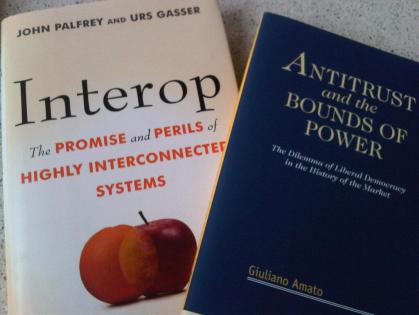
Nico is missing in action in some lost island, and I’m on forced semi-vacation in Spain due to a humerus fracture provoked by a humorous ski fall, and unable to do anything but bad jokes (see above) and read (on the antitrust-related side I’ve particularly enjoyed the two in the pic above -Interop, and Antitrust and the bounds of power- which I would recommend you to read whenever you injure yourself..).
I’m telling you this because since Nico and I are unfit (that is, even more) to take care of the blog as we’d like, our friend Pablo Ibanez Colomo (LSE) has accepted to write some stuff in the coming days. We’re grateful to him, even if we know there’s a risk that you’ll like his posts more than ours! 😉
Write to you soon!
Google reaches a settlement with the FTC

Google has reached a settlement with the FTC! Details can be found here.
The settlement concerns the licensing practices of some key technologies to competitors and the management of campaigns by online advertisers. The investigation into Google’s search-related practices, on the other hand, has been closed (by a 5-0 vote).
According to the press release, Google’s ‘Universal Search’ and other changes can be ‘plausibly justified as innovations that improved Google’s product and the experience of its users’.
We are all wondering the impact this outcome will have on the (European) Commission’s ongoing investigation (although we presume this did not catch DG Comp’s officials by surprise).
Btw, I will be speaking soon about antitrust and search engines, so these developments come in handy (not sure if that’s the right expression considering that for a couple of months I’ll be a one handed man..)
Nicolas Petit- an Ordinary Professor

I’ve just realized that I forgot to share some good news with you.
A few days ago I learnt that Nicolas had been promoted to Professeur Ordinaire. To be frank, given my absolute ignorance about Belgian academia (among vety many other subjects), going from Professor to Ordinary Professor rather sounded like a downgrade.
But nope, Google tells me that Nico has managed to attain the highest possible academic position at age 33, which is very hard to understand impressive. While writing this I’ve realized that he also turned 34 on Saturday (which of course I forgot).
Congrats and best of lucks, Nico!
Death Star economics: on market power and technological innovation

A couple of days ago the FT published an interesting piece on how market power in the tech sector might disprove assumptions about technological rates of progress. According to the author, science fiction had long anticipated the trends we are seeing today.
I could dsummarize the piece, but since (i)I broke my arm/shoulder skiing; (ii) it’s taking me ages to type with my left hand (not that there’s much else I can do..), and (iii) many of you are probably on holidays, you can probably spare a couple of minutes to read it here.
Btw, happy new year !!!!
Xmas Gift

My Xmas gift here: Poster – LLM in Competition and IP Law, the new poster of the University of Liege LL.M in Competition and IP law.
This programme keeps improving.
We have this year a very enthusiatic group of studs’ from all over Europe and beyond.
And for the upcoming year, we plan to (i) open a new academic position (senior lecturer) on a set of IP courses; and (ii) pursue the official lauching of the Liège Competition and Innovation Institute (LCII)