Archive for the ‘Uncategorized’ Category
Negotiations (and other non-legal abilities) in Antitrust Practice

Two days ago I read the obituary of Roger Fisher -Emeritus Professor at Harvard Law School and director of the Harvard Negotiation Project. Fisher was a co-author of one of the best-selling books in the art of negotiating: “Getting to Yes, negotiating agrement without giving in“. Reading this book was one of the requirements of the Harvard negotiation program to which I devoted 3 intense weeks of my LLM’s winter term.
Skimming again through its pages last night I remembered the paper that I wrote also as part of the requirements for the negotiation program; I chose to do it about the specific features of the negotiations that take place in the field of antitrust (as is the case with other competition lawyers my mindset is programmed to think mainly about one subject…). I would post it here, but my only digital copy of that paper was lost under very peculiar circumstances that would merit an ad hoc post.
Anyway, let’s cut to the chase:
Antitrust practice nowadays requires inmense negotiation skills. In many cases, and after the law plays its role, the final outcome is determined pursuant to a negotiation. Moreover, quite often practitioners and authorities don’t limit themselves to the application or establishment of liability principles, but rather negotiate in the shadow of the principles that regulators and courts may be expected to apply (for some material about negotiating” in the shadow of the law”, click here or here). In other words, very often a negotiation is what determines the success or failure of the project or case at issue.
In spite of the increasing prominence of negotiated solutions in antitrust enforcement (think of cartel settlements, settlements in actions for damages, commitment decisions in abuse of dominance cases, or the design of remedies, among others), awarenesss about the importance of negotiation skills in our profession is still scarce. To be sure, this attention deficit is not exclusive to negotiation abilities; the same happens with other non-legal abilities that in practice are as important -or much more- than a thorough knowledge of the law (notably writing).
Law firms often attempt to resolve the issue through one day talks and other brief and not-so-serious means, but I’m not sure of whether that’s enough. Universities and postgraduate centers would be providing a great service should they focus on these extra-legal abilities.
Don’t get me wrong. I don’t think that doing a course/seminar on negotiation or on many other skills is going to radically change anyone’s life. Negotiation skills (like salsa dancing, basketball playing, maths, and almost anything) are to some extent natural abilities. In fact, the best negotiators I’ve ever seen in action act by instinct or experience and would probably laugh at the idea of “studying” about it. Moreover, in a field of repeated interactions like ours, building the necessary trust from your counterparts (authorities or competitors) takes time. In spite of it all, it is a fact that most skills are perfected upon reflection and training.
In order to contribute to filling this void, Nicolas is devising (and trying to sell) an executive training program for lawyers in order to deal precisely with all these non strictly legal skills.
Any suggestions you may have about it would be most welcome!
On patent suits, lawyers’ suits and Suits

As I was reading a few online pieces on Apple’s victory over Samsung in one of the multiple patent battles confronting them (btw, you can check out this interesting interview with Richard Posner, as well as this piece on how jury deliberations took place) I came accross an article that blames not the proliferation of trivial patents but “suit-and-tie lawyers” for stiffling creativity and innovation.
Leaving aside the easy attack on lawyers, the “suit-and-tie” expression has always intrigued me: I’ve heard it many times, but I seldom hear it applied to other “suit-and-tie” professionals. I did a quick search on it and quickly came up with some material for a post on lawyers and suits; it later expanded to more suit related stuff. Here it goes:
Patent suits
Before continuing with the suit talk, a quick remark on the proliferation of patent suits and on the accusation about lawyers’ destructing creativity. I agree that some degree of oddness may be inevitable when competition and the battle for innovation moves from the markets to the courts. And even though in some (many) cases such a move may also be inevitable (which not only is natural, but also convenient because otherwise most of us would be unemployed), the level of litigation that is taking place in relation to the smartphone industry is simply nuts. Posner has a point (there’s definately something wrong with the system that feeds “trolls” or that forces a company is forced to buy another just to acquire its patents to avoid future suits). Given the enormous cash reserves that these companies have ($110 billion in the case of Apple), legal fees and expenses derived from multiple and expensive parallell lawsuts are not a major concern, much less when these suits often pay-off (it’s hard to speak of sham litigation in this setting) and even have the potential to significantly alter the market. Patent lawyers are benefitting from this, but is it their fault? Nope, what happens is that companies are rationally exploiting the opportunities that an arguably ill-designed legal regime offers them. And speaking about system design, I admit that I also have issues with the fact that the outcome of cases like this one depends on the decision that 9 jurors take over highly technical matters.
[I said above that patent lawyers are doing well. Want to know the estimated legal fees of Morrison&Foerster, Wilmer (both representing Apple) and Quinn Emanuel (Samsung) for this case? You do, uh? 😉 Check here then (for the lazy ones: the range goes from $10 million to several hundred million dollars per party…).
Lawyers’ suits
Now back to the other suits (I bet Apple and Samsung’s lawyers will be buying some pretty expensive ones in preparation for the appeal). My saturday-morning Google search on “suit-and-tie lawyers” [btw, Google is searching for an in-house competition lawyer] made me realize how candent this issue is. The suit has traditionally been lawyers’ uniform (I’m sure you’ve heard about “power suits”; see here) but it is a fact that lawyers are “dressing down” these days (although some say the contrary). I, for one, typically feel like a living old-school reminiscence when I meet friends working for US firms and I’m the sole one wearing a tie (at my firm we’ve so far only managed to make inroads into casual Fridays and casual August…).
There are many pieces that pose the question of whether we should start dressing differently (see, e.g. here). The proliferation of such questions have spurred vehement reactions from those who claim that “Enough is enough, lawyers should look like lawyers!” . Does this look like a trivial issue to you? In some places it apparently isn’t. Just a few days ago, a lawyer from Pakistan wrote a piece in the Herald Tribune advocating for the abandonment of western-suits with the argument that “if we are able to achieve that (at least with our lawyers’ uniform) then we can be at the threshold of reconstructing a new, more culturally connected and logically sound society. This change can lead to a domino effect that results in the recapturing of other areas of society and public discourse that are being dominated by the colonial mindset“. No less!
Btw, if you want to know which is the world’s smartest law firm, click here.
I’m generally in favor of wearing suits for meetings, but I’m not so sure about the usefulness of doing it during those many days that we spend isolated in our offices (I sometimes have the feeling that I dress only for my next-door neighbor Napoleon; I think he likes my fashionable style, though…). I admit suit wearing is sometimes convenient, but other times it’s a pain (I was already an intern at Garrigues during my two last years of law school, and every day after class I had to run to my student’s residence to suit up for work -how many hours did I lose doing that??-; a more recent example, I came back from holidays last week and I had to spend x hours quite some time in an attemp to iron a suit for a meeting the following day (that really took time!)
Suits
In our post about legal movies and TV series we forgot to mention the much acclaimed Suits. I watched the pilot last night (what better to disconnet from a working weekend than to watch a series about a law firm, right?) and I can confirm that it’s pretty good.
P.S. This post was brought to you by Suit Supply.
The Saturday Morning Slot?

Woke up all too early this Saturday morning, cannot understand why.
As the summer quietness was interrupted yesterday by a raft of breaking news (Breivik’s 21y sentencing, the NY shooting, Armstrong’s decision to throw in the towel, and the death of JL Delarue), several pieces of information of AT interest reached my mailbox/ears last night:
- Ben Van Rompuy’s book is finally out. Ioannis Liannos (UCL) will give a speech on 28 September at the book launch reception.
- I will be finally flying to Hong Kong in October for this conference. Cannot wait.
- Edward Elgar has penetrated the blogosphere. Their blog has a section entitled “law” with good posts on antitrust (by Mark Furse) and intellectual property.
- Covington’s associates are better compensated than Cleary’s (I find this one hard to believe though).
To all, a very good WE.
On my side, I’ll be busy completing the move to my new place. And I’ll be eating pasta prepping for the 25K next week in Liege.
Facts of Life
Yesterday at Ashurst, the receptionist: “You must be the student taking the exam with Professor Waelbroeck right?” => I enjoyed this one.
Heard through the grapevine, two days ago, : “Nico still needs a breakthrough article” => liked this one a little less, but there must be some truth to it.
Last but not least. Despite my young age, I almost had a heart attack when I realized that the publisher of the latest issue of the Journal de Droit International had been published, and that virtually all the corrections that my assistant and I had made on the proofs or our paper had been ignored.
Brussels School of Competition
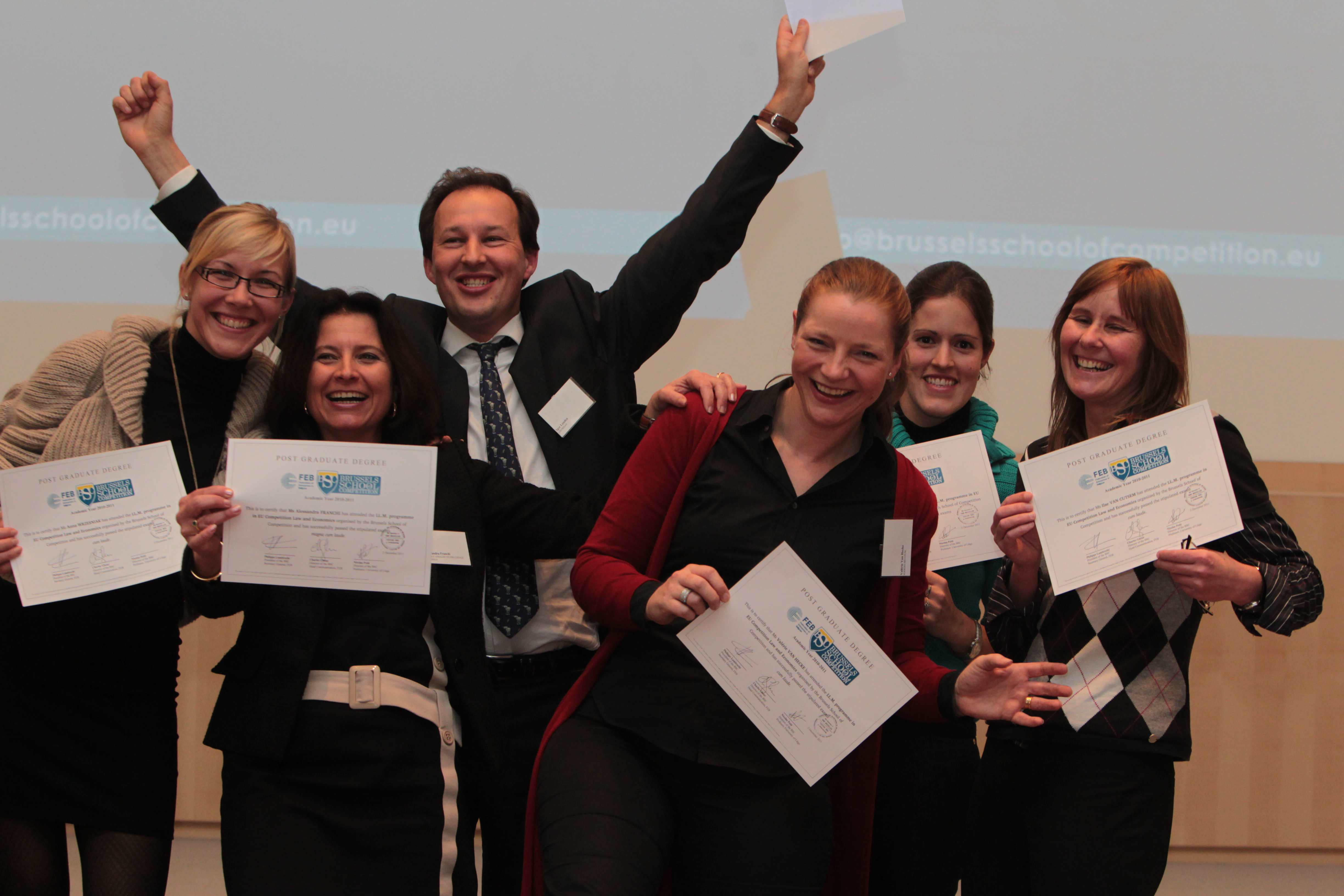
I had drinks last night with my good friend Charles Gheur from the Brussels School of Competition (“BSC”).
It sprung to mind that I had not yet advertised that the registration process for the 2012-2013 edition of the LL.M was opened .
There’s a bunch of new things for this third edition of the programme, not the leasts that (i) Fred Jenny stepped in and will co-teach the module on abuse of dominance, and that (ii) señor Lamadrid de Pablo has officially been drafted (he is a basketball fan) to join the team that teaches procedural matters.
Together with the fact that our studs are primarily in-house lawyers from large corporations (Microsoft, Umicore, Toyota, Mastercard, Basf KBC, Bayer, Distrigas, Verizon, etc.) this should convince young Brussels lawyers to relocate towards us instead of following the painful King’s College long distance programme.
Chuck Norris Antitrust Facts (3)
- The most stable cartels are those to which Chuck Norris participates. No one cheats for fear of Chuck’s retaliation.
- Chuck Norris is both a structural and a behavioral remedy. He can break a leg (the structural component) just by turning to a mean face (the behavioral component).
Office supplies for the new academic year
We don’t know if you ever had the same feeling, but when we were students we kept on buying new notebooks, pens, folders, etc at the beginning of each academic year under the reasonable assumption that they would make us smarter..
I had a reminiscence of that last week. I was in London for the basketball games of the Olympics (where Spain was very close to beating the U.S. Dream Team!) and after visiting Pablo Ibañez’s office at LSE (btw, he has been awarded the Departmental teaching award; congrats!) I passed by a legal bookshop called Hammicks where I remembered having spotted some fun stuff. I couldn’t resist purchasing some office supplies for the new year:
A note pad

A cushion

And a new book for my shelf: What Every Lawyer Thinks About Apart from Sex? (it’s 200 blank pages are a must-read!)

Chuck Norris AT Fact of the Day
Antitrust agencies can eliminate all consumer harm. Except those inflicted by Chuck Norris.
Can Do Better

Whilst seating on the beach, I read last week’s (now) famous Economist piece on fines.
I was quite astonished to read that The Economist supports further increases in corporate fines. The conclusion of the paper speaks for itself: “To deter bad behaviour fines need to rise. The watchdog are biting, but some need sharper teeth“.
That said, I found the paper a little weak. Strangely enough, it says nothing of most issues that currently matter in respect of corporate fines:
- No word on sanctions for individuals, in the form of director disqualification orders;
- Some references to theoretical studies, including references to the economics of crime (G. Becker) and cartel overcharges (O’Connor & Helmers), but no word on principal-agent problems in large multinational corporations;
- No word on the issue of fines in times of economic crisis;
- No word on compliance programmes.
Is there a hidden agenda there or am I again reading newspapers like the devil reads the bible?
Arguably, those omissions may be explained by the fact that the paper is not antitrust-related only (quod non). The paper opens with some words on the economics of corporate fines, and follows with a brief discussion of the penalties inflicted to Barclays a few weeks ago. But after this, the meat of the paper really is a discussion of antitrust fines. And even if it were true that the paper takes a larger focus, it remains silent on a number of key issues. Think, for instance, to the trade-off that regulators are now facing, i.e. sanctioning banks with hefty fines v. ensuring banking stability with subsidies.
The bottom-line: The Economist can do better…
Microsoft v Commission (T-167/08) – The Magill-IMS Health Re-Animator?

I was about to fall asleep reading the Microsoft judgment of last week (T-167/08), when I stumbled into paragraph 139.
This paragraph implicitly reverses the CFI’s Microsoft I ruling on the legal standard of abusive refusal to supply (CFI, Case T-201/04, Microsoft Corp. v Commission, ECR [2007] II-3601).
Remember, in this judgment the CFI had departed from the IMS Health and Magill “new product” condition.
It had held that:
“§647. the circumstance relating to the appearance of a new product, as envisaged in Magill and IMS Health . . . cannot be the only parameter which determines whether a refusal to license an intellectual property right is capable of causing prejudice to consumers within the meaning of [Article 102(b) TFEU]”.
The CFI further added that it was sufficient for the Commission to prove that the refusal to supply interoperability information gave rise to a “limitation […] of technical development”.
This new concept was (and still is) rightly criticized by scholars and practitioners as a loose, elusive and murky legal standard. Many expressed regrets over the disappearance of the simple three-pronged Magill-IMS Health test. Others argued that the CFI’s “technical development” standard was wholly inapplicable, and advised to rely on the Magill and IMS Health judgments of the upper ECJ. Finally, some practitioners (amongst others, D. Waelbroeck) talked of a lex specialis Microsoft.
Interestingly, the latest Microsoft judgment no longer talks of the “limitation of technical development“.
Rather, in what reads like an obiter dictum, the GC explicitly refers to the “new product” condition, and quotes IMS Health as the sole source of precedent on refusals to supply involving IPRs.
“§139. In that regard, it should be recalled that, in order for the refusal by an undertaking which owns a copyright to give access to a product or service indispensable for carrying on a particular business to be regarded as abuse, it is sufficient that three cumulative conditions be satisfied, namely that that refusal is preventing the emergence of a new product for which there is a potential consumer demand, that it is unjustified and that it is such as to exclude any competition on a secondary market“
Of course, the Court would not acknowledge that it applied a wrong legal standard in 2007.
It thus goes on to state at §140 that those three conditions were met in the Microsoft I case (they were not).
That said, paragraph 139 marks a welcome evolution of the case-law on abuse.


