Archive for the ‘Uncategorized’ Category
Competition Law Everywhere

I often tell my studs that there’s competition law everywhere.
Here’s an example, found this morning when reading the news at breakfast.
In several recent lectures, I have explained that the case-law insulates organs with “exclusively social functions” from the ambit of the competition rules. This is especially the case of social schemes that operate under the solidarity principle (ECJ, C-159/91 et C-160/91, Poucet and Pistre).
In France, the “mutualités” (complementaty social schemes) have recently announced their intention to collectively raise prices, to pass-on tax increases decided by the Government. I suspect that some of them do not operate under the solidarity principle, and might thus not benefit from the above exception. Needless to say that any coordinated plan to increase prices could be akin to an unlawful concerted practice or decision by associations of undertakings under Article 101 TFEU.
Moreover, it seems that the governement does not force them to pass-on the price increase (in which case they could benefit from the act of State defense). Hence, the sole economic situation in which 100% repercussion would be unavoidable, is where the “mutualités” already price at marginal costs. Otherwise, if they make a profit, they can take part (or all) of the tax increase on their profits. In this case, they should compete on the tax increase absorption. A joint decision to transfer it on consumers should thus be forbidden, in that it chills competition.
Now off to watch France v. Wales
Reforming the EU General Court

Last week, the European Commission adopted a formal position on the reform of EU Courts. The document refers to both the ECJ and the General Court, but for the moment we will focus on the latter as the main subject of the proposed reform.
The Commission´s position advocates for the appointment of 12 new Judges to the General Court (which would make a total of 39) as well as for the creation of at least two new specialised chambers (one of which would most likely be devoted to competition cases). These reforms are aimed at addressing the enormous workload that the General Court currently faces (with over 600 new cases registered every year and ever growing delays).
The Commission´s proposal -which to a great extent endorses that of the President of the ECJ, Mr. Skouris- has now been circulated to the Parliament and to the Council.
Unsurprisingly, the most contentious issue that has arisen in the context of the ongoing discussions between Member States relates to the designation and nationalities of the new Judges. As you know, the method for the designation of Judges falls entirely upon Member State, which have always acted on the basis of informal consensus. The Commission, fully aware of the fact that abandoning the principle of equal representation would be tough to swallow for some Member States, has attempted to tackle the issue by proposing two alternative methods of designation (see recitals 42-50 of the document that appears in the link above). In our view, the merits of the candidates should weigh much more than their nationality, and therefore the second option proposed by the Commission appears to be preferrable.
We feel nonetheless, that several important issues remain unaddressed:
First, whereas the nationality of the Judges may certainly be important, there is another very relevant nationality factor at the General Court that has so far gone unnoticed.
What would you say is the percentage of French référendaires (clerks) at the General Court? Under a system of equal representation, the answer should be approximately 4%. In real life, that number is however…..40%!
We know some truly excellent French référendaires, and of course French is the working language at the Courts, but, as a mater of principle, when it comes to judging shouldn´t quality and credentials matter more than language abilities? (I´m using “we”, but maybe Nico, being a froggy French citizen sees things differentlly…) 😉
Secondly, there is nothing the Commission can do about designations of candidates at the national level. The Committee envisaged in Art. 255 TFEU has certainly helped by acting as minimum filter in the most flagrant cases. Nonetheless, some Member States may still be tempted by the possibility of appointing candidates on grounds other than those strictly technical (although the second option proposed by the Commission has the virtue of perhaps shifting those incentives).
In our view, Member States should ideally follow the Dutch example (we believe that other Member States are already doing it). They arranged a merit-based competition and eventually appointed two outstanding Judges such as Sacha Prechal (ECJ) and Marc van der Woude (GC).
Tougher Competition Law

The day before yesterday, in Joined Cases C‑403/08 and C‑429/08 (Premier League), the Court of Justice :
(i) failed to understand what a public good is;
(ii) further expanded the “object” box.
And a proposition: would I be a monopolistic supplier (like FAPL), I’d sell to one buyer only in the EU, at a very high price. Or I’d sell to all of them, at a very high, similar price (to limit arbitrage).
This case has been presented as a victory for market integration. I am afraid this is more of a knock-out.
GCLC Lunch Talk on VEBIC and Tele2 Polska
I am very pleased to announce a new GCLC lunch talk on “The Rights, Powers and Duties of NCAs following the ECJ Judgments in VEBIC and Tele2 Polska“.
It will take place on 24 October. Time and place as usual. Online registration available here.
We have invited E. Sakkers (DG COMP), F. Zivy (French Competition Authority) and S. Brammer (University College Leuven) to discuss those fascinating cases.
Some background documentation can be found here.
Antitrust Story
Like theft, monopoly pricing does not necessarily harm total welfare, but injures consumer welfare.
Depending on where you stand on the total v. consumer welfare equation, this may influence your social tolerance to theft.
A good illustration of this can be found in a story about William Baxter, a former Professor at Stanford Law School. Baxter also served from 1981 to 1983 as Assistant Attorney General in charge of the Antitrust Division of the DoJ:
“While strolling one evening on a quiet street near the Washington residence, Bill and his wife Carol were confronted by an armed robber; they emerged minus some personal property but without injury. At the next Antitrust Division holiday party, the incident became a skit in which the robber demanded Bill’s watch. When Bill resists, the robber points out that it would be only a wealth transfer – a mere redistribution that would not affect economic efficiency or total social welfare. Reassured that the robber shares his standards of economic analysis and acknowledging that the point is analytically correct, Bill immediately surrenders his watch”.
Source can be found here. Found in reading Ben Van Rompuy’s doctoral dissertation (VUB, Belgium).
Competition Law and Sports: Conference in Budapest

This afternoon I will be travelling to Budapest to participate at a conference on “Olympics – Competition – Sports – Law: Competition and sports law issues of today’s sport”. The conference´s program is available here,
My presentation will deal with the competition law implications of the rules establishing the obligation for clubs to release players for international competitions. In essence, I will focus on the Oulmers and Asobal cases, that we already briefly discussed here on a previous post.
A very impressive line-up of speakers will be covering many other issues related to the application of competition law to the sports sector. If any of you is interested in this topic, I have been told that the discussions will be broadcasted online via the web page of the Hungarian Olympic Committee.
Thanks to Ádám Remetei-Filep and to Pal Szilágyi for their invitation.
THE RAID: An antitrust movie

In Chilling Competition we have devoted a number of posts to antitrust-related movies (see our previous posts on: “First ever Hollywood competition law movie?”; “OFT goes to Hollywood”, and, very specially, our nominations to the “Antitrust Oscars”). Given that all of those posts received a crazy amount of visits, we can reasonably presume that you too like this sort of videos.
Today Chilling Competition is proud to release a true gem, a “classic” on its own right that we have digitalized for our readers: The Raid.
In our opinion, The Raid is the best and funniest antitrust movie of all times. It has everything: it is a comedy with action, romance, and an educational purpose (it was filmed -a few years ago- as part of a compliance program for Neste).
If you think we’re not objective, then you’re absolutely right:
The Raid is directed and starred by very special actors to whom we profess great admiration: General Court’s Judge Marc van der Woude (who plays the character of Luc Desmet, a Commission inspector); Toni Huopalainen (who, in addition to being the scriptwriter, plays the role of European Commission official Tom Jenssen); and our friend and favorite competition lawyer Luis Ortiz Blanco (to see a moustached Luis in his role as a priest confessing a cartelist jump to minute 20.33).
A million thanks go to all three of them for granting us the permission to digitalize their movie and for their great sense of humor.
Enough for introductions…
(Only accessible on Chilling Competition’s youtube channel via this link).
Competition sound-alikes (2)
Yesterday, we missed a big one (tx to Sarah Long for the pointer):
John Davies (OECD) 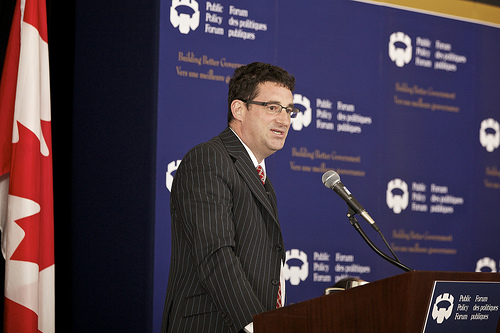 with John Davies (Freshfields)
Competition sound-alikes
We work in a small community and, funnily enough, a number of esteemed colleagues share similar names.
So our readers avoid confusion at social events, here is a recap. Do not confuse:
 Simon Bishop (RBB Econ) with Bill Bishop (CRA International)
 William Kolasky (WilmerHale) with William Kovacic (FTC )
 Damien Geradin (Covington) with Damien Gerard (Louvain)
Mario Monti (former Commissioner)  with Giorgio Monti (EUI)
 Peter Whelan (Uni East Anglia) and Anthony Whelan (EU Commission)
Myself  with a former Howrey chap, Nicholas Little (no kiddin’ here)
Will come back tomorrow with a post on competition dynasties.
Promotion (including self-promotion)

Yesterday, I made my mom and dad very proud. I was interviewed by the French newspaper Liberation.
The interview is about credit rating agencies and competition law. It is a follow-up to my blog post a few days ago. See link below for the text or here on the blog of Jean Quatremer.
So much for the self-promotion: Garrigues decided to promote Alfonso to senior associate level! A fully deserved decision: Alfonso is one of the most promising, brightest and funniest AT lawyer out there. Congrats!
This makes his mom, dad and co-blogger very proud too.


