Lost in Translation

[Please read this post with caution] Heard from a seasoned German-speaking Member of the Court of justice of the EU.
The fuzz about the object-effect dichotomy that has kept generations of EU competition lawyers busy would be a moot issue. We dumd: last year, at the GCLC, we devoted a full conference and book to this issue.
This is because this distinction arguably does not exist [following Hans, Petra and Rainer’s clarifications, I suspect this eminent person meant is “not really relevant”] in the German-language version of the Treaties. Hence the Court’s reluctance to consider effects in antitrust cases.
Puzzled by this assertion, I ran my investigation. At this juncture, I must mention that I am a complete German illiterate.
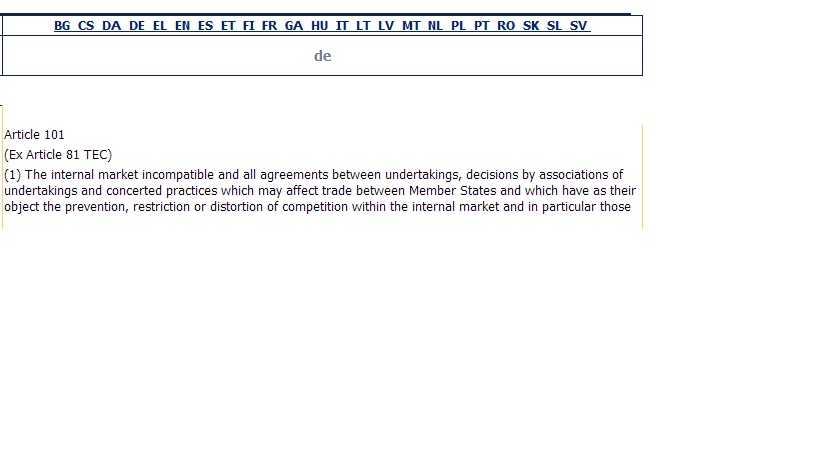
So here we go: I first consulted the wording of Article 101(1) of the Treaty in German:
“(1) Mit dem Binnenmarkt unvereinbar und verboten sind alle Vereinbarungen zwischen Unternehmen, Beschlüsse von Unternehmensvereinigungen und aufeinander abgestimmte Verhaltensweisen, welche den Handel zwischen Mitgliedstaaten zu beeinträchtigen geeignet sind und eine Verhinderung, Einschränkung oder Verfälschung des Wettbewerbs innerhalb des Binnenmarkts bezwecken oder bewirken, insbesondere”
Then I asked Google to translate this text to English:
“(1) The internal market incompatible and all agreements between undertakings, decisions by associations of undertakings and concerted practices which may affect trade between Member States and which have as their object the prevention, restriction or distortion of competition within the internal market and in particular those”
No trace of the word “effect“.
I did the same in French:
“(1) Le marché intérieur incompatibles et interdits tous accords entre entreprises, toutes décisions d’associations d’entreprises et toutes pratiques concertées qui sont susceptibles d’affecter le commerce entre États membres et qui ont pour objet d’empêcher, restreindre ou de fausser la concurrence au sein du marché intérieur et en particulier ceux”
Again, no trace of the word “effect“.
A weird finding. All the more so given that the official Treaty translation explicitly talks of “effect“.
So here I am, pondering whether I am making this up or if, as this distinguished Court Member hinted, there is a linguistic reason for the absence of serious effects analysis in the Court’s case-law.
Now, if the other language versions of the Treaty talk of “effect“, which version of the Treaty is the right one?
Gee, me completely lost in translation.
PS1: On this, I’d advise Google to manipulate its translation service, and reintroduce the “effect” word in all Treaty translations.
See below for more evidence (a print of my screen).
Job Application

Yesterday, one of my LL.M students made the buzz in French press.
President Hollande was apparently in Dijon to deliver a speech on new government-sponsored traineeships for young people without a degree.
Louis Godart, currently enrolled in our ULg LL.M, was in Dijon too.
He managed to hand in his CV to Hollande, and urged him to also help students with a degree, who too face hurdles on the labour market.
For more, see here.
A hat tip to Louis for his brave move. We don’t teach martial arts to our students – shall we? – so I am very curious to learn how he managed to make it through Hollande’s muscle men.
Louis also made a clever move. After all, in a country like France where Governement is omnipresent, the best mailbox to post a job application is that of the President, not that of the private sector.
Finally, a big thank you to Louis for the unexpected publicity for our ULg LL.M. On this, I must stress that the programme keeps improving. We have this year a group of 25 very motivated students, who come from all over Europe. And we’ll soon be appointing a new Professor in IP and innovation law (for the call for applications (in French), see link below; If anyone’s interested by this, pls drop a line).
Vacance – Charge de cours – Droit de l’innovation et de la PI
Antitrust History

A lot has been written on the history of the EU antitrust rules.
Those familiar with Jean Monnet’s Memoirs know that the wording of EU competition law owes a lot to the drafting skills of George Ball.
But I personnally did not know that the Brussels office of Cleary, the oft-cited n°1 law firm on the Brussels market:
was established in 1960 as a direct consequence of the close relationship between Jean Monnet and former Under-Secretary of State, George Ball, one of the firm’s founding partners and legal advisor to Jean Monnet on the implementation of the Marshall Plan and the drafting of the Treaties of the European Communities.
Caveat 1: this is no advertisement for Cleary.
Caveat 2: this is not another rant at conflicts of interests.
Microsoft’s contribution to the EU budget

Today the European Commission imposed a 561 million euros fine on Microsoft (roughly 37 euros per each of the 15 million copies of Windows that were sold in the EU in breach of the 2009 commitment).
As I said in a previous post, I don’t think anyone believes that Microsoft did this on purpose, so the amount of the fine might have come as a surprise to quite a few people (although not to those who participated in Nico’s poll yesterday).
In any case, this is the third time that Microsoft contributes to the EU Budget because of competition related matters. In total, it has paid approximately 2 billion euros.
[Btw, I couldn’t help remembering Neelie Kroes statement after fining Intel 1 billion euros: “Intel´s latest advertising campaign proposes Intel as the sponsors of tomorrow; well, now they are the sponsors of the European tax payer” (two years ago we nominated the video of this speech to an Antitrust Oscar)].
When one hears about these figures it’s easy not to realize what numbers mean. So we’ve decided to help you become aware of what 2 billion represent:
According to the World Bank there are 41 countries in the world whose GDP is lower than 2.1 billion euros (approx 2.7 billion dollars).
With 2 billion euros the European Union could:
– Bail out banks in Cyprus (estimates say that it will cost up to 2 billion);
– Pay for a couple of ambitious science projects (like studying graphene and fighting brain disease);
– Buy the full squads of Real Madrid, FC Barcelona or Manchester United to represent DG Comp in the internal football championship;
– Buy half of an aircraft carrier (don’t know why they would want an aircraft carrier, or why they would only want half, but I’ve seen more absurd public spending…);
– Pay DG Comp’s budget (93,5 million euros) for 21 years;
– Develop the atomic bomb (not in today’s money, though; it cost 2 billion back in 1945).
– Buy a few Greek islands for its officials to go on holidays (the most expensive one I’ve seen here costs 150 million..). Odd thing, I saw an ad for Bahamas islands on sale, and there is a private islands magazine with a Fall/Winter catalog for islands (!)
– Produce all of the 10 most expensive films in history (Pirate’s of the Caribbean, Tangled, Spider-Man 3, John Carter, Harry Potter and the Half Blood Prince, Avatar, The Dark Knight Rises, The Chronicles of Narnia: Prince Caspian, Pirates of the Caribbean: Dead Man’s Chest and The Avengers).
– Build the tallest building in the world to host DG Comp (it would be more impressive than the Madou Tower to which it is moving…the Burj Khalifa costed 1.5 billion). For my suggestion on how it could look like, see here 🙂
Anymore ideas??
An Unprecedented Fine
There’s a big storm coming.
Tomorrow, the Commission will slap yet another stratospheric fine against Microsoft.
We’re told that Microsoft did not implement the “browser choice” remedy negotiated with the Commission in 2009.
Worst: this is apparently due to an internal communication failure.
Alfonso blogged about this a while ago (meanwhile disclosing his core musical tastes).
Because the Commission understandably wants compliance but may be reluctant to micro-monitor the implementation of settlements, the fine will likely be high.
But how high?
More on antitrust and politics: Interview with CPI

As some of you may remember, a few months ago I wrote a post here on “Antitrust and Political Stupidity“. Competition Policy International asked me to develop the post for a special issue of the Antitrust Chronicle, which I did one-handedly during my extended Christmas break (the paper is available here). I was then asked to do a follow-up interview with CPI; the interview was published today (click here for the version in CPI’s web).
Asked about whether I was being too optmistic in the paper, I started my response saying that “my paper was written during the Christmas break, and it is not much more than a Christmas tale, a superficial exercise of wishful thinking” (see below for the complete answer). Little did I know that the mailing that was sent today to some thousands of people would summarize the interview saying that: “Lamadrid says his paper is ‘a superficial exercise of wishful thinking,’ and he tells CPI why“. So, here I am, promoting my work by saying that it’s really not any good (between us: it’s not a masterpice, but it’s somehow original and maybe not as crappy as my own quote suggests…). Man do I really need to work on my self-selling skills…. 😉
If anyone’s interested, you can click here to read the full interview:
WE readings

Some propaganda:
1. “Ethique et conflits d’intérêt en droit européen de la concurrence”: A 1,5 pager, a little controversial, and for good reason : upon inquiry, there is no standard ex post “recusation” procedure in EU competition proceedings. So how to dismiss a conflicted decision maker? And before this, how to know he is conflicted? Those weird findings, coupled with other recent developments (the ongoing revolving doors investigations of the Ombudsman) prompted further research on ethical rules in EU competition law. Will likely dig deeper in the upcoming months. An English translation of this edito is in the pipeline, and due to appear in ECLR…
2. “Industrial Policy and Competition Enforcement: Is There, Could There and Should There Be a Nexus?“: co-authored with N. Neyrinck. This paper makes a number of novel points. One of them is that under current legal standards, some transactions (e.g. mergers) that are deemed compatible when they originate from EU-owned firms, may be forbidden when they originate from non EU-owned firms. The explainer: efficiencies generated by EU-owned firms benefit more directly to EU consumers than efficiencies arising from non EU-owned firms. Another point of the paper is that the EU industrial policy agenda (and all the thinking that went into this) should inform DG COMP’s priority setting policy. This paper was presented at the 2012 GCLC annual conference and will be published as part of the conference proceedings.
3. “New Challenges for 21st Century Competition Authorities“: You guys know this one. A modest effort to identify some of the hottest issues in contemporary competition enforcement. The paper does not pursue great academic ambitions, but make a number of original points (on the use and abuse of settlements/commitments in particular). It will be published in a forthcoming issue of the Common Law Review and was presented at a conference in Hong Kong in October 2012.
European Commission prohibits Ryanair/Aer Lingus deal

Last Wednesday the Commission confirmed that it has decided to prohibit -for the second time- the proposed merger between Ryanair and Aer Lingus merger (click here for the press release). This is the fourth prohibition decision adopted under Commissioner Almunia, and the 24th in the history of EU competition law.
The decision has not yet been published. We had assumed that while we waited for it we could at least report on Michael O’Leary’s (Ryanair’s CEO) reactions. However, Mr. O’Leary has not made any public statements of the kind that we were expecting (remember his analogy between the European Commission officials and North Korean economists? 🙂
Ryanair has issued a press release in which it argues that its offer “was supported by an historic and unprecedented remedies package that included not one, but two upfront buyers (BA/IAG & Flybe) to take over approximately half of Aer Lingus’ short-haul business (…) The transfer to these upfront buyers of Aer Lingus’ business on the 46 crossover routes identified by the EU Commission, together with the relevant slots, aircraft, personnel and branding, was ensured by binding, irrevocable commitments by those upfront buyers including Board approvals”. In Ryanair’s view, “[t]he history of the EU’s treatment of Ryanair’s two offers for Aer Lingus conclusively proves that this prohibition is a “political” decision to pander to the vested interests of the Irish Government (a minority 25% shareholder in Aer Lingus) and is not one that is based on a fair and reasonable application of EU competition rules or precedent airline merger approvals in Europe”.
We have no clue on whether the allegations over the political motivations of the decision are founded or not. But politics aside, this case resuscitates some tricky substantive/institutional questions. The nature and scope of the remedies proposed by Ryanair was indeed pretty substantial, and arguably unprecedented (Ryanair had even pledged to give 100 million to Flybe to ensure its sustainability) so, query:
Are EU merger control rules on when an up-front buyer is a suitable one sufficiently clear? What discretion should the Commission enjoy in this regard? Ryanair has announced that it will appeal the decision before the General Court, so we should expect to have some answers to these question soon.
Post Danmark – More than just One Case

Our friend Christian Bergqvist has offered us a most interesting post on the national sequel of the CJEU judgment in Post Danmark. Christian is an associated professor at the University of Copenhagen/Faculty of Law. He holds a PhD in competition law and has specialized in particular on dominant firm conduct and the interplay of Article 102 TFEU and sector specific regulation. For more, see here.
PS: for a good reminder of the ruling and of its implications for future competition policy, I advise the reading of the excellent piece of E. Rousseva and M. Marquis (which suggests (in my view rightly) that the Court eventually embraced the Commission’s approach set forth in the Guidance paper).
About a week ago, on Friday 15 February, the Danish Supreme Court delivered its ruling in Post Danmark vs Konkurrenceraadet. This judgment settles the national case behind the (fabulous) 2012 CJEU ruling Post Danmark (C-209/10). Given the strong pronouncements made by the CJEU it does not come as a surprise that the Danish Supreme Court eventually decided to quash the challenged (national) decision on grounds of an incorrect material test. Rather than concluding that discriminatory conduct was per se able to exclude a competitor, the Danish Competition and Consumer Authority, should have conducted an “equally efficient competitor test”, or something close (the latter being my interpretation). Absent this, nothing conclusive could be decided on the existence of an abuse.
The ruling of the Supreme Court leaves little space for ambiguity. Yet, the final word might not have been said on the matter. First, the Danish Competition and Consumer Authority can at least theoretically reopen the case and conduct a proper analysis. This, however, looks quite unlikely. Second, back in 2009, the alleged “victim” of the exclusionary behavior (Forbruger-Kontakt) had successfully filed an action for damages, and was subsequentely awarded DKK 75 million (app. EUR 10 million). Unsurprisingly, Post Danmark has appealed this decision to the Danish Supreme Court, which is yet to decide on the matter.
This short post seeks to offer some thoughts on this issue. Prior to this, I provide some background information on the initial EU case.
Data protection and antitrust law

Regretably I couldn’t attend Concurrence’s New Frontiers of Antitrust conference held last Friday in Paris in spite of Nicolas Charbit’s kind invitation. I hear that the conference was once again most interesting, so congrats again to Nicolas and the rest of the team at Concurrences.
Perhaps the most prominent topic in this year’s program related to the interface between data protection and antitrust law. I’m sorry to have missed the discussions over this issue, for perhaps they would have enabled me to see where’s the substantive beef that justifies all the recent noise. Whereas I understand the practical reasons why this issue has conveniently become a hot one in certain academic circles, I confess my inability to see the specific features that make this debate so deserving of special attention.
The way I see it, personal data are increasingly a necessary input to provide certain online services, notably in two-sided markets. So far so good. But this means that personal data are an input, like any other one in any other industry, with the only additional element that the recompilationa and use of such input is subject to an ad hoc legal regime -data protection rules-.
In my view, competition rules apply to the acquisition and use of personal data exactly in the same way that they apply to any other input, and then there’s a specific layer of protection. I therefore understand that data protection experts have an interest in finding out about the basics of antitrust law to realize about how it may affect their discipline, but I fail to see the reasons why competition law experts and academics should devote their time to an issue which, in my personal view, raises no particularly significant challenges. [The only specificity may be that data protection practices may constitute a relevant non-priceparameter of competition, for companies may compete on how they protect consumer data]. I would argue that this is a serious matter, but one for consumer protection laws to deal with, and in which competition policy may at most play a marginal role (I understand this was also the view expressed by Commissioner Almunia in a recent speech).
To compensate for my absence at Concurrence’s conference, on Saturday morning I read some interesting “preliminary thoughts” published last week by Damien Geradin and Monika Kuschewsky: Competition Law and Personal Data: Preliminary Thoughts on a Complex Issue. The piece provides a contrarian view to the one I just expressed. Since I might very well be wrong (that’s at least what my girlfriend’s default assumption in practically all situations…) I would suggest that you take the time to read it in order to make up your own mind. It won’t take you long, but since behavioral economics (and the clickthrough rates to the links we show) tells us that many of you are of the lazy type, in the interest of a balanced debate here’s a brief account of its content; my comments appear in brackets:
(Click here if you’re interested in reading more)


