The Flour Cartel- A provocation?

Apparently someone at the French Competition Authority liked the series on the endives cartel (see here and here):
The Autorité de la Concurrence has imposed a fine of 242.4 million euros on flour makers.
Isn’t it obvious that this is a poor attempt to provoke us to write a new -and more appetizing- series on croissants?
Nice try, but they’ll have to do butter.
A Thank You Note

This weekend we were sending out invitations to the next guests of The Friday Slot, and at one one point the issue of how many readers Chillin’Competition has came up. We checked our stats with a bit more detail than we normally do, and we were amazed at what we saw:
In almost every month of its existence (leaving aside the summer holidays and Christmas) Chillin’Competition has set new readership records.
Last week was important, because it was the first time that we consolidated the figure of 1,000 daily readers. Last week, people from 83 different countries (!) read 182 different posts. Belgium, with 1282, was the country of origin of most of these visits, followed by the UK, the U.S., Spain, France, The Netherlands, Luxembourg and Italy.
Below is the map that wordpress shows us:
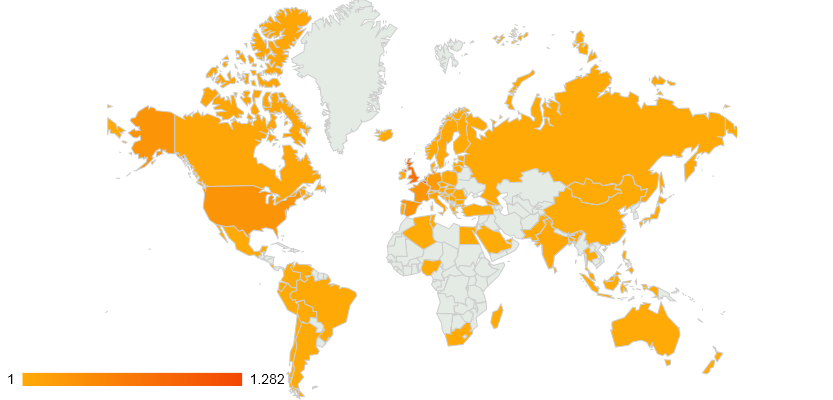
In February 2010 we recall thinking that maybe we had hit our ceiling (that month we had 4,993 readers). But in February 2011 we had 10,873; and then in February 2012 we had 14.994…
Throughout its history, Chillin’Competition has had 239,908 readers. Its LinkedIN group has 524 members, and more than 260 other people are directly suscribed to through our homepage.
We are thrilled.
Thank you!!
Social Competition Law

Next week is when Brussels antitrust specialists d***k their face off socialize.
See for yourselves:
- On Tuesday, the law firm Wilson Sonsini Goodrich and Rosati organizes a reception at the Cercle de Lorraine;
- On Thursday RBB Economics throws a party at the Concert Noble for its 20th anniversary;
- On Thursday, Mc. Dermott Will & Emery also holds a reception.
On top of this comes the1st edition of the Life Sciences College organised by the law firm Sidley Austin (I will make a short presentation there) and a GCLC lunch talk on minority shareholdings on Friday.
A heavy week ahead. I advise a quiet week-end. And the reading of this piece on Do’s and Dont’s at social events.
Disclaimer: unlike what a French dead writer may say, this post does not purport to flatter the Brussels establishement on competition law.
The Endive Brainstorming Room

Yesterday we said we were surprised by the number of people who had suggested us to comment on the fine imposed on French endive growers. Our post on this issue has given rise to very profound competition law related thoughts.
This is why we have created The Endive Brainstorming Room.
In addition to Hans Zenger’s brilliant comment on endives and Giffen goods (see the comments to yesterday’s post), over the past few hours several people have conveyed to us their views on endives:
– Well-known Commission official:
“I think the typically insightful analysis on your blog of the endives cartel has left a couple of important questions unanswered:
First, given that endives figured large on the menu at Garenmarkt a full 20 years ago, I think we should be looking at the possible 102 aspects and not only the 101. There’s clearly some durable market power at work here. The only plausible explanation of this continuing position of dominance must be exclusionary conduct as against those vegetables that are not utterly unpleasant.
Second, I think this cuts to the heart of the consumer welfare problem in antitrust. Surely consumer welfare is enhanced by endives being priced at as high a possible level, thereby reducing demand? Is the cartel therefore not welfare enhancing?”
– Raymond Radiguet:
“Alfonso and Nicolas use this blog to promote vegetables other than endives, which is fine with me. However, the claim that no one likes endives is so obvious that it is simply hilarious“.
– Current students at the College of Europe:
One student says “there is a maverick around here: last week (during dinner on Wednesday 29) a law professor was heard stating “I like endives; it’s a pity that they are not as bitter as they used to be”. “Seed selection should be blamed for this”, he added.
Another student tells us that in reality endives are not dominant: “at most, they are part of a duopoly; I would argue that endives and frites are collectively dominant“.
A third ELEA student commented that ” ‘Roulade de jambon avec endives’ sounds good but tastes horrible“.
– The anonymous lawyer who has found the solution to the debt crisis:
First email: “Great post! So the French are enforcing competition law in the agricultural sector. Cripes – whatever next?! Will DG COMP pay OPEC a visit in Vienna??
Second email (2 minutes later): “Thinking about it, that would be a way to solve Europe’s debt problem – fine all OPEC countries 10% of their turnover! This is brilliant! I’ve found the solution to the crisis!!!!”
If you have any additional reflections on the relationship between endives and competition law/economics that you just can’t keep for yourself, please share them with us.
Reactions to the endives cartel

The French Autorité de la Concurrence has imposed a fine of 3,6 million euros on four French endive growers for their participation in an endive cartel.
The news has attracted the interest of our readers, who have sent us several emails suggesting a post on this story. The interest of our readers on endives has matched that raised in the past by the Dutch investigation on erotic toys and costumes. Weird.
The news has spurred interesting reactions from some experts. “This case proves that what competition law/economics considers in the interests of consumer welfare (low prices, lots of endives) does not necessarily equate to what society (or the students at the College of Europe in Bruges) would consider consumer welfare!”, says Grace Aylward.
Some background: Grace studied as the same time as me in Bruges, and we both share the suspicion that all of the French and Belgian stocks of endives are regularly served to the students at the College of Europe. There is no other plausible explanation as to why endives featured in the menu every other day.
Consulted about this phenomenon, Napoleón Ruiz (who also claims to have been affected by overfeeding of endives in Bruges) said to Chillin’Competition that “the decision of the Autorité de la Concurrence will have the effect of enhancing the dominant position of endives at the menu of the College’s canteen“.
“They are disgusting; I can’t stand them” said Mark English.
Mr. English directed us to another competition lawyer Alex Papanikolaou (“ask Alex; he was a real canteen presence”, he said). Mr Papanikolaou seems to share the opinion of his peer: “Hard to believe people would buy and consume these things at any price, let alone at cartelized prices“, he says.
A legal director at a high-tech company who requested anonimity said “they are as bitter as the country where they’re grown. Anyone buying them deserves the overprice”.
A partner at a Spanish firm says “the Bundeskartellamt should imitate the French Authority and investigate manouvres by German growers of cucumber to impede imports of Spanish cucumber. Why focus on endives when you have cucumbers?”
Please comment on this post if you also have an strong opinion on this investigation.
P.S. For further information on endives click here. For the role of Belgian endives in US politics click here (I’m not joking; and I bet this is the link that you’ll click the most). For recipees featuring endives, click here.
Yet another (good) antitrust quiz

Antitrust quizzes seem to be the flavor of the day.
In the past few weeks we posted a few on this blog (see here, here, and here). Today we have just learnt that the European Commission has launched its own competition law quiz: http://ec.europa.eu/competition/consumers/quiz/index_en.html
Nice initiative from the Commission! (many thanks to our friend Isabel Yglesias for pointing us to it)
It’s actually quite well done. It has 3 levels: “Basic (general audience); Advanced (students in competition law); Expert (advanced students in competition law and practitioners)” (as if all practitioners had expert knowledge…).
We would love to arrange a competition among our readers to see how many of you get 10/10, but we have no way of verifyng any results you would report, and since most of you are also lawyers we can’t just trust you..
– – – – – – – – – – – – – – – – –
P.S. We can’t give you more details for the moment, but you should know that a sort of competition law quiz will be an important part of the competition law conference of the century, decade, year, month? the first Chillin’ Competition conference.
The program is now half baked, and we will soon start contacting the speakers/participants we have in mind. We will be giving you further information in the coming days.
Yet another well-timed complaint against Google

It has been reported by Reuters that Microsoft and other companies are behind a new complaint against Google before the European Commission. Microsoft has denied having lodged any formal complaint. Regardless of whether Microsoft is involved or not, the news raises some thoughts:
Timing:
Once again, this complaint seems to have been strategically timed. Rumor had it that the European Commission would be adopting a preliminary position on the ongoing investigation by mid-March. No matter the merits of the complaint, whoever is behind it deserves credit for outstanding timing; they know how to play the game.
It reminds me of a well-known scene of my favorite movie saga, when in The Godfather III (yes, my taste for movies is absolutely mainstream) Al Pacino screams “Just when I thought I was out, they pull me back in!” (doesn’t he look a bit like Sarkozy in the pic above?) (it also brings to mind the “Yet another on-time flight from Ryanair” pre-recorded phrase that follows that “sweet” melody that you get when you land..).
In our previous posts on this pending case we have always highlighted the good timing of complainants (see here). Also, last April Nicolas wrote here that the “chief, and maybe sole merit [of Microsoft`s complaint] is to throw some mud at Google in the press, at a moment when (i) Google has been reported to be close to a settlement with the Commission; and (ii) Google has suffered a major setback last week, when its settlement with US publishers and authors was annulled by a NY judge” (this opinion by Nicolas was also reported in the press).This time, the complaint not only comes a few days before the Commission is expected either to drop the case or send an Statement of Objections. It also comes a few days after Microsoft lodged another complaint against Motorola (only a week after the Commission and the DOJ gave green light to its acquisition by Google). Per Hellstrom and his unit must be swamped with so many complaints being brought in relation to IT markets.
Substance:
The new complaint apparently focuses on a new function recently introduced by Google (“Search, Plus Your World”) that integrates information (photos, news and comments) from Google’s social network (Google+) within Google’s search results. Those opposing the new function apparently claim that it constitutes anticompetitive tying on the part of Google. This would be intended to reinforce allegations that Google uses its search engine to promote its own services.
According to the Commission’s initial Press Release, the alleged conduct subject to investigation is “unfavourable treatment of [other search service providers’] services in Google’s unpaid and sponsored search results coupled with an alleged preferential placement of Google’s own services” . Following the initiation of the investigation by the Commission there have been various attempts at enlarging its scope.
In the past both Nicolas and myself have been very critical with the allegations against Google (we have no direct/indirect involvement whatsoever in the case and only comment on info that is in the public domain, so we may lack relevant information). For our previous comments on this case, see here, here, here and here; see also here for a guest post by Pablo Ibañez Colomo on this same issue. We understand that the Commission had no choice but to investigate it thoroughly, given that an eventual rejection of the complaints would with all certainty be challenged in Court. Nonetheless, we are concerned that a case against Google would imply either a significant lowering of standards of intervention or the acceptance of the theory of “Karate Competition Law“.
I’m not aware of any evidence pointing out to the fact that Google does or doesn’t discriminate, but let’s move away from the facts, let’s leave aside important issues such as the question of whether Google is dominant and the ease of switching to competing services, and let’s focus on a matter of legal principle: can we require absolute neutrality from a company, even if it is dominant?
The mere term “discrimination” carries extremely negative connotations (if you look at is as “differentiation” it sort of looks a bit more acceptable). It also implies some sense of inherent unfairness. Nonetheless, there is a significant difference between what is unfair and what is questionable under the antitrust rules. Many things in life are unfair, but I can’t complain saying that they’re illegal; or can I?
As we have both written in previous posts, discrimination does only run afoul of the antitrust rules provided that it gives rise to foreclosure (i.e. elimination of competition) (as with most antitrust debates, the best way to find a solution is often to go back to basics). Foreclosure is is the usual standard of intervention and we see no compelling reason for abandoning it in this particular case. Let’s apply this criterion to the reported new complaint: is the fact that information from Google+ will appear in the results enough to eliminate competition from, let’s say, Facebook? It seems like a very long shot.
Given the above, and in light of the limited information at our disposal, we tend not to see any grounds for intervention.
Some suggested readings:
I spent a few hours of the weekend in the train from Brussels to Luxembourg (I would have gone by car, but I never told you that my car got burn by skinheads who felt like burning a trash can right next to my parked car..). The train takes ages, but it allows for some good reading time. The subject of this trip’s readings (aside from an incredibly good novel in Spanish) was precisely search neutrality.The three pieces I read are highly recommendable:
– If Search Neutrality is the Answer; What is the Question? (by G. Manne and J. Wright);
– “Non-Discrimination in Communications and IT Regulation: Understanding the Rise of a Transformative Principle” (forthcoming; can’t say who the author is because the paper is currently undergoing a blind-peer review).
– Search Neutrality as an Antitrust Principle (by D. Crane).
The Friday Slot (6) – Jacques Bourgeois

Prof. Jacques Bourgeois is on this week’s Friday Slot. A few words about Jacques are in order. I first met him as a student at the College of Europe. He was presenting his seminar during the “beauty context” shopping week, when students select their options. I was impressed, so impressed that I did not chose the seminar, for fear of not being up to the challenge. Jacques seemed a somewhat demanding Professor for the continental student I was, navigating with increasing ease in competition and trade law matters, requesting active student participation, and professing in beautiful English.
Our paths crossed again 8 years after, when I started as the executive secretary of the GCLC. We worked together for several years. In my short career I have had the immense chance to meet very many professionals. Yet, I have rarely seen a lawyer with a such mastery of social skills and management capabilities. Jacques is the kind of person who can turn a tense meeting with irritated attendees into a relaxed, and possibly funny, event. This is maybe why everyone in the business likes him, and why we at Chillin’Competition like him so much. Thanks to him for having taken the time to answer our questions.
“Oscar” of the best competition law book? Non-competition book?
In the competition law field, I praise the book of David Gerber: Law and Competition in Twentieth Century Europe. Protecting Prometheus (Oxford University Press, 2001)
Out of the antitrust world, but still related to the legal field, John Rawls’ A Theory of Justice (Belknap, 1971) is a must.
“Oscar” of the best case-law development in the past year? “Oscar” of the worst case-law development?
In my opinion, the CJEU made a great job in Confédération européenne des associations d’horlogers-réparateurs (CEAHR) v European Commission (CJEU, 15 December 2010, Case T-427/08).
On the contrary, I am very critical towards the Alrosa ruling (CJEU, European Commission v Alrosa, Case C‑441/07 P).
Let’s do it like economists => assume that you could change 3 rules, principles, judgments, institutions in the current EU competition system. What would you do?
The one reform that I would organize in priority: that fines be decided upon by a court of law.
Antitrust Chatspeak
//tr8
Or my first try at using Internet slang for antitrust issues…
BTW, I have to participate to a conference on the pharmaceutical sector in 10 days, and I welcome any fresh intel on //tr8, as well as on any other hot, burning issue relevant to the sector.
Given the industry’s taste for secrecy, you may write to me directly at Nicolas.petit@ulg.ac.be
Economics in competition law


Nicolas’ post from yesterday was somewhat of a declaration of lawove to economics. However, as the post noted, in my personal case this love is not at all unconditional.
Nico’s post stated that the “reptilian reflex of dismissing economics as a source of legal uncertainty is misguided“, but acknowledged that “on this point Alfonso has more nuanced views that he will develop here“.
So, here they are.
Those “more nuanced views” have been recently developed in a couple of pieces co-written by Luis Ortiz Blanco and by myself (one was presented at Fordham’s Annual Conference and the other at a GCLC Annual Conference, and both are about to be published as part of the proceedings of these two events). In these papers we argue that the growing influence of economics in competition law enforcement has brought about many positive consequences, but that we should be mindful of letting the about pendulum swing too far. We submit that there is a limit to the concessions that a legal regime can make without renouncing its nature, and that effects-based legality tests might approach decision-making to economic divination to the prejudice of legal certainty.
I’m conscious that these thoughts may not appear be shared by the mainstream (I don’t expect them to make me the most popular guy if I go to Place Lux for a drink tonight). Nevertheless, I do tend to think that there is a silent large minority/majority that supports these ideas. In fact, a very prominent European Commission official read outloud the following paragraphs from one of our papers at a conference held two or three months ago (by the way: he said he liked them, not that he endorsed them), and invited the attendants to reflect on them:
(If interested, click here to continue reading)


 Chillin'Competition