Price Discrimination (and the Brussels Conference Market)
A thought on something that lawyers – including myself – often have a hard time to understand.
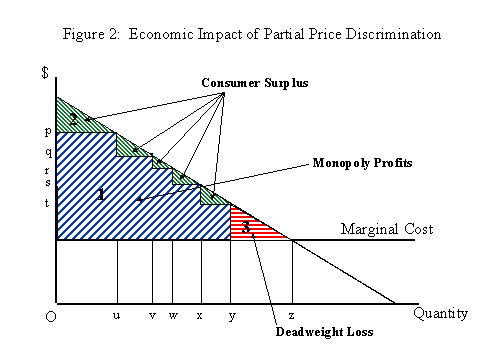
Conventional economic theory posits that price discrimination by a monopolist is conducive to allocative efficiency.
This is because price discrimination entails a welcome departure from uniform monopoly pricing. With price discrimination, the monopolist undercuts its own uniform price to the benefit of certain customers (or to categories of customers as shown in the above picture). With price discrimination, customers that could not initially take the uniform monopoly price now get a chance to be served.
Furthermore, the monopolist increases output and, assuming fixed costs, achieves economies of scale. Price discrimination is thus also conducive to productive efficiency.
With this background, I was last week confronted with an odd price discrimination scheme which, in my opinion, brings little – if no – improvements in terms of allocative efficiency. A famous conference organizer has the following price menu for a forthcoming competition law event:

On cursory examination, this conference organizer has designed the above price menu to attract academics, judges and young lawyers. However, I doubt this price scheme will attract many of them, simply because those fees are well beyond the average reservation price of such customers. Saving appearances?
An additional remark: given that this conference is sponsored (law firms essentially) and that most speakers are brussels-based (means no transport/accomodation costs), I do not see the cost basis for such rates. Although I am not a huge fan of excessive pricing cases, the Brussels competition conferences market could make an interesting candidate for Article 102 TFEU proceedings. Still to see whether there is a dominant player on this market. Food for thought.
Forthcoming GCLC Lunch Talk on the Energy Sector

The 51th Lunch Talk of the GCLC will be devoted to recent enforcement trends in the energy sector.
The speaker are Céline Gauer (DG Competition) and John Ratliff (WilmerHale ).
It will take place on 18 March 2011 at The Hotel (formerly the Hilton), 38 Boulevard de Waterloo, 1000 Brussels.
See link below for registration form.
51th GCLC Lunch Talk – 18 March 2011
Upcoming competition law seminars in Madrid

The level of the Annual EU and Spanish Competition Law course directed by Luis Ortiz in Madrid keeps getting better each year (and it´s now on its 14th edition..). It really is hard to find a program with so many excellent speakers participating on it. Let me give you an example:
The seminar which took place last week was coordinated by Cecilio Madero (Director General at DG COMP), and focused on novelties in the areas of mergers and abusive conduct. Amongst the speakers were Per Helmström (Head of Unit at DG COMP), Nicholas Banasevic (Deputy Head of Unit), Milan Kristof (Référendaire at the ECJ), Ainhoa Veiga (Partner, Araoz y Rueda), Antonio Guerra (Counsel, Uría Menéndez), Juan Jiménez-Laiglesia (Partner, DLA Piper) and Miguel Odriozola (Partner, Clifford Chance).
Yesterday and today another bunch of top-notch speakers such as José Luis Buendía (Partner, Garrigues), Piet Jan Slot (Professor, Leiden University), Jerónimo Maillo (San Pablo CEU University), Carlos Urraca (Legal Service, European Commission), Joaquín Fernández (Head of Unit, DG COMP) or Jorge Piernas (EUI), amongst others, have been dealing with state aids and other public interventions.
Here comes the advertising: If you´re sorry you missed those, and fancy the idea of spending a spring weekend in Madrid you can still register for the last two seminars:
– On the 18th of March I will be coordinating a seminar on the application of competition law to network industries. It will feature:
Jarleth Burke (Partner at Jones Day, London) who will be speaking about the regulation and competition law in the telecoms sector;
Júlia Samsó (Latham&Watkins, London), who will deal with the specificities of the energy sector;
Jasper Sluijs (Tilburg Law and Economics Centre), an expert on network neutrality issues;
Myself, for an overview of the challenges posed by network effects and network industries.
– On the 25th of March there will be another seminar on IP and Competition law coordinated by Alvaro Ramos (Senior corporate counsel at Cisco). Its three sessions will deal with
“Excessive pricing and copyrights” with Daniel Escoda (Telefónica), and Pablo Hernández (SGAE);
“Standards and Competition Law” with Jennifer Vasta (Senior Legal Counsel, Qualcomm); Miguel Rato (Partner, Shearman&Sterling) and Álvaro Ramos;
“Competition Law in Cloud Computing“, with Jean Yves Art (General Counsel EMEA Microsoft), Tero Louko (Antitrust Counsel, Google), and Luis Ortiz Blanco (Partner, Garrigues).
There are very few seats left, but if anyone´s interested in registering (half prize for those coming outside of Spain) or obtaining more info, you can write here competencia@ieb.es
My slides
Am in Paris with limited access to the Internet.
I attach the slides I used today in support of a presentation on EU and French competition law at the Association Française d’Etude de la Concurrence (AFEC). Nothing groundbreaking.
Actualité du droit matériel des pratiques anticoncurrentielles – AFEC
Conflicting views on the Google/ITA Software deal

Last week I mentioned here the White Paper issued by the American Antitrust Institute on Google´s proposed acquisition of ITA Software. As you will recall, the AAI concluded that the deal would give rise to competitive concerns that made antitrust intervention necessary. As practically all Google-related debates, this one is fast getting huge, and extremely interesting.
On the one hand, the anti-Google “Fair Search” coalition has created a web page stating all the reasons why the deal would harm consumers in every conceivable way. You may or may not agree with it, but one must admit that they´re doing a pretty good job in speading their message around (this is a consequence of what I meant when I said here that Google has tough and very powerful competitors, who have the incentives and the means to present a fierce battle in as many fronts as possible).
We´ve given you the link to the AAI´s White Paper and to the Fair Search web page, both of which favor close scrutiny of this transaction. The picture would not be complete if we didn´t direct you to some of the arguments explaining why the acquisition of ITA by Google would actually be procompetitive. Daniel Crane, a Professor at Michigan Law School, has just written a guest post on the blog Techcrunch.com in which he does that exactly; he also sends a very clear message: “Let´s calm down on the Google-ITA deal” (thanks go to George Pedakakis for pointing us to it).
Crane´s main point is that “Google’s competitors naturally fear Google’s emergence as a formidable rival in travel search, but that is hardly a reason to block the transaction. Indeed, it’s a reason to approve the deal. The most likely scenario is that Google’s acquisition of ITA would allow Google a quick and efficient entry point into travel search that would expand consumer options and increase rather than decrease competition“. His post also responds to the main allegations put forward by those opposing the deal.
Now that you´ve a complete picture of the main positions in this debate we´d be happy to know about any thoughts our readers may have on this matter. Anyone?
Unrelated: We are also reporting more and important moves in the Brussels legal market: a bunch of great associates have also left Howrey to join Shearman&Sterling. Amongst them are some of the brightest young lawyers around (some of whom are also very good friends of ours), such as Mark English, Elvira Aliende, Louise Rabeux, or Marixenia Davilla.
And a chillin´leak: Julian Joshua is apparently headed to Steptoe & Johnson
It´s shocking to see how what until very recently was a top-notch practice at Howrey´s has disintegrated so quickly. Looking at the positive side: there will be more empty tables at L´arte di, which is were we constantly ran into each other at lunchtime..
My WE Readings…

… involved approximately 5000 pages of case-law (see list below).
I am currently preparing for a conference this Thursday. I have 40 minutes to brief the audience on the main developments in EU and French competition law over 2010.
Now that I have read all that stuff, I should certainly start monetizing my knowledge by making presentations for law firms in Brussels and Paris. I heard a god of competition law used to do this in the past. Any clue?
Next BSC Module

In the forthcoming weeks, the Brussels School of Competition (“BSC”) will host a series of three weekly lectures on “The Procedural and Institutional Framework of EU Competition Enforcement”
Our speakers are Fernando Castillo de la Torre (Legal Service, European Commission) and our friend Luis Ortiz Blanco (also Alfonso’s boss ).
We still have a few seats free. See registration form and details below.
Important for Alfonso’s growing fan-club: our co-blogger will most likely make a “not to be missed” guest appearance at the BSC.
Weekend reading and a confession
For those of you who can get some time off to do some reading this weekend, this is a real must: Why (Ever) Define Markets? , by Louis Kaplow.
PS. I was reading last week a piece on the identity of the real people behind many tweets, facebook status updates and posts attributed to celebrities, politicians and others. It made us reflect and feel bad for not having been completely open to our readers. We too have a ghost writer who does most of the work for us. He´s quite shy, but as a exception, has admitted to have a picture taken: here he is.
Mercato

Some time ago, we have been informed of a forthcoming large, big, huge move on the Brussels legal market.
The story is now official:
Our friends Trevor Soames, Miguel Rato, Stephen Mavroghenis, Götz Drauz and Geert Goeteyn are joining Shearman and Sterling as partners.
They take with them a bunch of top notch associates (we’ll report on that in the next days).
Best of luck to all of them at S&S.
Nicolas/Alfonso
Unfaithful

Shame on me: I cheated on chillin’competition.
Yesterday, a short piece emanating from my computer was posted on adjudicating europe, a blog commenting on the case-law of the Court of Justice.
I attach hereafter a longer version of this post in the form of a working paper. As usual, I’d be happy to have your comments.
And BTW, it deals with the judgment of the ECJ in VEBIC, a case that we covered on this blog a few weeks ago.


 Chillin'Competition