Private Enforcement in Ireland
Hart has offered us a book in exchange of some advertisement on this blog.
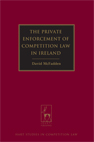
So here we go: their latest competition law volume is a book by David McFadden entitled “The Private Enforcement of Competition Law in Ireland”.
Abstract: Competition is recognised as a key driver of growth and innovation. Competition ensures that businesses continually improve their goods and services whilst striving to reduce their costs. Anti-competitive conduct by businesses, such as price-fixing, causes harm to the economy, to other businesses and to consumers. It is small businesses and the consumer who ultimately pay the price for anti-competitive conduct. A coherent competition policy that is both effectively implemented and effectively enforced is essential in driving growth and innovation in a market economy. The importance of competition was recently emphasised when the EU/ECB/IMF ‘Troika’ included a number of competition specific conditions to the terms of Ireland’s bailout. Both Irish and Community law recognise the right for parties injured by anti-competitive conduct to sue for damages. This right to damages, in theory allows those that have suffered loss to recover that loss whilst helping to deter others from taking the illegal route to commercial success. However private actions for damages in Ireland are rare.
This book asks what the purpose of private competition litigation is and questions why there has been a dearth of this litigation in Ireland. The author makes a number of suggestions for reform of the law to enable and encourage private competition litigation. The author takes as his starting point the European Commission’s initiative on damages actions for breach of the EC antitrust rules and compares the position in Ireland to that currently found in the UK and US.
David McFadden is Legal Adviser and solicitor to the Irish Competition Authority and has published extensively on competition law and other regulatory issues in Ireland.
April 2013 302pp Hbk 9781849464130 RSP: £50 / €65 / US$100 / CDN $80
20% DISCOUNT PRICE: £40 / €65 / US$80 / CDN$80
Order Online in US
USA: http://www.hartpublishingusa.com/books/details.asp?ISBN=9781849464130
If you would like to place an order you can do so through the Hart Publishing website (link above). To receive the discount please type the reference ‘CCB’ in the special instructions field. Please note that the discount will not show up on your order confirmation but will be applied when your order is processed.
Order Online in the UK, EU and Rest of World
UK, EU and ROW: http://www.hartpub.co.uk/BookDetails.aspx?ISBN=9781849464130
If you would like to place an order you can do so through the Hart Publishing website (link above). To receive the discount please type the reference ‘CCB’ in the voucher code field and click ‘apply’.
Hart Publishing Ltd, 16C Worcester Place, Oxford, OX1 2JW
Telephone Number: 01865 517 530
Fax Number: 01865 510 710
Website: http://www.hartpub.co.uk
AT Paradoxes of the Day

I had weird thoughts today:
When the agency dismantles a monopoly in a market, it expands the consumer wealth open to appropriation by monopolists on other markets.
When the agency dismantles a monopoly in a market, it expands the amount of resources on which government can raise taxes.
Or the proof that all too often, we forget the basic principle that the economy works as a general equilibrium.
Auto-critique + Mixed bag of thoughts

I’ll tell you a secret. I’ve lately been quite frustrated with regard to my latest contribution to this blog. In the past few weeks there have been very interesting substantive developments that we could’ve covered, but I’m having increasing trouble to find the time to write here. That’s a problem, for it makes little sense to write for a (now) large audience unless you’ve something meaningful to say. So I thought, either I quit, either I make an enhanced effort to post some -arguably decently- interesting stuff. Risking sleep deprivation I’ve chosen option 2.
But, as with all important commitments, I’ll start next week 🙂 For the time being, I’ll leave you with some brief thoughts on some of the different issues that we’d like to cover more in depth in posts to come:
1) On Google’s proposed commitments: Some basic elements of Google’s proposed commitments were leaked to the press (see the Financial Times’ piece on this). Rumor has it that the text to be market tested next week will be a bit dense, which has given us an idea for our very own commitment: we commit to explaining its content as objectively as we can in order to make Chillin’Competition a forum of discussion on this topic.
Some preliminary comments: (i) DG Comp appears not to object to Universal search itself; the basic description of the commitments reveals that the Commission has sensibly engaged in a balancing exercise which aims at creating more room for competition without disrupting too severely Google’s successful and innovative business model; (ii) apparently the commitments in relation to search mainly concern changes in Google’s user interface (UI). I would be curious to know who within COMP took responsibility for assessing what changes needed to be effected on something as important to Google as their UI (some say that the Commissioner himself had a significant intervention on this point!). We’ll come back to this as soon as there’s more info available.
2) On the reactions of Google’s complainants to the commitments: A few weeks ago –while teaching a 6 hour course on procedure at the BSC in the middle of easter (my gf appreciated that we had to break our holidays for this…) I had to talk about, among others, commitment decisions and I used the Google case to illustrate some points. I realized then that many people don’t know that when the Commission adopts an Art. 9 decision in a case in which it has received complaints, it also has to adopt specific decisions rejecting each complaint. Now, if complainants were really sure that their theory of harm fits within current legal standards and that the commitments are insufficient, they would appeal the decisions rejecting the complaints, right? I’m not sure they will (even if it would be interesting to read for once how this case can be framed in legal terms).
Also, some complainants are there to address a specific business concern that they have concerning Google’s practices; others seem to be there just to put some sticks on Google’s wheels no matter what. I’m intrigued as to whether these two categories of interested parties will adopt the same approach from now onwards or not…
3) On Nico’s yesterday post on the Expedia Judgment: Readers of this blog will not be surprised at the fact that Nico and I disagree on something 😉 I told him yesterday that I didn’t share his reading of the Expedia Judgment. In fact, when it came out I thought about writing a post on it, but when I read it I thought it was so common-sensical that there was little to be said.
However, and whereas I still like the overall Judgment, I now get Nico’s point, and I understand that para. 37 of the Judgment might sound equivocal. I also see the point in the comments made by Bagnole and Asimo to that post. My take on it: the criterion of “appreciability” of restrictions of competition has a qualitative and quantitative dimension; restrictions by object are qualitative appreciable by definition; the quantitative appreciability criterion should be assessed separately. In this case the Court appears to assume that, to the extent that trade between Member States is affected the quantitative requirement is fulfilled, which could be understandable, but it’s also very arguable. Effects on inter-State trade may be an acceptable proxy as Bagnole and Asimo say, but I’d rather regard this as a different jurisdictional element not necessarily related to the quantitative significance of the restriction. True that in practice the Völk Judgment mixes them, and true that Expedia does too, but strictly speaking they’re different things.
(I hope this is clear despite the abstraction; I’m writing while on a plane next to someone who’s snoring [(-_-)zzz] and trying that my diet coke doesn’t spill on me, so I’ve trouble concentrating…)
Pay also attention to the fact that para 11 of the de minimis notice solely states that the threshold in the Notice are not applicable to hardcore restrictions, but it does not exclude the possibility that a hardcore restriction could be considered of minor importance when the combined market power of the parties is significantly below those thresholds.
4) On the CISAC Judgments: Last Friday the General Court issued its Judgments in the Cisac case. We haven’t commented on them because the case is quite complex, and having only skimmed through it I would risk saying some stupidity missing something. We’ll come back to it. A couple of non-substantive interesting things in the meanwhile: (i) There have been various outcomes to the case for different parties: some did not appeal –apparently because they liked the new scenario-; others (the Spanish applicant) missed the deadline to lodge the appeal (I’ve nightmares about this ever happening to me), and others appealed everything but the point on concerted practices, which is the one that has been quashed. At the end of the day, however, the result may matter little in practical terms, for collecting societies could always unilaterally decide to do adopt any licensing policy, including the same one challenged by the decision (only on the grounds that it had been collectively agreed upon). In any case, I’m told that market circumstances may have changed, and that some collecting societies are now interested in the “liberalization” (in terms of multi-territorial licenses) that the decision sought to promote. (ii) It’s funny to read the Court saying that the Commission failed to explain some stuff; these cases required more than 100 hours of hearings (as our readers may know, the hearings had to be repeated for procedural reasons); Fernando Castillo, the lead Commission agent in the series, is well known for speaking extremely fast; surely he must have explained quite a few things in the course of so many hours !
5) Remember the debate on exhaustion of copyrights in the case of computer programs and the most interesting Usedsoft/Oracle Judgment? The Spanish Competition Commission just issued a decision concerning Microsoft’s policies in this regard. It’s not yet published, but we’ll give you our views on it as soon as it is. [If you prefer not to wait for the free comments that we’ll publish here, I can always offer a premium version at hourly rates 😉 ]
6) More on Microsoft. Some of you may have read that Microsoft is the target of a complaint lodged by Spanish users of Linux. I have no knowledge of this case other than what has appeared on the press (which sounds a bit odd, since it was reported that the complaint was lodged at the Commission’s delegation in Madrid and that it refers to Arts 81 and 82…). Reports say that the complaint alleges that the secure boot system in Windows 8 forces developers to conform to Microsoft’s requirements, thus extending the latter’s dominance in the OS market. Apparently, the new firmware supports authentication with digital certificates of the installed OS and their loader; in order for OEMs to get a “Designed for Windows 8″ label they must comply with Microsoft’s requirements, among which is the one (applicable to ARM equipment) of only booting Microsoft-certified software. Whereas I can’t comment on whether there’s any actual legal basis for this complaint, I’ve come across an interesting technical piece that explains what’s the factual background thereto: see Arstechnica’s piece here.
Law Firms = Cartels
From Judge Bork himself:
“The typical law partnership provides perhaps the most familiar example [of agreement on prices and markets]. A law firm is composed of lawyers who could compete with one another, but who have instead eliminated rivalry and integrated their activities in the interest of more effective operation. Not only are partners and associates frequently forbidden to take legal business on their own …, but the law firm operates on the basis of both price-fixing and market-division agreements. The partners agree upon the fees to be charged for each member’s and associate’s servicse (which is price fixing) and usually operate on a tacit, if not explicit, understanding about fields of specialization and primary responsibility for particular clients (both of which are instances of market division)” The Antitrust Paradox, 1978, p.265.
Bork used this example to criticize the blanket per se prohibition of price-fixing and market division schemes. Cartels formed amongst lawyers yield redeeming efficiencies (the combination of complementary skills, notably) + there are many law firms and all compete fiercely. Hence, output restriction is not a tenable hypothesis.
This later point ties in well with C‑226/11 Expedia Inc. v. Autorité de la concurrence, a judgment poised to earn a “worst antitrust development Oscar”. Bork’s example casts a bright light on the judgment non-sense: in this case, the Court held at §37 that conduct with marginal market coverage (<10%) ought to be deemed to have appreciable anticompetitive effects as long as it can be categorized as a restriction by object:
“It must therefore be held that an agreement that may affect trade between Member States and that has an anti-competitive object constitutes, by its nature and independently of any concrete effect that it may have, an appreciable restriction on competition“
In other words, a price-fixing scheme that covers 5% of the market is per se illegal under Article 101(1) TFEU. Again, a dispairing judgment…
Death of the Google Case – A Big Win for the Commissioner?

With the anticipated settlement in the Google search case (amongst other things), journalists keep asking whether this represents a major win for the Commissioner. Like I have said before, the best way to address this question consists in assessing the substantive merits of the case. The settlement certainly represents a major win if one believes that the case is meritless (I have argued this elsewhere). The FTC’s decision to do nothing on search supports this theory.
In contrast, this settlement is not a major win if one believes that the case is strong, and that the Commission could have easily pushed for an Article 7 decision (I have also made arguments to this effect, given the loose substantive and judicial review standards promoted by the EU courts in abuse cases).
But there’s one thing which may have dissuaded the Commissioner and his administration from using the conventional Article 7 track (remember, he actually voiced his disinterest for the Article 7 procedure and pleaded that fast moving markets need fast enforcement mechanisms (read Article 9): the protracted duration of such proceedings. The Commissioner’s mandate expires somewhere in the Fall of 2014. Under an Article 7 procedure, he might no longer have been in office to sign the prohibition decision. In short, to put the Google case on his hunt list, Almunia needed a settlement.
But is it really true that it takes so much time to adopt an Article 7 prohibition decision in an abuse case? After all, we are now 3 years and 2 months after the initial complaints in the Google case (they date back to February 2010), and the supposed celerity of Article 9 decisions seems all the more relative.
I made a quick check on the duration of Article 7 proceedings in abuse cases since 2005 (using COMP’s case search tool):
- Intel, 9 years following complaint
- Microsoft, 6 years following complaint
- Astra Zeneca, 7 years following complaints
- Tomra, 6 years since complaints
- GVG/FS, 4 years following complaint
- Wanadoo, 4 years following investigation
- Telefonica, 4 years following complaint
- Telekomunikacja Polska, 3 years following investigation
- Clearstream, 3 years following investigation
Two things stand out of this review: 1. Article 7 decisions can be adopted in 3-4 years; 2. cases with formal complainants are much longer than cases without.
Against this backdrop, the Commission could thus not have conceivably adopted an Article 7 decision before the term of Almunia’s mandate.
So if the Commission is ever to settle with Google, this will clearly be a big win for Commissioner Almunia.
PS: for a funny paper on Google death inactive account manager service, see here.
PS2: for yet another ordinary interview of the author of this post in the press, see here.
Speaking slots for sale
.jpg)
I landed in Brussels this morning at 7 am after an intense week of cocktails antitrust events at the ABA’s antitrust spring meeting in DC. I’m knackered (I also have to recover from the sight of 2,700 antitrust lawyers under the same roof) and have lots of catching up to do, so let’s keep it simple today:
Nicolas’ Friday post criticized several pricing practices in the conference market, namely excessive pricing and lack of pricing discrimination in favor of academics and students.
This is not a new topic; some of you might remember that many posts ago I proposed an algorithm for competition conferences, positing that “the likelihood of getting to listen to new and interesting stuff is inversely proportional to the combination of three cumulative variables: the price of the event, the number of attendees, and the number and lenght of slide decks. It’s generally not a good sign if an event is pricy and crowded. The ones with a greater chance of not being interesting at all are those for which you have to pay in order to be a spayeaker (yes, there are plenty of those!)”.
I discussed Nico’s post with a few sensible people over the w-e, and the discussion quickly came down to one sole issue: the ‘funny’ (not as in haha, but as in questionable) but prevalent practice of paying for speaking slots, which I had only touched upon in passing in my previous post.
I would argue that paying to speak is essentially a marketing trick based on misleading the audience. Let me prove my point: how many spaykers do you think would want to appear at a conference if the audience had transparent information about who’s paying for the slot and who’s not?
If you’ve something interesting to say, you should get paid for it (not so difficult, even Sarah Palin gets paid to speak) or at least be invited to speak for free. Note also that people who pay to speak would not normally (there are of course exceptions) give objective overviews of the topic at issue; their presentation would tend to be a more or less obvious sales pitch. I’ve nothing against lawyers advertising themselves, but, as in other contexts (some might think of search engines), it’s generally good to be able to tell what’s advertising and what’s not.
The most obvious way to address this “market failure” and push for a merit-based allocation of speaking slots would be to have lawyers stop paying (smart, uh?), but since self-regulation is unlikely to work, I would suggest, for a start, that public officials refuse to appear in conferences where people pay just to sit with them.
What’s your take?
It’s all about the money
–
Competition conference organisers are yield management experts.
Take a look: if you register now for GCR’s next telco, media and tech conference due on 2 July, you will benefit from a “super early booking rate” of £650.00!
You read well: £650.00 for a one day conference in one of the cheapest cities of Europe, London.
Sure, the programme mentions no such thing at this stage – I guess it is still too “super early” in GCR’s language – but you may even get a free coffee/meal and a bunch of great GCR brochures for this price. Wow!
In contrast, GCR seems less familiar with the output-enhancing effect of third degree price discrimination. Take a look:
| Registration type | Super early booking rates: |
| Standard | £650.00 |
| In-house Counsel/ Government Agency |
£425.00 |
–
–
–
There are no categories for “academics“, let alone “students”. Sheeze.
Maybe it’s just that the event has no academic ambition, as the list of stakeholders speakers suggests.
After all, it’s all bout the business. And Chinese-speaking academics do not write on those issues: #1; #2; #3; #4; #5; #6.
PS: Kaï-Uwe Kuhn is presented as CRA. Did he quit the CET yet?
PS2: If agencies seek a target for excessive pricing investigations, they should sure throw an eye on the lucrative conference business.
Forthcoming events

On 23 May, the GCLC will have a lunch talk on Compliance Programmes in EU and National Competition Law.
Hendrik Bourgeois (GE), Steven Preece (OFT) and Wouter Wils (European Commission) will discuss this controversial issue.
Ahead of this event, some reading suggestions: Wouter has published a thorough paper in support of the view that compliance programmes should NOT be rewarded by agencies. Interestingly, a friend of this blog, Damien Geradin (Covington) has recently published a reply to Wouter, where he argues to the contrary. I have myself written that no rewards should be given for such programmes… but now that I have read their prose, I have to admit that I have done this less eloquently than those two antitrust titans.
Another friend of this blog, David Mamane, has asked us to advertise the programme of a forthcoming interesting seminar organised by the International Association of Young Lawyers (do I qualify for young?). This event will be devoted to competition law issues in regulated industies, and it will be held in the beautiful city of Marseille.
On the Proposed Branding Remedy in Google

Google is a clever company.
Remember: as part of a proposed settlement with the Commission, Google has offered to brand search results.
Under this remedy, users can spot if Google preferentially displays links towards its own related services.
But if my understanding is correct, the nub of the issue is not one of consumer information, but rather one of users’ reaction to Google’s preferential search tactics.
Put differently, what matters is how users behave when Google’s own related services appear prominently in search results lists.
I have qualms with the idea that a remedy of this kind can change anything. It may even backfire. Faced with branded search results, users may increasingly click on Google’s related services, at the expense of competing services. This is because a large number of users find value to using services that belong to one single IT ecosystem (a sort of service-based network externality, driven by economies in transaction costs – no need to login twice, for instance – technological stability and service integration). Not to talk of the fact that Google has strong image in the public that users may associate with higher quality.
This thought came whilst reading Josh Wright’s excellent paper on Evidence-Based Antitrust. In essence, Wright makes the point that antitrust enforcement should be based on existing empirical data and on robust economic analysis. In contrast, antitrust enforcement should stray from predictive analysis, and avoid using untested economic models, brought by parties and elaborated by economic consultants in the context of particular cases.
This paper is refreshing. It illustrates the profound intellectual schism that separates antitrust enforcement in the US and the EU. For a number of years, I had been leaning with the view that both sides of the Atlantic had achieved convergence . But Wright’s arguments that antitrust enforcers should display”humility” and avoid a too predictive approach to antitrust enforcement shines a bright light on the arrogant resilience, in the EU, of the object-based enforcement model. A must read.
Commission Bashing?

As any other bias – including prosecutorial bias – Commission bashing is bad (and boring).
So the other day, I thought to myself what makes a true”Commission basher” (I was told confidentially that my piece on conflicts of interests had been seen as Commission bashing :()?
Here’s a personal four-pronged proxy. To be a Commission basher one must:
- never say anything good about the Commission’s output
- reserve criticism only to the Commission, and fail to extend to other EU organs
- address criticism exclusively to the Commission, and not to other competition agencies
- express criticism in crushing language
At times, I reckon that the content of this blog may have read a bit like Commission bashing. Since we don’t want our readers to have this impression, two clarifications are in order.
Number 1 is that good news don’t sell. This may explain that this blog tends to focus on bad case-law, which is also funnier to comment upon. Note that we have never refrained from saying very good things on EU competition law developments, much to the contrary. Recent examples include our comments on Post Danmark, on DG COMP’s effects-based approach or on the Article 102 TFEU Guidance paper, etc. Alfonso even turned cyranesque, with his poignant love declaration to Commission officials.
Number 2 is that we tend to focus a lot on Commission’s output because it has kept a predominant position in EU competition enforcement. Yet, we often cover the case-law of the EU courts too, as well as interesting national competition developments when we can.
The bottom-line: at Chillin’competition we are not Commission bashers.


 Chillin'Competition