Archive for October 2009
First Ever Hollywood Competition Law Movie?

For those of you who are brave enough to take an additional drop of competition law stuff over the WE (if you’re reading this you’re probably within the category), rush to the theatre watch ‘The Informant’.
This movie -directed by Steve Sodenbergh and based on Kurt Echenwald’s book- tells the story of the DOJ’s investigation inthe lysine cartel from the perspective of the executive who blew the wisthle, Mark Whitacre (played by Matt Damon).
The lysine cartel was also sanctioned in Europe, and in fact Whitacre is also a relevant character in the Commission’s decision (see paragraphs 336-341).
You may already have watched the videos of the cartel’s meetings, taped thanks to Whitacre. In case you haven’t, the transcripts are available here in different segments: 1, 2, 3, 4, 5, 6 (the part in segment one where they joke about the FBI and the FTC being present at the meeting is particularly good).
P.S. If Nicolas keeps recommending books and I get started with movies we might build a “leisure time” section for all competition geeks.
New Book on Standard of Review in Competition Law and Economic Regulation
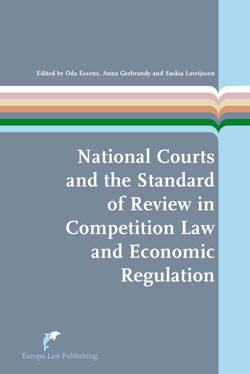
Oda Essens, Anna Gerbrandy and Saskia Lavrijssen (Utrecht University) have just edited a new book entitled National Courts and the Standard of Review in Competition Law and Economic Regulation (Europa Law Publishing). Once more, I cannot say much of this book because I am conflicted (I co-authored the Chapter on French judicial review).
Yet, the overall topic of the book is extremely interesting. In a nutshell, the whole point is to assess whether the ECJ’s Tetra Laval ruling, and the specific standard of review it encapsulates, has had repercussions on national judicial review practices. Congratulations to the editors for bringing this project to completion.
2009 Worst Antitrust Law Development Prize

With the awards season coming to a close, it is perfect timing to introduce the prize for the worst antitrust law development of the year. For the first time this year, this prize will reward a ruling, article, speech, career-move, research issue, policy initiative, or any other thing that has been undertaken, said or written that is stupid, infamous, crazy.
The prize will be awarded by the end of December 2009. Please refer to me anything that could qualify for it. I will keep all the info absolutely confidential, and will set up a jury of lawyers to award the prize (Alfonso and myself will be part of it). If you’d like to join, please let me know.
To give you an example: in 2005, a Dutch judge stated in 2005 that the Commission had exclusive competence to exempt an agreement under Article 81(3) EC (Rechtbank Zwolle-Lelystad, 4 April 2005, case n° 106345 / KG ZA 05-92, Walstock / Polar Electro). Surely, a strong candidate for this prize, had it been awarded in 2005.
(Image source: http://upload.wikimedia.org/wikipedia/en/c/c2/NobelPrize.JPG)
Call for papers
The Next Generation of Antitrust Scholarship Conference NYU School of Law January 29, 2010 Co-sponsored by NYU School of Law, American Association of Law Schools – Antitrust and Trade Regulation Section and the American Bar Association – Antitrust Section
Conference Co-organizers
Harry First – NYU School of Law
Ilene Knable Gotts – Wachtell, Lipton, Rosen & Katz Edward Cavanaugh – St. John’s School of Law
D. Daniel Sokol – University of Florida Law Levin College of Law
This conference is the first ever conference for the Next Generation of Antitrust Scholars. Much has changed in both the law and economic theory of antitrust in the past 30 years. The purpose of this event is to convene a conference of the next generation of antitrust law professors (people who started their teaching career in or after 2000) and provide them an opportunity to present their latest research. Senior antitrust scholars and practitioners in the field will comment on the papers.
Submissions are open to professors around the world. Papers will be accepted based upon the highest scores given to the 1,000-2,000 word abstract or full article submitted. Speakers who are accepted by an abstract must have a completed draft of the paper ready two weeks before the conference.
The conference organizers will not pay for any expenses for speakers or discussants. Refreshments at the conference, however, will be provided free of charge.
Please send abstracts of papers or completed drafts to nyuantitrustconference2010@gmail.com. Please email any questions about the conference to nyuantitrustconference2010@gmail.com.
The deadline for submissions is November 20, 2009. Participants will be notified by November 30, 2009.
For more see here.
No comment

Unrelated to EC competition law, but could not resist to post it. In its conclusions under Case C-246/07, Commission of the European Communities v Kingdom of Sweden, 1 October 2009, Advocate General Poiares Maduro made a surprising reference:
Sweden did not let that decision-making process take its natural course and culminate in a Council decision either for or against the addition of PFOs to the Convention. Sweden should have engaged in the Community decision-making process until such a decision was reached, even if, politically, it felt that its efforts to achieve a common proposal on the addition of PFOs to the Convention were as doomed as lemmings heading towards the edge of a cliff.
Plain excellent. Thanks to Cedric Cheneviere for the pointer.
New Book on Associations (Federations) of Undertakings and Competition Law

Charles GHEUR and Philippe LAMBRECHT, of the Belgian Federation of Undertakings (FEB), have just published
The book is edited by Larcier.
No book review for this one, because I am conflicted (I wrote the chapter on exchange of information agreements). This being said, this book is one of the first to provide a comprehensive overview of the implications of EC/national competition rules for federations of undertakings. It will surely help many in-house lawyers from federation/association of undertakings in their daily work.
Apple, Google, and more on Interlocking Directorates

Last Monday, Arthur Levinson -until now a member of the board of both Apple and Google- resigned from the board of Google. The resignation follows that of Eric Schmidt (Google’s CEO), who abandoned his position on the board of Apple in August. Both moves were aimed at addressing the FTC’s concerns over the possible anticompetitive effects arising from the close inter-personal nexus between the two companies.
Even though the FTC’s investigation on this matter may have reached its end, Google has not moved away from the antitrust spotlight. The initial book settlement was derailed pursuant to the numerous objections put forward against it, and the District Court has required a new version to be delivered by November 9th for preliminary approval. Meanwhile, the DOJ’s investigation concerning hiring practices at Google, Yahoo and Apple is ongoing. And some suggest that this could only be the beginning…
Those cases, as well as last week’s announcement of the opening of an investigation about IBM’s conduct in the mainframes market, have been seen as consequences of the stricter approach undertook by antitrust enforcers under the Obama administration regarding high-tech markets, particularly in the presence of network effects.
Now, coming back to the Google/Apple issue: in the US, the Google/Apple investigation constitutes the second challenge to interlocking directorates brought by the FTC under Section 8 of the Clayton Act over the past two years (the case brought against Commscope was resolved by a consent decree in December 2007).
In Europe, the ECJ and the European Commission have acknowledged that interlocking directorates and, more generally, minority shareholdings, could wield anticompetitive effects. It has also been held that such effects could be dealt with under Articles 81 and 82 EC (see the Judgment in cases 142 and 156/84, British American Tobacco and Reynolds v. Commission, and the Commission’s decision in case 93/252, Warner-Lambert/Gillete).
However, in spite of recent evolutions in merger control (see the Ryanair/Aer Lingus decision, currently pending before the CFI), to my knowledge, the Commission has never initiated any proceedings challenging the acquisition of minority shareholding and/or interlocking directorates since the Gillete case in 1993.
As a consequence of this lack of interest on the part of antitrust authorities and, to a certain extent, of commentators too, this remains, one of the under-explored areas of EC competition law. In contrast with the clear prohibition contained in Section 8 of the Clayton Act, companies in Europe are again faced with considerable legal uncertainty. In sum, a great topic for research if anyone’s interested.
For a brief and recent account of the state of the law in the US and the EU on this subject, check out these: US – EU.
(Source: image possibly subject to copyrights)
New Paper on Exclusionary Abuses Following The Guidance Communication
I paste below the abstract of a new paper, which I presented a few months ago in Warsaw, at a seminar on abuses of dominance and new technologies. As usual, the paper can be downloaded here on ssrn.
The purpose of the present article is to offer thoughts on the “Guidance Communication on the Commission’s Enforcement Priorities in Applying Article 82 of the EC Treaty” and, in particular, to review the requirements which the Commission must meet in Article 82 EC cases when it purports to apply the Communication’s economics-oriented, effects-based. In addition, this article seeks to assess whether the Communication’s effects-based approach really entails a paradigmatic shift towards increased competition economics, comparable to the (r)evolution that has taken place in other areas of EC antitrust enforcement since the early 2000. It comes to the conclusion that whilst the Communication marks a welcome economic sophistication of the Commission’s Article 82 EC enforcement policy, it nonetheless often fails to go beneath the surface of modern antitrust economics, and thus provide only limited guidance to firms and their counsels.
Speakers on antitrust and search engines
[This is a test post]
Looking for speakers on antitrust and search engines?
PICK ME!
Why?
1) Because it’s bad enough that I’m not involved in the case.
2) Because i
3) Because I’ve written this, and this, and this, and this.


 Chillin'Competition