Archive for March 2012
The Economist Corner (2) – Patent Settlements in the Pharmaceutical Sector

For this second edition of the Economist Corner, Benoît Durand from RBB Economics has sent us a post on patent settlements in the pharmaceutical sector. Benoît advocates against a per se approach to such agreements, and gives examples of pro-competitive settlements. The topic of Benoît’s post is timely. At a Brussels event last week, an EU official hinted that COMP would likely not treat such agreements under a per-se approach. He also said that the Commission would seek to provide as much legal certainty as possible on the issue. As some of you may know, the Commission dropped several settlement cases lately (GSK; AstraZeneca) but still continues to scrutinize other cases (J&J v. Novartis; Cephalon v. Teva; Servier (Perindropil); Lundbeck).
Following the conclusion of the pharmaceutical sector market inquiry in 2009, the European Commission has launched a number of investigations on patent-settlement agreements that include a payment between an originator and a generic company (also called “reverse payment” settlements[1]). The Commission is worried that some of these payments may be used used by originators to reward generic manufacturers for postponing the launch of cheaper drugs on the market. It is easy to see that the originator has a strong incentive to delay generic entry in order to continue earning a monopoly rent on the sale of its patented drug. When the patent exclusivity expires generic drugs may begin challenging the originator’s monopoly position. In this case, sharing part of the monopoly profit with a potential entrant is a better outcome than letting competition eat the rent away.[2]
However, as you might have guessed, reality is more complicated, and perhaps surprisingly, patent settlement agreements involving reverse payment need not necessarily be anti-competitive. The first thing to note is that the originator drug is protected by a patent, and it is only when the legal exclusivity expires that generic drugs may begin challenge the originator drug. The second thing to note is that the validity of a patent is never a sure thing, and therefore its expiry date is uncertain. Even though a pharmaceutical company has filed a patent, generic entrants may still challenge the incumbent before the formal expiry date. Generic producers may consider that they have a good chance of challenging the patent in courts. In the case of entry, the patent holder would seek an injunction to prevent entry, but judges may or may not grant the injunction, and they may or may not uphold a patent.
Presidential Endives
Endives have been a highlight of this blog.
They have become a presidential topic.
Last week, in a large-audience TV programme, N. Sarkozy discussed – and actually lambasted – the decision of the French competition authority (FCA). This comment was in reaction to a question by a woman in the audience, who complained that the FCA decision prevented agricultural producers to coordinate selling prices.
Here’s N. Sarkozy’s answer (quick and dirty translation):
The FCA “went a little to far … I would like agricultural producers to be able to sell at prices above production costs … hence one must define, with other production groups, what is an average production price … and the competition authorities must not consider this average production price as a restriction of competition“.
In clear, the price of veggies should be defined collectively amongst producers at a level > costs, and the competition watchdogs should not challenge this.
But there comes my preferred part. To conclude N. Sarkozy added, referring to the FCA officials:
“They must have the intelligence of understanding that were are not talking about Microsoft and Apple“.
Check the video above or here between 2:00:45′ and 2:01:57′.
European Competition Football Championship 2012
[Note by Alfonso: That competition authorities compete to be among the world-class enforcers is something we all knew (see for instance GCR’s Ranking Enforcement Special Issue). What you probably didn’t know (and, frankly, we didn’t either) is that there is a football championship in which competition authorities also sweat out their competitive spirit. We have been asked by the organisers of the upcoming edition to help promote this event among competition authorities, and we’re glad to do it; it looks like sure fun!]
After two highly successful and memorable events hosted by the NMa and the Bundeskartellamt in 2010 and 2011, the Hungarian Competition Authority (GVH) has the pleasure to announce that the 3rd European Competition Football Championship (ECFC) will take place in Budapest this year.
The GVH is pleased to invite all European competition authorities to the 2012 ECFC in Budapest, which will be organised together with a workshop on sports and competition law.
Workshop on sports and competition law
3rd European Competition Football Championship 2012
7-8 September 2012
Budapest, Hungary
Should you have any questions, don’t hesitate to contact the organisers at ECFC2012@gvh.hu. Any interest in participating at the event should be made by the end of April.
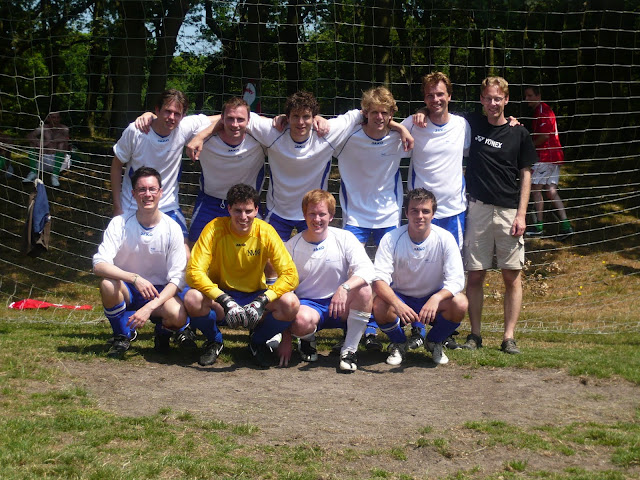
Here are some pics from the winners of the previous editions: The Ducth NMa (2010) and the Hungarian GVH (2011).

You’re invited
It’s very impolite to speak about parties to which only you have been invited. Yet, this is exactly what Nicolas did last Friday!
Nico talked about all these competition law-related social events that are taking place in Brussels this week, without realizing that many of us have not been invited (I guess this was not on the piece of Social Do’s and Don’ts that he suggested on his post…) 😉
To compensate for my co-blogger’s mistake, I will free-ride on my firm to invite you to some free drinks extend a personal invitation to all readers of Chillin’Competition for THE competition law social event of the month in Brussels: the launch of the book “Market Power in EU Antitrust Law” (we had intended to write a review here, but our objectivity is so compromised that we will ask someone else better placed than us to do it) next Tuesday.
I’m not kidding; you’re all welcome to share a drink with us. You only have to confirm your attendance to the email address that appears on the invitation.
Hope to see you there!

P.S. Nicolas will miss it because he will be lecturing in Russia, so here is another incentive to come.
A turn of the screw (José Luis Buendía on SGEIs)

[Note by Nicolas and Alfonso: Since we learnt the news that the Commission was preparing a reform of the State aid rules applying to services of general economic interest we have been trying to have our friend (also Alfonso’s boss) José Luis Buendía to give us his views on the reform. Apart from a being a top-notch State aid lawyer and the author of the seminal (and perhaps only) book on Article 106 (a new edition is in the pipeline), he was heavily involved in the drafting of the original “Altmark package” at the time when he was working for the European Commission. In fact, a few months ago a member of the European Commission said at a conference that whereas some people call this package the “Monti package”, many Commission officials refer to it as the “Buendía package”. We are very thankful for him for having taken the time to write this insightful piece that we believe will be a “must” for anyone dealing with this subject. It’s a privilege for us. Enjoy!]
The editors of this blog have kindly invited me to comment the recently adopted ‘Almunia package’, in which the EC has revisited the State aid rules applicable as regards the financing of Services of General Economic Interest (SGEI).[1]
I have chosen the expression “a turn of the screw” to introduce this short comment for two reasons. The first and most obvious reason is that the new rules would – at least at first sight – increase the pressure and make life more difficult for the big operators of SGEI. The second relates to a Henry James novel, “The Turn of the Screw” (1898), subsequently adapted to cinema by Jack Clayton under the title “The innocents” (1961). The reference to the story seems pertinent to me because it has had very differing interpretations, often mutually exclusive. The ambiguity of the story makes difficult to conclude whether the governess has actually seen the ghosts or whether she simply dreamed. “The Turn of the Screw” definitively looks like a ghost story but… is it really a ghost story? In any case it is a great story I can recommend.
As I will try to explain, when comparing it with the previous post-Altmark (or Monti-Kroes) Package, the Almunia package definitively looks as a turn of the screw as regards the rules applicable to the financing of SGEI.
In my opinion, and given the current political context, the most remarkable feature is the mere adoption of the package by the Commission. One has to remember that some Member States wanted that the rules on SGEI were adopted, not by the Commission but by the Council and the Parliament, under the new legal basis introduced in Article 14 TFEU by the Lisbon Treaty. Despite this political pressure the Commission chose not to make a proposal under this new basis (probably for the same reason that turkeys do not vote for Thanksgiving). Instead, it revisited the package under its own powers under Articles 106 and 107 TFEU. This decision seems wise and legally well founded, in particular given the limits of Article 14, but is still quite courageous in this time of centrifugal tendencies at the EU level.
Obviously this small comment cannot cover all the interesting issues raised by the package. It is however fair to say that the content of the reviewed package does not look as particularly conciliatory with those who wanted more flexibility for SGEI. It is true that there are some changes going in that direction. This is the case for the small operators in charge of SGEI that are exempted from notification (in particular, there is a new exemption of some social services and a new draft de minimis specially conceived for SGEIs), but the story seems quite different for the bigger operators that remain subject to individual notification. Under the Almunia package – and contrary to the previous Monti-Kroes package – the rules applicable to the big operators are going to be different and stricter from the rules applied to the smaller.
The Flour Cartel- A provocation?

Apparently someone at the French Competition Authority liked the series on the endives cartel (see here and here):
The Autorité de la Concurrence has imposed a fine of 242.4 million euros on flour makers.
Isn’t it obvious that this is a poor attempt to provoke us to write a new -and more appetizing- series on croissants?
Nice try, but they’ll have to do butter.
A Thank You Note

This weekend we were sending out invitations to the next guests of The Friday Slot, and at one one point the issue of how many readers Chillin’Competition has came up. We checked our stats with a bit more detail than we normally do, and we were amazed at what we saw:
In almost every month of its existence (leaving aside the summer holidays and Christmas) Chillin’Competition has set new readership records.
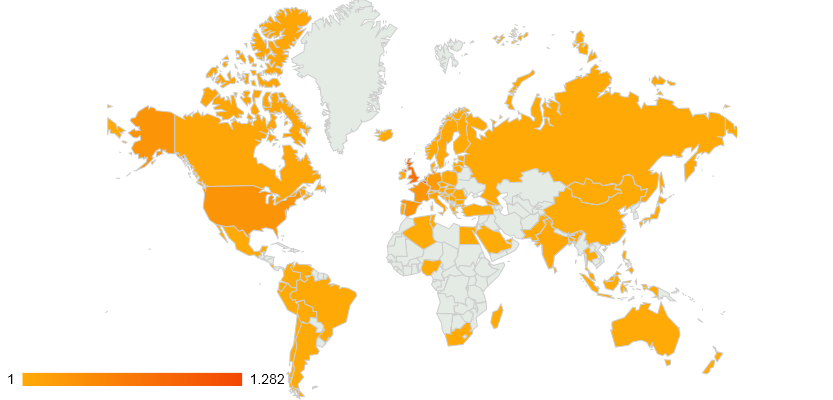
Last week was important, because it was the first time that we consolidated the figure of 1,000 daily readers. Last week, people from 83 different countries (!) read 182 different posts. Belgium, with 1282, was the country of origin of most of these visits, followed by the UK, the U.S., Spain, France, The Netherlands, Luxembourg and Italy.
Below is the map that wordpress shows us:
In February 2010 we recall thinking that maybe we had hit our ceiling (that month we had 4,993 readers). But in February 2011 we had 10,873; and then in February 2012 we had 14.994…
Throughout its history, Chillin’Competition has had 239,908 readers. Its LinkedIN group has 524 members, and more than 260 other people are directly suscribed to through our homepage.
We are thrilled.
Thank you!!
Social Competition Law

Next week is when Brussels antitrust specialists d***k their face off socialize.
See for yourselves:
- On Tuesday, the law firm Wilson Sonsini Goodrich and Rosati organizes a reception at the Cercle de Lorraine;
- On Thursday RBB Economics throws a party at the Concert Noble for its 20th anniversary;
- On Thursday, Mc. Dermott Will & Emery also holds a reception.
On top of this comes the1st edition of the Life Sciences College organised by the law firm Sidley Austin (I will make a short presentation there) and a GCLC lunch talk on minority shareholdings on Friday.
A heavy week ahead. I advise a quiet week-end. And the reading of this piece on Do’s and Dont’s at social events.
Disclaimer: unlike what a French dead writer may say, this post does not purport to flatter the Brussels establishement on competition law.
The Endive Brainstorming Room

Yesterday we said we were surprised by the number of people who had suggested us to comment on the fine imposed on French endive growers. Our post on this issue has given rise to very profound competition law related thoughts.
This is why we have created The Endive Brainstorming Room.
In addition to Hans Zenger’s brilliant comment on endives and Giffen goods (see the comments to yesterday’s post), over the past few hours several people have conveyed to us their views on endives:
– Well-known Commission official:
“I think the typically insightful analysis on your blog of the endives cartel has left a couple of important questions unanswered:
First, given that endives figured large on the menu at Garenmarkt a full 20 years ago, I think we should be looking at the possible 102 aspects and not only the 101. There’s clearly some durable market power at work here. The only plausible explanation of this continuing position of dominance must be exclusionary conduct as against those vegetables that are not utterly unpleasant.
Second, I think this cuts to the heart of the consumer welfare problem in antitrust. Surely consumer welfare is enhanced by endives being priced at as high a possible level, thereby reducing demand? Is the cartel therefore not welfare enhancing?”
– Raymond Radiguet:
“Alfonso and Nicolas use this blog to promote vegetables other than endives, which is fine with me. However, the claim that no one likes endives is so obvious that it is simply hilarious“.
– Current students at the College of Europe:
One student says “there is a maverick around here: last week (during dinner on Wednesday 29) a law professor was heard stating “I like endives; it’s a pity that they are not as bitter as they used to be”. “Seed selection should be blamed for this”, he added.
Another student tells us that in reality endives are not dominant: “at most, they are part of a duopoly; I would argue that endives and frites are collectively dominant“.
A third ELEA student commented that ” ‘Roulade de jambon avec endives’ sounds good but tastes horrible“.
– The anonymous lawyer who has found the solution to the debt crisis:
First email: “Great post! So the French are enforcing competition law in the agricultural sector. Cripes – whatever next?! Will DG COMP pay OPEC a visit in Vienna??
Second email (2 minutes later): “Thinking about it, that would be a way to solve Europe’s debt problem – fine all OPEC countries 10% of their turnover! This is brilliant! I’ve found the solution to the crisis!!!!”
If you have any additional reflections on the relationship between endives and competition law/economics that you just can’t keep for yourself, please share them with us.
Reactions to the endives cartel

The French Autorité de la Concurrence has imposed a fine of 3,6 million euros on four French endive growers for their participation in an endive cartel.
The news has attracted the interest of our readers, who have sent us several emails suggesting a post on this story. The interest of our readers on endives has matched that raised in the past by the Dutch investigation on erotic toys and costumes. Weird.
The news has spurred interesting reactions from some experts. “This case proves that what competition law/economics considers in the interests of consumer welfare (low prices, lots of endives) does not necessarily equate to what society (or the students at the College of Europe in Bruges) would consider consumer welfare!”, says Grace Aylward.
Some background: Grace studied as the same time as me in Bruges, and we both share the suspicion that all of the French and Belgian stocks of endives are regularly served to the students at the College of Europe. There is no other plausible explanation as to why endives featured in the menu every other day.
Consulted about this phenomenon, Napoleón Ruiz (who also claims to have been affected by overfeeding of endives in Bruges) said to Chillin’Competition that “the decision of the Autorité de la Concurrence will have the effect of enhancing the dominant position of endives at the menu of the College’s canteen“.
“They are disgusting; I can’t stand them” said Mark English.
Mr. English directed us to another competition lawyer Alex Papanikolaou (“ask Alex; he was a real canteen presence”, he said). Mr Papanikolaou seems to share the opinion of his peer: “Hard to believe people would buy and consume these things at any price, let alone at cartelized prices“, he says.
A legal director at a high-tech company who requested anonimity said “they are as bitter as the country where they’re grown. Anyone buying them deserves the overprice”.
A partner at a Spanish firm says “the Bundeskartellamt should imitate the French Authority and investigate manouvres by German growers of cucumber to impede imports of Spanish cucumber. Why focus on endives when you have cucumbers?”
Please comment on this post if you also have an strong opinion on this investigation.
P.S. For further information on endives click here. For the role of Belgian endives in US politics click here (I’m not joking; and I bet this is the link that you’ll click the most). For recipees featuring endives, click here.


 Chillin'Competition