Archive for the ‘Antitrust Scholarship’ Category
Google Dissertation

A post to be taken with a grain of salt.
There’s a Google Prize at the College of Europe.
It rewards the best thesis on “EU competition rules and policy relating to information technology“.
This prize was just awarded. Here’s what has been published on the College of Europe website:
GOOGLE Prize – Open to all students from the legal studies department or following the ELEA programme in Bruges.- Best thesis on “EU competition rules and policy relating to information technology”.- Prize of €2000. Procedure : all thesis titles are submitted to GOOGLE which selects the theses with relevant topics. An electronic version of the preselected theses which receive the minimum mark of 15/20 will be sent to GOOGLE at the beginning of June 2013.
Decision taken by GOOGLE.
CALDINI Giuditta (DR) (IT) Thesis title : “Commitment Decisions under Article 9 of Regulation 1/2003. Does the Shortcut Arrive at Destination?” Thesis supervisor : Prof. L. ORTIZ BLANCO
I guess it is fair to congratulate Giuditta (and Luis too BTW) for the prize.
As for the rest, no comment…
Or maybe a comment: Google was again in the news yesterday. The concessions offered do not sufficiently meet the Commission’s concerns. My two cents on this here.
Light summer reading

It’s July; the weather is good even in Brussels; you should be either on holidays, enjoying outdoors, or finishing off work in order to be able to go out and to do some photosynthesis; but nevertheless you’re reading a competition law blog… (yes, writing it is even worse, but we aren’t talking about us now…).
So, there is cogent, consistent and sufficient evidence to indicate that you’re a bit of a geek. If that’s the case, these are 3 recommendations of short reads, all of which deal with issues on which we’ve touched in the past:
– Wouter Wils, Ten Years of Regulation 1/2003, A retrospective– A very good and concise overview of the history and results of the procedural modernization of EU competition law (my only negative comment is that, for some unknown reason, it doesn’t cite my masterpiece, excellent, quite good, good, decent? more or less tolerable paper on the issue…)
– Thomas Graf – who together with Maurits Dolmans (click here for his Friday Slot interview) is the main lawyer for Google in the framework of the Commission’s investigation- has written a blog post about Google’s proposed commitments., available here. It’s always interesting to know the impressions of those with first hand knowledge of cases. My own post on this subject is referred to as a one among three “thoughtful comments”; not sure if that is because my post was any good or because we actually have similar views on the main issues…
– Also on Google, last week I received a piece published in the Financial Times positing that “true progressivists” would seek Google’s break up.
Actually, this was of quite some interest to me, since (as frequent skimmers may remember) I’ve devoted a few posts to what “true progressivism’ or “radical centrism”should mean to the antitrust world: see here (for the original post), here (for the short article developing the post), and here (for an interview in which I’m quoted saying that both the post and the article are superficial exercises of wishful thinking -I’ve original marketing techniques, you see..-).
Not being a fan of labels, I would have more or less defined myself as a radical centrist, and nevertheless I fail to see the reasons for Google’s breakup; query: does that make me a bad centrist?! The author of this interesting piece is Prof. Richard Sennet, a LSE professor. Since I didn’t recognize the name I “Googled” it and saw that he’s professor and expert in urban sociology.
Now, this is a worrying development for most competition lawyers. First it was economists who (quite successfully) started to eat “our cake” become antitrust experts, and now it’s urban sociologists!! I guess it’s time to retaliate and send the FT my expert piece on the effects or rural migration in postmodern Spain.. 😉
Collusion?


Odd pricing pattern.
My book and its main competitor at the FNAC (Vogel, Dalloz) both sell for €48.
Collusive RPM? Tacit, explicit?
At least, this will channel consumer choice on quality only. Not sure I’ll win on this ground :(.
Reverse payments (Pay for delay settlements) in EU and US antitrust law (Part I)

I’ve somewhat of a bad conscience for not having been able to cover this topic before (not least because one of you has been pestering me with emails asking when I’d write about it…)(btw, the same person has also gently and repeatedly reminded me to post a link to his new –and actually very interesting (really)- paper, so here it is; titled The Law of Abuse of Dominance and the System of Judicial Remedies).
As you may have read, within a lapse of two days the US Supreme Court (SCOTUS) and the European Commission issued, respectively, an opinion (in FTC v Actavis) and a decision (against Lundbeck and others) addressing reverse payments.
Most of the superficial client alerts analyses I’ve seen merely note the time coincidence and suggest a certain convergence in the US and EU approaches to the issue. The headline goes that the Commission imposed its first fine for this practice, and that the SCOTUS reversed a Circuit clash, holding that reverse payments are subject to the rule of reason and dismissing the “scope of the patent test”. In my view, this reading, although right, is also incomplete and hides a few of the interesting issues that have surfaced in these cases.
If I were to start explaining what reverse payments are, the background to these cases and the content and implications of the opinion and the decision you’d probably be tempted to stop reading after a few lines. In order to avoid that, instead of following the normal structure of a post, this will be a reverse post on reverse payments:
Today we will provide you with some comments on these developments and of why they can be relevant beyond their specific context. Tomorrow (if I’ve time) or on Friday (more likely) we’ll offer you our vision on the background to these cases and an overview of the opinion and the decision. I trust this will enable (i) connaisseurs to skip the background stuff; and (ii) those not initiated in these issues to grasp their relevance and to become interested in reading more about them.
Some reactions to the SCOTUS opinion and to the Commission’s decision
– Leaving the pharma sector aside, and looking at things from a broader perspective, the underlying philosophy of the Opinion in relation to the IP regulation/antitrust interface (condensed in this statement: “it would be incongruous to determine antitrust legality by measuring the settlements anticompetitive effects solely against patent law policy, rather than by measuring them against procompetitive antitrust policies as well”) appears to be at odds with the principles governing the interface between sector-specific regulation and antitrust established in Trinko . It’s therefore not surprising that Justice Scalia, that wrote the majority opinion in Trinko, has joined Roberst and Thomas in a dissenting opinion here. So, does this signal a change of trend in the way the SCOTUS interprets antitrust law? The 3 dissenting Justices at least do seem to see it that way, and argue in strong terms that the opinion overturns understood antitrust.
– On a very related but more specific note, although I haven’t read any comments on this point I see common link between these two recent cases on reverse payments and other landmark cases like Linkline US) and Telia Sonera (one of the most controversial EU cases in recent years). In all these cases some party relied on the idea that “he who can do the most can do the least”. In Actavis and Lundbeck the argument was that a patent holder was entitled to exclude competition provided that it remained within the limits of the “scope of the patent”; and in TeliaSonera and Linkline it was that if refusing to supply would not be deemed abusive, there could be no room to find an abusive margin squeeze.
This argument, however, had only been accepted by the SCOTUS in Linkline, with European Courts taking a different line in the most criticized TeliaSonera Judgment, so it’s not surprising (at least to me) that the Commission has rejected it in Lundbeck, but it’s remarkable that the SCOTUS has taken a different line in Actavis.
By the way, I leave one provoking thought I heard from someone the other day discussing TeliaSonera: “I don’t have an obligation to let anyone into my home, but once they’re inside it would be illegal for me to kick them out violently…”. (I expect some virulent reactions to this; happy to discuss).
– Are the EU and US approaches converging with regard to reverse payments, or even with regard to the assessment of horizontal agreements more widely? Not really (leave aside the synchronized summer desk cleaning timing coincidence). Sure, both the SCOTUS and the Commission see a margin for potential restrictions of competition in reverse payments, but they have chosen very different approaches. And whereas the theoretical difference does not appear to be large, the practical consequences hugely differ. In the US reverse payments will need to be assessed under the rule of reason –which imposes a very considerable burden on plaintiffs- (as we will explain in our forthcoming post, the Supreme Court has dismissed the “quick look approach” proposed by the FTC). In Europe, on the contrary, the Commission has decided to take the usual “object” shortcut. This is key, for an “amorphous rule of reason” (an expression actually used in the dissenting opinion in Actavis) analysis normally means difficulties for the plaintiff, whereas a “bifurcated” 101(1) / 101(3) analysis generally results in condemnation because of the (anticipated and worrysome) death of Art. 101 (3).
(Interestingly, the FTC wasn’t able to give a satisfactory answer to a very pertinent question asked by Justice Sotomayor at the hearing: “Why is the rule of reason so bad?”)
If you ask me, I would have no objection to the EU solution if Art. 101(3) were an effective possible way out (this was basically the ECJ’s stand in GlaxoSmithkline) and I would have no objection to the US approach if the burden of proof incumbent upon plaintiffs was a bit less burdensome. As things stand, it was probably not feasible to strike the right solution in theory (where I think the SCOTUS’ one is preferable) as well as in practice (where the Commission’s will likely yield better results) for these cases.
To be continued…
Economics 1.01

The publication of this book confronts me to THE elementary issue at the core of economics: how to best allocate scarce resources?
My editor has sent me 10 free copies of the book. What shall I do?
Option 1 => Auction them, and let the market decide;
Option 2 => Reward friends, out of my political discretion. This option is tricky. Assuming I have more than 10 friends (I guess I have), how to pick those that should receive the book without p****g off disincentivizing other from being my friends?
Option 3 => Reserve part of them for the university library out of “universal service” considerations + sell the remainder
Option 4 => Do nothing, and shelve them, like a lazy monopolist

Book Review – Soft Law in Court
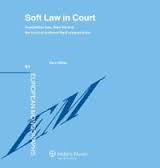
Oana Stefan (HEC Paris) has kindly sent us a copy of her book on soft law in competition and state aid law.
This book is the first monograph ever devoted to this issue.
Amongst other things, the book uses quantitative data to confirm that the judgments of the EU Courts abundantly refer to soft law instruments.
It also argues that the distinction between binding and non binding effects is too crude.
Lastly, it shows that the EU courts have created legal hybrids when endorsing soft law instruments on the ground that they are the expression of general principles of law. This generates, in the author’s words, a “judicialization” of soft law.
A must read. Apparently, Oana will in the future focus on how national courts deal with soft law instruments.
A full description of the book can be found here.
Two final remarks. First, I’d love to read Oana’s views on the appalling Expedia judgment (Expedia Inc v Autorité de la concurrence and Others C-226/11). Second, this book review does not mean that we are “sokolizing” this blog. Our tacit understanding with Dan is that he focuses on the scholarship reviews, we concentrate on the rest (including the nonsense).
Back in Business

with two presentations:
Number 1: evidence in oligopoly settings (or can tacit collusion be proved ex post)? My submission is yes. I give examples of papers that proved tacit collusion, and try to explain how economists do this . I gave this presentation 10 days ago at the IMEDIPA conference in Athens. Looking back at the success of the event, Greek competition law is NOT in crisis.
Evidence in Oligopoly Settings – IMEDIPA N Petit 8 June 2013
Number 2: under what substantive standard of abuse should the Commission deal with injunctions on FRAND-encumbered SEPs? I gave this presentation at GCR’s conference last week. A nice but pricy event + quite one-sided. I got some free tickets for my LLM studs.
Injunctions for FRAND encumbered SEPs – GCR Conference – June 2013 – Petit
Preliminary thoughts on Google’s proposed commitments

As long anticipated, here are some comments on the proposed commitments in the Google case (I graciously granted myself an extension, like the one other third parties have received; it actually is convenient because I can comment on others’ comments as well).
Four caveats are in order:
- The views expressed below are written against the background of the Commission’s concerns as set out in the press release and the Q&A doc. accompanying the market testing of Google’s proposal. The relevant question to keep in mind is whether the proposed commitments –in their current form- are apt to address the concerns identified by the Commission in its preliminary assessment, not whether they are apt to lead to candy world for satisfy the wishes of all third parties.
- My views are necessarily incomplete and they’re also work in progress. I’ve only read the limited publicly available information and have not had access to any confidential info or documents that might be contained in the case-file. Moreover, I have allocated two flights time to draft this (and I should ideally also do some billable work, you see), so I’ll (i) update and improve this document on the basis of any new thoughts or possible feedback and (ii) refine my thoughts for a forthcoming piece on Oxford’s Journal of Competition Law and Practice
- My views are mine (sounds like a tautology, but don’t always take this for granted in our area of work…); some of my colleagues and clients may well have different opinions.
- I haven’t worked nor for Google nor for any of the 17 complainants.
In case I haven’t yet got you tired before even starting, here is a methodological explanation. This will be a five-pronged analysis; I will very succinctly summarize (i) DG Comp’s concerns; (ii) my take on the substantive concerns; (iii) the content of the proposed commitments; (iv) third-party criticism of the proposal (notably that read here, here, here or here) (I actually read some favorable comments as well); and (v) my take on the proposed commitments. And this for each of the four concerns flagged by the Commission (although only the two first ones raise interesting issues).
The structure will make this post longer. In order not to cram the page, click if interested.
The Bon Jovi Defense

I gave a presentation last week at the Intertic conference organised by F. Etro in Rome (see link hereafter:Recent Developments in Article 102 TFEU – Intertic Conference – Final).
This was a very good event, with many great speakers.
One of the main points in my presentation was to exort the Commission, as a best practice, to avoid working on the new “hi tech” cases under the “likely” effects framework, and prefer to investigate them under an “actual” effects framework.
A Commission official rightly remarked, however, that agencies cannot wait to have dead bodies on the floor to intervene.
So I gave some thinking to the remark. On face value, this is a commendable suggestion.
Yet, when one thinks about it, this is a bit of a rethorical, oversimplistic defense: a company is either dead or alive, full stop (we may call it the “Bon Jovi defense“, after the band’s classic “dead or alive” gem).
Bu this wholly fails to understand that there is – and this is fortunate – something between life and death, and that companies do not exit markets instantly.
On top of this, most players in the hi tech sector are big corporations with deep pockets – they all accuse each other of being dominant – that are unlikely to disappear overnight.
That said, I understand the Commission’s concerns. To help the agency, I would argue in favour of the use of interim measures. After all, those measures may give the Commission the time necessary to amass empirical proof of anticompetitive effects, meanwhile mitigating the harm on alleged victims of the dominant company.
Besides this, it would be probably more satisfactory to think about this issue in terms of threshold, and ascribe a well-defined probabilistic threshold to the concept of “likely” effects, drawing for instance inspiration from the discussion that took place in merger control in the Tetra Laval case (“in all likelihood” v. “balance of probabilities“). Given the escalation of sanctions for infringements of Article 102 TFEU, I’d set the bar quite high.
A last thing: no one can predict the future… and I trust antitrust agencies are no exception to this. So again, the principle of enforcement humility (we mentioned it in a previous post) calls for a modest, empirical approach to fast moving markets, as advocated by J. Wright in a recent excellent speech.
PS: a question for our readers: I am looking for real life evidence of firm exit out of anticompetitive exclusionary conduct. Can anyone help? Examples shall not necessarily come from antitrust cases. I am thinking of running some case studies with my students.


 Chillin'Competition