Archive for the ‘Uncategorized’ Category
SAVE THE DATE: 12th May | Conference at the London School of Economics

On 12th May, the London School of Economics will be hosting a major conference that will look into the future of competition law and regulation. The event is the product of joint work with Thorsten Käseberg, who moonlights as a Visiting Professor at LSE on top of his duties at the German Ministry for Economic Affairs and Climate Action.
The conference will address upcoming challenges from a legal, institutional and policy perspective. In addition, we will explore the lessons that can be drawn from sectoral regimes, in particular utility regulation and data protection.
We hope to see many of you in London in May. We will be providing all information on how to register (for free) and how to attend already next week: make sure you keep an eye on this blog and LSE Law School’s social media profiles (including Twitter and LinkedIn). In the meantime, do not hesitate to get in touch.
If you want a taster of the conference, here is the lineup of confirmed speakers:
On policy matters:
- Andrea Coscelli (Chief Executive, Competition and Markets Authority);
- Cani Fernández (President, Comisión Nacional de los Mercados y la Competencia); and
- Andreas Mundt (President, Bundeskartellamt).
On legal issues:
- Fernando Castillo (Principal Legal Adviser, European Commission);
- Heike Schweitzer (Professor of Law, Humboldt University of Berlin); and
- Fabienne Siredey-Garnier (Vice-President, Autorité de la concurrence).
On institutional and coordination matters:
- Sarah Cardell (General Counsel, Competition and Market Authority);
- Niamh Dunne (Associate Professor, London School of Economics); and
- Damien Gerard (Prosecutor General, Belgian Competition Authority).
On lessons from other regulatory regimes:
- Claudia Berg (General Counsel, Information Commissioner’s Office);
- Martin Cave (Chair, Ofgem); and
- Lindsey Fussell (Board Member, Ofcom).
Enjoy the break!
OUT NOW: Special Issue on Google Shopping in JECLAP
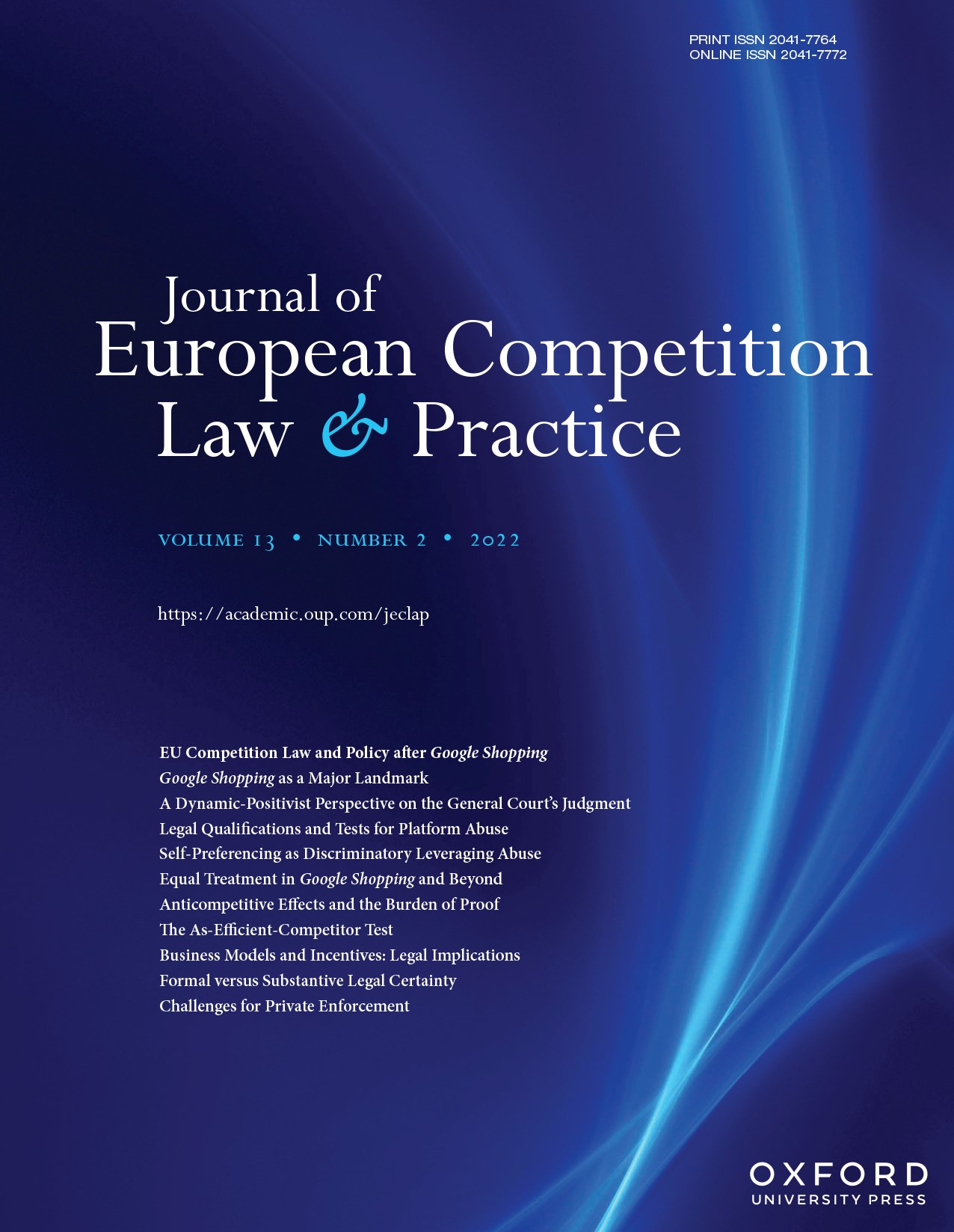
On behalf of JECLAP‘s editorial team, I am proud to announce the publication of the Special Issue dedicated to the General Court’s ruling in Google Shopping.
You can be access it here. Choosing the pieces was not an easy task (we received over 30 submissions in no time), but we could not be more delighted about the end-product.
The contributions are invariably thoughtful and approach the judgment from different angles (some more practical, other more theory-minded). As an editorial team, we are particularly happy that this Special Issue provides a platform to new voices in academia and the world of practice (we are convinced they will become household names in the near future).
If you are curious, below is a glimpse of what the Special Issue offers (I will be discussing some pieces in closer detail in the coming weeks). If (for reasons beyond comprehension) you or your institution are not yet subscribed to JECLAP, you will be pleased to see that some contributions are available in Open Access format.
Enjoy and do not hesitate to contact us and/or the authors with any comments!
Rules, Discretion, and Reasoning According to Law: A Dynamic-Positivist Perspective on Google Shopping (open access), by Justin Lindeboom (Groningen).
The General Court’s Google Shopping Judgment Finetuning the Legal Qualifications and Tests for Platform Abuse, by Friso Bostoen (Leuven).
Bronner revisited: Google Shopping and the Resurrection of Discrimination Under Article 102 TFEU, by Christian Ahlborn, Gerwin Van Gerven and Will Leslie (Linklaters).
Article 102 TFEU, Equal Treatment and Discrimination after Google Shopping, by Lena Hornkohl (Max Planck Institute Luxembourg).
Anticompetitive Effects and Allocation of the Burden of Proof in Article 102 Cases: Lessons from the Google Shopping Case, by Raffaele Di Giovanni Bezzi (European Commission).
Google Shopping and the As-Efficient-Competitor Test: Taking Stock and Looking Ahead (open access), by Germain Gaudin (Freiburg) and Despoina Mantzari (University College London).
Business Models and Incentives: For an Effects-Based Approach of Self-Preferencing?, by Patrice Bougette (Côte d’Azur), Axel Gautier (Liège) and Frédéric Marty (Côte d’Azur).
Between Substance and Autonomy: Finding Legal Certainty in Google Shopping (open access), by Yasmine Bouzoraa (Groningen).
Following the Google Shopping Judgment, Should We Expect a Private Enforcement Action?, by Jeanne Mouton (Côte d’Azur and College of Europe) and Lewis Reed (College of Europe).
Announcing the Winner and Finalists of Chillin’Competition’s 2nd Rubén Perea Award

On 1 April 2020 we lost Rubén Perea, a truly extraordinary young man who was about to start a career in competition law. We decided to set up an award to honour his memory, and to recognize the work of other promising competition lawyers/economists under 30. Today we are announcing the winner and runners-up of the 2nd edition of this award.
The winner of the 2nd (2021) edition of the Rubén Perea Award is JÉSSICA NEMETH, for her paper “Blockchain, Behavioral Remedies and Merger Control: How can access remedies do better?”.
Lass Tuesday Jessica and the winner of the first edition (Vladya Reverdin) received their awards from EVP Vestager, who very kindly accepted to give out the awards at her offices:

The jury also selected 4 finalists whose papers will be published in a special JECLAP issue. The finalists are:
-“Firm’s own price elasticity of demand in dominant position analysis” (by Jan Kupcik)
-“Trading Off the Orchard for an Apple: the iOS 14.5 privacy update” (by Alba Ribera)
-“Is ‘‘more’’ better? Broadening the right to sue in competition damages claims in both sides of the Atlantic” (by Grigorios Bacharis)
-“Should the New Competition Tool be put back on the table to remedy algorithmic tacit collusion?” (by Vasileios Tsoukalas)
Congratulations to Jessica, Alba, Jan, Grigorios and Vasileios, and many thanks to my fellow members of the jury, namely Damien Gerard, Lena Hornkohl, David Pérez de Lamo, Michele Piergiovanni and Gianni De Stefano.
We will soon be announcing the 3rd edition of the Rubén Perea Award. Stay tuned!
‘Law, Policy, Expertise: Judicial Review in EU Competition Law’ | My CELS seminar at the University of Cambridge
The lunchtime seminars at Cambridge’s Centre for European Legal Studies have long been an institution in EU law. Having followed the activities of the Centre since my days as a Teaching Assistant in Bruges, I was delighted to accept their invitation. You can access the video of my presentation here, and the PPT I used here.
The topic I chose, judicial review, is dear to my heart (and hopefully relevant for EU lawyers at large). My presentation focused on the complex relationship between law, policy and expertise. In our field, the EU courts are consistently asked to walk the fine line between the exercise of effective judicial review and the respect for the policy choices of the European Commission.
Judicial review is particularly complex considering that issues of law are subject to full review whereas policy-making is, if at all, only controlled for manifest errors of assessment. As I put it during the lecture, the challenge for the EU courts is thus to avoid the cross-contamination of standards of review.
Against this background, I discussed what I called some of the hallmarks of effective judicial review in the case law. They include the following:
- Policy must be implemented through clear legal criteria that can be anticipated and subject to judicial review
- Policy must be grounded on the expert consensus
- Policy-making must be consistent with prior commitments
- The relevant economic and legal realities must be considered
- Consistency within and across provisions
On the first of these hallmarks, I pointed out that the interpretation of legal provisions must make it possible to distinguish between issues of law and issues of policy. The case law suggests that, where the interpretation would blur the line between both issues, it is unlikely to survive judicial review. CK Telecoms provides a wonderful example in this regard.
The second hallmark is one that I have discussed at length. The interpretation of the law must be grounded on the expert consensus (as opposed to informal, fringe or heterodox views). Ongoing developments raise a couple of fascinating questions:
- First: can an infringement be established in the absence of consensus? The rules on the allocation of the burden of proof would suggest that consensus is a precondition for a finding of infringement.
- Second: can the review of administrative action itself rely on informal analysis? The logic of the system would lead to the conclusion that it cannot.
Finally, the renvoi judgment in Intel was very useful to illustrate the third and fourth hallmarks (the fifth was left for a forthcoming paper). That judgment shows that the EU courts expect the Commission to behave in a manner consistent with its policy commitments (for instance, if a policy document declares that it will consider the coverage of a practice, one can reasonably expect it to look at the matter subsequently, unless it explains why it is not appropriate in a particular case).
The fourth hallmark addresses what is arguably the most consistent lesson of the past few years: any legal conclusions must result from a careful analysis of the relevant economic and legal realities. The object and/or effect of a practice cannot be based on hypotheticals or on abstract considerations. By the same token, arguments capable of casting doubts on the premises on which administrative action is based must be taken seriously by an authority if a decision is to survive judicial scrutiny.
It would be wonderful to get your views on the presentation. Have a wonderful weekend!
GCLC Annual Conference (in Bruges and online), 25-26 March 2022

The Global Competition Law Centre will be holding its annual conference at the College of Europe in Bruges (as well as online) on 25-26 March 2022. For many years, and leaving Chillin’Competition conferences aside, this has been arguably the most substantive event on EU competition law. This is a conference with no agenda other than contributing to the understanding and the refinement of our discipline. Every year it brings together a balanced mix of competition law experts from public institutions, academia and private practice genuinely interested in discussing substance.
This year’s program is available here.
I will be taking part in panel 6 on the role of the EU Courts, together with General Court President Marc van der Woude, Judge Ingeborg Simonsson and Damien Gerard as Chair. My presentation will be titled “The role of the EU Courts: a view from the Bar“.
You can CLICK HERE for further information and registration. Whoever registers via this link (and lets me know) will get a post-conference beer at my favorite bar in Bruges (here is a view from that, the, Bar).
Competition Law in Hi-Tech Markets (25 February 2022)

The 2022 edition of the annual IEB seminar on “Competition Law in Hi-Tech markets” will take place next Friday 25 February at 16 .00 CET. This will be a hybrid seminar, with most speakers participating in-person at the Instituto de Estudios Bursátiles in Madrid and others joining via Teams. Should you be interested in joining, either in-person or remotely, please contact competencia@ieb.es
The program is the following:
Panel I- Recent competition law developments in hi-tech markets (16.00-17.30 CET)
-Moderator: Lewis Crofts (MLex)
-Nicholas Banasevic (Gibson Dunn)
-Milan Kristof (Court of Justice of the European Union)
-Alfonso Lamadrid (Garrigues)
Panel II- From antitrust to ex ante regulation (17.45-19.15 CET)
-Moderator: Lewis Crofts (MLex)
-Pedro Hinojo (CNMC)
-Kay Jebelli (Computer and Communications Industry Association)
-Natalia Moreno (European University Institute)
-Anne Witt (EDHEC Business School)
The (growing) role of the Guidance Paper on exclusionary abuses in the case law: the legal and the non-legal

The most recent developments on exclusionary abuses suggest that the reports of the demise of the Guidance Paper on exclusionary abuses might have been exaggerated. Just when we thought that it might have fallen out of favour, it has been cited in AG Rantos’s Opinion in Servizio Elettrico and by the General Court in its Intel renvoi.
These references might seem surprising at first glance. After all, the Guidance Paper is not, and was never intended to be, a statement of the law. It is for the Court of Justice, not the Commission, to interpret the scope of Article 102 TFEU. Why, then, the references to the instrument? I can think of a number of legal and non-legal reasons.
The legal: pre-commitment devices and good administration
A point that transpires clearly from a reading of the Intel renvoi is that, while the Guidance is not a statement of the law, it is not devoid of effects, either. We have long known that soft law instruments bind the authority that has issued them. Suffice it to think in this regard of the de minimis Notice (as explained by the Court in Expedia; and by Alfonso in a number of posts, such as this one).
The above is a logical and necessary corollary to the principle of good administration: if a public authority has publicly announced that it will exercise its powers in a certain way, it is reasonable to expect that its subsequent behaviour will follow the position stated in the relevant instrument (irrespective of whether it is a form of ‘soft’ or ‘hard’ law). And it is likely that review judges will assume that an administrative authority will keep its word in its dealings with individuals.
In the specific context of the Guidance, it is reasonable to anticipate that the Commission will follow the approach to the prioritisation of cases that is enshrined in the document. If there was any doubt: this fact does not mean that the Commission can never depart from the Guidance. It simply means that, if it ever prioritises a case in accordance with a different set of criteria, its decision must at least explain the reasons why it is following another approach.
The non-legal: a good, concise document that captures the case law and the expert consensus
The above is certainly relevant, but I do not believe it tells the whole story. Reading the Intel renvoi and AG Rantos’s’ Opinion in Servizio Elettrico suggests that the reasons behing the rising prominence of the Guidance Paper in the case law go beyond the strictly legal.
Arguably, the main reasons are in fact non-legal. I can think of three interrelated ones. The Guidance Paper is, first and foremost, a very good policy document. It is concise, clear and useful for courts. It provides the right amount of detail in an orderly way.
What is more, the Guidance Paper is very much in line with the case law as it has evolved since Post Danmark I. As the Intel saga shows, the criteria to assess foreclosure, as laid down in the relevant judgments, is aligned with para 20 (extent of the dominant position, coverage of the practice, features of the relevant market, evidence of actual effects and possible foreclosure strategy).
As far as price-based conduct is concerned, the approach proposed in paras 23-27 faithfully reflects the consistent case law since Deutsche Telekom and TeliaSonera all the way to Post Danmark II and Intel (not only because of the cost benchmarks proposed, but also in relation to the ‘as efficient competitor’ principle and the potential exceptions to the principle that might arise in a given economic and legal context).
Finally, the Guidance Paper captures the expert consensus. Its primary purpose was in fact to bring the Commission’s practice in line with mainstream economics. And if there is something that my research has taught me, it is that the Court of Justice has consistently crafted the law around the expert consensus. The latter is, in fact, a key constraint on administrative action in the context of Article 102 TFEU. From this perspective, the Guidance could be seen as a digest of mainstream positions and, as such, the sort of document that review courts are likely to cite.
Case T‑286/09 RENV, Intel v Commission, or the sign of an effective competition law system

When reading the General Court’s renvoi judgment in Intel, I immediately thought that the annulment of the Commission decision is, above all, a reliable sign that the European Union has an effective competition law system. If administrative action were never quashed, it would mean either that the authority is too risk-averse (and therefore that there is insufficient enforcement across the board) or that judicial review is overly deferential (and therefore that there are insufficient checks in the system).
In this particular instance, moreover, it is difficult to see how, in spite of the inevitable footballising takes (‘upset’, ‘big win’, ‘blow’), the outcome represents anything other than a victory for EU competition law and policy.
It is true that the original decision was annulled. It is also true, on the other hand, that the judgment shows (just like the Court’s ruling on appeal) that the law is in line with the Commission’s enforcement priorities as outlined in the Guidance Paper and with the economic consensus (which has long emphasised that anticompetitive effects are not an inevitable outcome of exclusive dealing and conditional rebates). The institutional setup has delivered a legal outcome that comes a step closer to the optimum.
Some may retort that the case has taken too long and may even go as far as to suggest that the length of the proceedings (the original decision was adopted when I was still working on my PhD) is a sign of dysfunction in the system. I struggle to agree with this take.
The pace of law is not, and should never be, the pace of policy. The law, as interpreted by the Court of Justice, evolves slowly and incrementally. Those in favour of moving fast and breaking things may find it frustrating. In my view, however, the cautious process that characterises the EU legal order is a manifestation of the ‘Union of law’ and as such an effective check against arbitrary whims (it is also superior, for many of us, to a system based on administrative discretion).
The renvoi judgment: the implementation of an ‘arrêt cadre‘
As I have mentioned a number of times before, the Court’s 2017 judgment in Intel is an arrêt cadre: it was confined to providing a set of principles to be fleshed out when engaging with the facts in a particular economic and legal context. Because the judgment was relatively brief, it opened the door to some speculation about its exact meaning. This week’s ruling clarifies a few crucial points:
First (para 124), the ‘by object’ status of exclusive dealing and loyalty rebates is based on a presumption that these practices are capable of restricting competition (that is, of foreclosing equally efficient rivals). This presumption can be rebutted by a dominant undertaking. As a result, the Commission had erred in law by arguing that it was not necessary to evaluate the rebates’ capability to foreclose competition (para 145).
Second (para 165), where the Commission’s case is based on the ‘supposition’ that the behaviour under consideration cannot be explained on grounds other than the restriction of competition, the decision will necessarily be annulled where the dominant undertaking provides evidence casting the facts in a different light. This point is particularly important in relation to ‘by object’ abuses (unsurprisingly, para 165 cites two Article 101 TFEU cases).
Third (paras 119 and 125), the evaluation of the foreclosure effects of the rebate scheme must be based on all five criteria identified by the Court of Justice in para 139 of its judgment, namely: (i) the extent of the dominant position; (ii) the coverage of the practice; (iii) the conditions and arrangements for the award of the rebates; (iv) the length and amount of the latter; (v) and the existence of an exclusionary strategy.
Fourth, the ‘as efficient competitor’ test is not an indispensable ingredient of the analysis (para 126). However, such test will be a relevant factor where the Commission has carried it out as part of its assessment of the foreclosure effects of the rebate scheme.
One is tempted to add that, in practice, the ‘as efficient competitor’ test will feature prominently. As the General Court explains in paras 152-159, this test may show that an equally efficient rival would be able to match the dominant firm’s prices and is therefore likely to be advanced by any dominant firm in a case involving conditional rebates.
The assessment of anticompetitive effects is a meaningful one
A fundamental lesson to draw from this renvoi judgment is that the assessment of anticompetitive effects in EU competition law is a meaningful one. It is not a formality. What is more, merely showing that rivals are placed at a disadvantage is clearly insufficient to establish actual or potential foreclosure to the requisite legal standard.
If you read the various sections devoted to each individual scheme, you will see the detail into which the assessment goes. The additional factors need to be robust enough to cast doubt on the prima facie findings resulting from the ‘as efficient competitor’ test. Similarly, the nature and operation of the rebates will be subject to a detailed analysis.
More generally, the judgment confirms the importance of the coverage of the practice to evaluate its impact. In this regard, it notes that the contested decision failed to determine this factor (para 499), which would place the said decision at odds with the Court’s judgment in Intel and, importantly, with the Commission’s own Guidance Paper.
Final thoughts
It would be very difficult to argue that the many lessons to draw from the renvoi judgment apply exclusively to rebate schemes. Some points are relevant across the board, and certainly beyond price-based conduct. This is obviously true of the factors in light of which actual or potential foreclosure is assessed. For instance, it would be difficult to credibly claim that the coverage and/or the nature of the practices would not play a role non-price-based cases.
The possibility for firms to provide evidence showing that a practice can be explained on grounds other than the restriction of competition is also obviously applicable across the board. This point would be of particular relevance in relation to the so-called ‘naked restraints’ in Intel. These restraints were assumed to have an anticompetitive object. However, they always seemed to me like exclusivity obligations by another name, and thus capable of being rationalised on pro-competitive grounds.
I very much look forward to your comments (as always, nothing to disclose). Have a wonderful weekend!
Recent Developments in EU Competition Law (IEB Webinar, 4 February 2022)
Every year Fernando Castillo de la Torre (Director of the Competition team at the Commission’s Legal Service) and Eric Gippini-Fournier (recently appointed as Competition Hearing Officer) coordinate a high-level, one-afternoon seminar in the context of the IEB competition law course. They always make sure that this is one of the top-quality seminars in our field.
Unfortunately for those of us who were planning to travel to Madrid, we have now decided to move the discussion online. This should nonetheless be good news for those of you interested in joining remotely.
For more information and registrations, please write to competencia@ieb.es
The program is the following:
16:00 – 17:45: The review of the horizontal guidelines and block exemptions, and “sustainability agreements”
–Georgiana Capraru Ianus. DG Competition, European Commission.
–Belén Irissarry. Clifford Chance.
–Giorgio Monti. Tilburg University.
–Ekaterina Rousseva. Legal Service, European Commission.
Chair: Fernando Castillo de la Torre. Legal Service, European Commission.
18:00 – 20:00: The meaning and relevance of competition “on the merits”
‐Helmut Brokelmann. MLAB Abogados.
‐María Pilar Canedo. Comisión Nacional de los Mercados y la Competencia and Deusto University.
‐Damien Geradin. Geradin Partners.
‐Viktoria Robertson. University of Economics and Business, Vienna.
Chair: Eric Gippini-Fournier. Competition Hearing Officer, European Commission.
Antitrust Music (a playlist)

In a very questionable use of his free time, Nuno Carrolo dos Santos (Vieira de Almeida) has spent years compiling a themed Spotify playlist of 101 songs that might be appealing (or maybe not) to competition experts.
You can check out this work of a lifetime here: Spotify – Antitrust Music
The playlist includes (real) songs like “Oligopsony Sucks”, “Cartel Swag”, “Short Form and/or long Form”, “Monopolistic Industry”, “Deadline and Commitments”, “State aid Blues” and “Predatory Impalement”.
Nuno has made the list collaborative so that other people might be able to add new songs. The geekiness bar is high, but no such bar is too high for the readers of this blog.
All featured musicians should be honoured and humbled to have made it to such a prestigious playlist. Given the Bob Dylan Nobel prize precedent, however, they will surely be left wondering why there are no writing award categories for the best lyrics in a sort-of-antitrust-themed song (subdivided by area of competition law and type of music, of course).


 Chillin'Competition