Archive for the ‘Uncategorized’ Category
Since you are in the mood….

Yesterday not only did we, a bit surprisingly, fill the Chillin’Competition conference in less than an hour (there is now a decent waiting list that we will try to satisfy somehow), we also (or rather you) broke the record for number of visits to the blog in a day, with 2,044. Many thanks once again…
Since you seem to be in the mood for conference announcements (and given that the next few days will be packed with interesting stuff on which to comment) I’ll take advantage to advertise some pending courses and events in which we are involved:
- We have now closed the dates for the XIX edition of the EU and Spanish Competition Law Course that I co-direct with Luis Ortiz Blanco in Madrid and that also features Pablo and Nicolas among many others. It will run from 8 January until 11 March and, aside from the annual introduction by Nicolas Petit on 8 January will also include modules on cartels (11-13 January), horizontal and vertical agreements (18-20 January), abuse of dominance (1-3 February), merger control (8-10 February), sector Regulation and Competition (22-24 February) and State aid (29 February-2 March), as well as seminars on recent developments in 101 (29 January),102 and mergers (19 February) and competition law and technology (11 March). More info is available here: XIX Curso de Derecho de la Competencia Europeo y Español IEB 2016
- In the coming weeks, and going against all promises I made to myself about saying no to speaking proposals, I will be speaking about the legal challenges brought by the sharing economy (on 4 November, see here;) and about “online platform regulation” (on 17 November, see here). Any suggested reads you might have on any of these would be much appreciated, particularly by the colleagues at my firm who will otherwise have to help me compile materials 😉
- Today I attended an interesting breakfast organized by our friends (and sponsors) CCIA and by EPICENTER on
business investment, legal certainty and taxationthe pending investigations on tax rulings (the two first decisions will apparently be out tomorrow). The main takeaway from the event is that it confirms the worrying trend of organizing events at 8.am in this town. For the first time in a long time I woke up earlier than my son, and that’s just unacceptable!
- On 29 October our friend Kevin Coates (who will, btw, make a much appreciated effort to speak at our conference) will participate in a Brussels Matters talk dealing with one of the topics that we have recently paid attention to on the blog: the notion of single and continuous infringements in cartel cases (Connor Maguire has quite a good eye for topics). For more info, click here.
- And on 30 October your favorite blogger, Pablo Ibañez Colomo, will come to Brussels to speak at the GCLC’s lunch talk on Post Danmark II. For more info, see here.
Register now for the Chillin’Competition Conference

UPDATE: LESS THAN ONE HOUR AFTER OPENING UP REGISTRATIONS, THE 230 AVAILABLE SLOTS (WE HAVE ALSO RESERVED SOME FOR SPONSORS) ARE ALL GONE.
WE HAVE JUST CREATED A WAITING LIST AND WE ARE TRYING TO THINK OF POSSIBLE SOLUTIONS TO ACCOMMODATE EVERYBODY.
ONCE AGAIN, IF YOU HAVE REGISTERED AND CANNOT ATTEND PLEASE LET US KNOW SO THAT SOMEBODY ELSE CAN GET A PLACE. THANKS!!
——
It is now possible to register for the Chillin’Competition conference (apparently it was also possible before, as some people have somehow managed to find our registration site before we made it public!)
If you are interested in joining us, you can register here.
Places are limited, so we would ask you to please register only if you really plan to attend. And if you register and something comes up later, please let us know so that someone else can make it.
Look forward to seeing you there!
On the State aid investigations into tax rulings
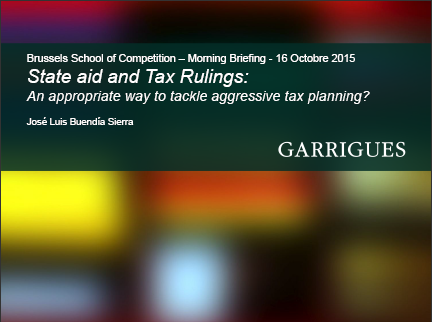
My plan for today was to discuss AG Wahl’s very sensible Opinions in the cement cases concerning the Commission’s powers to request information (something very close to my heart, as explained in my comment on the Judgments of the General Court) as well as the Judgment in AC Treuhand, due today (we already commented on AG Wahls Opinion in that case; see here). However, since I have a busy morning (I rarely sometimes work, you know) and need to catch a plane later, we’ll leave that for next week.
In the meantime, I’ll leave you with something equally interesting: the detailed and self-explanatory slides used this morning at the Brussels School of Competition by Garrigues’ partner and state-aid specialist, José Luis Buendía in a talk together with Karl Soukup (Director at DG Comp supervising the investigations into tax rulings, aside from being an impressive runner).
The event was quite a success, which is impressive considering that it started at 8 a.m, which is indecent.
The presentation puts the current investigations (the decisions were expected last Wednesday) into context, and identifies some novelties and apparent flaws debatable issues. You won’t see it in the slides, but he also suggested that someone read beyond Article 102 of the Treaty and get to 116…
P.S. Btw, both AG Wahl and José Luis will be among the speakers at our upcoming Chillin’Competition conference.
Chillin’Competition Conference- The Final Programme
After a few years announcing a conference to come, here we are, roughly one month away from it. Here is the programme and the registration info:
Registrations open on Monday 19 October via a link that we will publish on the blog at 10 am (Brussels time). Please note that there will be limited seats and that some are reserved for our sponsors (listed again at the end of the programme); registration will work on a first-come-first-served basis.
Below you will find the programme of the conference. We are quite proud of how it looks and very grateful to all speakers. Since time is limited, we could not invite everyone we would have liked to, including some friends; our invitation policy was based on preference for established names with interesting things to say and who had somehow interacted, recommended, participated or appeared on the blog. We will soon announce other future events with new names.
———————————————————————————————————————————————————–
Chillin’Competition Conference
19 November 2015, Rue Ravenstein 4, Brussels
THE PROGRAMME
9.15- 9.45: Coffee and registration
9.45: Six years of Chillin’Competition
10.00-11.30: “Letters or Cards” – Object and Effect in Articles 101 and 102 TFEU
10.00-10.20: AG Nils Wahl
10.20-11.30:Panel presentations with Christian Ahlborn (Linklaters), Eric Gippini (Legal Service, European Commission), Heike Schweitzer (Freie Universität Berlin) and Johan Ysewyn (Covington) Chair: Pablo Ibáñez
11.30-13.00: An Emerging Competition Law for a New Economy?
11.30-11.50: Kevin Coates (DG Comp, European Commission)
11:50-13:00:Panel presentations with Maurits Dolmans (Cleary Gottlieb Steen & Hamilton), Stephen Kinsella (Sidley Austin), Lars Kjolbye (Latham&Watkins) and Bo Vesterdorf (Herbert Smith Freehills) Chair: Alfonso Lamadrid
13.00-14.15: Lunch break
14.15-15.45: Institutional and Procedural Developments – Known Knowns, Known Unknowns and Unknown Unknowns
14.15-14.35: Wouter Wils (Hearing Officer, European Commission and King’s College)
14.35-15.45:Panel presentations with Luis Ortiz Blanco (Garrigues and College of Europe), Mercedes Pedraz (Audiencia Nacional/Spanish Court of Appeal), Barry Rodger (University of Strathclyde) and Eddy de Smijter (DG Comp, European Commission) Chair: Alfonso Lamadrid
15.45-17.15: Competition Law and Intellectual Property – A New Balance?
15.45-16.05: Nicholas Banasevic (DG Comp, European Commission)
16.05-17.15:Panel presentations with Peter Alexiadis (Gibson Dunn and King’s College), James Killick (White & Case), Alvaro Ramos (Cisco Systems) and Miguel Rato (Shearman & Sterling Chair: Nicolas Petit
17.15-17.30: Coffee Beer break
17.30-19.00: State Aid – Into Uncharted Territory
17.30-19.00:Panel presentations with Andrea Biondi (King’s College), José Luis Buendía (Garrigues and King’s College), Jacques Derenne (Sheppard Mullin), Conor Quigley QC (Serle Court) and Elisabetta Righini (Latham & Watkins and King’s College) Chair: Pablo Ibáñez
19.00: Chill out time
Sponsors: AB Inbev, Cleary Gottlieb Steen & Hamilton, Computer and Communications Industry Association, Covington, Garrigues, Gibson Dunn, Hart Publishing, Herbert Smith Freehills, Latham & Watkins, Linklaters, Mason Hayes & Curran, Sheppard Mullin, and White & Case
Koen Lenaerts elected President of the ECJ – His track record in competition cases

Last week Belgian Judge Koen Lenaerts was elected by his peers as President of the ECJ. This was not surprising to many, as this was one of those things that was only going to be a matter of time.
Judge Lenaerts takes over the role of President at a challenging time for the institution, with the pending reform and amidst some internal turmoil, but few, if any, can dispute that he is the ideal man for the job. His intellectual brilliance and encyclopaedic knowledge of all areas of EU Law cannot be questioned, but he is also a person with a vision for the EU and the institution, and one who is very much aware of the importance of the Court and of his role therein: it is no secret that for many years he and his cabinet have made an effort to have a say in much of the Court’s output.
Due to personal reasons I got the chance to meet him in a non-professional context a number of years ago, when I was a student in Bruges. I remember having dinner with him in Luxembourg in which, I don’t know how, someone raised a competition law issue and mentioned the Piau case. Coincidentally, that same morning I had read an article on the case written by Denis Waelbroeck and my now co-blogger Pablo (see here) in Common Market Law Review, so I pretended to have my own smart opinion on the case by essentially repeating what I had read. Judge Lenaerts immediately responded that my opinion was very much the same he had recently read in an article, of which he perfectly remembered the content and authors. What struck me is not only that he remembered all that, but the fact that he had actually read it as soon as it came out, despite not being related to any cases of his!
Since then I admit I have always held him in particular admiration; one of the geeky first things I did when I arrived at Harvard to do my LLM was to go down to the dungeons at Langdell Library to find his LLM paper. I also am witness of his openness and availability to discuss with anyone (students, researchers, new court clerks) who would resort to him for guidance, as was the case for a number of close friends of mine.
Judge Lenaerts’ doctrinal contribution to EU law is enormous and well known. Less transparent –but also well- known – is his impact on the case-law of the Courts. But since readers of this blog mostly care about competition law, let me just focus on his contribution to our little world by reference to the cases in which he has acted as “rapporteur” (any errors in their identification are attributable to the Court’s search form!) As it happens, many of them deal with issues that are or have been of particular interest to me:
Whilst at the CFI, now General Court, he was a first-hand witness of the evolution of competition law. His first cases as “rapporteur” were some that now belong to the antitrust canon in relation to the definition of “agreement and concerted practice”, including a long series of cases in 1991 and 1992 related to the Polypropylene cartel, in which the CFI for the first time endorsed the “single and continuous infringement” characterisation”, as well as the famous Cimenteries Judgment (perhaps the lengthiest and most detailed in the history of EU competition law with 5134 recitals!!) which earned him fame in this sector. Something you might not know is that he had to cancel university courses for a couple of weeks to be able to lock himself up and write the Cement Judgment. As a matter of fact, these cases are, still today, the basis for any discussions on the assessment of evidence in competition cases (such as my own contributions, discussed in this blog last week). Following his experience in these cases Judge Lenaerts himself wrote down his thoughts here: “Some Thoughts on Evidence and Procedure in European Community Competition Law”.
He also was the rapporteur in Irish Sugar, a 1999 Judgment that for the first time accepted that there could be an individual abuse of collective dominance, a perfectly sensible notion that is specific to EU competition law and which, by the way, was the starting point for my LLM Paper at the College of Europe. Again, something you might not know is that, reportedly, he wrote a good part of the Judgment at pizza parlours where he took his daughters for long lunches.
In that same year he was also the rapporteur in Micro Leader v Commission, a case about geographic price discrimination and parallel imports of software from outside the EU and which is interesting when read together with Silhoutte and Javico (Pablo has recently written about this and will upload his piece soon).
In that period he also contributed to State aid doctrine with a number of cases (CETM, and all the saga related to the tax incentives provided by the Diputaciones Forales in the Basque Country) with which, again by coincidence, I have also worked extensively (both in current ongoing work and in my first paper on EU law, while in my 3rd year of law school). By the way, I will soon be commenting on the blog an element of those Judgments (about discretion and selectivity) that is likely to arise in the decisions on the tax rulings (some of which will apparently be adopted tomorrow). On this matter, btw, he is the author of a piece titled “State Aid and Direct Taxation”.
In 2003, shortly before being “elevated” to the ECJ, he was also the rapporteur in Michelin II, a case on loyalty rebates permanently under the spotlight (any student of D. Waelbroeck in Bruges is most likely to hear a critique on it every half hour), and which was confirmed (?) only last week in Post Danmark II (an interesting Judgment which nevertheless also included a nod to the more economic approach zeitgeist, as discussed here). He was also rapporteur in another interesting case decided on the same day, Cableuropa, the first ever dealing with a decision to refer a merger to a Member State. I had always assumed that he had been the author of TACA (a Judgment that has gone unnoticed for some but that contains some yet to be interpreted recitals; see here for the best discussion so far) but I´ve just found out it was Jaeger, Lenaerts being the President of the Chamber.
During his time at the ECJ Judge Lenaerts has focused mostly in other, more important, stuff. Nevertheless he was still rapporteur in the Judgment confirming the 38 million fine on E.ON for the breach of an inspection seal, and in a much more relevant case, Lélos (Glaxo Greece) involving parallel trade of pharmaceuticals and Article 102 (for my comments on the case, in Spanish and back in 2008, click here). His writings show that with time he has developed an interest for legal issues having to do with procedure and enforcement, rather than with the substance of EU competition law.
For a complete list of all his publications, including a good number of articles on competition law, see here.
Congratulations to him, and to his peers for the choice!
Launch of the Third Edition of European State Aid Law and Policy: Congratulations to Conor Quigley QC!

I was truly delighted to attend, last week, the launch party of the third edition of Conor Quigley’s famous European State Aid Law and Policy. I managed to forget that the event was yet another painful reminder of my old age and enjoyed the time with the author and other guests. I do not think it is necessary to say much about the book itself, which has acquired an outstanding reputation over the past decade. The new edition will no doubt be as successful as the preceding ones. I remember using the (much slimmer) first edition back in Bruges and I am pleased that the book has grown together with the discipline. Needless to say, my anxious self cracked and bought a copy at the event. It was absolutely indispensable to take a look at the way in which recent developments were covered. What else would you do on a Wednesday evening?
Since the date of the Chillin’ Competition Conference is approaching, it makes sense to add that Conor Quigley will be one of our speakers. We look forward to seeing many of you on 19 November in Brussels!
Case C‑23/14, Post Danmark A/S v Konkurrencerådet: first thoughts on the judgment

As announced by Alfonso, here I am to share some thoughts on today’s ruling in Post Danmark II. It is impossible to do full justice to it in a blog post. It is incredibly rich and some of the points can only be meaningfully developed in independent posts that I will try to publish in the coming weeks.
I would mention for the time being that the ruling is valuable, first and foremost, for the many issues that it clarifies. The effort in this sense is apparent (and very successful). There is also a clear attempt to bring together different strands of the case law and to achieve overall consistency (both within Article 102 TFEU and across provisions). I find it much easier to explain Article 102 TFEU case law to my students after the ruling.
It is useful to distinguish, as I have done in past entries, between issues of principle (relating to Article 102 TFEU as a whole) and issues that are specific to rebate schemes.
Issues of principle
Abuses by object and by effect: The ruling further confirms that the object/effect divide exists in the context of Article 102 TFEU. As the law stands, some practices are prima facie prohibited as abusive irrespective of the context and effects they produce (this category includes exclusive dealing and loyalty rebates). Other practices are only prohibited insofar as they have exclusionary effects (such as ‘margin squeeze’ practices and standardised rebate schemes).
Threshold of effects: While it has been clear for a while that some practices are only abusive where they have exclusionary effects, the relevant threshold has remained elusive. In line with the Advocate General, the Court seems to hold that the relevant threshold is one of likelihood. Post Danmark I is paraphrased in the ruling to state that the relevant question is ‘whether the conduct of the dominant undertaking produces an actual or likely exclusionary effect, to the detriment of competition and, thereby, of consumers’ interests’ (para 69). Para 67 (‘only dominant undertakings whose conduct is likely to have an anti-competitive effect on the market fall within the scope of Article 82 EC‘) is equally eloquent.
Effects on what?: The case law was not entirely clear as to the effects to consider when examining the lawfulness of potentially abusive practices. Some rulings gave the impression that the impact of a practice on the contractual freedom of the customers of a dominant firm was sufficient for Article 102 TFEU to come into play. Post Danmark II suggests that this is not enough. The impact of the practice on the competitive process needs to be considered. The assessment of all the circumstances relates to whether the practice ‘makes market entry very difficult or impossible for competitors of the undertaking in a dominant position’ (para 31). It is now credible to claim that the notion of ‘effects’ has a single meaning across competition law provisions (I will develop this thought further in a separate post).
Issues specific to rebate schemes
Scope of the prima facie legality rule: As I explained in my paper, the rebate scheme applied by Post Danmark was based on the volume supplied. It was therefore reasonable to infer from Hoffmann-La Roche and Michelin I that it was presumptively lawful under Article 102 TFEU. The ruling (para 28) clarifies that the prima facie legality rule only applies to rebate schemes that are (i) based on volume and (ii) that relate to individual orders. Only this category of rebate schemes is presumed to be justified by the cost savings made by the firm. The Court seems to attach importance to categories but redefines them.
Assessment of ‘all the circumstances’: According to the Court, it is necessary to consider all the circumstances to determine whether a system of standardised rebates has exclusionary effects. Such factors include the position of the dominant supplier and the conditions prevailing on the relevant market (para 30); the rules and criteria governing the grant of the rebate (para 32), and in particular the retroactive nature of the scheme and the length of the reference period. Beyond the specific issues, the judgment proposes a true effects-based analysis. The regulatory context and the features of the relevant market seem to play a crucial role in the assessment (as they should).
More on the analysis of effects:
- The expressions ‘fidelity-building’ and ‘loyalty-inducing’ seem to be absent from the judgment. These expressions were used in rulings that suggested that a restriction in the commercial freedom of the customers of the dominant firm is sufficient to establish an abuse. This conspicuous absence suggests, in line with what I pointed out above, an attempt to bring together different strands of the case law and to propose a true analysis of effects.
- Precisely because the Court engages in a careful analysis of the impact of the practice on the competitive process, the references to de minimis and the appreciability of the practice seem to be of little theoretical or practical relevance.
Relevance of the ‘as efficient competitor’ test: Unsurprisingly, the Court holds that the relevant case law does not mandate the ‘as efficient competitor test’ (para 57). Equally unsurprisingly, it holds that the purpose of the Guidance is merely to set the priorities of the Commission as a competition authority (para 52). More interesting is para 58, where it states that the above ‘ought not to have the effect of excluding, on principle, recourse to the as-efficient-competitor test in cases involving a rebate scheme for the purposes of examining its compatibility with Article [102 TFEU]’. In the specific context of the case, the test is not deemed to be relevant. I am inclined to agree with the Court. You may remember that I said ‘never say never’ in a previous post. Well, Post Danmark II is a good example showing that sometimes even rebate schemes that do not amount to below cost pricing can be exclusionary (the regulatory context is crucial in this regard and supports this conclusion, in my view).
Objective justification: In line with Post Danmark I, the Court confirms that an objective justification is available to dominant firms, and that it may relate to the efficiency gains made through the award of the rebate scheme (para 48). This is the aspect of the ruling that is likely to prove more controversial. Because the scope of the legality rule is defined so narrowly, it is not obvious to see how an efficiency defence will succeed (but I may be wrong). In this regard, the ruling seems to be in line with Michelin II (which helps explain, in turn, why an objective justification has not been put forward by dominant firms in some recent cases). I will develop this point elsewhere.
This seems enough for today. As usual, I would love to read your views on the ruling!
Single and continuous infringement

Before this blog is flooded with the zeitgeist debates on the Post Denmark II Judgment issued this morning (the good news for Pablo is that all his previous posts on the subject remain valid…), here are the slides (in Spanish, sorry) that I used this morning for my intervention at the Spanish Competition Authority, as announced in my previous post:
Infracción única y continuada- Alfonso Lamadrid
(Many thanks to Paloma Lantero for the help in preparing them)
Cartel-related thoughts, ads and requests

I’m in a train preparing the slides for my intervention next Tuesday at the Spanish Competition Authority´s and USP CEU’s conference on the fight against cartels in the Iberoamerican Community (EU, Spain, Portugal, Brasil, Mexico, Argentina, Chile and Colombia).
The conference will also be an opportunity to present a hot-off-the-press book on cartels (pictured above) to which I have contributed with a quite significant number of pages, taking care of the chapters on cartel procedure (together with JL Buendía) and on cartel evidence (together with Ana Balcells). The book is part of a project directed by Jerónimo Maillo and coordinated by Javier Porras.
My intervention on Tuesday will focus on one of the sub-topics discussed in one of the two chapters: the interpretation of the notion of “single and continuous infringement” in EU and Spanish competition law. Despite being the essence of the “cartel offence” and a feature of practically every single cartel decision, there are still perplexing divergences in how the notion is interpreted throughout the EU. I also see some divergent trends: whereas the concept keeps on expanding at the national level, EU Courts seem to be adopting a more restrictive interpretation, particularly when it comes to establishing individual liability for the whole infringement (the trend was made evident with Coppens and Aalbers and again only a few weeks ago in the Toshiba Judgment). If any of you has thoughts on the matter, I would appreciate if you would send them my way (I can offer a beer in reward).
And since I’m asking for favours, if anyone from Colombia reads this (I’ve just checked the blog’s stats and it seems we have a good number of Colombian readers), I’ll be happy to return there to speak about anything. It doesn’t have to be competition law: I only need a excuse to visit my brother living in Bogota pretending it’s a work-related trip 🙂
And since I’m mixing famly and cartels: I recently told my mum that I had worked in a case where cartel meetings had taken place in a hotel we know well. She thought there could be a niche there, and has asked me to please advertise to any potential cartellists that I know that my parent’s hotel has very suitable facilities for cartel meetings, is quite hard to get to (undoubtedly an advantage for this purposes) and can offer a tie/ discount in legal services. Special prices would apply to continuous infringements.
Finally, those interested in cartels should know that our friends at ERA are holding a workshop on cartel enforcement in the EU in Brussels on 29 October. For more info, click here.
Update on the Chillin’Competition Conference

As recently announced, the Chillin’Competition Conference will be taking place in Brussels on November 19th.
The programme is practically finished and we hope to publish here next week. In the meantime (and since work has precluded me from writing anything more substantive today) we can give you some additional details:
-Where? The conference will take place at the premises of the Federation of Belgian Enterprises, in Rue Ravenstein 4, Brussels.
-When? On Thursday, November 19th, 2015, from 9.30 a.m. to 19 p.m, although there will be drinks afterwards [actually, not only afterwards, you’ll see 😉 ]
-What? We will be holding 5 panels, each with 5 panelists, one touching on object/effect issues in Arts. 101 and 102; one on competition in the online world, one on competition and IP, one on institutional and procedural issues, and one on State Aid.
-Who? We have managed to have a quite impressive line-up of speakers, including a member of the CJEU, several Commission officials, national judges, academics and quite a few top-notch practitioners (I’m sure my firm will appreciate that I organize an event to showcase competitors). Quite impressively, only two of the many people invited have said they unfortunately could not make it [a clue: one is Danish :)]. Pablo and I will not be speaking, since –as you might have noticed- we’ve already depleted our stock of ideas.
-How much? Nothing, but if you ever see us around, you can invite us to a couple of beers.
We can also safely announce that we will be breaking a good number of the 10 commandments for Brussels conference organizers.
-Sponsors. We are immensely grateful to those who have so far agreed to contribute to the conference via sponsorships, so far (for the sake of clarity, the bold in “so far” means that others can still join; but hey, no pressure…): Cleary Gottlieb, CCIA, Covington, Garrigues, Gibson Dunn, Hart Publishing, Herbert Smith Freehills, Inbev, Linklaters and White & Case.


