Archive for the ‘Uncategorized’ Category
Competition Bank Runs?
Jeroen Dijsselbloem triggered a spate of criticisms yesterday when he mentioned that the Cypriot deal was a “template” for future EU bailouts.
If this is true, the Commission may one day be subject to the sort of haircut imposed on wealthy Russian mobsters Cypriot bank account holders.
Up to this point, this is still sci-fi competition law. But take a look:
1. Fines paid to the Commission in cases with subsequent appeals are provisionally held in specific deposit accounts with commercial banks and they cannot be used to finance any other EU activities.
2. In 2009, a Special report of the Court of Auditors mentioned that the volume of fines held in such account lied in the ballpark of €5 billion.
3. At the time, the Commission had accounts with Fortis, BBVA, ING Belgium, KBC, ING NL and Citibank. In a not so distant past, several of those banks were bailed out. And it cannot be excluded they’ll have to be rescued again.
Interestingly, the 2009 Report warned at §47 that “this approach [i.e. leaving fines in such accounts] exposes the Commission to risk of loss in the event of banking failure. An optimum approach to better managing has not been established“.
I have no information on the status of this issue, but I understand that the Commission has been working on a better approach to address such risks (notably by using banks with good credit ratings…).
Yet, given the recent turn of events in Cyprus, I cannot help but thinking that one day the Commission could lose big money.
Not to think to the flood of legal consequences this may have, should the General court or the Court of Justice subsequently rescind (in part or full) the fines held in the Commission’s accounts.
Theories of Harm potentially applicable to Apple’s Distribution Tactics

On TV last week, I looked dumb reciting the obvious: in the EU, the law forbids RPM as an outright unlawful practice. So if it was proven that Apple is RPMing, then there could be trouble down the road.
Some voices blarred amongst some competition lawyers’ friends, as I had proferred accusation on Apple (I have not).
So I made some research in the WE. Upon inquiry, it seems that Apple’s tactics are more subtle. If I understand correctly, Apple tells its independent retailers that consumers can take a price up to a certain level (let’s say 500€), but no more. In turn, Apple sets in the contract a recommended maximum price of 500€. And then, it sells them the product at a price slighlty below this (let’s say 495€). On top of this, Apple would allegedly charge lower prices to its own retail distribution network.
On face value, such maximum prices are per se lawful. But the question is whether this can be akin to de facto RPM, given that with the high input price, Apple in essence gives little choice to its independent retailers but to apply the maximum price. Further evidence that this constitutes hidden RPM would stem from the fact that Apple accords much lower prices to its own retail operations (incl. over the Internet).
But there’s something puzzling with this theory of harm: why on earth would Apple seek to harm independent retailers? Possible options are (1) Apple engages into de facto RPM in countries where it does not have large retail operations of its own, so as to yield as much profit as possible; (2) Apple is reluctant to sell through independent retailers in countries where it has its own retail operations, but anticipates that with control over a “must store” product, it would be forced to supply.
In option 1, we are looking at a theory of anticompetitive exploitation, amenable to an infringement under the RPM framework, pursuant to 101 TFEU or to unfair pricing rules pursuant to 102 TFEU (if Apple is proven dominant).
In option 2, we are looking at a theory of anticompetitive exclusion, amenable to an infringement under article 102 TFEU (if Apple again is proven dominant), under the refusal to supply/price discrimination/margin squeeze doctrines.
A related puzzling thing is about retailers’ incentives to buy a product on which they make so little margin. But again, one may consider that they have incentives to do so at any rate, because this brings traffic towards their shop. And after all, each distributor is likely to believe that it is better to be the one to make the sale, rather than to leave it to another distributor.
All this, of course, should be backed by facts. The Commission is apparently looking into this, if I believe the latest news.
Nicolas on TV

Those of you watching Belgian TV on Wednesday night (not many, I guess) might have have come accross a program on RTBF about competition policy as seen from the perspective of consumers. Prix trop élevés : arnaques bien ficelées? (i.e. Too High Prices: a well set up robbery?; please excuse my French..).
The program features some big names, including our Friday slotee J.F Bellis, P. Nihoul and a certain Nicolas Petit (who’s becoming an ubiquitous TV presence; he’s becoming the Kim Kardashian of antitrust) 😉
Ckick here to watch the video:
http://www.rtbf.be/video/emissions/detail_questions-a-la-une?pid=10
Happy

To our lawyer readers: competition for rankings just got much tougher.
Today, Alfonso has become a contender for the 40 below 40 ranking.
Happy Bday mate.
Learning curve

Random thoughts following yesterday’s discussion:
- Google translate is an ordoliberal software
- Or … the systematic removal of “effect” from Treaty translations may be part of the settlement currently discussed with DG COMP (in a bid to please the ordos within the Commission)
- The bad news about inconsistencies in the various language versions of the horizontal cooperation guidelines and of the guidance paper? EU law not applied uniformly.
- The good news? Entitles to perform natural experiments, and test in real life the economic impact of distinct legal standards
Lost in Translation

[Please read this post with caution] Heard from a seasoned German-speaking Member of the Court of justice of the EU.
The fuzz about the object-effect dichotomy that has kept generations of EU competition lawyers busy would be a moot issue. We dumd: last year, at the GCLC, we devoted a full conference and book to this issue.
This is because this distinction arguably does not exist [following Hans, Petra and Rainer’s clarifications, I suspect this eminent person meant is “not really relevant”] in the German-language version of the Treaties. Hence the Court’s reluctance to consider effects in antitrust cases.
Puzzled by this assertion, I ran my investigation. At this juncture, I must mention that I am a complete German illiterate.
So here we go: I first consulted the wording of Article 101(1) of the Treaty in German:
“(1) Mit dem Binnenmarkt unvereinbar und verboten sind alle Vereinbarungen zwischen Unternehmen, Beschlüsse von Unternehmensvereinigungen und aufeinander abgestimmte Verhaltensweisen, welche den Handel zwischen Mitgliedstaaten zu beeinträchtigen geeignet sind und eine Verhinderung, Einschränkung oder Verfälschung des Wettbewerbs innerhalb des Binnenmarkts bezwecken oder bewirken, insbesondere”
Then I asked Google to translate this text to English:
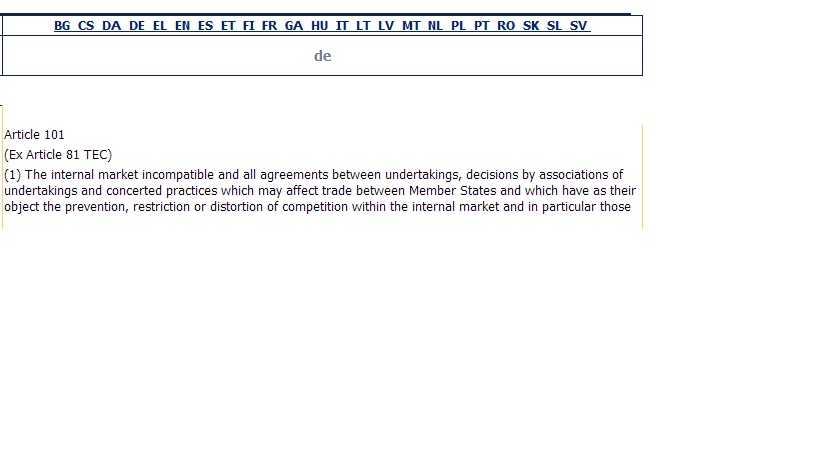
“(1) The internal market incompatible and all agreements between undertakings, decisions by associations of undertakings and concerted practices which may affect trade between Member States and which have as their object the prevention, restriction or distortion of competition within the internal market and in particular those”
No trace of the word “effect“.
I did the same in French:
“(1) Le marché intérieur incompatibles et interdits tous accords entre entreprises, toutes décisions d’associations d’entreprises et toutes pratiques concertées qui sont susceptibles d’affecter le commerce entre États membres et qui ont pour objet d’empêcher, restreindre ou de fausser la concurrence au sein du marché intérieur et en particulier ceux”
Again, no trace of the word “effect“.
A weird finding. All the more so given that the official Treaty translation explicitly talks of “effect“.
So here I am, pondering whether I am making this up or if, as this distinguished Court Member hinted, there is a linguistic reason for the absence of serious effects analysis in the Court’s case-law.
Now, if the other language versions of the Treaty talk of “effect“, which version of the Treaty is the right one?
Gee, me completely lost in translation.
PS1: On this, I’d advise Google to manipulate its translation service, and reintroduce the “effect” word in all Treaty translations.
See below for more evidence (a print of my screen).
Job Application

Yesterday, one of my LL.M students made the buzz in French press.
President Hollande was apparently in Dijon to deliver a speech on new government-sponsored traineeships for young people without a degree.
Louis Godart, currently enrolled in our ULg LL.M, was in Dijon too.
He managed to hand in his CV to Hollande, and urged him to also help students with a degree, who too face hurdles on the labour market.
For more, see here.
A hat tip to Louis for his brave move. We don’t teach martial arts to our students – shall we? – so I am very curious to learn how he managed to make it through Hollande’s muscle men.
Louis also made a clever move. After all, in a country like France where Governement is omnipresent, the best mailbox to post a job application is that of the President, not that of the private sector.
Finally, a big thank you to Louis for the unexpected publicity for our ULg LL.M. On this, I must stress that the programme keeps improving. We have this year a group of 25 very motivated students, who come from all over Europe. And we’ll soon be appointing a new Professor in IP and innovation law (for the call for applications (in French), see link below; If anyone’s interested by this, pls drop a line).
Vacance – Charge de cours – Droit de l’innovation et de la PI
Antitrust History

A lot has been written on the history of the EU antitrust rules.
Those familiar with Jean Monnet’s Memoirs know that the wording of EU competition law owes a lot to the drafting skills of George Ball.
But I personnally did not know that the Brussels office of Cleary, the oft-cited n°1 law firm on the Brussels market:
was established in 1960 as a direct consequence of the close relationship between Jean Monnet and former Under-Secretary of State, George Ball, one of the firm’s founding partners and legal advisor to Jean Monnet on the implementation of the Marshall Plan and the drafting of the Treaties of the European Communities.
Caveat 1: this is no advertisement for Cleary.
Caveat 2: this is not another rant at conflicts of interests.
An Unprecedented Fine
There’s a big storm coming.
Tomorrow, the Commission will slap yet another stratospheric fine against Microsoft.
We’re told that Microsoft did not implement the “browser choice” remedy negotiated with the Commission in 2009.
Worst: this is apparently due to an internal communication failure.
Alfonso blogged about this a while ago (meanwhile disclosing his core musical tastes).
Because the Commission understandably wants compliance but may be reluctant to micro-monitor the implementation of settlements, the fine will likely be high.
But how high?
WE readings

Some propaganda:
1. “Ethique et conflits d’intérêt en droit européen de la concurrence”: A 1,5 pager, a little controversial, and for good reason : upon inquiry, there is no standard ex post “recusation” procedure in EU competition proceedings. So how to dismiss a conflicted decision maker? And before this, how to know he is conflicted? Those weird findings, coupled with other recent developments (the ongoing revolving doors investigations of the Ombudsman) prompted further research on ethical rules in EU competition law. Will likely dig deeper in the upcoming months. An English translation of this edito is in the pipeline, and due to appear in ECLR…
2. “Industrial Policy and Competition Enforcement: Is There, Could There and Should There Be a Nexus?“: co-authored with N. Neyrinck. This paper makes a number of novel points. One of them is that under current legal standards, some transactions (e.g. mergers) that are deemed compatible when they originate from EU-owned firms, may be forbidden when they originate from non EU-owned firms. The explainer: efficiencies generated by EU-owned firms benefit more directly to EU consumers than efficiencies arising from non EU-owned firms. Another point of the paper is that the EU industrial policy agenda (and all the thinking that went into this) should inform DG COMP’s priority setting policy. This paper was presented at the 2012 GCLC annual conference and will be published as part of the conference proceedings.
3. “New Challenges for 21st Century Competition Authorities“: You guys know this one. A modest effort to identify some of the hottest issues in contemporary competition enforcement. The paper does not pursue great academic ambitions, but make a number of original points (on the use and abuse of settlements/commitments in particular). It will be published in a forthcoming issue of the Common Law Review and was presented at a conference in Hong Kong in October 2012.


 Chillin'Competition